
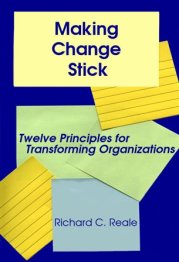
 Two figures stand out when reading this book: twelve and twenty. What do they have in common? The same man, Richard C. Reale. For twenty years, he’s studied why change fails and why it succeeds. Then he boiled down his knowledge base into twelve principles that are absolutely necessary if change is to happen correctly and last in an organization. The amazing thing is that these principles will not only ensure the success of a transformation, but will pay dividends in the long run, by having made an organization more change-capable.
So what’s missing? What’s causing organizations to fail when implementing change? The most common reason is the “failure to consider the human side of change.” It’s easy enough to draw the roadmap. The hardest part is the execution, the fulfillment of that plan. If you don’t believe it, just look at the last time you resolved to do something. What was harder: making the decision and putting some thought into how to best achieve it, or actually doing what you planned?
The twelve principles outlined in this book allow organizational leaders to focus on the people, and to empower them to bring change to fruition. It’s about setting down the right process for change, and following along closely, making sure change is proceeding as planned. It’s about walking the talk, and encouraging people to do the same by praising their efforts to change, and setting them up for success. It’s about monitoring the right metrics, the ones that will tell you how you’re really doing. In theory, it doesn’t sound hard, but in practice, it’s another story. Fortunately, the author explains every one of the twelve principles in detail, and the examples he gives clearly illustrate the point. Inspirational quotes from notable personalities are also provided, to help drive home the point.
This book is a wonderful resource. Twenty years of “on-the-job” experience can’t be wrong. The author’s expertise shows, and will help guide the book’s readers toward that great goal of organizational change, which is a hard goal to achieve indeed. If individual change is hard, organizational change is orders of magnitude harder – but this book will show you how to do it successfully. Get it, and achieve lasting change!
 The story of this movie is simple, and normally bankable: small town girl makes good in big city. This is a story with plenty of room for nice little twists and turns that make a movie worthwhile. However bankable the story is, the movie feels fake all the way through. Granted it’s a musical, and they’re always a little fake, but still, it’s terrible, and I can point exactly to what’s ruining it: the screenplay.
  Raoul Pop