Reviews

Animation is hard work!

A wonderful video from the late 1930s, a newsreel, has been posted to YouTube. It depicts Fleischer studios in action, making a Popeye cartoon. In this age of computer animation, when things work differently, it’s a real treat to see animators in action, drawing for a change. Golly, cartoons were sure hard to make! We, as spectators, can’t possibly imagine the incredible amount of work that goes on to produce a 7 or 8 minute cartoon, but this video does a pretty good job of setting us straight on that subject. This is why old cartoons are still relevant. The sheer amount of work it took to make them qualifies them as works of art. We should do our best to preserve them and share them with generations to come.

[via Cartoon Brew]

Standard
Thoughts

Who we are

➡ Updated 3/9/08: This post reflects the state of the site back when it was still called ComeAcross and I’d just started it. That’s no longer the case, as I’ve combined all of my content since at this domain. For more on that switch, have a look at the About page.

If I asked you who you were, it’s only fair to tell you who we are, or what my site is. If you already know, hang in there, you might learn some new stuff.

I’m Raoul Pop, and I launched the site with Ligia, my lovely wife. She doesn’t post much, because she works behind the scenes. She takes great care of me so I can keep on writing and working.

I launched the site on May 3, 2006 — not quite 5 months ago. Here’s why some of the content is older than 5 months. That same page has an explanation of the ComeAcross name.

So far, there are about 20-30 loyal feed readers for the Blog, about 10 or so for my Photos feed, and a couple for my Videos feed (although I suspect those are just my own subscriptions). There are about 8-10 really, really loyal Podcast subscribers, who’ve hung in there with me even though I haven’t published a podcast since May. Thank you! Who are you folks?

I started checking stats with Google Analytics on May 31, 2006. From that date until today (October 25, 2006), ComeAcross has had 8,927 unique visits and 16,055 page views. 14.75% of those visitors were returning ones. While most people were from the United States, if you look at the map below, you’ll see they’re coming from a lot of other places: Europe, South America, the Middle East, the Far East, and of course, Australia and New Zealand. A big, American HI to everyone! Google has been my biggest referrer by far (Sergey, Larry, thank you, and thank you), and I’ve also had significant traffic from Digg, StumbleUpon, and Yahoo.

ComeAcross Stats - Executive Summary

The top five keywords that people use to find ComeAcross so far are:

  • HP dv6000
  • Davison Inventegration
  • War between Israel and Lebanon (I don’t know why that post struck a chord, I didn’t think it was that good)
  • Funny animal photos (always a hit with folks, I gather)
  • Lasermonk (don’t know why this keyword is so popular)
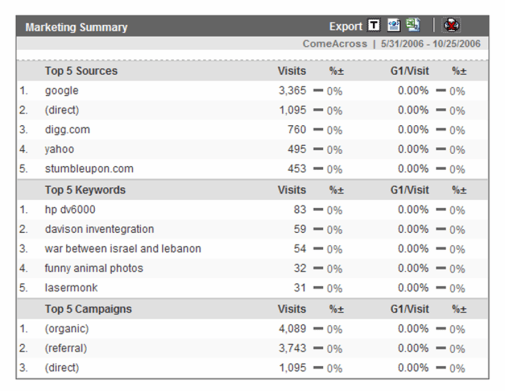
ComeAcross Stats - Marketing Summary

The top five pieces of content on ComeAcross are:

ComeAcross Stats - Content Summary

I couldn’t have accomplished this without two wonderful products/services: WordPress and FeedBurner. They’re both fantastic, each in their own way, and amazingly useful. I am truly grateful for their existence, and the fact that they’re both free to use, easy to use, and feature-packed is a testament to the ingenuity of today’s web developers, thinkers and dreamers.

ComeAcross was once a dream for me. I dreamt that I could have a site where all of my content from my disparate sites was drawn together, and made easily accessible to anyone who wanted to read it, view it or search it. That dream is now a reality, and thanks to you, my readers, ComeAcross is shaping up very nicely.

I really do hope you’ll continue to read ComeAcross, and if you like it, spread the word. I’d like the site to continue to reach new readers, every day.

Standard
Thoughts

Who are you?

If you’re reading this, first, I thank you, and, I kindly invite you to say hi. Write a comment on this post, and tell me what’s up, who you are, and if you want, when you started reading it. Do you like the site? Do you like the posts? Are there some things you’d like to see? If you don’t feel comfortable writing comments, write me an email. C’mon, let me know who I’m writing for. Thanks!

Standard
Reviews

Gotta see Stranger Than Fiction (2006)

Just stumbled onto the site for this upcoming movie, in theaters on November 10th, and I’m looking forward to it. The screenplay was written by Zach Helm and it was directed by Marc Forster. The really interesting thing about it is the screenplay, and kudos go out to Zach for a wonderfully quirky and original idea. Who’d ever think of coming up with a plot about a man whose life is literally scripted by a down-and-out writer? He hears her voice in his head as she writes his next actions, and it’s driving him cuckoo, but he can’t do anything about it. Should make for a really, really fun movie! Can’t wait for it to come out!

Standard
Thoughts

Consolidation lurks in the wings for web development industry

I’m struck by the amount of consolidation that’s taking place these days. Companies are gobbling up other companies in order to scale up, expand horizontally or simply eliminate competition. We in the web development industry have so far been spared this fate, simply because of the amount of incredible innovation and changes that always take place in what we do. Let’s face it, a company needs a solid product that can be sold, and so far, it’s really hard to pin down “products” in web development. Plus, the very nature of our work, which can be done anytime, anywhere, rewards individuals, especially those willing to stretch the boundaries of what’s thought possible and come out with something cleaner, something nicer, something slicker, something cooler.

But, even with all of these road bumps in the way of web development consolidation, it’ll still happen. Don’t think I’m enjoying myself as I write this. I don’t want it to happen! You know what’s going to act as the catalyst? The same thing that’s driven manufacturing companies out of the States: price. Look at some of the free products that are out there, that let you create websites with no cost at all: Google Pages, MSN Spaces, Yahoo (whatever it’s called), etc. They’re not full-featured, but they work to get people started. And they’re really easy to use, to the extent that even a “moron in a hurry” (aka the Apple courtroom test) would know how to use them. I’m not implying that most people are morons, but most people don’t need fancy sites that do lots of cool things and manipulate databases, etc.

If you don’t believe me, look at MySpace. It’s there that you’ll see the tastes of most people: that site is full of tasteless decoration, crowded, nasty-looking things that can’t even be called web pages. And that’s only the content. I’m not even talking about the MySpace-imposed page layout and horribly big, screaming ads. The whole site is gross. But, that’s the idea of a “nice” web page to most people. They don’t understand what goes on behind the scenes when it comes to web development. They don’t understand how to design a site. They have no idea about the stress and hard work that goes on when coding/designing a real site. And they shouldn’t be expected to know this. After all, that’s what web designers and developers are paid to do. But the point is, the masses don’t crave and don’t care about good design, they want the free stuff, and most don’t care if that free stuff is ugly.

As free products like the ones I mentioned get more full-featured, and more complicated systems like WordPress or Drupal get even easier to use and customize (not that WordPress isn’t easy to install and use, it is, but you still need to know how to code and design when customizing it) the needs of more and more people will be met. And as that happens, the market for web developers shrinks more and more. And here we get back to my opening comments: solidification of product offerings leads to consolidation. Once a market develops for a clear-cut product, competition will increase, the main differentiating factor will become the price, and the biggest company will be able to offer the lowest price — hence the catalyst for consolidation. Besides, who can beat FREE stuff? How do you beat that? Who can beat offshore web development, where people can live on dollars a day and can afford to develop a complicated site for a few hundred dollars? It’s really, really sad to see web designers and web developers who aren’t able to make a living in the States anymore. I can understand why it happens, but it’s still very troublesome.

What recourse is left to us, as web developers? I would hope we can find some solution that would allow us to keep our independence while also allowing us to make a living without competing purely on price with Ivan in Russia or Mihai in Romania or Jose in Argentina, because living in the States, we’d lose the price battle very quickly.

I realize the outlook as portrayed in this post is a bit depressing, but I plan to write a counter-post to this in the next few days. I do think there’s light at the end of the tunnel, and there’s hope for those of us willing and able to seize certain opportunities.

Standard