Places

Downtown Bacau, Romania

Bacau is one of the bigger cities in Romania. I had a chance to visit its downtown area this September. I’d never been there before, so I stopped to take a few photos. It was early on a Sunday morning, so there weren’t many people on the streets.

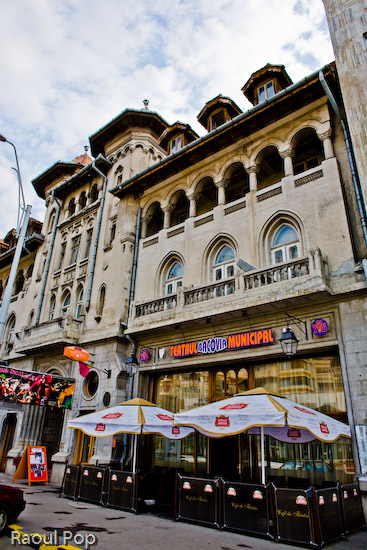
I love the northern Italian architectural elements used in the facade of the Bacau Theatre building, especially the upper floor, with its balcony, arches and mini-towers.

Teatrul Municipal Bacovia

The entrance to the theatre is quite imposing:

Entrance to Bacau Theatre

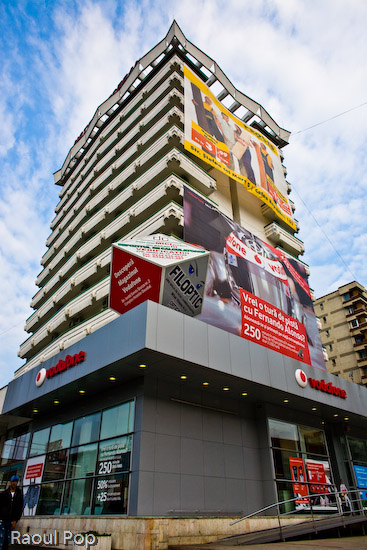
Across the street from the theatre, you can see this large condominium building (at least I assume it’s condominiums, I doubt they’re all offices.) I thought the architectural plan was a good way to make a square shape look interesting. It looked pretty good, but, as one finds in Romania, ads were plastered all over its sides. I wonder what the people living in those apartments now obscured by the posters must think of it all. Are they getting paid? Are they just getting annoyed? Who knows.

Vodafone Bacau

Right next door to the building above, we can see a monster left over from communist times… At least this dying breed of an apartment building is one of the better ones I’ve seen in Romania. One mostly sees nasty, crumbling, weather-stained concrete ruins when it comes to communist architecture. This particular building looks pretty well maintained, too. Of course, its central location might have something to do with that.

Complex Comercial Junior

A little ways down the street, we find the public library, but the building is in sore need of restoration. I’m not sure if it’s still being used, but I’d love to get inside it at some point in the future. It could lead to some interesting photographic opportunities.

Biblioteca Bacau

Here’s another view of the library, from the back:

Almost in ruins

There was a public park in the area, with art on display. I found a modern statue, and some post-modern wooden carved poles, styled after folk themes.

Pensive

Abstract wooden sculpture

Hidden behind the park and public library, I found the Bacau Ateneu. One of our friends plays the violin over there. 🙂

Ateneu Bacau

Further down the street, you’ll see the county government building. This is the main entrance:

Consiliul Judetean Bacau

I liked the clasically-styled architecture, typical of turn-of-the-century construction. Here’s a window detail. Notice the stucco stripes, columns and arches.

Striped and arched

That concludes my sightseeing tour of downtown Bacau. Who knows, maybe I’ll get to visit it again in the future and take more photos. 🙂

Standard
Thoughts

Google bought Jaiku

Around noon today, I saw Scoble’s Twitter about Google’s purchase of Jaiku, and left two comments on his blog post. Basically, I said that Jaiku’s purchase made sense, but that Google probably considered Twitter and found Jaiku to be less expensive. I use both Twitter and Jaiku myself. I tried using Jaiku as my primary microblogging service, but came back to Twitter.

The thing about Jaiku is that it has more built-in features than Twitter, no questions about that. Its built-in feed integration service doesn’t even exist at Twitter, where we have to use the third-party Twitterfeed to get similar functionality. I wrote an in-depth comparison of Twitter and Jaiku back in July, and I invite you to have a look at it (see Part 1 and Part 2 of “The value of microblogging services”).

The kicker could be even more interesting though, and I don’t know if someone else has already touched on this. We all know about Facebook’s ridiculous $15 billion valuation, right? Well, Google’s purchase of Jaiku has just burst that absolutely ridiculous bubble. Jaiku offers functionality very similar to Facebook’s, but without all the annoying hype.

I bet you the price Google paid for Jaiku was very reasonable, much like the price they paid for FeedBurner. I for one am glad Google pays sane prices for their acquisitions, unlike Microsoft. The only time I think they splurged was with YouTube, but they paid for the users there. (They obviously didn’t pay for the content, since most of it was and still is pirated from TV and movies…)

I hope Facebook’s valuation drops down to some normal amount now, something like $500-750 million. By the way, I’m not on Facebook and I don’t intend to join it any time soon. I’m also not on MySpace.

Standard
Thoughts

Photography, take two, part two

I continued to work on replacing photos hosted with third party services. The list of modified posts is provided below. This has proven to be a huge effort. I had to locate the photos in my digital library — not all of which is keyworded yet, though I’ve got location information for all my photos — but I also chose to re-process, keyword and re-title the photos. You see, most of these photos were keyworded through bulk uploaders, for the purpose of displaying that data on third party photo sharing sites, not for my own library. Clearly that effort was wasted, but I didn’t know that back when I did it… Where applicable, I am also re-writing some of the text.

I want to make sure that the content I provide here at ComeAcross is truly top tier, as much as possible. What does that mean? Well, it means I spent my entire weekend, including Monday, working on the posts listed below, and on the posts listed in part one. I still have more posts to go. I don’t mind doing this — actually, I look forward to it — but I do hope that you, the reader, appreciate the effort that goes on behind the scenes. 🙂

Also see Photography, take two, part one.

Standard
Thoughts

Photography, take two

Over this weekend and the last several days, I’ve gone through posts that contain photographs, and replaced all of the images with ones hosted directly at ComeAcross. In the past, I’ve used photos hosted with third party photo sharing services, and I realize now that’s a folly.

If a third party service goes down, which is very likely with beta services, my photos become unavailable. Even if that service is not in beta, a simple action like closing one’s account shuts down access to all of the photos uploaded there. It’s much more practical to host the photos together with my website. That way, I am fully responsible for making sure that all of my content is accessible. If something goes down, I can take care of it. If I need to change web hosting providers, I simply transfer all of my files over to another server.

It’s not as simple to transfer one’s content with photo sharing services, no matter what they may promise. Image and meta data portability is still not 100% there, and it doesn’t help when a photo sharing service advertises their API’s availability for more than a year, yet fails to put it out for public use. It also doesn’t help when said portability is rendered useless by the amount of compression used on the uploaded originals, or the deletion of meta data embedded in the originals…

You see, everyone is ready to promise the world to you when they want to sell you on something. Quite often, that “world” is nothing more than an empty little shell. I speak in general terms here, from the things I’ve learned through my various experiences — mostly recent ones…

At any rate, I’ve still got to modify a number of posts, but I thought I’d point out the ones I’ve already worked on. They’re quite a few, and I’m happy with the results so far. Here they are:

Also see Photography, take two, part two for more updated posts.

Standard
Reviews

Lens comparison: EF 24-70mm f/2.8L Zoom vs EF 24-105mm f/4L IS Zoom

Have you ever wondered how the EF 24-70mm f/2.8L and EF 24-105mm f/4L zoom lenses would do if compared side by side? Which one would come out as the winner in real-world use? Here’s my answer to that question.

First, some recommended reading:

Those two reviews of mine should give you a good idea of what each lens can do. Now let’s talk about how they do when they’re together. 🙂 Here’s a photo of the two lenses. As you can see right away, the 24-105mm is smaller in both height and girth — it’s shorter and a little narrower than the 24-70mm.

When we look at the rear lens elements, we can see some differences there as well. The 24-105mm lens is on the left. If you look carefully, you can see a baffle in place. The 24-70mm lens has no baffle.

It’s possible that the baffle is there in order to reduce possible flare effects, since the focal range is longer. It could also be there to baffle us — after all, it is a baffle. 🙂 It’s also possible that the optics aren’t as high quality as those in the 24-70mm lens — they’re both priced the same, but the 24-105mm has image stabilization and an extra 35mm of range. On the other hand, I’ve seen a very similar baffle on the EF 14mm f/2.8L prime lens, and no one can say that the 14mm lens is made with cheap glass. So the more likely explanation is that it’s there to reduce lens flare due to the increased focal range.

(By the way, the baffle can be seen even more clearly in this product advisory from Canon warning about unacceptable levels of lens flare in early builds (2005) of the 24-105mm lens.)

Here’s another look at the lenses side by side, this time with the lens controls visible. As you can see, the only thing that’s different on the 24-105mm lens is that it’s got the IS switch. The controls seemed a little thicker on the 24-70mm lens. As for their durability, I assume they’re both long-lasting since these are L series lenses.

Chances are you can already know that the 24-105mm lens is lighter than the 24-70mm lens. It’s no small difference, by the way. The 24-105mm lens is 670g, while the 24-70mm lens is 950g — that’s 280g of difference! While both lenses extend outward as you zoom, the 24-70mm lens is more top-heavy than the 24-105mm lens, and that makes a big difference in wrist fatigue — the 24-105mm lens is less punishing and can be held comfortably for longer periods of time.

The weight difference is remarkable to me because the 24-105mm lens has 18 elements, while the 24-70mm lens has 16 elements. Canon managed to keep the weight down even though they placed extra glass in there and added image stabilization.

There are some limitations to being lighter and smaller though. The 24-105mm lens’ closest focusing distance is 1.48ft or 0.45m, while the 24-70mm lens’ closest focusing distance is 1.25ft or 0.38m. It also looks like the general consensus is that images obtained with the 24-105mm lens are somewhat softer than those obtained with the 24-70mm lens.

Other than the difference in focal lengths, another obvious difference between them is the maximum aperture. The 24-70mm lens opens up to f/2.8, while the 24-105mm lens only opens up to f/4. That’s a full f-stop difference, or a 2x reduction in the amount of light that can enter the lens. This is where the baffle comes in again. Since the baffle itself limits the amount of light that can hit the sensor in order to reduce glare, it stands to reason that the aperture can’t open up any wider. Even if it did, we’d end up seeing the baffle contours in our photos.

What the 24-105mm lens has going for it is the built-in image stabilization, which, in my experience, more than compensates for the reduced maximum aperture. See the photo below. I took it completely handheld (I didn’t prop myself up against anything) at a shutter speed of 1/15th seconds.
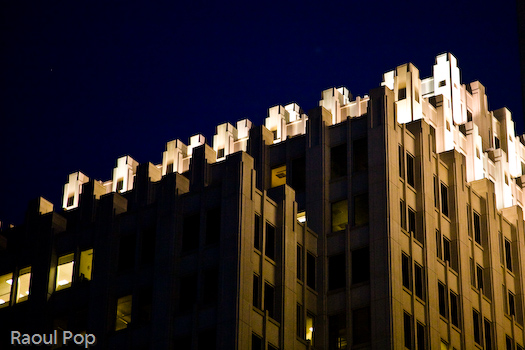
I tried to get similar photos with the 24-70mm lens, and I couldn’t, not without leaning against something to stabilize the lens. The slowest shutter speed I could use was 1/30th seconds with that lens. As I concluded in my previous review of the 24-105mm lens, the image stabilization counts for a lot and makes the lens truly versatile and useful.

While I’m talking about versatility, let’s not forget that extra 35mm of focal range. At close distances (6-15 feet), you don’t notice how much it matters, but when you start focusing on things farther away (30-100 feet or more), you realize how valuable those extra millimeters really are!

Let’s not forget bokeh. Both lenses have gorgeous bokeh, but the 24-70mm produces a creamier bokeh. That’s because it opens up all the way to f/2.8, while the other only opens up to f/4. If you do a lot of close-range photography, in tighter spaces, and you really need that bokeh (portraits, etc.), the 24-70mm would probably be a better candidate. This next photo was taken with the 24-70mm lens.

If you’ve got a little wiggle room and can position your subjects further away from things (walls, trees, background), don’t discount the 24-105mm lens. Its bokeh is right up there with the best of them. Have a look below.

In the end, it really comes down to your own, precise needs. I’ve heard of some people who only carry two lenses in their bag: the 24-70mm and the 70-200mm (both of which I reviewed here). They’re both professional-grade, L series lenses. They’re heavy, but they deliver the goods, and they’re versatile.

For my needs, I’d go with the 24-105mm lens. It’s lighter, has extra range, and has built-in image stabilization. I really enjoyed using it, and I seemed to get better photos with it than with the 24-70mm zoom. While it may not be as sharp, I didn’t notice anything that would turn me away from using it. I thought it was a superb lens and couldn’t believe the quality of the optics when I looked at the photos I got with it.

At least one commenter here asked how these two lenses compare, and I hope that I’ve answered that question in as much detail as I could give. If you have any other questions, pose them in the comments on this post, and I’ll try to answer them.

More information:

Standard