Thoughts

Scary stuff is happening in China

As I look at these truly scary images of pollution in China, I realize how big a problem pollution really is over there. For most of us, China’s this big country over there in Asia, sort of communist but not really, with plenty of human rights abuses under its belt, but still more decent than other communist countries like North Korea. We also know it as the place our products (toys, computers, clothes, etc.) come from. Well, it’s high time we got to know as the place where incredible pollution exists, and it’s as much our fault as it is theirs.

As consumers, we’ve happily accepted the lower-priced products made over there, because we can buy more of them, more often. As companies, we’ve happily moved our factories over there, because the labor was cheaper and the environmental laws were almost non-existent. China itself was only too happy to receive our business. They got an incredibly influx of money, expanded their economies and gross national product through the roof, got a middle class and a very wealthy upper class, and started walking out of the darker stages of communism toward something that might be called “capitalism light”.

Along the way, people all around easily closed their eyes or winked at the horrible pollution that was accumulating around them, poisoning China’s air and water and earth and cities. They reasoned that it was the price to pay for progress. They chalked it up to growing pains.

Well, it’s hard to close our eyes any more. Not after you see those photos. Don’t worry, they’re not the only photos available. There is plenty of proof of the damage that’s occurred there. And it’s scary. Very scary.

China is a very sick country. It’s very polluted. It’s incredibly polluted. I don’t know if it’ll ever fully recover. The damage has been done, irreversibly. Yet we all keep on going ahead, full steam, in a mindless race toward certain disaster, motivated by corporate greed and consumer lust for more shiny toys.

It has to stop. This will come back to bite us, right here in the US. It’s guaranteed.

Part of the solution is willing to live with “upgradeable” products. Instead of buying a new computer, send the old one in to get new, faster parts put in the old enclosure. Instead of throwing away a toy, donate it if it can still be used. Same with clothes. Don’t throw them away, give them away. Furthermore, Truly gigantic recycling efforts must be put forth, like the Japanese are doing. Every kind of plastic must be recycled. All metals must be reclaimed and reused. Poisonous chemicals must be contained. This is serious stuff.

Recycling efforts in the US are half-assed at best. Let’s face it, if the best stuff we can come up with from recycled plastic is park benches, then we’re screwed. If our answer to reducing environmental pollution is sending our used computer equipment to China, where it piles up by the mountains, we’re screwed. If companies’ answer to societal needs is to create crappy designs that age in months and practically scream “throw me away”, then we’re screwed. If we do nothing, we’re all screwed.
Standard
Reviews

Washington National Opera's 2008 Rigoletto

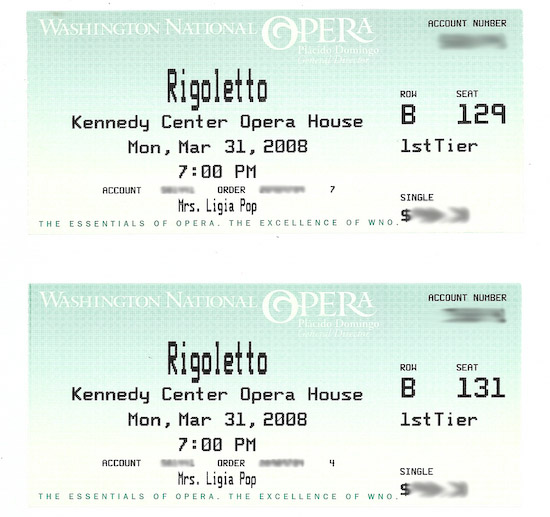
This past Monday night, Ligia and I went to see WNO’s 2008 production of Verdi’s Rigoletto. Our overall impression was positive. All of the elements: cast, direction, costumes, lighting, decor, music contributed to make it a great production. There were a few things that could have been improved, and I’ll mention them below.

The Kennedy Arts Center also has its act together when it comes to taking care of its public. Free shuttles are provided from the nearest metro station (Foggy Bottom) directly to the building’s entrance, there are plenty of ushers to check tickets and direct people to their seats, the bathrooms are kept clean, and there are many concession stands in the grand foyer outside the opera hall to keep people’s appetites in check. Very nice job there.

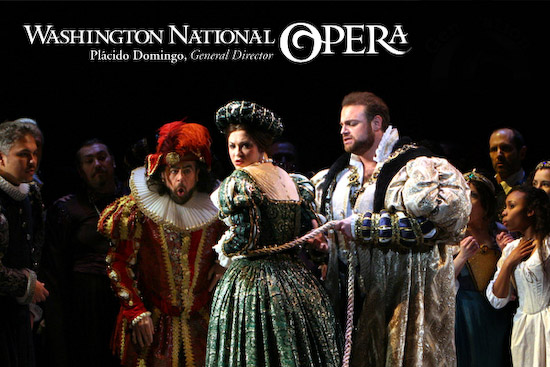
The costumes were just wonderful: rich, colorful, beautiful — perfect. The lighting was done right: not too much, not too little. The sets were somewhat sparse, but the pieces put on stage looked fairly realistic and well-proportioned. The only problematic piece was the long feast table in Act II, which was horribly bare, and its matte paint showed all of the performers’ footsteps. I would have expected a more ornate and better-made piece for the Duke’s dining table.

The standout roles were performed by great singers, which was as expected. Carlos Alvarez did an amazing job as Rigoletto. He carried the role very well, and his voice was in top shape throughout. Joseph Calleja was great as well. He struck an imposing figure as the Duke, and his physique suited the clothes of that period well. Let’s just say he filled them in nicely. His voice was clear, wonderful and commanding.

Andrea Silvestrelli, as Sparafucile, was my personal favorite. That mountain of a man has a bass voice that makes the hall boom. It literally fills the room and makes your intestines shiver. I kid you not. And what a great guy! At the end of the performance, he proved his sense of humor by trying to crawl under the curtain to get one more round of applause!

There were a couple of roles which could have been cast better, but I’d rather not mention those people directly by name, to spare them any embarrassment. I’ll refer to them by their stage roles. Count Monterone’s voice unfortunately just couldn’t get past the orchestra. Oh, he had an impressive stage presence, but when you put all your might into the role and the audience can barely hear you, perhaps it’s not the role for you.

I wouldn’t have been so annoyed with this except the father’s curse uttered by Monterone is key to this opera. If you can’t get someone with a truly booming voice to pronounce the curse, someone that can strike fear into the hearts of the audience and blast past the orchestra, then it’s a letdown for the spectator. It’s true, Monterone’s role is a small one, and you won’t be able to get big names for it, but you should still try to get someone with a big voice, right?

Gilda was another choice that didn’t quite work out for me. The singer was charismatic and had a good stage presence, but her voice barely carried past the orchestra unless she sang high notes, where her voice was particularly strong. The orchestra helped her a bit by playing softer when she sang, but it still wasn’t quite enough. By contrast, the orchestra didn’t help Monterone. The poor fellow sang at the top of his lungs and his voice kept bouncing off the orchestral sound wall. Things didn’t quite work out for him.

In Act III, during the thunderstorm, when Rigoletto, Gilda, Sparafucile and Maddalena sing together — that’s another scene where the orchestra played too loudly and we couldn’t hear the singers. Rigoletto and Sparafucile in particular had very powerful voices, yet I could barely hear them during that particular scene because of the thunder effects and the orchestra. Shouldn’t they have adjusted their playing to allow the players’ voices to come through? After all, this was an opera, not a concert.

In spite of my gripes, Ligia and I really enjoyed ourselves. It was a great performance with many talented singers, and it was well worth our time and money. If you have a chance to go before the performances run out, do it.

[Photos courtesy of the Washington National Opera]

Standard
Thoughts

Where are the Condensed Knowledge posts?

Good question. Some of you have gotten quite accustomed to those daily Condensed Knowledge posts, and they’ve gone AWOL since last week. On the other hand, others have told me they were distracting, and detracted from the substance of my site.

I’d been giving the matter some thought myself, and in the end, sided with the folks who said I should stick to writing original content. You see, while I enjoy sharing the information with you, and while I also believe that it’s important to highlight valuable content on the Internet, those posts were distracting me from writing. Since I had something to post every day, other than my own writing, I tended to do less of it, and that was not good.

So, for the time being, no more Condensed Knowledge posts. That’s not to say you can’t access them anymore. You still can, but in a separate feed: feeds.feedburner.com/FavoriteBlogPosts. Subscribe to it if you’d like. The feed is actually more reliable than the method I used with the Condensed Knowledge posts, which was to share items from Google Reader, publish them to Twitter, then use the Twitter Tools plugin to collect them in a daily summary. That method was highly dependent on Twitter’s uptime/downtime, and that meant you weren’t getting the full link list every day. With the feed, you are getting everything I share from Google Reader.

I can’t deny I’d rather have the same link summaries present in my site feed, just like with my daily del.icio.us links, and perhaps at some point in the future that’ll be possible, but until then, the separate feed will do just fine.

If you have any questions, let me know in the comments and I’ll see if I can answer them.

Standard