Reviews

A glimpse at the new Snow Leopard from Apple

Snow Leopard, the new version of Mac OS X, was announced at the 2008 WWDC in San Francisco. It’s an important release for the following reasons:

  • Builds upon existing technologies and perfects them. It introduces few new features, but will allow Apple to really focus on delivering a very good OS by developing further the technologies introduced with Leopard. I for one am glad to see Apple slow down their frantic development cycle. That sort of rhythm can’t be sustained and leads to burned-out employees.
  • Optimized for multi-core processors. Truth is, most applications and operating systems aren’t optimized for multi-core processors. They’re not even multi-core aware. So while multi-core technology is here to stay and has already made it into all processor makes and models, applications are still hobbling along, relying on built-in chip technology for a sort of multi-core experience, not the real thing. I’m glad to see Apple pursue this seriously and make it easy for developers to build their apps for multi-core systems.
  • OpenCL programming. You know about OpenGL, right? Well, OpenCL will let developers take advantage of the amazing processing power of graphics cards (measured in gigaflops) to do computations previously reserved only for graphics applications. To get an idea of how powerful graphic card processing has become, have a look at FASTRA, a supercomputer built with 8 GPUs.
  • RAM limit raised to 16TB. I did a double take when I read that. I first thought they were talking of 16GB, which would have been impressive, but also a misprint. The Mac Pro can do up to 32GB right now if I’m not mistaken. But 16TB, wow! That’s amazingly high for RAM. Most machines don’t even have that much hard disk space, much less memory. That’s going to be very useful when building supercomputers with Macs. Keep in mind that 32-bit Windows operating systems (the prevalent ones on the market) STILL have a 4GB limit on RAM. Microsoft’s 64-bit OS versions (XP and Vista) are not usable yet, because there are plenty of compatibility issues with drivers and applications. For a clarification of this point, make sure to read my comment below.
  • Quicktime X. Apple’s venerable Quicktime will get an overhaul which will make it much more efficient, and will allow it to support more audio and video formats. Perhaps now we can look forward to Quicktime movie exports taking less than 24 hours? 🙂 Joking aside, I like Quicktime, and I hope it sticks around for a long time.
  • Faster Safari. It will use a new webkit that will make it 53% faster. Nice! I should mention that all the JavaScript used on AJAX-heavy pages like Google’s Gmail or Apple’s new MobileMe is what’s slowing down our browsers. The new Safari webkit is supposed to be able to render JavaScript a whole lot faster.
  • Native support for Microsoft Exchange. In spite of grumblings from various Apple fans, this is a biggie, and it will finally ensure that Macs play nice in Microsoft Shops. In addition to being able to network properly on Windows domains, which they could already do, now they’ll do exactly what Outlook is able to do on PCs, without having to bother with the kludgey Entourage. Mail, Address Book and iCal will communicate directly with Exchange, making it a whole lot easier for corporations to use Macs instead of PCs.
  • Faster OS, smaller footprint. Apple promises the new OS will work faster overall, and will also take up less space on our hard drives. Amen to that. OS bloat is not a welcome thing (just look at Vista), and a faster OS is always a good thing.
  • No support for PowerPC processors (source). According to documentation handed out to developers at WWDC, Apple will indeed break with the PowerPC line on this Leopard upgrade, as rumored. That means my iMac G5 won’t be able to use it. By that time, it’ll be outside its projected 3-year lifespan, but still, it would have been nice…

Image used courtesy of Apple, Inc. More information about Snow Leopard can be found in Apple’s original press release, and on the Snow Leopard website.
Standard
Reviews

Meet the replacement for .Mac: MobileMe

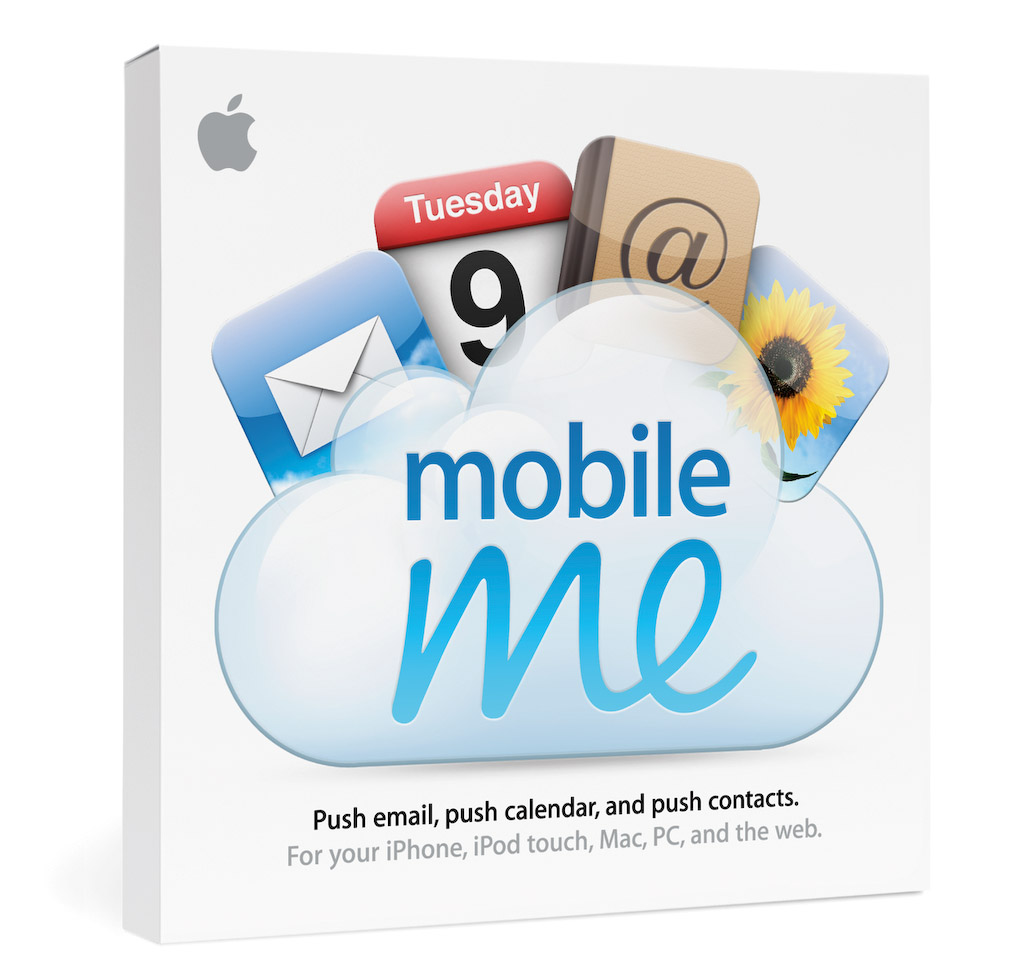
I mentioned in yesterday’s iPhone 3G announcement that Apple had secretly purchased the domain me.com for an undisclosed sum of money (in the neighborhood of 11 million). It came as no surprise to Apple fans when we found out that MobileMe was the replacement for .Mac. Users had griped for years about .Mac’s lackluster performance and puny space available (1GB for $99/year last I used it).

So, other than the new domain name (personally, I liked the .Mac domain), how’s the new service different?

  • More space: 20GB for the same price ($99/year for individuals and $149/year for a family pack). Additional space is $49/year for another 20GB or $99/year for another 40GB.
  • Push… everything: Apple has upgraded their .Mac email service and calendar and contact syncing to “push” technology. I don’t really see what’s different here when I compare it to .Mac, except the syncing is seamless and faster. And oh, now it works with PCs/Exchange as well.
  • Great web interface: Apple outdid itself here. .Mac had a web interface as well, but it was slow and kludgy. The new web interface behaves like desktop applications and looks really, really nice. Not sure how fast it loads on regular broadband connections, but we’ll find out soon, won’t we?

That’s about it, really. The bulk of the effort went into the better, cross-platform syncing and the innovative, beautifully-designed web interface. The additional space was long overdue.

Existing .Mac members will be upgraded automatically to MobileMe, and their existing subscriptions will be transferred over to the new service when it becomes available on July 11.

What’s the draw to MobileMe? For me, it’s the Back to My Mac service, which was introduced alongside iChat Screen Sharing in Leopard. It wasn’t enough to get me back when .Mac was overpriced and underfeatured, but it may be enough now that MobileMe has more space and is better designed. For iPhone users, it’s the obvious integration and contact/calendar syncing between the phone and the computer(s).

In terms of web storage space, the 20GB isn’t really that big of a deal for me. There are PLENTY of companies out there that offer more space. ADrive, for example, offers 50GB for free, and they’ve worked reliably for the past several months that I’ve used them. Dropbox, although it offers less space for free, has incredibly nice integration between Macs and PCs, and lets me share files seamlessly from computer to computer, or with my friends.

What I have to wonder about is Gmail. Given the partnership between Apple and Google, I’d have hoped that Google products would be better integrated into MobileMe somehow. It seems they’ve still been left by the wayside. They work, but not quite. I still can’t sync my calendar appointments properly from Gmail to iCal, and still can’t sync my contacts properly from Addressbook to Gmail (unless I have an iPhone or iPod Touch). Even Gmail’s IMAP interface in Mail leaves a lot to be desired. After using it for a few months, I switched back to POP3.

That’s annoying. I suppose it may have had something to do with Apple’s desire to keep building on their existing products and to develop an Apple-designed web interface (which is quite different from the spartan design of Google’s products).

Images used courtesy of Apple, Inc. More information about MobileMe can be found in Apple’s original press release, or on the MobileMe website.

Standard
Thoughts

Thank you Congressman Van Hollen!

This is Congressman Chris Van Hollen, the man that represents our district on the Hill. He’s got our heartfelt thanks and gratitude.

Do you want to know why? My wife and her students had to suffer for seven months at her piano studio — without heat in the winter and without air conditioning in the summer — because of Pepco’s unbelievable (one could call it criminal) inability to fix a panel on the outside of the building where she works and had caught fire. (Pepco is our local electricity company.)

The store owner and store manager called Pepco on numerous (countless) occasions to ask about the status of the repairs. They’d get one excuse after another. Usually, Pepco tried to blame the county, who they said was moving too slow in their approval of the repairs permit. Most often, they simply didn’t pick up the phone. Too busy, I gather. Hah.

The store owner even tried to contact the Washington Post, to see if they’d be interested. They weren’t. Shame on them. I guess the story was too small to bother with, right?

This went on for SEVEN MONTHS. I’d love to know how an electricity company that can respond within hours in case a tree downs a power line can’t get their act together and fix an electrical panel in SEVEN MONTHS.

I wrote about it here on my site back in April. Nothing came of that, either. I guess Pepco doesn’t care about bad PR unless it airs on big media, like the Washington Post — who didn’t seem to care.

Long story short, do you know who cared? Congressman Van Hollen, that’s who! We wrote to him on 5/27/2008, and a day later, on 5/28, he wrote a letter back to us and promised he would look into it. He put us in touch with one of his staffers, Miti Figueredo, who even called us to confirm that the congressman was interested in helping us.

Fast forward to 6/09/2008 (yesterday). It was horribly hot — temperatures approached 100 degrees. Pepco showed up in force, with a large team, and got the panel fixed within hours. The store and the studio now have air conditioning once more!

Thank you, Congressman Van Hollen! Thank you for caring when no one else seemed to care! You have our many thanks and gratitude! Thank you for truly representing your district and for caring about your constituents!

Standard
Reviews

The skinny on the new iPhone 3G

At the 2008 WWDC keynote, Steve Jobs introduced the new iPhone 3G. As it turned out, most of the rumors about it were true. Here’s the rundown on the things that made it into the new phone:

  • 3G: YES. This was by far the biggest rumor, and it made sense for Apple to bring it to life. What’s nice is that it continues to support EDGE in addition to WiFi, so now users have three networks they can use.
  • Skinnier, hence the title of this post: YES, at the edges, which are tapered.
  • Less expensive: YES. $199 for 8GB or $299 for 16GB, BUT only with a 2-year contract with AT&T.
  • Built-in GPS for real-time mapping and tracking AND photo geotagging: YES.
  • iPhone 2.0 software, which includes support for third party apps, making it super easy to add functionality to your phone through the App Store: YES.
  • Enterprise features: YES. But we knew these were coming, because Steve Jobs and Phill Schiller had demoed them months ago. This includes support for Microsoft Exchange through ActiveSync, over-the-air push email, contact and calendar syncing, remote wipe and Cisco IPsec VPN.
  • Seamless integration with MobileMe, the replacement for .Mac: YES. We suspected this would happen when word got out last week that Apple had secretly purchased me.com for approximately 11 million dollars.

Now here’s what didn’t make it:

  • Unlocked phone: NO. I knew that sounded too good when people announced it. You can’t drop the iPhone to $199 and ALSO unlock it. It has too many features, it’s too advanced. When you have half-baked unlocked phones that cost $300 to $400, you’re not going to get an unlocked iPhone 3G for less. So, we’re stuck with AT&T, and with 2-year contracts.
  • Video chats through iChat/Skype: NOT SPECIFIED. This was my #1 feature request for the new iPhone. I’d really hoped they’d let us do video chats on the phone. After all, it has a camera, and it can record video. No official guidance yet on this. Does anyone have any specifics?
  • 5 megapixel camera: NO. That’s annoying. Still stuck with an underpowered 2 megapixel camera. Perhaps the photos it takes are better this time around.
  • Cut and paste: NO. I know of several people that were eagerly awaiting this feature. Apparently, it didn’t make it to the iPhone yet. But thankfully it’s a software, not a hardware issue, so it can be implemented later.

New features introduced without rumors:

  • 3G dock: YES. Apparently, faster, and will let you do speakerphone calls.
  • Compact USB power adapter: YES. It’s significantly smaller.
  • Bluetooth headset: YES. It’s made specifically for iPhone.

I was one of the people who held out for iPhone 2.0 –namely, this one — when the first version came out last year. Will I now purchase one? Not sure. I really wanted to be able to do video chats on the iPhone, and if it turns out that I still can’t, it may be a deal breaker for me. Plus, being hobbled with a 2-year AT&T contract is not the kind of commitment I enter into lightly. I don’t know, I’ll have to think about this. At any rate, I’ve got until July 11th to make up my mind.

Photos courtesy of Apple, Inc. More info can be found in Apple’s original press release and on the iPhone website.

Standard
Places

Cannon House Office Building

A composite photo (made up of 17 individual 12-megapixel photos) of the left wing of the Cannon House Office Building in Washington, DC. Its total resolution is approximately 64 megapixels. All sorts of interesting little details can be seen at full res.

For example, there’s a “Do Not Remove” sticker on one of the windows, probably left there from the time when the windows were replaced, way back when. And in spite of the fact that there’s electrified wire strung over all edges of the building, to discourage birds from building nests, one enterprising sparrow found a spot where it could build one.

I posted this photo at a width of 1000 pixels, to show more detail. Click through to view it at that size. You can find the full res original in my Washington DC gallery, inside my photo catalog.

Standard