How To

A cure for simple burns

This is something that my wife told me about, and has worked for me numerous times in the last several years. Want to know what will cure your burns quickly, lessen the pain significantly and immediately, eliminate the bubble of interstitial fluid that forms at the burn site, and minimize tissue scarring?

It’s simple. Dab honey on the burn.

As soon as you’ve burned yourself, take honey (in as natural a state as possible — we like Really Raw Honey, but any quality honey should work) and spread it on the burn site. Keep it there for half an hour to an hour if possible. You’ll notice that the pain will go away within minutes, and that the burn site won’t swell up and form that painful bubble that can burst and leave your flesh raw underneath.

What about if you’ve burned your finger (for example) at work and have no honey available? (This happened to me a few months ago.) That’s okay. Put the burned finger in sugared water and hold it in there for 15 minutes or so.

I took some sugar from the coffee station and put about 4-5 teaspoons’ worth in a half a cup of lukewarm water. I mixed it as well as I could so it would dissolve, then I stuck my finger in there. It didn’t work quite as well as the honey, because I the burn pain continued for a couple of hours, though not at the same levels, but in the end, my finger didn’t swell up, and instead, the healing process began from inside, naturally. Look at the middle finger in this photograph. That’s how it looked a few hours after I’d just burned it severely by accidentally grasping a burned piece of Pop-Tart where the sugar was in the process of carbonizing (past the melting point).

You see nothing wrong with the finger, right? Well, that’s the idea! Other than a small numbness at the site, and pain when pressing on it, my finger was fine. After several days, the dead skin peeled off, again with no pain, revealing the fresh new skin underneath.

I know it’s hard to believe this sort of thing, but trust me, honey is a miracle cure for burns. Try it out when you next burn yourself and see what happens.

Standard
Places

The ancient city of Histria

On the shore of Lake Sinoe in Romania, very close to the Black Sea, lie the ruins of the oldest documented city on the territory of modern-day Romania: Histria. (See satellite view below, or go to Google Maps to explore the full map.) We visited it in September of 2008.

It started its life around 630 BC [reference], built by Milesian colonists from Greece, to trade with native Getae tribes (Geti in Romanian). The Getae were Thracian tribes that occupied Dacia, whose territory is matched in smaller proportion by modern-day Romania. They, and the other people who settled in Romania at later times (like the Romans) are the ancestors of modern-day Romanians — my ancestors.
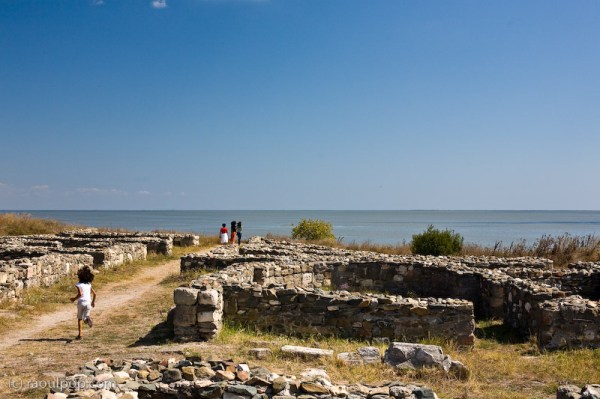
When Histria was built, its port was literally on the shore of the Black Sea. Over its approximately 14 centuries’ existence, silt deposits from the Danube River blocked off its access to the sea and formed what is now Lake Sinoe. This meant that the city’s importance as a port and trading post slowly diminished as the silt deposits grew to become the current land border between the Lake Sinoe and the Black Sea. It must have been painful to try and salvage the city’s livelihood by finding routes through the growing silt, hoping that ships stuck in the increasingly shallow water would somehow want to come back, should they manage to get away. Little did they know that in modern times, a canal would be cut through the silt shore at Periboin, not far from them.

By 100 AD, the city, who had resisted countless attacks and rebuilt its walls time after time after time, could only rely on fishing as a source of income. It managed to survive another 600 years or so, until it was destroyed one last time in the 7th century AD by the Avars and the Slavs. Its inhabitants moved away, and the once bustling and prosperous city, who had forged an important trading link between the Greeks and the Dacians so many centuries ago, began to decay, unoccupied.

Its name forgotten, it didn’t even appear on maps. Its memory swallowed whole by time, its walls covered by the ground itself, it lay in wait until it was re-discovered by a Frenchman, Ernest Desjardins, in 1868. In 1914, Vasile Parvan, a Romanian, began the first excavations of the site. The archeological digs continue to this day, conducted by various multinational teams. This was how we found it a month or so ago.

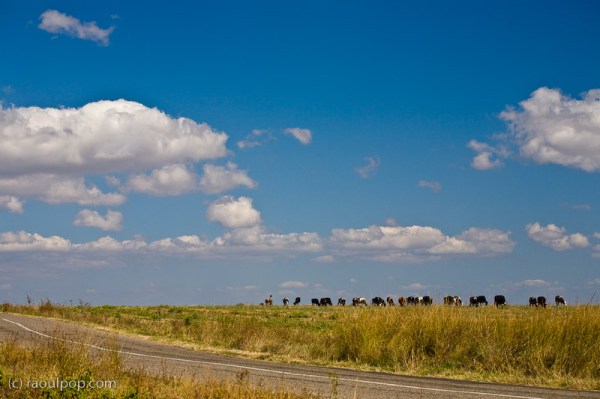
It was a warm, sunny, late-summer day when we visited. The heat shone down oppresively while we drove through the flat Dobrogea landscape. Yet a soft, cooling breeze from Lake Sinoe met us as soon as we stepped onto the grounds of the city.
There was a peace and quiet at Histria that I can only find when I visit certain ruins. I stood among the remains of the walls, and thought of the people that lived there before I set foot on what used to be their homes. They were born, lived and died there, making a living the best way they knew how, in a famous city by the Black Sea. The breeze must have been stronger then, since the waves of the sea beat against the city’s very shores.

What an adventurous spirit those Greek traders must have had, to get in their boats and travel far off, in hope of establishing a little colony of their own in an unknown land. How did they choose the site? Likely because it sits on top of a slight hill. Just think, the first few families built little homes out of field stone (there are very few trees around), and through hard work applied over time, grew that little settlement into an important port of trade and a fortress, one rich enough to attract the attention of countless attackers.
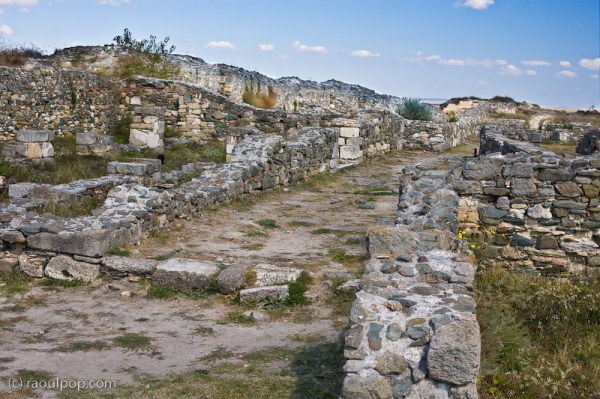
As I sat there and listened to the lull of the waves, I understood why they rebuilt after each attacks. The peace between each bout of violence was worth the effort, and the surroundings themselves invited (and still invite) company. Had their direct access to the Black Sea not been cut off, I believe Histria would survived to this day, and perhaps the city of Tomis (Constanta) might have had a different fate.

If you walk slowly among the houses or on the streets at Histria, you too will understand why it survived for so long. It’s hard to leave a place like that. It’s so peaceful, so quiet, so welcoming. You want to spend more time there, looking toward the horizon, hoping against hope to spot your ship, which is making its way slowly but surely toward the small port, bearing goods that will replenish your warehouse and provide for your family for another year.
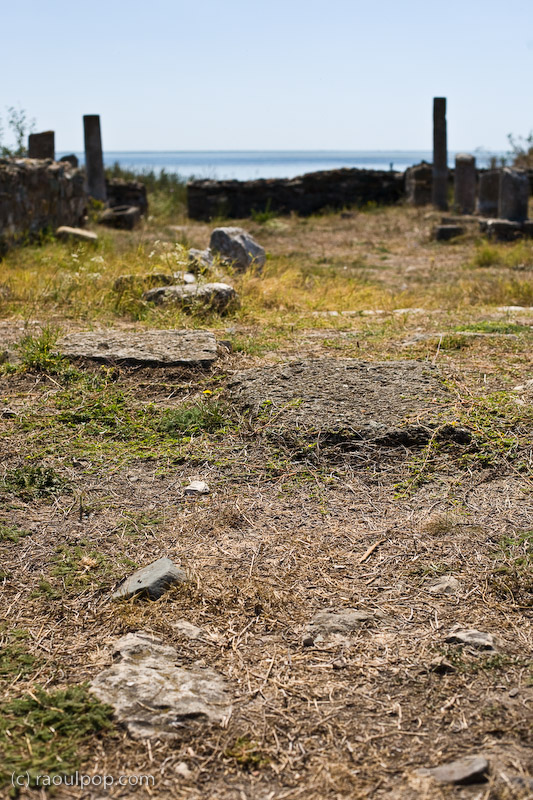
The full set of photos from Histria is available at my online photography catalog. You’re welcome to view them all there. Mircea Angelescu, a Romania researcher, developed a 3D model of Histria which can give you a detailed idea of the city’s layout over time. More info on Histria can be found at Wikipedia.

Standard
Places

George Washington's Mount Vernon Home

We visited Mount Vernon, George Washington’s own estate near Washington, DC, this past summer. If you don’t live in the DC area, you don’t necessarily get to appreciate one of the grand gestures done to honor George Washington’s memory, namely that of building a parkway (named after him) that starts right at the gates of his estate and becomes a major thoroughfare that winds its way parallel to the Potomac River, through Alexandria, past the Ronald Reagan National Airport, through DC, and upwards, past the CIA Headquarters, right to I-495. Getting to his home becomes a pleasurable drive on a scenic parkway for the DC area driver, particularly those who are traveling South from DC and Maryland.

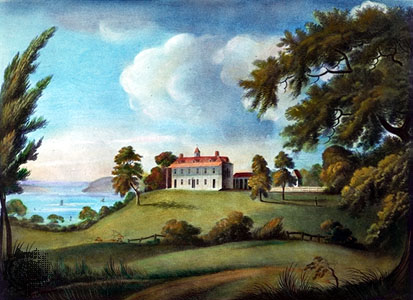
The location for Washington’s farm, and particularly his mansion, couldn’t have been chosen better. Even today, the view is spectacular, and one can only imagine what the surrounding area looked like during his time, unspoiled by modern “advances” and urban planning. An aquatint from Francis Jukes, done in 1800, gives us an idea, though I have a hunch he embellished things a bit.

Ligia and I visited Mount Vernon on two occasions, and took plenty of photographs each time. I picked the best ones from both sets and published them at my online photo catalog. There are 70 photos in the Mount Vernon set there, and all of them are available in HD (1920×1200 pixels, 16:10 aspect ratio). I selected a representative sample of those photographs for you to see right here. The gallery is shown below.

I hope you enjoyed the photos, and that you will find time to go visit Mount Vernon if you’re ever in the DC area. I for one am heartened to see that we are still paying respect to one of our nation’s founders and our first president, even in these very unpatriotic times, when we are getting involved in wars that our founders would have nothing to do with, and when fear-mongering has taken the place of freedom, and liberty, and justice for all.

One bit of advice: if you’re planning to visit the estate multiple times, get the yearly pass. It pays for itself in just two trips. We’re glad we got it. Our third visit, if we should go again, will be free.

More information about Mount Vernon can be found directly on the estate website, or at Wikipedia. Google Books also lists two books on Mount Vernon. The first is called “George Washington’s Mount Vernon – At Home in Revolutionary America“, and is written by the Dalzell brothers, and the second is called “Mount Vernon: Washington’s Home and the Nation’s Shrine“, by Paul Wilstach and Henry Saylor. The great thing about the two books is that they can be read online in their entirety.

Standard
Reviews

I like Snapple Lime Green Iced Tea

Not much to say other than I like it. I had it this past week, and it’s got a nice, refreshing taste. I already like green tea anyway, and if you’re going to flavor it with lime, then sweeten it just right, I can’t say no. Oh, and it’s definitely much better than this stuff.

Standard
Reviews

Camera preview: Canon EOS 5D Mark II DSLR

I’m a little late to the table with my thoughts on the new 5D, but I have an excuse: I’ve been traveling abroad (see this, this and this) and only now managed to sit down and think about it. There’s also an advantage to this: I got to read through the other reviews that have come out before I wrote mine.

So, what sources did I consult?

  • The Canon website was the first place I looked. There’s the official press release for the new 5D, and then the 5D Mark II pages. (I looked at the press release back on September 20th, when it came out.) Canon has also published 1080p HD video clips shot with the new 5D on their website, and they’re definitely worth checking out. They make a point to specify that the clips were shot with a pre-production 5D Mark II, so they may not accurately represent the quality of the production camera.
  • Digital Photography Review put together a very detailed review of the new 5D, as usual. Their review was very helpful to me.
  • The Online Photographer talked about the quality of the 5D’s HD video, and he brought up a good point. I’ll mention it here because I felt the same way when I saw Vincent LaForet’s video: it just wasn’t very good in terms of realization. It didn’t tie together, it felt empty… In a way, this was to be expected when there were only two days to write it, produce it, film it and edit it. But the quality of the video from the 5D Mark II was definitely worth seeing.
  • Robert Reichmann from the The Luminous Landscape posted pre-production video shot with the new 5D and gave his first impressions of the camera. He was in a hurry as well, as he was leaving for a trip to Africa and had only 48 hours with the camera. He says that the video is very high quality (so high that MBPs playing the full resolution video will skip frames), and there is no jellocam effect, where you see balooning artifacts due to slow recording of the data by the CMOS.
  • PopPhoto chimed in with a quick preview that did a little feature comparison between the old and new 5Ds.
  • On Taking Pictures had an interesting first reaction. He pointed out that the AF system should have been improved. It’s still the same 9-point AF found on the original 5D, and it has its limitations, as I can attest.
  • Thomas Hawk wrote up his impressions. He’s excited and plans to get one as soon as they’re available.
  • I found out about a new review aggregation site while I was writing this post. It’s called TestFreaks, and it’s one of the places where I looked for other reviews of the 5D. So far, they’ve posted links to four reviews for this camera, out of which an Italian review was worthwhile, particularly their side-by-side comparison of the old and new 5Ds. The rest of the linked reviews simply spewed the press release, which involves no effort or thought whatsoever. But I think the site is useful as a place to check for reviews when you want to learn more about a product.

What about me? Well, I wrote about the original and new 5D back in August 2007, when I took a shot a predicting the features of its new iteration. And I also wrote another article a little over a month ago, on August 28, where I talked about the coming convergence of DSLRs and video, and predicted that after the launch of Nikon D90’s 720p HD video capabilities, 1080p HD video wouldn’t be far off. Amazingly, Canon had already been at work on that very same feature, and launched it with the new 5D shortly afterward.

Let me first indulge myself and see how right (or wrong) I was in my own predictions about the 5D Mark II:

  • EOS integrated cleaning system (YES)
  • Live View (YES)
  • 16 Megapixels (NO, even better)
  • Up to 3200 ISO (NO, even better)
  • Increased battery life (YES)
  • Weatherproofing (YES)
  • AF upgrade (NO, unfortunately)
  • Increased zones for exposure metering (YES)
  • Shutter durability up to 300,000 cycles (NO, but still increased to 150,000 cycles)
  • 3″ LCD (YES)
  • Retail price $3,300 (NO, it’s $600 lower)

What I did as I read through the official specs found on Canon’s website and through the other reviews was to take notes of the interesting differences between the original 5D and the new 5D.

Original 5D 5D Mark II
12.8 megapixels (4368×2912 pixels) 21.1 megapixels (5616 x 3744 pixels)
DIGIC 2 processor DIGIC 4 processor
12 Bit A/D conversion 14 Bit A/D conversion
Pixel size 8.2 μm Pixel size 6.4 μm and reduced microlens gap
Native ISO capabilities 100-1600;
expanded capabilities 50-3200
Native ISO capabilities of 100-6400;
expanded capabilities 50-25600
Frame rate 3.0 fps Frame rate 3.9 fps
Shutter life 100,000 cycles Shutter life 150,000 cycles
Full HD (1080p) movies encoded with H.264 codec and PCM sound;
1080p movie mode (1920×1080) records clips up to 12 minutes;
480p movie mode (640×480) records clips up to 24 minutes;
Single file size (for movie clips) is limited to 4GB
No internal microphone/speaker;
No microphone input socket
Has microphone input socket to record higher quality audio for video files;
internal microphone on front of camera, and built-in speaker on back of camera
Viewfinder coverage 96% Viewfinder coverage 98%
Can use infrared remotes
Battery BP-511A;
up to 700 shots per charge;
1390 mAh
Battery life LP-E6;
up to 850 shots per charge;
1800 mAh
No additional batter info other than remaining charge improved battery status displayed on screen; camera can memorize batteries by their S/N and show you exactly how much power you have in each one.
RAW shooting enabled in Auto mode
Exposure bracketing +/-2 EV Exposure bracketing up to up to +/-4 EV
Creative Auto mode makes depth of field and exposure adjustments easier (for those that don’t bother to learn the basics…)
Auto Lighting Optimizer evens out harsh highlights and strong shadows
Peripheral Illumination Correction minimizes vignetting effects
Can embed copyright info but not intuitive at all Easier embedding of copyright info and photographer name in each photo taken with camera
Accessory shoe painted black, which leads to paint scratches as speedlites are mounted to camera Accessory shoe now left bare (metal-colored), which is better
2.5″ LCD, not very good at all in sunlight, low resolution 3″ LCD, great in sunlight, high resolution
Uses CF Type I and Type II cards Uses CF Type I, Type II, UDMA and CF+ cards
Auto ISO (100-3200);
can be turned on everywhere but in M mode, which is the way it should be
AF microadjustment
Live View with three AF modes: passive (mirror flips down briefly to focus), contrast detection (mirror stays up) and face detection (self-explanatory)
No water resistance, although I have taken my 5D out in the rain and it did fine as long as I didn’t get it completely wet Water resistance (10mm rain in 3 minutes)
Some dust resistance
2.5″ LCD, not very good at all in sunlight, low resolution 3″ LCD, great in sunlight, high resolution
No Quiet Shooting mode;
mirror slap is pretty loud
Quieter shooting mode available;
mirror will either lock up, or it will move slowly to the halfway position and close normally from there, creating less noise

How could the new 5D be even better?

  • AF should have been upgraded to something faster and more accurate
  • RAW files still CR2 format; it would have been nice to standardize on the DNG format
  • Color space options are still only sRGB or AdobeRGB; what about ProPhotoRGB?
  • HDMI Out miniport puts out great video but NO audio, which is unfortunate
  • Hand grip now slightly thicker, but space between grip and lens barrel slightly smaller, which means you may end up jamming your fingernails into the lens as you hold the camera, should you have thicker fingers. This was a point of contention with the 30D, was addressed in the 40D, and now I see it potentially coming back (though to a lesser degree) in the 5D Mark II.
  • No controls for video other than focus and exposure compensation once you start recording. It really does seem like the video mode was grafted onto the camera, as Luminous Landscape puts it in their review. Plus, the microphone input socket isn’t a pro-level socket, but a plastic one that can easily break if you’re not careful.
  • Recording video will drain the battery a LOT faster than shooting photos. And it will take up space. You’ll go through a single 4GB CF card in about 11-12 minutes if you’re shooting video. I guess this is to be expected given that the camera records full HD video on a huge 35mm sensor.

On the plus side, it’s interesting to note that I paid $100 more for my original 5D back in April of 2007 than what the new 5D Mark II will cost at retail when it hits the market. I bought my 5D for $2800 from Costco, and the new 5D will cost $2,700, but it will have all these incredible new features. Something to think about. I suppose I shouldn’t complain, since I did get about 1 1/2 years about of my 5D before it was rendered outdated by its successor.

So, will I be getting one? Not at the moment, no. My original 5D is still very usable, and I don’t have the deeper pockets of some other folks. I’m still without a good zoom lens. Coincidentally, the same great zoom lens that I like (EF 24-105mm f/4L IS) can be bought as a kit lens with the new 5D, so I definitely encourage you to get it if you don’t have it in your inventory. It will prove its versatility over time, and you will be glad you have it.

At some point in the future, I will be glad to buy the new 5D. Perhaps by that time they’ll have made the video mode more streamlined, and integrated it a little better within the menus and external buttons of the camera, not to mention that I’ll have had a chance to save up for it.

If you’d like to get it though, don’t let me stop you:

Photos used courtesy of Canon.

Standard