Reviews

Flickr launches People in Photos

Flickr launched a new feature they call People in Photos a few hours ago, on October 21, 2009. It lets you tag people in your photos or in your contacts’ photos. I guess it was only a matter of time before this happened. While Riya and iPhoto went the route of computer-aided facial recognition, which is a pretty cool feature indeed but processor-intensive, Facebook and now Flickr have gone the more low cost route of letting members manually tag people in their photos.

At any rate, the process is easy and real-time. You start typing in some identifier for a person you want to identify in a photo, such as a name or screen name or email address, the database of members is searched live, and you’re presented with a drop-down list of people that narrows down with each letter you type. Pretty cool. Flickr also went the extra mile and included the ability to let you determine who can add you to photos, and who can add people to your photos. Very nice touch there.

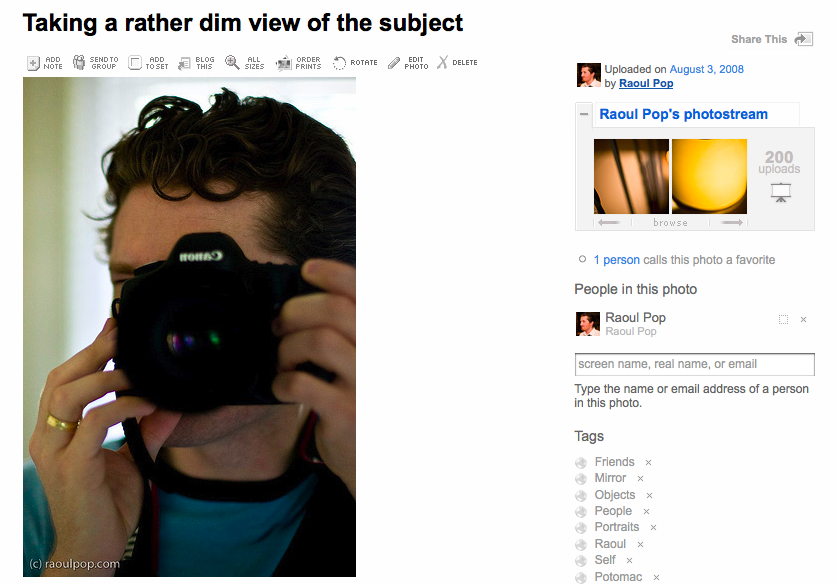
I added my wife and myself to a couple of photos where we appear, and took the following screenshots to show you what the new feature looks like. The only reason I noticed it is because I logged into my Recent Activity page a few minutes ago and saw a small change in the options, as you can see below.

flickr-people-in-photos-1

The option to add people to a photo is located in the sidebar, below the photostream and groups thumbnails and above the tags.

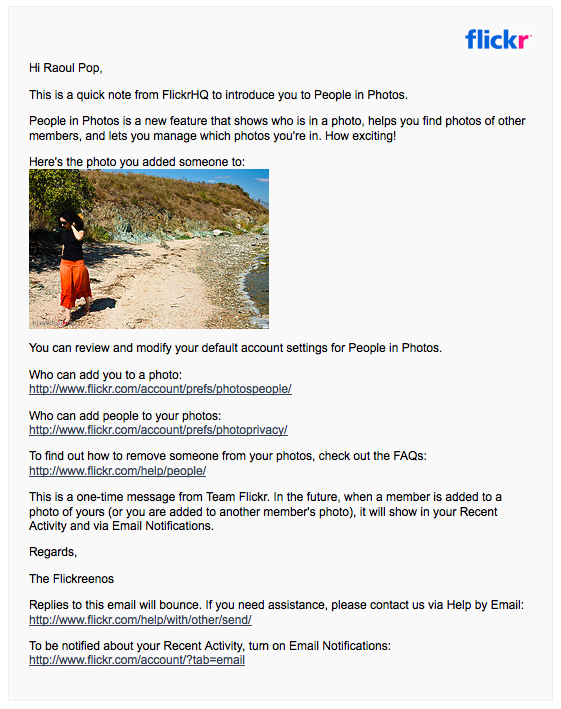
flickr-people-in-photos-2

As soon as I got done tagging my wife and I in the photos, I got an email from Flickr where they explained the new feature to me and allowed me to set the privacy options I mentioned above.

flickr-people-in-photos-3

Like I said, pretty cool implementation, user-friendly, too, and it was something that was bound to happen sooner rather than later. There’s also a post on Flickr’s official blog announcing the feature launch.

What I’d like to know now is if Flickr can read the iPhoto person tags and somehow match them up with Flickr members, so that photos uploaded to Flickr from iPhoto get people-tagged automatically. Or is that the next step down the road?

Standard
Thoughts

Healthcare in Romania


There are two options for the person requiring care: the public healthcare system, financed by the government, where one is supposed to be cared for without cost if they hold medical insurance, and the private healthcare system, which is not really a system but is made up of different, unrelated private clinics or hospitals, where one must pay all expenses out of pocket. Let’s look at each system in more detail.

Public healthcare

I believe there are three main problems plaguing public healthcare in Romania:

  1. Widespread corruption at all levels of care. Bribes must be paid to hospital directors, managers, doctors and nurses, and sometimes even to hospital guards, if you are to get any competent care other than a daily temperature and blood pressure check until you check out or expire, whichever comes first.
  2. Incompetent personnel, due to:
    1. An inefficient medical education system, staffed with teachers and professors who care more about furthering their own careers, brown-nosing and getting bribes than teaching students how to be proper nurses and doctors.
    2. An unwillingness on the part of most students and medical personnel to put in the effort to acquire the knowledge they need to do their jobs right.
  3. Old facilities and equipment. Hospitals and clinics lack the funds to maintain the infrastructure properly, so all of them are run-down, cold in winter, hot in the summers, with drafty rooms and hallways where you’re likely to catch pneumonia, with bathrooms that have leaky faucets and leaky toilets, mostly left uncleaned, smelly, wet and old, with metal beds that date way back from the 1st or 2nd world war (I’m not kidding about this), and with mattresses that have seen more than their fair share of human bodies and bodily fluids. When it comes to equipment, it’s mostly non-existent, other than basic X-ray machines.

Sure, there are exceptions. There are some doctors and nurses who don’t ask for bribes. And there are some medical personnel who are competent at their jobs — they know how to do them and take the time and effort to put their knowledge to good use. But if you think the two groups contain the same people, you are probably mistaken. It’s usually the doctors who are the most competent that demand the bigger bribes, though it could be that a really good doctor or nurse may also be the one who doesn’t ask for or accept bribes. There’s no way to tell, really. It’s like taking a potshot in the dark. You’ll go to get some care and may end up with a butcher or a blundering fool who only makes things worse, and you may also end up paying him or her plenty of money for the shoddy treatment.

On some level, I understand why the corruption exists. Salaries for government-paid doctors and nurses are very low — janitors at profitable private businesses usually make more money than doctors in government hospitals — but that’s still no excuse for the endemic corruption. While salaries are low, medical personnel have also gotten used to asking for money from each and every patient, to the point where they expect it for the littlest thing and won’t help you if you don’t pay. There’s a ridiculous, infuriating sense of entitlement among most, if not all of them. Somehow they’ve gotten to think you owe them money simply for looking at you. That’s not right.

If only they’d take the time to study more, to get better at their craft, I, along with the millions of Romanians who visit hospitals, would feel better about paying extra to get care, but most are ignorant of any new developments in their fields. They only know enough to get by on routine matters. As soon as there are complications, they’ll take your money for a consultation, then tell you to go see this other doctor, who’ll ask for his share, then send you along to another, and so on and so forth until you’ve seen seven, eight, nine, ten doctors, have spent a month’s or two months’ salary on bribes, and you’re still no closer to getting treated right or cured. They’ll all nod their head, promise to help, take your money, run their tests, then scratch their heads and say they’re not sure what’s going on, that you’ll need to come see them again in a little while, etc., while happily fleecing you.

When it comes to government nurses, they won’t administer the injections or infusions or obey the doctors’ orders if you don’t slip them a bill, or some coffee, or chocolate, or whatever. It has to be something a little more expensive than just some candy or a trinket, and let me tell, when you’re being seen by four or five nurses and you need to make sure each of them gets something, it gets expensive. It’s so sad to visit hospitals and see all the old people on small pensions walk about with sad looks on their faces, mostly ignored by the nurses who are supposed to care for them, simply because they can’t afford to bribe them.

Private healthcare

There is hope when it comes to Romanian healthcare, and as is usual in a free enterprise system, it’s found in the private arena, where there are financial incentives for those willing to take some risks and make some investments in buildings, medical equipment and qualified personnel.

There are private clinics and hospitals, completely separate and unrelated to the government, where you can get competent care if you have the money to pay for it. Truth be told, it may end up costing you less than government healthcare if you add up all the extra costs involved with bribing government personnel.

Only the best doctors and nurses get hired in the private clinics and hospitals, are paid good salaries, are forbidden from taking bribes, and these facilities are equipped with the latest devices needed for proper patient care. There are entire hospitals and sanatoriums placed in beautiful locations in the mountains, where you can go to spend a few weeks to relax and get allopathic or natural, holistic treatments. There’s an entire gamut of options available to those willing to pay out of pocket.

For example, let’s say you need to run a whole battery of tests to see how your body is doing. You can go to the local government hospital, see and bribe a doctor to get some tests, then go to five or six different labs inside the hospital to run those tests, bribe your way through each place, then come back to the doctor in a few days to give him or her more money to look at the test results and tell you what’s going on. Or you can check into a private clinic, where for a fixed cost, you will spend a few days in a clean, private room with proper heating and cooling, pick your food from a menu, have your meals served to you, be able to take showers in a clean bathroom, be seen by caring, competent doctors and nurses, and get accurate test results interpreted properly. That’s the difference.

I should mention that private doctors’ offices aren’t the same thing as privately-run clinics and hospitals. Many government doctors also keep private offices, and will actually force people who come to see them in hospitals to go to their private offices and pay out of pocket to get the same care they could get for free in hospitals, but the care patients get there is just as bad as inside hospitals, and the facilities are usually just as unhygienic and inefficient. No, you must seek out professional private clinics and hospitals if you want to get the serious care I mentioned above.

Possible solutions

I think you know by now which option I would pick if I were to get sick in Romania, and for good reason. That’s not to say public healthcare can’t be fixed. In recent years, there’s been a serious push against corruption in Romania, at all levels of government, not just in healthcare, driven by the EU, but they haven’t made much headway other than talking about it and putting up posters in government agencies. Much more needs to be done, and it needs to start first with better salaries for medical personnel, probably double or triple what they are now.

Corruption in Romania is a very serious problem, one that requires an organization with teeth, one that can and does take immediate action against infractors, and where the identity of the person reporting incidents of corruption is kept top secret. Sadly, the system is still stacked against those willing to report it. Think for a moment what happens to someone who wishes to report a doctor who asks for money. First, they won’t get the treatment they need, and they may have an urgent medical problem, and then, if their identity is leaked, word about them spreads like wildfire, and no medical personnel at that hospital will want to treat them — and it may be the only government hospital or clinic in town. So people usually shut up and pay up, because they want to get on with their lives, not cause problems for themselves and for others.

Until the problems of corruption and salaries and public healthcare infrastructure get resolved, I would encourage people to use private healthcare options, if they can afford it. The more people use private healthcare, the more affordable and accessible it will get over time, and the more incentive there will be for the government to fix public healthcare.

Standard
Thoughts

New album from Chris Isaak

2002 GQ Men of The Year Awards - Show

I saw a new video from Chris Isaak this morning, for a song entitled “We Let Her Down”. The album is called “Mr. Lucky” and was released this year. You can listen to clips from all of the songs on his album at Recordnet or at Amazon.

We Let Her Down” by Chris Isaak

Chris Isaak was/is one of my favorite singers, though I forgot about him these past few years. Back in college, in the mid 90s, I loved his songs. That whole melancholy jive of his resonated with my less than successful romantic life back then…

I visited Chris’ website afterward, where I watched videos for some my favorite songs, such as “Wicked Games”, “Blue Spanish Sky”, “Think of Tomorrow” and “Dark Moon” (the list goes on, but not all of the songs were made into videos).

Wicked Games” by Chris Isaak

Blue Spanish Sky” by Chris Isaak

Think of Tomorrow” by Chris Isaak

Dark Moon” by Chris Isaak

Standard
Reviews

Camera preview: Canon EOS-1D Mark IV DSLR

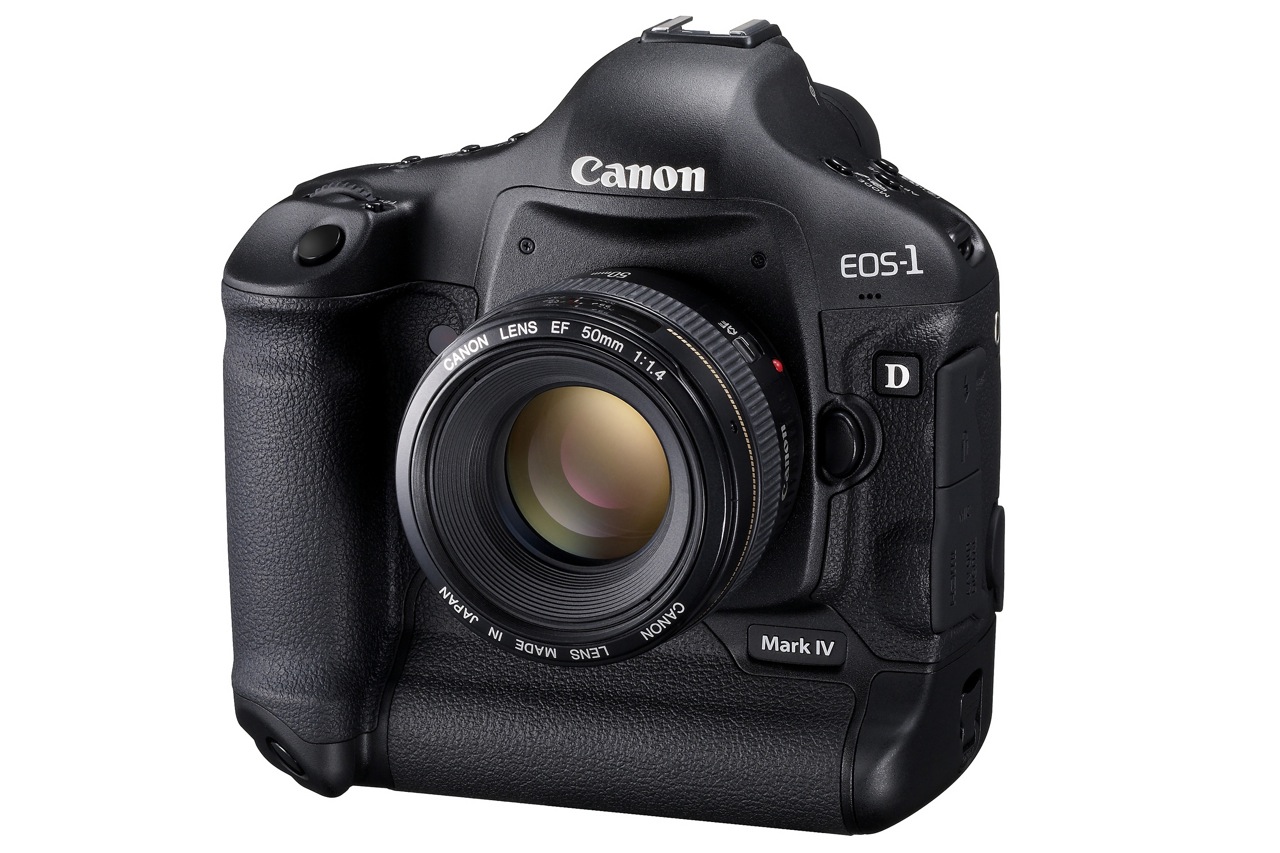
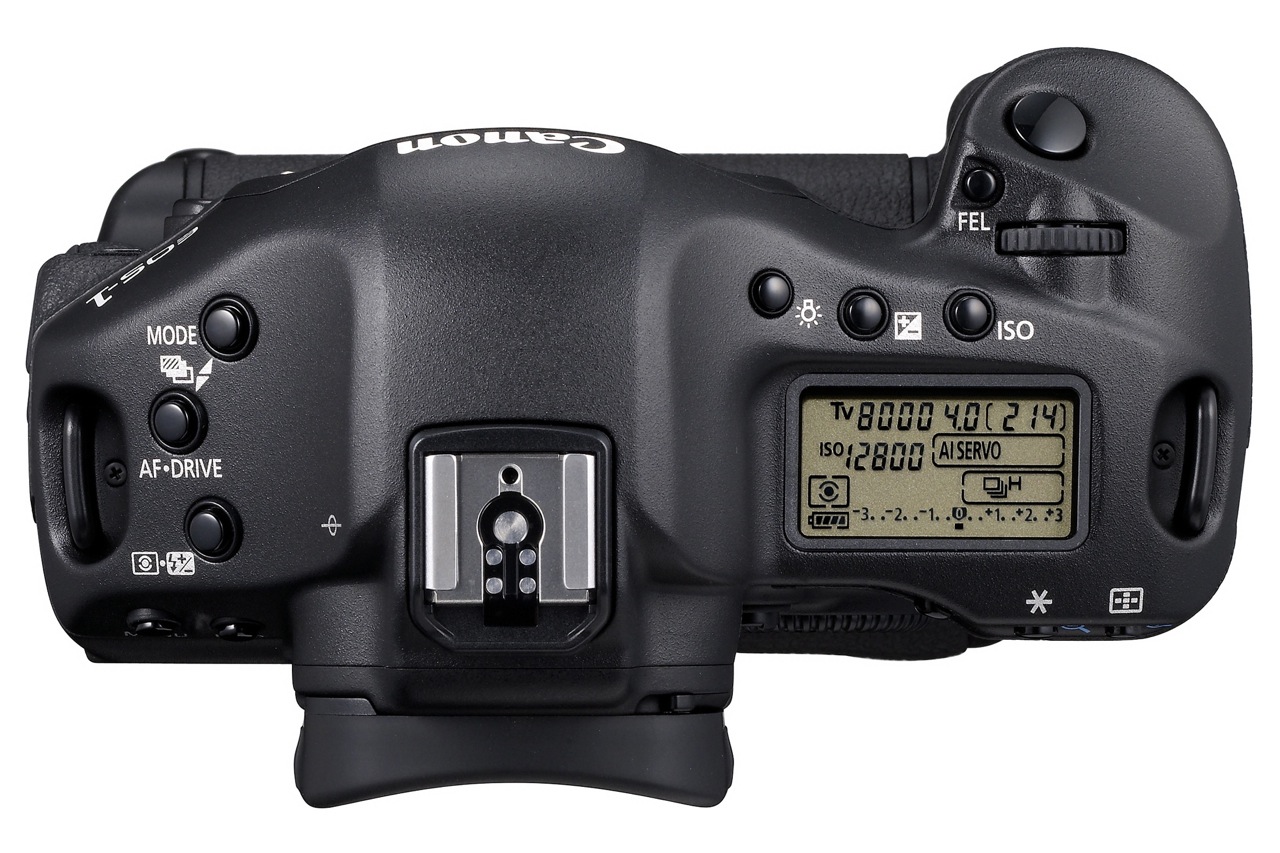
Canon EOS-1D Mark IV - 1

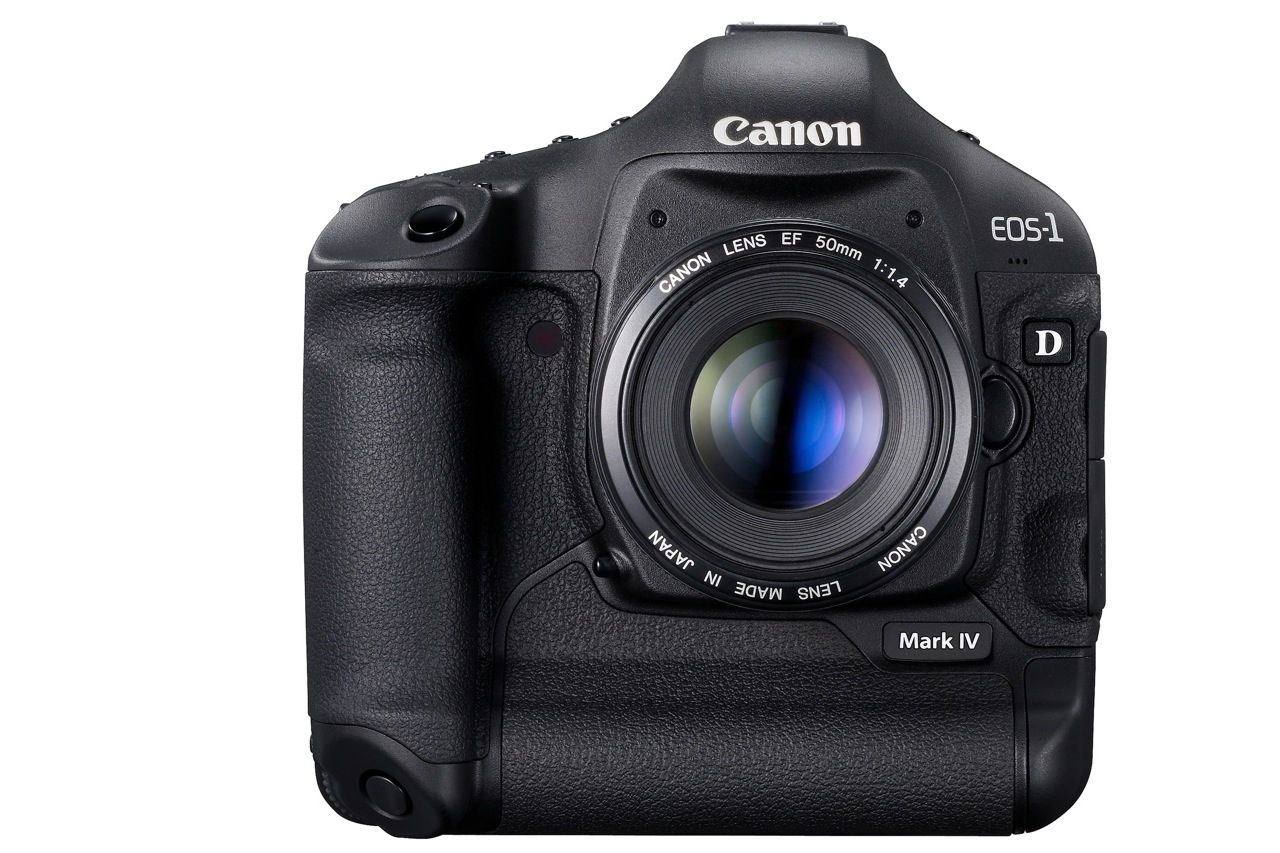
The Canon EOS-1D Mark IV pro DSLR was officially announced by Canon today, October 20, 2009. The specs are really good and they show Canon’s been hard at work on a solid response to Nikon’s latest DSLRs.

Many photographers were disappointed with Canon because of their 2008-2009 DSLR product releases, which didn’t seem to keep up with the competition and fell short in many areas of common interest, such as auto-focus, high ISO performance and image quality. I’m glad to see Canon listened to their customers’ concerns and put out a camera that offers what people want to see.

Let’s have a look at what sets this camera apart. The EOS-1D Mark IV has:

  • A 16-megapixel Canon CMOS sensor
  • Dual DIGIC 4 Imaging Processors
  • 14-bit A/D data conversion
  • 10 frames-per-second (fps)
  • The widest ISO range Canon has produced to date (50 to 102,400)
  • 1080p Full High-Definition video capture at selectable frame rates
  • A new 45-point auto-focus system with 39 high-precision cross-type focusing points

Canon EOS-1D Mark IV - 4

New autofocus system

Given the auto-focus problems with the 5D Mark II and other high-end cameras like the 1D Mark III and 1D-s Mark III, I for one am very glad Canon put out a new AF system. The newly redesigned AF system…

  • Can track fast moving subjects, such as athletes or wildlife accurately, even when shooting at full 10 fps bursts
  • Can detect subjects much better than the previous AF system
  • Can focus accurately with the new AI Servo II AF predictive focusing algorithm
  • Has twice as many cross-type focusing points as the EOS-1D Mark III
  • New AF sensor construction that improves performance in low light and with low contrast subjects

Not having used the camera yet, I can’t vouch for the accuracy and speed of the new AF system, but it shouldn’t be long before those who’ve had the chance to use the camera in real-world scenarios chime in with the results.

New 16.1 M CMOS sensor

I like Canon’s new 16.1-Megapixel CMOS sensor. I’m glad to see they focused on image quality and low light performance, not megapixels. Don’t get me wrong, extra resolution is always good, but gratuitous resolution is useless unless the resulting images prove their quality when viewed 1:1.

The sensor has improved photodiode construction to enhance dynamic range, and gapless microlenses that are positioned closer to the photodiodes for improved light gathering efficiency. The transmissive quality of the color filter array has been enhanced to improve sensitivity. Canon has also upgraded the sensor circuitry to improve noise reduction before the image data is exported from the CMOS sensor to the rest of the image processing chain.

In order to process all the extra raw data from the sensor at up to 10 fps, Canon put two Dual DIGIC 4 Image Processors inside. The 1D Mark IV has approximately six times the processing power of DIGIC III, for full 14-bit A/D conversion at 10 fps.

Full HD video capture

I’m also glad to see that Canon has put 1080p HD video on this camera, which means that for them, HD video is here to stay on all their DSLRs. It really is a new era for HD video when it becomes a standard feature on professional DSLRs; wonderful things are in store for those interested in blending photography with videography.

The 1D Mark IV has full HD capture and full manual exposure control, plus selectable frame rates. Its new APS-H image sensor is similar in size to a Super 35mm motion picture film frame. The camera allows for three video recording resolutions…

  • 1080p Full HD, 16:9
  • 720p HD, 16:9
  • 640×480 SD, 4:3

… and multiple selectable frame rates…

  • Full HD at 1920 x 1080 in selectable frame rates of 24p (23.976), 25p, or 30p (29.97)
  • 720p HD or SD video recording at either 50p or 60p (59.94)

SD video can be recorded in either NTSC or PAL standards. Sound is recorded either through the internal monaural microphone or via optional external microphones connected to the stereo microphone input.

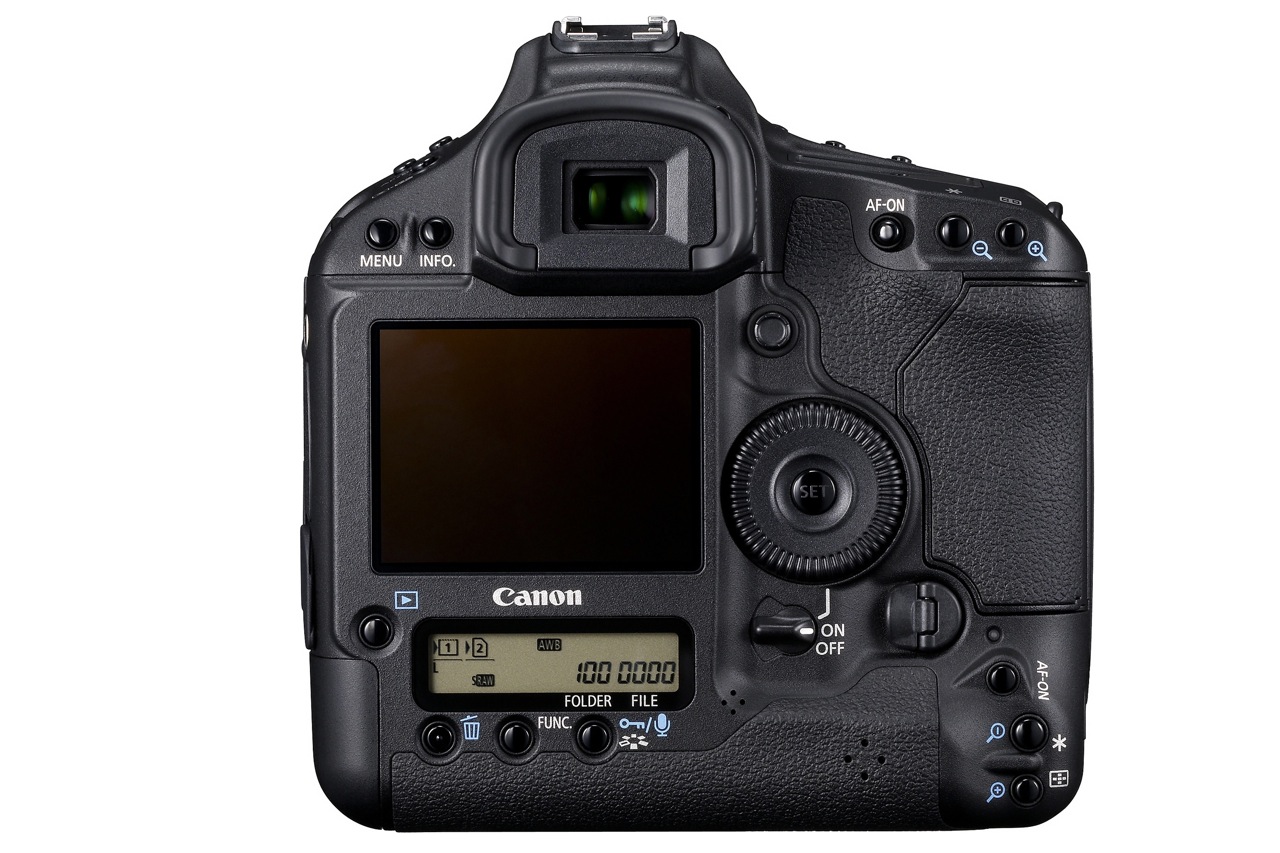
Canon EOS-1D Mark IV - 3

Other good features are:

  • Auto Lighting Optimizer (ALO) system. When enabled, Canon’s ALO automatically adjusts the image for optimal brightness and contrast on the fly during in-camera image processing, reducing clipped highlights while keeping shadowed areas as clear and detailed as they actually appear. Canon says that “demanding professional photographers who tested ALO clearly stated that this one feature will reduce their post-production image optimization process by more than 75 percent”. It’ll be interesting to see what others will say about this.
  • Highlight Tone Priority, which takes maximum advantage of the camera’s extensive dynamic range to preserve detail in highlight areas of the image.
  • Improved white balance algorithm making colors more accurate when shooting under low color temperature light sources such as household tungsten lamps.
  • Peripheral Illumination Correction function, which corrects darkening that can occur in the corners of images with most lenses when used at their largest apertures. When activated, it is automatically applied to JPEG images and video clips as they are shot. For RAW images, it can be applied in DPP software. Personally, I like the vignetting effect that occurs with some lenses, so I don’t really plan on using this very much.
  • A large, 3-inch Clear View II LCD screen with 920,000 dot/VGA resolution (finally) with a wide 160-degree viewing angle for enhanced clarity and more precise color when reviewing images and shooting video.
  • In-camera copyright information feature (hooray) helps professionals secure control over images by setting copyright data directly into the camera and appending that information to each image file in the Exif metadata.
  • A fluorine coating on the Low Pass Filter to further repel dust and enhance the EOS Integrated Cleaning System (less dust spots is always a good thing).

Finally, the 1D Mark IV’s body, chassis and lens mount are completely weather-resistant and 76 gaskets and seals surround all buttons and seams. The body covers and internal chassis, including the mirror box, are constructed with magnesium-alloy, and the lens mount is constructed with stainless steel. When used with Canon’s Speedlite 580EX II and/or most current L-series lenses, the entire camera system remains fully weather resistant.

Comparing this camera with the Nikon D3s, which has similar specs but retails for about $100 more, I have to ask, what makes the Nikon DSLR better? Other than niceties like better exposure compensation control (±5 EV vs. ±3 EV) and more physical buttons for manipulating the settings, this Canon matches or bests the Nikon on all major specs, like fps (10 vs. 9), ISO (same), resolution (16 vs. 12) and HD video (1080p vs. 720p).

The new WFT-E2 II A wireless file transmitter, available exclusively for the EOS-1D Mark IV Digital SLR camera, is quite interesting in its capabilities. It offers connectivity through IEEE802.11a/b/g and Ethernet. The new Camera Linking feature allows a single photographer to simultaneously fire up to 10 cameras remotely. The updated WFT Server mode lets you remotely use Live View, control settings, and fire the EOS-1D Mark IV over the internet from anywhere in the world using a standard Web browser or many Web-enabled smart phones. Additionally, geotagging is now possible via Bluetooth, using compatible GPS devices to append coordinate data to the images. Given that the previous wireless transmitter, WFT-E2A, costs $1,200, you can be sure this new one will cost a bundle, but for those who need it and can afford it, I’m pretty sure it’ll do a good job.

Canon EOS-1D Mark IV - 2

The Canon EOS-1D Mark IV Digital SLR camera is scheduled to be delivered to U.S. dealers in late December, and will be sold in a body-only configuration at an estimated retail price of $4,999. Final pricing and availability for the Canon WFT-E2 II A wireless file transmitter will be available later this year.

Full specs for the camera are available here. Demo videos produced by Canon specifically for this camera are available here. There’s a section on the camera, with more information, at the Canon Digital Learning Center.

You can buy the Canon EOS-1D Mark IV from Amazon or B&H Photo.

Images used courtesy of Canon.

Standard
Thoughts

Constitutional court strikes down Berlusconi's immunity

World Leaders Attend First Day Of UN General Assembly

Glad to see Berlusconi won’t have his way when it comes to the brazen immunity he granted himself a couple of years ago. Italy’s Constitutional Court threw out his immunity law as unconstitutional. This means he will now be subject to two ongoing trials and a probe into an alleged prostitution ring.

What can I say, Mr. Berlusconi… at some point all the stuff you’ve been doing has got to come back and bite you in the rear.

Standard