Reviews

Song of the Thin Man (1947)

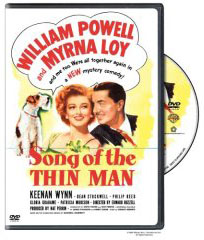
“Song of the Thin Man” (1947) is the sixth and final installment in the Thin Man series, starring Bill Powell and Myrna Loy. The series started in 1934 with “The Thin Man”. In the midst of the depression, that first movie struck a chord with people and was instantly popular. More movies followed, in 1936, 1939 and 1941. One was even made during WWII, in 1944.

This final movie made in 1947, at the end of WWII, was a turning point. From that point on, movies changed. Americans who came home from abroad, from war and travel, had a different perspective in life. Social hierarchy changed. American prosperity came into its own and people’s expectations changed (not necessarily for the better). You’ll see hints of all those things in this movie.

I may be wrong on this, but it’s possible that Bill Powell was made to wear a wig for this movie. He had a receding hair line as early as 1931, and it was visible in his other Thin Man movies. In this one, however, you’ll see a clear, determined hair line, much closer to his forehead than in earlier movies. It bothered me a bit. I wanted to see the Bill Powell I knew, with his own hair.

The plotline for this movie is similar to the others in the series. Someone gets murdered, there are lots of suspects and motives, the likely suspects turn out to be false, and the criminal is someone close to the action but an unlikely choice. Although we know how things are going to unroll, it’s the action, the dialogue, and above all, the actors that keep us interested in this movie, and in the others as well.

Bill Powell and Myrna Loy are two of my favorite actors, and they’re amazing when they’re together on screen. It’s a delight to watch them. Every time I see a movie that stars only one of them, I miss the other. They’re just not the same if they’re not together.

More information:

Standard
Reviews

The Ambassador's Daughter (1956)

The Ambassador’s Daughter (1956)We watched it tonight and liked it. It’s a funny romantic comedy full of light laughs. The script’s somewhat thin at times — some of the plot twists are sewn with white thread, as they say — but the acting’s great, in particular that of Olivia de Havilland, who plays the title role. What’s also a rare treat is the location: Paris in the 50s — need I say more about that? The movie’s in color, in spite of the black and white screenshot (which was the only one I could find).

Overall, the movie’s easygoing, and it’s really a wonderful movie for a quiet evening at home. It’s about an innocent, unlikely romance between the daughter of the American ambassador to Paris and an American soldier on leave. It starts out as an experiment for her, but ends up serious, and with a very happy ending.

The movie also has Myrna Loy, and that’s a treat as well. If it only had Bill Powell, too, but you can’t have everything, can you? John Forsythe plays the American soldier. I’d never heard of him before this movie, but he played his part very well.

Pick it up and relax with your significant other while you watch it. It’s a quiet, nice little movie that’ll let you have a peaceful night’s sleep afterwards.

More information:

Standard
Reviews

Re-makes aren't as good as the originals

My Favorite Wife (1940) Move Over, Darling (1963)

Just finished watching “My Favorite Wife” (1940), and found it so much better than its remake, “Move Over, Darling” (1963). The thing is, I watched the 1963 version first, so I wasn’t prejudiced against it by the original. Yet after watching the original tonight, there is no doubt that I prefer it. Ligia and I were laughing out loud virtually through the entire movie. The gags, the lines, the acting, the action — everything was fresher and funnier. By contrast, I found the acting flat and the jokes overworked in the 1963 version.

Cary Grant and Irene Dunn shined again in this movie. They were a fantastic pairing in The Awful Truth (1937), and they put on a similar bedroom routine at the end of this movie, except this one’s absolutely hilarious. If you have a chance, pick up “My Favorite Wife“. They don’t make them like that anymore, and it’s really worth watching, if only for the comedy!

Standard
Reviews

Pirates of the Caribbean: At World's End (2007)

Pirates of the Caribbean - At World's End (2007)Saw Pirates of the Caribbean: At World’s End last night with Ligia. Superb follow-up to Dead Man’s Chest (2006). I loved the plot twists in this one, and thought the script was handled wonderfully to offer closure to the story points from the first and second movies in the series. It seemed to me there was a ton more action packed into this one than the first and even the second. And it was certainly not as dark as the second, which left me frustrated and with a headache. As expected, things definitely had the Jerry Bruckheimer signature: big music, big fights, and furious, charging action.

I loved all of the legends and tales that were weaved so nicely into this movie’s plot (Calypso, the maelstrom, the literal end of the world, Davy Jones’ locker). (For more information about the places discussed in the movie series, see the Geography of the Pirates of the Caribbean, but know that it contains spoilers.)

Now about the acting: superb, as we’ve come to expect from the previous two movies. Honestly, praises are to lavished all around. Everyone’s performances felt authentic. I was in awe of Geoffrey Rush’s portrayal of Barbossa this time around. That man is a born character actor! Orlando Bloom really grew into the role of Will Turner this time. It felt to me as if he finally inhabited the character. Kevin McNally’s performance as Mr. Gibbs also stood out as more forceful than in the other two movies.

There’s a surprise appearance by someone in this movie. I’ll give you a hint: he appears at Shipwreck Cove as a pirate, and he was supposedly an inspiration for Johnny Depp’s portrayal of Jack Sparrow… This may be a spoiler, but I have to point it out, or you may miss it: it looks like Jack Sparrow is the son of this pirate king. Watch closely for the dialogue between them!

The set designers and the editors are to be praised as well. Like in the first movie of the series, they did a wonderful job in making the sets inhabitable. When I watched it, things were so real I could imagine walking around the streets and places that were filmed. Beyond that, the entire movie came alive — it was believable and authentic. It met my litmus test: I didn’t notice the sets, and focused on the movie.

There was one thing I didn’t like: the makeup on the actors’ faces was very visible in some scenes, and it was a deep sort of yellow. It looked as if they had jaundice. I understand it’s really hard to deal with makeup in humid and wet environments, especially when people are sweating and action sequences are being shot, but still, it was disconcerting to look at their faces and see them yellow in one cut and normal in the next. This happened especially during scenes filmed on the ships.

The way is left open for another movie at the end. Don’t worry, this movie does NOT end in a cliffhanger, like the second one. I thought that was a particularly cruel move, and I’m glad to see it didn’t happen here. Everything that needs closure gets closure, while the gate is still left ajar. Beautiful ending, if you ask me. And that reminds me: do NOT leave the movie theater until ALL of the credits roll by. There is a surprise scene at the end (and I mean the END) of the movie. Don’t want to spoil it for you, but do NOT leave the theater, wait for it. It’s worth it!

One of the last scenes takes place between Will and Elizabeth. I’ll spoil it if I go into the details, but it’s very endearing, and involves a play on words — a wonderful metaphor about sincere love, and the act of giving someone your heart with the hope that they will guard it well.

More information:

Standard
A Guide To A Good Life, Reviews

Random Harvest (1942)

Just saw Random Harvest (1942), and had to blog about it. What a wonderful movie! I had no idea it even existed until tonight. Ligia spotted it on TMC a week or two ago, and we moved it toward the top of the queue of our Netflix account. I’m so glad we did!

The story is fantastically beautiful. A woman (Greer Garson), meets and falls in love with an amnesia patient (Ronald Colman), a convalescing officer from WWI. His life, until then a dreary, monotonous stay in an asylum, begins with their chance meeting.

They move to the country, and he begins to write. He’s quite good at it, and emboldened by his success and the prospect of making a living from writing, he proposes to her. She accepts, of course, and they settle down to a beautiful married life.

They have a boy, and one day he gets a job offer in nearby Liverpool. They’re both very happy about it, and he sets off for the city right away. On his way to the job interview, he has an accident, and a concussion brings back all memory of his previous life, erasing his current one.

Naturally, he goes back to his family home (he happens to be an aristocrat) and picks up his life, troubled as he may be by the lapse of three years from his life. His now ex-wife, desperate, searches everywhere, falls ill and the baby dies. When she sees his photo in a newspaper some time later, she applies to be his secretary, and gets the job, but does not tell him about her identity, hoping that he’ll recognize her. He does not, and things go on like that for years: he, tormented by unrecognizable wisps of memory from the past, and she, so close and yet so far from his heart.

I won’t tell you more, because I don’t want to spoil the movie for you if you haven’t seen it. Suffice it to say that it’s absolutely excellent. It’s a perfect screenplay, and Ms. Garson and Mr. Colman are absolutely marvelous in their parts, and they’ve now made my list of favorite actors and actresses. I was left speechless at the beautiful ending, and could only think “Bis, bis, bis!” I’m truly shocked that I did not hear of this movie until now, and want to find more like it. Record it, rent it or buy it, but see it. You must. You won’t regret it.

Standard