Reviews

Camera preview: Canon EOS-1Ds Mark III DSLR

On the same day that it released information about the upcoming EOS 40D DSLR, Canon dropped a bombshell. The much-expected 1Ds Mark III is ready, and will begin shipping in November. We all knew it was coming, but what we didn’t expect was the medium format-like resolution: a whopping 21.1 megapixels!
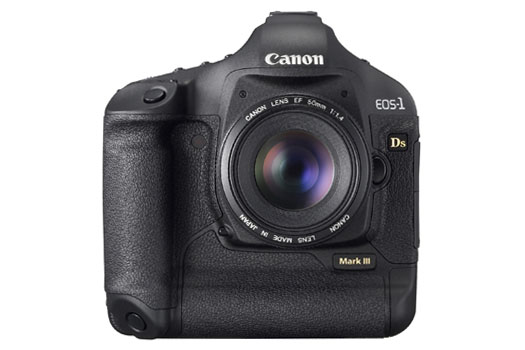
Canon EOS-1Ds Mark III (front)

Here are the specs where the 1Ds Mark III differs from the 1Ds Mark II:

  • Resolution: 21.1 megapixels vs. 16.7 megapixels
  • Processing engine: DIGIC III vs. DIGIC II
  • AF: re-designed 45-point vs. previous-generation 45-point AF (there were some issues with this new AF system in the 1D Mark III, and I hope they’ve been addressed by now)
  • Color depth: 14-bit vs. 12-bit
  • Live View
  • Integrated sensor cleaning
  • WB: 12 vs. 10 settings
  • Viewfinder magnification: 0.76x vs. 0.70x
  • Exposure control: 63-zone vs. 21-zone metering
  • Drive speed: 5 fps vs. 4 fps
  • LCD monitor: 3 inches vs. 2 inches
  • Shutter durability: 300,000 cycles vs. 100,000 cycles
  • Battery: lithium-ion (LP-E4) vs. Ni-MH (NP-E3)
  • Battery life: better, but no data provided vs. 800-1200 shots/battery/charge with the 1Ds Mark II
  • Weight, body only: 1,205 grams vs. 1215 grams

As Canon themselves point out, they wanted to venture into the realm of high-fashion and commercial studio photography with the new 1Ds. Traditionally, medium-format cameras dominated those markets. Besides the wonderful resolution, the 1Ds would bring two other things: portability and affordability. Medium-format cameras are more expensive, and they’re usually heavier. Let’s not forget the 1Ds also goes up to 1,600 ISO, which is unheard of in medium format cameras with digital backs. The ISO range there is usually 100-400, with the occasional 800 seen in some models. The additional ISO range should provide those photographers with more creative uses of light and more flexibility in various conditions.

The camera uses the new DIGIC III image processor introduced with the 1D Mark III earlier this year. But it uses two of them, working in parallel. There’s a lot of data crunching to be done when the resolution is 21.1 megapixels and the frame rate is 5 fps! The CMOS sensor reads out to both processors through eight channels, ensuring fast signal transfers.
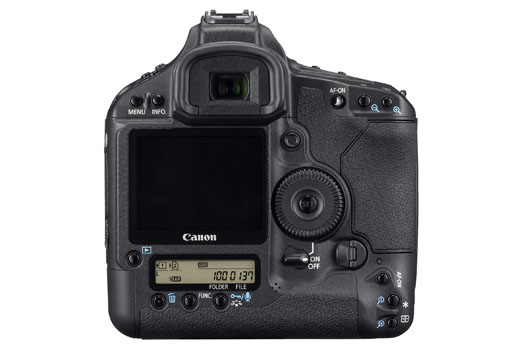
Canon EOS-1Ds Mark III (back)

The 1Ds also features a new 14-bit analog-to-digital conversion process, which means that it can recognize 16,384 colors per channel — four times the number of colors recognized by 12-bit cameras like the 1Ds Mark II or the 5D.

In addition to using CF type-I and II cards, the camera is also compatible with the UDMA specification, which doubles the data transfer speed of a normal CF card when used with UDMA-compliant cards.

The sensitivity of the new AF system’s sensor has been doubled to EV-1, for greater accuracy in low light. The AF point of focus can also be micro-adjusted based on the type of lens used, and the focus-tracking sensitivity can also be finely adjusted.

Another really nice feature is Live View, which works in much the same way as on the 40D — see my review of it for those details. The Live View function also works with the EOS Utility software, which means you can see just what the camera sees through your computer’s monitor, and control it remotely for studio sessions.

The EOS Integrated Cleaning System shakes off dust from the low-pass plate installed in front of the sensor with ultrasonic vibrations when the camera is turned on or off. A special adhesive collar installed around the sensor collects the dust and holds it there.

Finally, comprehensive weatherproofing is present at 76 locations on the camera, providing protection and allowing the use of the camera in demanding conditions.

The camera will start shipping in November and retail for $7,999. I expect the street price to stick pretty close to that for at least a few months after the launch.
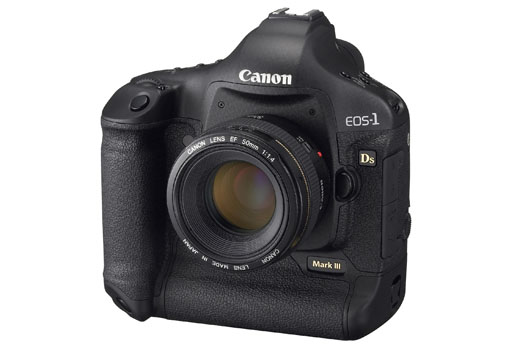
Canon EOS-1Ds Mark III (side)

More information:

Standard
Reviews

Camera preview: Olympus Stylus 770 SW

At the same Olympus PR event I attended last week, Michael Bourne from Mullen demonstrated the new Olympus Stylus 770 SW (Shock and Waterproof camera). It’s a very sturdy camera, enclosed in an all-metal housing that can not only withstand drops from up to 5 feet and water pressure up to 33 feet, but can also take up to 220 lbs. of physical/mechanical pressure. Ligia and I have been looking for a new point-and-shoot, and this looks like it might be the camera we want.

While were were talking, Michael casually raised and dropped the camera right onto a concrete ledge, leaving me with a case of drop-jaw. Then he picked it up as if nothing happened, and took some photos with it. Wow! Then, to drive the point home, he dropped it to the ground again, and stood on it with one foot, putting his entire body weight on top of the camera. Again, he picked it up and it was just fine! Here’s a triptych showing that little sequence of events:

Standing on an Olympus Stylus 770 SW

I got to use it a bit as well, and it’s got just the right weight for its size. It doesn’t feel flimsy at all. When you grip it, you know you’re gripping something well-made. The all-metal housing looks really nice, and the shutter lag isn’t bad considering that it’s a point-and-shoot. I got to handle it inside a dimly lit store as well, and when I bumped up the ISO to 1600, the photos still looked decent on screen, even when zoomed in. It’s certainly a whole lot better than our current point-and-shoot camera, the Kodak EasyShare v610, which was all the rage in July of last year (2006) due to its dual lenses and in-camera photo stitching capabilities.

Here are a few more photos of the camera (these ones are courtesy of Olympus USA). Notice the sleek lines. If you read my blog regularly, you know I’m a sucker for good design, and I think Olympus did a great job here.

Olympus Stylus 770 SW -- Front

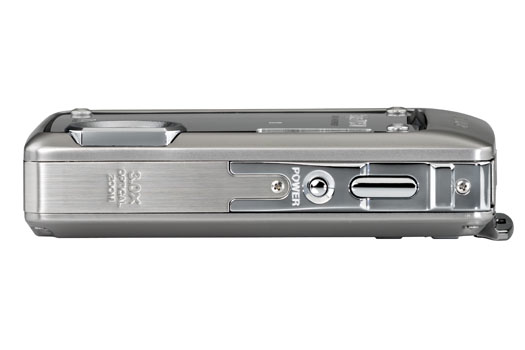
Olympus Stylus 770 SW -- Top

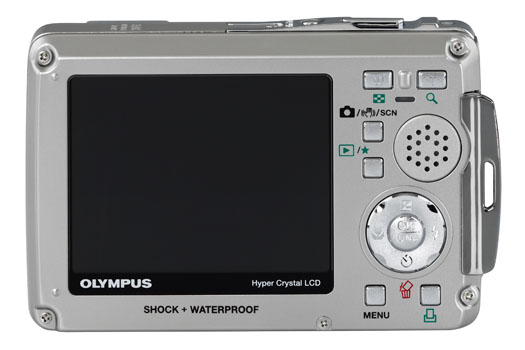
Notice how nicely laid out the buttons are. There’s no confusion about their function, like on some cameras (Samsung, I’m talking about you here). The on-screen menus are also easy to navigate. I had no problem finding my way around the menus as soon as I went in.

Olympus Stylus 770 SW -- Back

All in all, this little camera’s one hot contender in the point-and-shoot market, and a virtual shoe-in for our next ultra-portable digital camera.

More information:

Standard
Reviews

Lens review: Canon EF 100-400mm f/4.5-5.6L IS USM Zoom

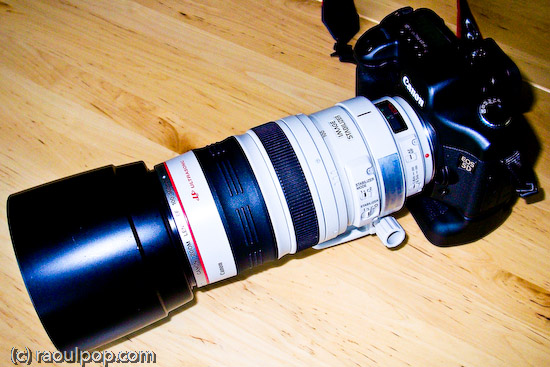
Canon EF 100-400mm f/4.5-5.6L IS Zoom Lens

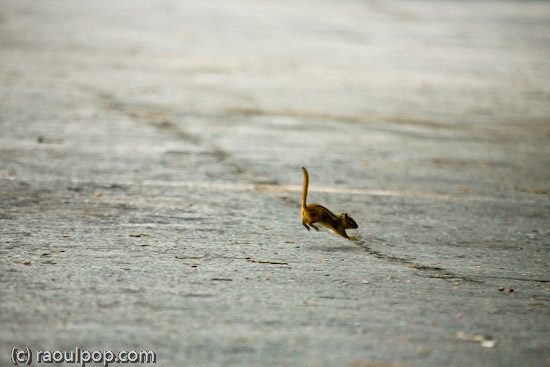
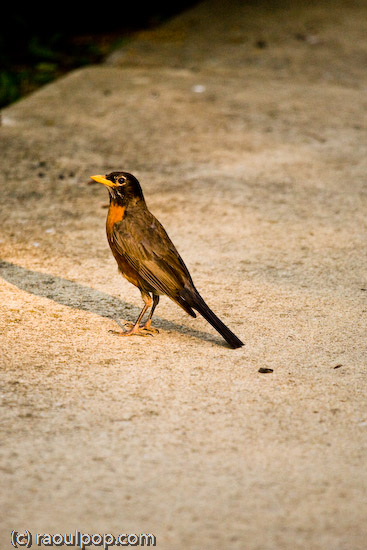
I had a chance to play with Canon’s affordable 100-400mm L series zoom last week. I rented it for a day from Penn Camera at Tyson’s Corner, mounted it on my 5D, and ran out to chase wildlife as soon as I got home from work. As the sun began to set, I took it up to the roof, set it on my tripod, and took photos of the horizon. In the morning, I snuck out onto the terrace at sunrise and got photos of that as well. All in all, I put the lens through its paces, shooting in daylight, dusk and dawn conditions, handheld and on a tripod. Even though I only used the lens for a day, albeit a pretty full one, I’m fairly comfortable with what I’m about to say.

Leap year for Mr. Chipmunk

Tree cover at sunset

The robin examines me

I liked it. The 100-400mm range is a versatile range, and the fact that you can get this L series lens at around $1,400 makes it a bargain. The lens isn’t as heavy as the 70-200mm L series zoom (which I played with today), and it’s fairly comfortable to hold for moderate amounts of time. It has a push-pull mechanism for extending the focal range, and that has its benefits and drawbacks. The benefit is that it does make it a bit easier to get through the large focal range a little faster. It’s also necessary in order to make the lens affordable. Push-pull lenses are cheaper to make than regular zooms, and require less glass as well, making them lighter.

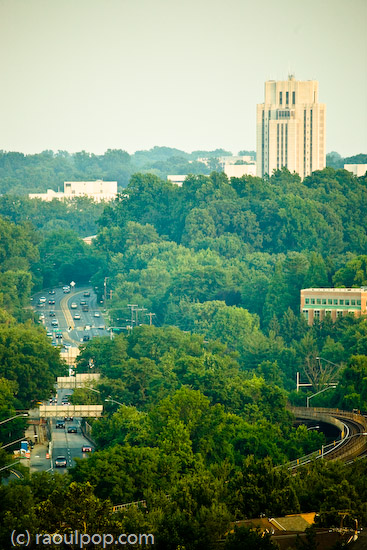
Bethesda, as seen from the top of Grosvenor

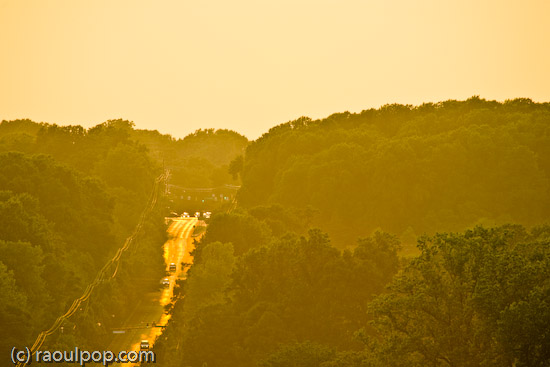
Tuckerman Lane at sunset

➡ Updated 7/4/07: Erik Persson asked me two relevant questions this morning via private email. One is about how the autofocus handled, and the other was about whether autofocus is possible at all with an extender, or whether manual focus needs to be used. Autofocus was a bit slow, but that’s to be expected. This is a big zoom that can focus over a large distance. There is a focus limiter switch that decreases the focusing distance. You tell it to focus either from 1.8m to infinity or 6.5m to infinity. If you know you’re only going to shoot things farther away than 6.5m from you, then set the switch to that, and the autofocus will be a little faster. I’m not sure how to answer Eric’s second question. He suggests autofocus on EOS models up to the 5D is possible only up to f/5.6, and Mark 1D models can autofocus up to f/8.0. Not sure about that. I can only point you to this lens chart at Canon, which talks about the compatibility of the extenders with various lenses, and tells you what the expected aperture will be, and whether or not autofocus will be possible at all. I checked the specs for the 5D and 1Ds, and can’t find the upper f-stop limits for either models. Perhaps a call to Canon will clear this up, but it is the 4th of July today, and I doubt they’re open. Maybe one of you who has more information is willing to comment on this.

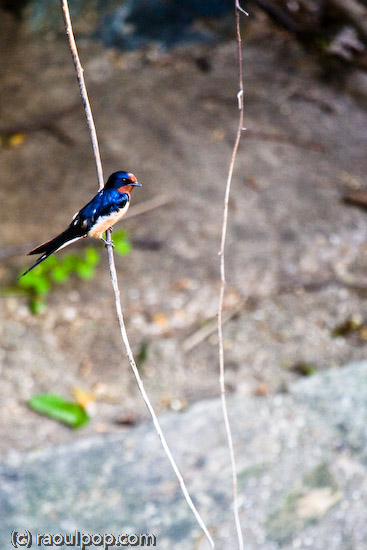
Beautiful swallow

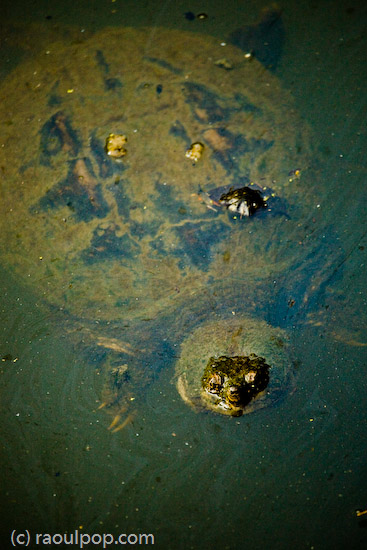
Ugly one awaits

➡ Updated 7/6/07: Erik got back to me once more with a link to a review by The Digital Picture, where the AF to aperture specs are discussed. Furthermore, he provided a link to specs from Canon for the EOS 1v SLR (film camera) where the bit of information about being able to use AF with lenses that only open to f/8 is provided. So it looks like you’ll have to use manual focus if you stick extenders on the 100-400mm zoom. Thanks Erik! You know, you could just as well use the comments instead of sending me emails, but whatever works for you. 🙂

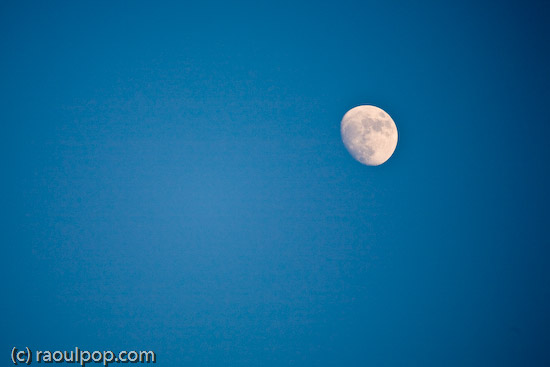
Moon rises over Grosvenor

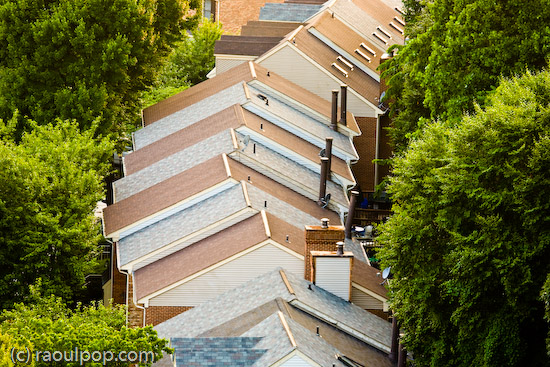
Grosvenor rooflines

If you’ve been looking at the 400mm f/2.8L tele, which retails around $6,500, and you’re wondering why this lens is so inexpensive, you should know there is a reason for the price difference — but I doubt you needed me to tell you that. I stated the reasons in the paragraphs above, and they are: less glass, push-pull mechanism for the EF 100-400mm zoom lens. I haven’t tried out the 400mm tele myself yet, but I have a feeling it’s a great deal sharper and has more contrast than this lens.

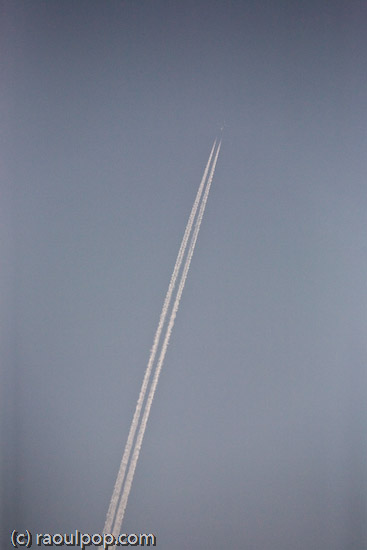
Early morning contrails

Clarity

I think you can already guess what my two complaints are: the details are a bit soft when the photos are viewed at 100%, and the push-pull mechanism creates a sort of vacuum between the camera and the innermost lens. Every time I extended or contracted the lens, air rushed in or out through the crevices. I’m sure things are isolated pretty well and dust doesn’t get sucked in, but it feels odd, and it makes it difficult to stop at say, 300mm. It’s certainly a lot easier to either pull the lens all the way out to 400mm or push it all the way back in to 100mm. You know how they say that zoom lenses are soft at either ends of the focal range? Well, it would have been nice to have some sort of limiter switch that could let me stay between 110-390mm, or something like that. With the push-pull mechanism, it was hard to get the focal length just below or above its limit in order to avoid softness.

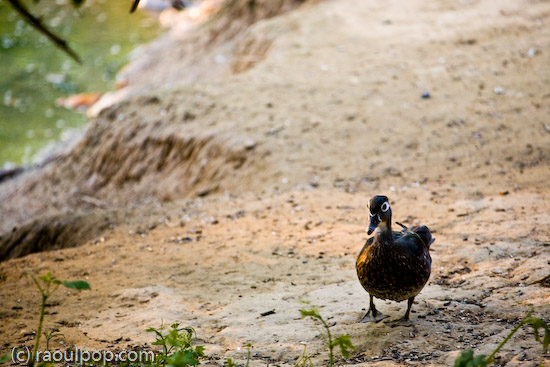
Wood duck advances

EF 100-400mm lens, wide

Having said all this, let me reassure you that this lens is a bargain at its price. If you’ve had your eye on it, get it. Realize you won’t get the results you might get with a more expensive tele, but you won’t pay through the nose for it either. This lens will definitely shine on cropped sensors like those found in the 30D and Rebel, where the effective focal range will be 160-640mm. How else can you get in the 600mm focal range without spending a ton of money? What’s more, with extenders like the 1.4x or the 2x, you can get up to 800mm on a full sensor or up to 1260mm on a cropped sensor. That’s pretty amazing!

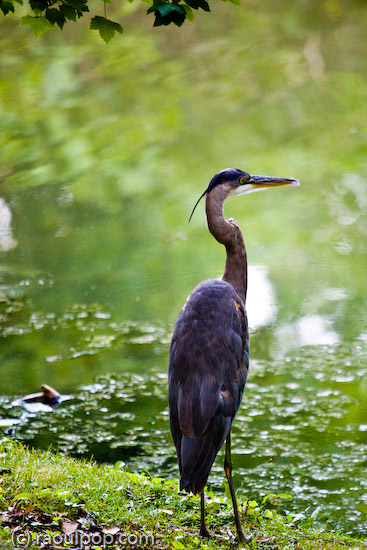
Heron at Grosvenor Lake

Afternoon traipse

There are a few other things to keep in mind though. The maximum aperture at 400 mm is f/5.6, and that means you’ll need pretty good light in order to shoot handheld with it. If you stick an extender on it, the effective aperture will get even smaller, so you’ll either need serious daylight or a tripod. But, as I’ve already said, you get amazing range with this lens, and it’s inexpensive for an L series zoom. If you’re willing to live with the few issues I’ve outlined, then get it.

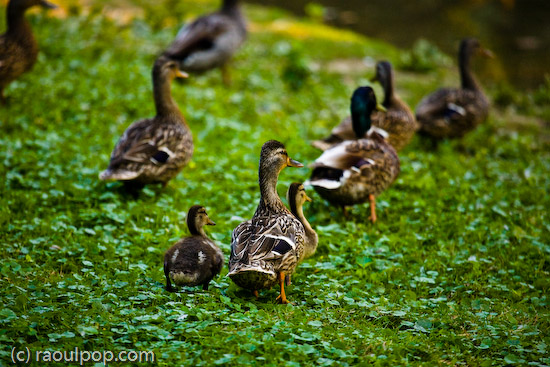
Many lives

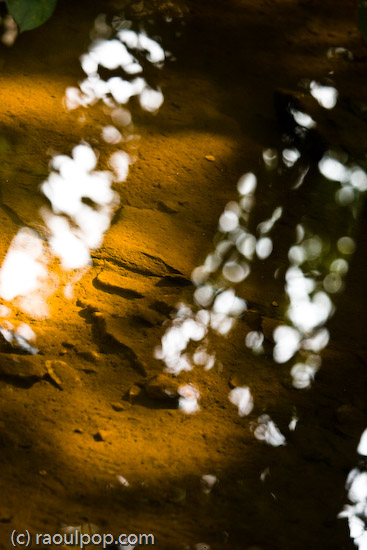
Waterside

Buy the lens

Sun sets over Grosvenor

Standard
Thoughts

Goodbye little bird, goodbye

As I was about to walk into work at the start of May, I saw a little bird on the ground, trying to walk but unable to do so. The poor thing was convulsing, and its head kept rotating wildly. Two other birds were nearby, a blue thrush, and an orange-chested robin. At first I thought they’d ganged up on the poor little bird, but no, they were concerned and eyed me with fear, worried that I’d hurt it.

They didn’t have to worry about me. I picked it up and held it in my hands, hoping it would recover. I sat down on a bench and waited for about 10 minutes, and the little bird was thankful. It nested in my hand. Its eyes would close, then open again, and its breathing was heavy while its little beak was wide open. It was obvious that it had problems breathing. What had probably happened is that it flew into one of the windows, but really slammed into it. It seems to happen most every day at work, but the other birds are fine — slightly dazed, but otherwise okay. It wasn’t so with this poor little bird. It had suffered major internal injury. There were little stains of blood on my hand.

The human in me wanted to nestle it in my hands until it recovered, but the photographer in me quickly grabbed the camera and took a few photos. I couldn’t change lenses, and I had to use my wide-angle 24mm, which was already mounted on my 5D. Now I’m so glad I took the photos, because they’re the only things I have left to remind me of it.

Goodbye, little bird, goodbye

Since the little bird wasn’t getting any better, I figured I’d take it upstairs to my office and keep it safe there for at least part of the day. I was worried that it would make a quick meal for cats or hawks. Upstairs, I tried to give it some water, but it didn’t want to drink. Its condition was getting worse by the minute. I held it in my hand as it breathed its last breath. Needless to say, I don’t count that day as one of my happiest. Later, I took it outside and buried it at the root of this tree:

Under the sun

Goodbye, little bird. Goodbye. Rest in peace.

Standard
Thoughts

Falling upwards

I got home one afternoon just as a summer storm was about to break the heavens open. I had a choice: do some consulting work, or set up my camera and get some photos. The camera won.

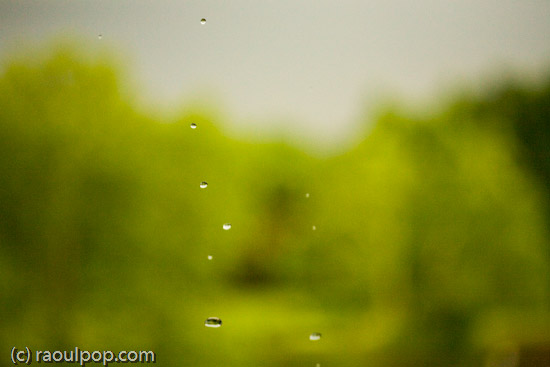
Got all sorts of great photos of the clouds wrestling with each other during the prelude to the wet show. As the rain started, I decided to do some high speed photography as well. Set my 5D to 3200 ISO, put it in Aperture Priority mode and the aperture to f/2.8 (the largest my 100mm lens could do), and had lots of fun capturing raindrops in mid-air. It helped that I knew my 5D would go all the way up to 1/8000 secs on the shutter speed…

It looks as if I’ve photographed a wet window pane here, but trust me, those raindrops were caught in mid-air, as they were falling downwards.

Caught mid-air

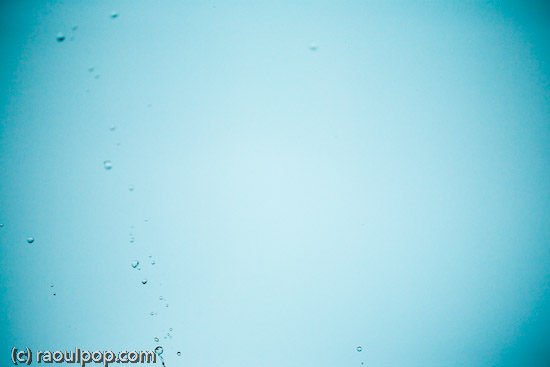
I thought it’d be fun to process this photo differently, and to turn it upside down. So the raindrops are falling upwards here. 🙂

Falling upwards

Photos taken in North Bethesda, MD.

Standard