Reviews

Lens preview: EF 14mm f/2.8L II USM Prime

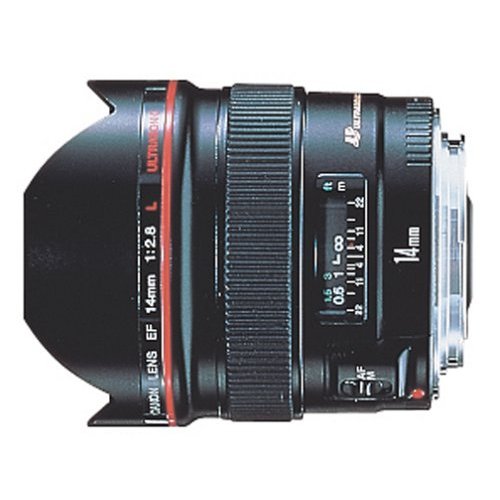
Canon chose to announce the availability of a new wide-angle lens along with the EOS-1Ds Mark III. It’s the new EF 14mm f/2.8L II USM prime, which upgrades the existing EF 14mm f/2.8L USM.

The lens will feature the same correction for rectilinear distortion, but with improved dust and water resistance, a round aperture for nice bokeh, and a better-designed cap, that’s held to the lens by a stopper. Having briefly used the existing 14mm prime, I can tell you the lens cap kept falling off, and it was a real hassle to get the lens out of a gear bag if the cap end was facing toward you. It would come off immediately, and then you’d inevitably touch the lens surface with your fingers, which required a cleaning.

The price for this lens will be approximately $400 more than the street price of the existing 14mm prime, at around $2,199.

More information:

Standard
Reviews

Camera review: Canon EOS 5D DSLR

With the release of the new EOS 40D and EOS-1Ds Mark III, it’s easy to forget the camera that changed the entire market: the EOS 5D. It was the first affordable full-frame sensor DSLR ever. I bought it in April of this year, and I still don’t regret the purchase. As a matter of fact, I love my 5D!

âť— Updated 2/1/09: I’ve also written about the new 5D Mark II.

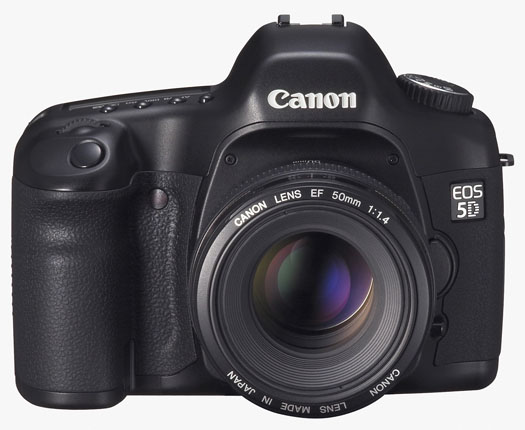
Canon EOS 5D (front)

Yes, the newer models that came out have more resolution and low light sensitivity, in addition to the EOS Integrated Cleaning System, which shakes dust off the sensor. It’s annoying to have to clean my 5D’s sensor with swabs once in a while, and to get out my bulb air blower and make sure there’s nothing inside the sensor chamber, but I don’t mind it that much — except when I have to use the Heal brush to get that dust off my photos. Even then, Adobe Lightroom makes it a breeze with its wonderful Heal/Clone tool.

I went back through Canon’s PR section and dug up the 5D’s original press release. You know how we have a healthy amount of mistrust when we read press releases? Well, read through that one and tell me if anything written there turned out to be untrue.

All these new models make me wonder what Canon will do with the 5D. I don’t think the 5D will go away. It fulfills a very important role in the marketplace and it’s beloved by many photographers. But what will happen come November? Will Canon announce a second-generation 5D? I’d kind of like them to hold off on upgrading the 5D till next spring, and I recognize that I’m entirely biased when I say that.

Whenever they decide to upgrade it, here’s what I think will happen:

  • It will get the EOS Integrated Cleaning system
  • It will get Live View
  • The pixel count will go up, possibly to 16 megapixels, but not much beyond that. If they go up higher, the renowned low light sensitivity of the 5D will suffer. Remember, pixel pitch (the space that each pixel occupies on the sensor) has a lot to do with low light sensitivity. The more pixels you squeeze on that sensor, that harder it is to keep noise in check. The DIGIC III processor should help with this, and putting microlenses over each pixel should also help, but I don’t think the new 5D will get more than 16 megapixels. Keeping all this in mind, I’d really like the new 5D to be able to go up to 3200 ISO natively, and to 6400 ISO with expansion turned on.
  • The battery life will go up slightly
  • The body will get weatherproofing
  • The AF will get upgraded with the new system present on the Mark III cameras
  • Exposure metering will get more zones, possibly as many as the new 1Ds Mark III, or at least as many as the new 40D
  • Shutter durability will be increased to 300,000 cycles from 100,000 cycles
  • The LCD screen will be upgraded to 3 inches
  • The retail price will be around $3,300, just like with the previous model, and the street price will stick pretty close to that for the first few months after the launch

Meanwhile, the existing 5D cameras aren’t outdated by any measurement, and I look forward to using mine for a long time to come. It was a significant investment for me, and I’ll try to get at least 3 years from it before I upgrade.

Buy the Canon EOS 5D

Standard
Reviews

Camera preview: Canon EOS-1Ds Mark III DSLR

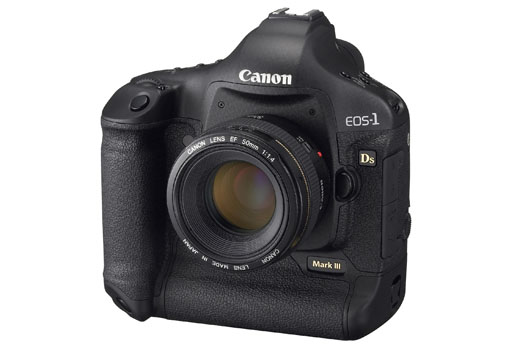
On the same day that it released information about the upcoming EOS 40D DSLR, Canon dropped a bombshell. The much-expected 1Ds Mark III is ready, and will begin shipping in November. We all knew it was coming, but what we didn’t expect was the medium format-like resolution: a whopping 21.1 megapixels!

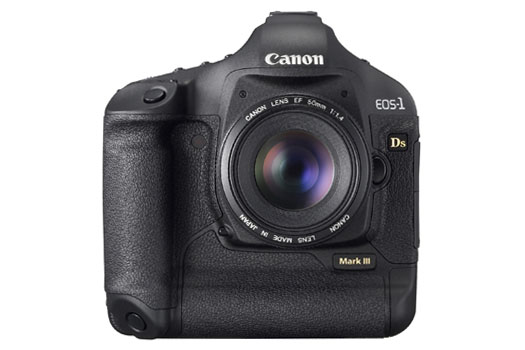
Canon EOS-1Ds Mark III (front)

Here are the specs where the 1Ds Mark III differs from the 1Ds Mark II:

  • Resolution: 21.1 megapixels vs. 16.7 megapixels
  • Processing engine: DIGIC III vs. DIGIC II
  • AF: re-designed 45-point vs. previous-generation 45-point AF (there were some issues with this new AF system in the 1D Mark III, and I hope they’ve been addressed by now)
  • Color depth: 14-bit vs. 12-bit
  • Live View
  • Integrated sensor cleaning
  • WB: 12 vs. 10 settings
  • Viewfinder magnification: 0.76x vs. 0.70x
  • Exposure control: 63-zone vs. 21-zone metering
  • Drive speed: 5 fps vs. 4 fps
  • LCD monitor: 3 inches vs. 2 inches
  • Shutter durability: 300,000 cycles vs. 100,000 cycles
  • Battery: lithium-ion (LP-E4) vs. Ni-MH (NP-E3)
  • Battery life: better, but no data provided vs. 800-1200 shots/battery/charge with the 1Ds Mark II
  • Weight, body only: 1,205 grams vs. 1215 grams

As Canon themselves point out, they wanted to venture into the realm of high-fashion and commercial studio photography with the new 1Ds. Traditionally, medium-format cameras dominated those markets. Besides the wonderful resolution, the 1Ds would bring two other things: portability and affordability. Medium-format cameras are more expensive, and they’re usually heavier. Let’s not forget the 1Ds also goes up to 1,600 ISO, which is unheard of in medium format cameras with digital backs. The ISO range there is usually 100-400, with the occasional 800 seen in some models. The additional ISO range should provide those photographers with more creative uses of light and more flexibility in various conditions.

The camera uses the new DIGIC III image processor introduced with the 1D Mark III earlier this year. But it uses two of them, working in parallel. There’s a lot of data crunching to be done when the resolution is 21.1 megapixels and the frame rate is 5 fps! The CMOS sensor reads out to both processors through eight channels, ensuring fast signal transfers.

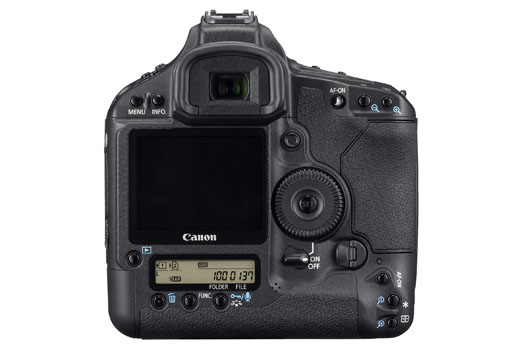
Canon EOS-1Ds Mark III (back)

The 1Ds also features a new 14-bit analog-to-digital conversion process, which means that it can recognize 16,384 colors per channel — four times the number of colors recognized by 12-bit cameras like the 1Ds Mark II or the 5D.

In addition to using CF type-I and II cards, the camera is also compatible with the UDMA specification, which doubles the data transfer speed of a normal CF card when used with UDMA-compliant cards.

The sensitivity of the new AF system’s sensor has been doubled to EV-1, for greater accuracy in low light. The AF point of focus can also be micro-adjusted based on the type of lens used, and the focus-tracking sensitivity can also be finely adjusted.

Another really nice feature is Live View, which works in much the same way as on the 40D — see my review of it for those details. The Live View function also works with the EOS Utility software, which means you can see just what the camera sees through your computer’s monitor, and control it remotely for studio sessions.

The EOS Integrated Cleaning System shakes off dust from the low-pass plate installed in front of the sensor with ultrasonic vibrations when the camera is turned on or off. A special adhesive collar installed around the sensor collects the dust and holds it there.

Finally, comprehensive weatherproofing is present at 76 locations on the camera, providing protection and allowing the use of the camera in demanding conditions.

The camera will start shipping in November and retail for $7,999. I expect the street price to stick pretty close to that for at least a few months after the launch.

Canon EOS-1Ds Mark III (side)

More information:

Standard
Reviews

Camera preview: Canon EOS 40D DSLR

On August 20, just three days ago, Canon announced the new EOS 40D DSLR, the successor to the very good EOS 30D camera. The camera will begin selling in September, and Amazon has already started taking pre-orders. After reviewing the specs and photos, I am impressed. Canon has made the 40D better than the 30D exactly where it mattered, and more.
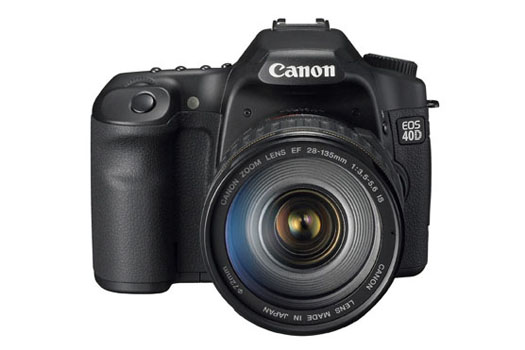
Canon EOS 40D (front)

The 40D is a bargain considering its features. Let me run through the important ones:

  • 10.1 megapixel CMOS imaging sensor, capable of up to 3200 ISO natively
  • DIGIC III image processor
  • Redesigned AF
  • 6.5 fps continuous shooting capability up to 75 large/fine JPEG or 17 RAW files
  • 3-inch LCD with a higher brightness level and broader color gamut than the 30D
  • Upgraded viewfinder: 0.95x magnification, 264 degrees viewing angle and 22mm eye point)
  • Magnesium-alloy body with dust and weather resistant construction, unlike the 30D
  • Live View (yes, this isn’t a typo)
  • Integrated sensor cleaning

Although the sensor has the same resolution as the Rebel XTi, it is not the same sensor. The 40D’s sensor has microlenses over each pixel to enable increased sensitivity up to 3200 ISO. More importantly, the sensor can recognize four times the number of colors recognized by the 30D, due to its 14-bit color depth (wow!). In addition to this, the 40D also features Highlight Tone Priority and High ISO Noise Reduction functions as the 1D Mark III professional DSLR.

The amazing frame-rate, which is more than the 5 fps rate of the 30D, is achieved through the new DIGIC III processor, DDR SDRAM memory buffering, four-channel per line sensor readout, and two separate motors for shutter and mirror operation.

The on-screen menu now has the same tabbed format as the 1D Mark III DSLR. The viewing angle had to be decreased from 170 to 140 degrees, in order to make the screen more viewable during bright daylight — this is in addition to the improvements cited for the LCD in the bullet points above.
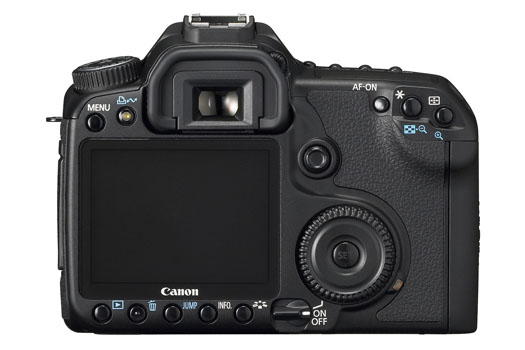
Canon EOS 40D (back)

AF has been re-designed to produce greater precision at all focal points, up to f/5.6, and increased precision for center AF on lenses at or faster than f/2.8. AF calculations are 30% faster on the 40D than the 30D. Photographers can also opt for two focusing screens: a grid-type screen that makes it easy to compose the shots, or a matte screen re-designed for AF precision.

Not many other reviewers have spotted this, but the 40D offers Live View! Yes, indeed, you can now compose your shots using either the viewfinder or the LCD screen. A quick aside: Olympus was the first company to use Live View on their prosumer DSLRs.

Usually, there’s increased shutter lag with Live View, since the mirror has to swing back down to block out the light, then back up to allow for the proper exposure. The shutter lag with the 40D is said to be minimal because the mirror stays up and only the shutter opens when you click the shutter button. This also helps reduce noise and vibration. Oh, did I mention that you can zoom in on the LCD screen to make sure your focusing is tack sharp during Live View?

The Live View function also works with the EOS Utility software, which means you can see just what the camera sees on your computer’s monitor, and control it remotely for studio sessions.

The EOS Integrated Cleaning System shakes off dust from the low-pass plate installed in front of the sensor with ultrasonic vibrations when the camera is turned on or off. A special adhesive collar installed around the sensor collects the dust and holds it there.

There’s a redesigned vertical grip/battery holder, with weather and dust resistance built-in, and a new Wireless File Transmitter (WFT-E3A) has also been introduced. The battery life’s been improved over the 30D, and my guess is you’ll be able to get about 1,500 shots/battery/charge. That means about 3,000 shots altogether with the vertical grip in place.

You can buy the 40D by itself, or with the new EF-S 18-55mm f/3.5-5.6 IS Standard Zoom (available in October), or the EF 28-135mm f/3.5-5.6 IS USM Zoom (as pictured below).

Canon EOS 40D (side)

More information:

Standard
Reviews

The future of image resizing is here

If you think you’ve got it pretty good with Photoshop and Genuine Fractals when it comes to image resizing, think again. Here comes a new technology, developed by Dr. Ariel Shamir, called Content-Aware Image Sizing, that will literally blow away our current concepts of image sizing and cropping. Yeah, it’s that good! I don’t often gush about products, but I would absolutely LOVE to see this software integrated into Photoshop.

You can see the original video here, but know that it’s really slow to load, at least today. It’s also been uploaded to YouTube.

Adobe, are you listening? Please buy this and integrate the functionality into Photoshop.

Standard