Let’s call this a journal of casual discoveries about Betta fish, made by an uninitiated Betta owner. Having had only bad experiences with aquarium fish in the past, I have only good things to say about owning Bettas. I’ve written about a few of them below.
November, 2004
I have three Bettas at the moment. I’ve only recently acquired them. Until now, I gave into the notion that Bettas are the most commonplace fish one can get as pets. I thought that when it came to entertainment, they were no better than goldfish, which was a short way of saying they were at the bottom of the aquatic intelligence scale. But I was wrong, and I’m glad to admit it! I’ve since discovered that Bettas are quite intelligent and very entertaining.
Unlike most aquarium creatures, they actually express gratitude for the love they receive. One can actually form a relationship with them that is quite rewarding. I like to think of them as the Italian greyhounds of the aquarium: small, delicate, clean, yet loving and wonderful. In this article, I will attempt to describe to you what I have discovered in the short time I have owned Bettas.
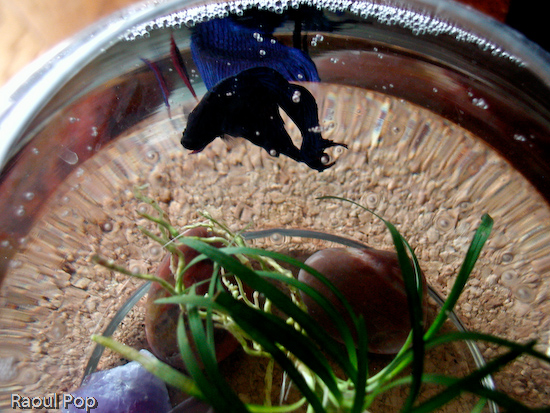
My wife and I bought our first Betta in October of 2004. A week later, we bought another, and a day later, we bought the third. We couldn’t resist! They each have their little personality quirks that make them endearing. Yes, each Betta has a personality! The first thing we noticed is that they recognized our faces after just a few days of owning them. Since this happened with all three of our Bettas, I believe it can also happen with others. I suggest you try it out.
You will need to spend a little time with them, though. You need to let them get to know you. The usual mistake that people make is not spending enough time with their Bettas. Most of the time, they are thought of as ornaments or decor. That’s not how a smart fish can be treated. If they are ignored by their owners, the Bettas will withdraw into themselves and will become loners. They will shy away from the owner when they are fed, and they won’t look at him or her. It will become a stress for the fish to see the them. On the other hand, if you take the time to know your Betta, and spend a little time every day looking at the fish, smiling and talking to it, you will find that a relationship will develop between you and it.
For example, our Bettas move to the edge of the aquarium to greet us when we approach. Not only that, but as soon as they can see us enter the room, they will quickly move toward us, and will become active, even playful. They do this not because they expect food. They will do it because they are happy to see us. Having owned fish before, I was quite surprised to discover this. My other fish simply shied away whenever they saw me. The only time they gave me any notice of recognition was when they saw me feed them, and even that reaction wasn’t consistent. Most of the time, they were simply frightened of me. That’s actually what deterred me from continuing to keep fish. I found it discouraging that these creatures, to whose every need I catered, didn’t show the slightest amount of appreciation, even after months of being around me. Bettas certainly don’t do this. They do express appreciation, and it is very gratifying to see it.
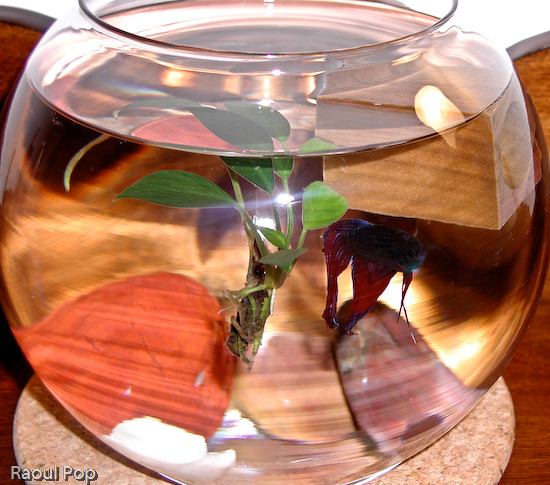
If they don’t like the food you give them, they will let you know. One of my Bettas didn’t like the Betta Bits I bought for him, and he would spit them out or not even touch them. He would then look intently at me, as if to say, “C’mon, can’t you do better than this?” If I looked at him as if to say, “Please try again,” he would make another go at it, though most of the time he’d spit it out again. To have this sort of interaction, where there is a halfway-intelligent question and response, amazes me. How is this possible with such a small fish? One usually only finds this in larger animals with more developed brains.
Bettas happen to like certain plants in their aquariums. I’ve found that the frilly plants, the ones with thin, long leaves, bother them. They act annoyed whenever they try to swim by them and their fins get caught in the leaves. I believe they like simple plants with well-defined leaves. Mine in particular seem to like these small plants with short stems and large, 1-2 leaves. They sleep under the leaves at night, nestled in next to the stem. Sometimes they take naps during the day right in-between the leaves.
At other times, they hover right next to the bottom, almost out of sight. This leads me to believe that they enjoy a little hiding place of their own. I don’t think they like being out in the open all the time. If you have a Betta, it might be a good idea to get them a hollow shell or a little fish house they can hide in.
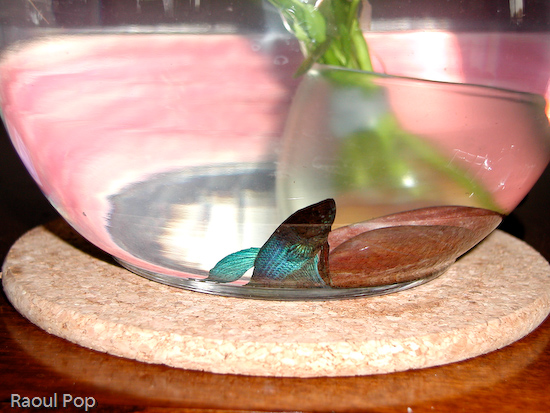
I have also found that aquarium placement matters quite a bit. My Bettas were all fairly restless when their vases (I use large vases, 1-2 gallon capacity, as my Betta aquariums) were placed on tables, or somewhere in the open. As soon as I placed them next to walls or other pieces of furniture where one side was enclosed, they quieted down. I believe this gives them a sense of security. I think fishes in general don’t like to stay out in the open all day. Being next to the wall can afford them a little rest, because they don’t have to constantly look around for danger.
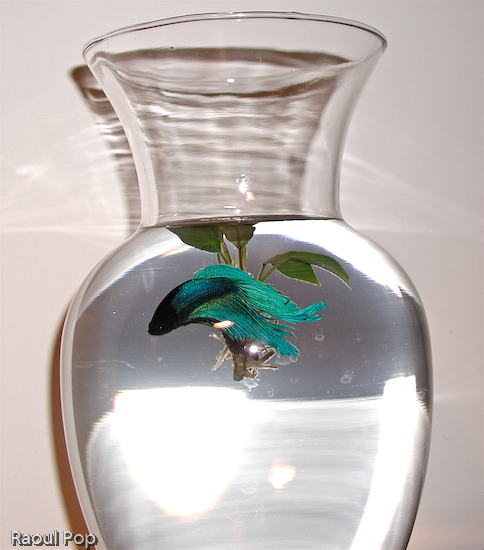
Each of our Bettas has their little quirks and their behavior can’t be predicted. They don’t necessarily do the same things every day. For example, one of my Bettas would actively move back and forth, and perform intricate turns and flips a few weeks ago. As soon as I’d look at him, he’d quiet down and look at me. I’m not quite sure why he did that. I’ve found that my other Bettas have engaged in this sort of behavior at times, too. I don’t think they do it just to attract my attention. I haven’t discovered anything wrong with them so far, and I’ve had them for some time.
One of my Bettas displays a penchant for burrowing under the pebbles that are at the bottom of his vase. One of my other Bettas seems to like to nuzzle next to the glass and nibble on it. My last Betta enjoys staying under his plant most of the day, unless I’m near his vase. I think this is part of their personalities, and Betta owners shouldn’t worry if their Bettas are quirky like this. I don’t think they’re sick. I can’t judge the mental health of a fish, but physically speaking, if they were sick, their fins or scales would show discoloration or would start to peel off. They would also lose their appetite, which is definitely not the case with my Bettas.
Sometimes Bettas like to nap out in the open water, either right below the water surface or halfway between the bottom and the top. They won’t move their fins and it may look to you like they’re dead. They aren’t. I’m not sure why they do that sometimes, but it does happen.
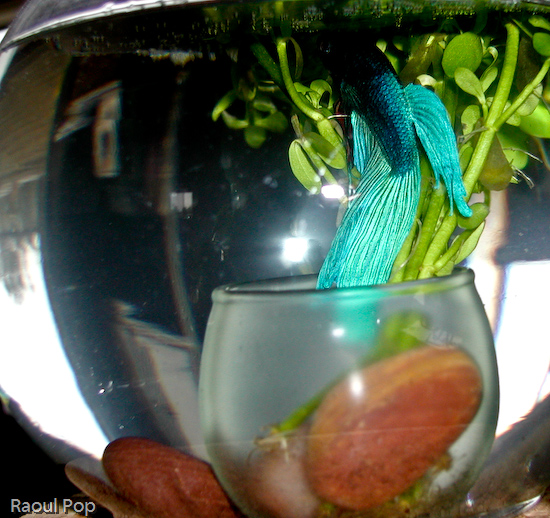
At other times when they sleep, they’ll move their fins, and it may not be apparent to you that they’re sleeping. If you approach the aquarium and they happen to wake up with your face next to it, they’ll be too surprised to recognize you and will dash away. They may even turn around and puff up their little beard to show you they’re not scared. Don’t be offended. You’ve just frightened them, and they are reasserting themselves. Remember, they are mighty fighting fish, even if they are small in size.
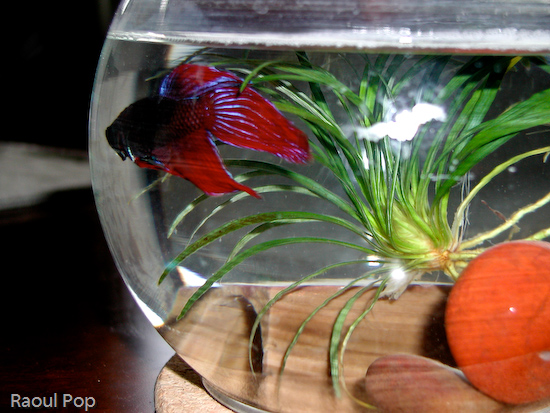
If you get along well enough, they may even “strut” for you sometimes. They will puff up their beard, and they will fan out their tail and fins, and will show you how beautiful they are. Don’t think they are threatening you. They are simply letting you know they feel safe and happy in their territory, patrolling their borders and being taken care of by you. Enjoy the show!
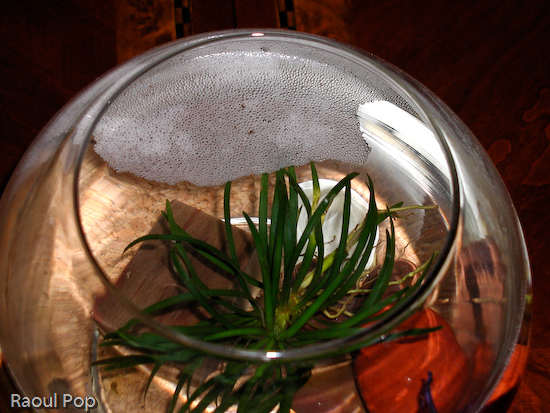
When your Bettas are content, they will build a bubble next at the surface of the water. You can’t miss it. There will be stacks of bubbles (2-5 levels on top of each other) on the water surface one morning, and you’ll wonder how in the world they got there. What the fish are telling you is that they’re very happy with their conditions and are ready to mate. Since I doubt you’ll want to provide them with a female Betta every time this happens, just enjoy it and know that you’re taking good care of them.
I hope you find your Bettas as rewarding as I have. Please remember, your Betta is more likely to get sick if you don’t treat it right. Spend a little time with your fish every day, and you will have a very rewarding relationship. Just think of the benefits! You don’t have to house-train them, they don’t pee all over the carpet if they’re mad at you, and they don’t bark at the neighbors!
February, 2005
I don’t think Bettas have a sense of hearing. However, they have can immediately sense any tremor or vibration in the water. For example, one of our Bettas has his bowl on the corner of my desk, which is quite wide. If I tap my fingers on the opposite corner (not a loud tapping, mind you) he will immediately stop what he’s doing and turn around to face me.
Bettas can be jealous. If they see me or my wife giving attention to one of the other fish, they won’t like it and they’ll start swimming wildly in their bowls to get our attention. Sometimes they’ll even get upset, and when we do go and see them, they’ll stay at the bottom of their bowls and won’t come up to greet us as they usually do.
Bettas can get upset if they don’t get their food. Our Bettas expect to get fed every morning and night. My wife and I agreed not to feed them one day of the week, to help clear out their digestive systems – we read about this somewhere. That whole day of the week, they’ll swim wildly in their bowls every time we get near them, to remind us that they’re hungry. They’ll look at us and open their mouth wide – other fish seem to do this as well – as if to tell us we need to give them something to put in there. Toward the end of the day, they’ll start showing they’re upset by pretending not to notice us when we get near them. The next morning, we’ll literally have to coax them up from the bottom of the bowl to give them food. Sometimes they don’t even want to look at us and avoid the food altogether, to show us how upset they are.
Two of the Bettas have started to jump up out of the water to get their food. All I have to do is hold it above the water’s surface, and they’ll jump. Their aim isn’t very good though, so they end up nibbling at my fingers instead of the food. But it’s cute nonetheless! I think this means they can be trained to do tricks.
I read that their bowls should be covered so they don’t jump out and end up dying on the floor. I think that’s a bunch of baloney. We fill their bowls almost to the brim, and it hasn’t happened yet. If the Bettas are happy with their surroundings, they won’t jump out, period. You have to watch them and see whether they’re happy or not. We haven’t covered our bowls, and we don’t intend to do so, because there isn’t a need.
Here is a quick guide to help you figure out if your Bettas are happy:
- Do they notice you as soon as you get close to the bowl?
- Do they start to swim left and right and wiggle their tails?
- Do they eat the food you give them right away?
- Do they build bubble nests once in a while?
- Is their coloration bright and vivid?
If the answer to these questions is yes, then they’re happy and healthy.
August, 2005
Over these last few months, I’ve been forced to admit that Bettas actually communicate with each other using sounds. I have no other way of putting it. We had put little glass containers in their bowls for them to hide in when they wanted, and I thought at first they were pushing them around, because I kept hearing sounds that sounded like glass being rapped on glass within water, or as if a pebble fell on a glass surface inside the water. But we kept on hearing the sounds even after we removed the glass containers. Recently, I even got to watch them as they were making the sounds. They’re swimming along, and all of a sudden, there are the sounds! They’re not touching the bowl walls, they’re not near the top of the bowl. They’re making these sounds while they’re fully submerged. I find it amazing. I don’t know to what purpose they’re doing it, perhaps to attract female bettas, to mark their territory – I’m not sure, but I have yet to hear of another small fish that can make sounds audible to the human ear!
I’ve also discovered that it’s better to keep about two feet away from the bowl when looking at them or greeting them. Otherwise they may get startled, especially if they’re sleeping. The two foot rule seems to work most of the time.
Thanks for reading, and I hope this has been helpful to you!
Updated 8/23/07: I’m truly appreciative of all of the traffic that this article has sparked, and for all of the wonderful comments that people have left, but please realize that my little Bettas have passed away some time ago. I decided not to get new ones after that happened. I am also not a Betta expert, just an owner who decided to record what happened. So please, no more questions. Your local pet store or Betta sites like Betta Talk are much more knowledgeable about these smart little fish than I am. I still welcome your thoughts, but I’m not equipped to answer expert questions on Bettas. Thanks!

 Raoul Pop

