Reviews

Lens review: Canon EF 24-70mm f/2.8L USM Zoom Lens

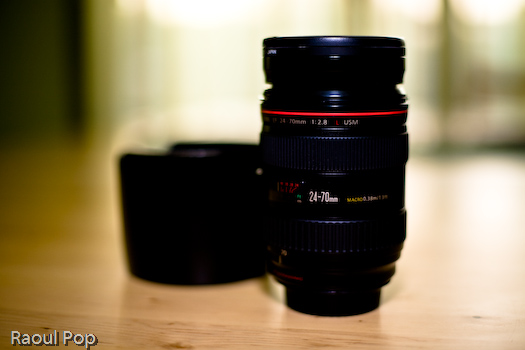
The EF 24-70mm f/2.8L USM lens is the professional standard zoom from Canon, and so far the golden standard for sharpness, contrast and bokeh in a zoom lens. Photographers drool over it and swear by it. Its focal range on a full frame sensor makes it very appealing for event photography. It goes from a wide 24mm to an almost portrait-length 70mm to allow for close-ups. It’s also plenty fast for a zoom — f/2.8 — just about the fastest a zoom lens can get these days. (I’d like to see an f/2.0 standard zoom, but I don’t know when that’ll happen, and the cost will probably be fairly high.)

I’m going to talk exclusively about the 24-70mm lens in this review, but if you’re interested, I also wrote a comparison of this lens and the 24-105mm f/4L zoom. You may want to read that as well, in order to get a better idea of how this lens performs.
As you know if you’re a regular reader, I write about how products feel and the results they give me. My reviews aren’t spec-heavy. I give you my honest opinion about a product, and tell you what results I got with it.

With that in mind, the 24-70mm zoom is a good lens. It’s plenty sharp, has plenty of contrast, and the bokeh is great. I liked it. But it’s heavy — really heavy. When you hold it in your hand, it doesn’t feel that heavy, but when it goes on your camera, your wrist really takes a beating, and it feels as if the camera’s body is going to give. This lens is incredibly front-heavy. That means there’s no chance of holding the camera with one hand for long when you use it. On my 5D, it’s really hard to use the lens without a vertical grip, which gives me more finger room. Without the grip, you have to support the lens itself when you take the shots, and then you have to be careful that you don’t grip the focus ring and impede the auto focus from rotating when you press the shutter button. I use a keyboard and mouse all day long, so I realize I may not be the strongest guy around, but I lift weights once or twice a week. Still, I tell you, this lens really took its toll on my wrist joint and finger muscles. It was a real workout. I didn’t expect this kind of weight from a standard zoom. I did expect it from the EF 70-200mm f/2.8L IS USM zoom. If you’re so results-oriented that you’re willing to overlook the weight, great, get it, you’ll love the results.

I mentioned the useful focal range above. Let me illustrate it with a few examples below. At the wide end, you can capture beautiful landscapes… or nice wide angle shots of buildings. At medium range (30-60mm), you can get photos like these. The lens also has a very useful close-focusing range (0.38m), which allows you to get close-ups like you see below.

Let’s talk about low light. This lens has no image stabilization (like the 24-105mm zoom) and that means the maximum aperture of f/2.8 starts to show signs of strain in low light. It means we have to bump up the ISO and make sure the shutter speed stays at or above the focal length, stabilize the camera, and/or use a flash. Like I said in the opening paragraph, this isn’t a fault of the lens — f/2.8 is the fastest aperture for a zoom lens on the market, so that’s just how things are.

I enclosed a few photos taken in low light above. The first was taken inside a piano store, and although there was plenty of fluorescent lighting, I found that it wasn’t quite enough to shoot freely, like I would have done with a faster prime lens. I can’t argue with the sharpness and bokeh though. It’s beautiful.

There’s a second interior photo, where I had to use a speedlite. I used the 580EX II, also from Canon, and bounced it off the white ceiling. The lens does fine with a good speedlite, so that’s no problem.

The last two low light photos were taken in downtown Bethesda at night. For the first, I stabilized the camera with both hands on a balustrade in order to take it. The second photo of a VW Bug was taken handheld from a lower angle.

A lot of photographers use this lens for portraits, so I thought I’d show you a portrait I took with it as well. It’s on my wife’s website, Fun Piano Lessons. The tele end of the focal range is just right for portraits, and the sharpness, contrast and bokeh are great, especially with a wider aperture like the f/4 used in that photo.

All in all, this is a lens that does not disappoint. I expected professional results when I used it, and got them, without a doubt. The only two things that I minded were the weight — in particular its front-heavy distribution — and the lack of image stabilization. But if you were to get this lens and the EF 70-200 mm zoom, you’ll have covered most of the useful focal range you’ll need with just two very versatile lenses. Some food for thought there.

More information:

Standard
Reviews

Stuart Little and Stuart Little 2 (1999, 2002)

Ligia and I really loved the first two Stuart Little movies. They both combined live action with 3D computer animation, and back in 1999, this was an achievement. By today’s standards, we can tell the animation’s a bit dated, but still, the overachieving, little white mouse is a lovable character and you soon gloss over the flaws in the animation that couldn’t be helped back when it was made.

The first movie deals with Stuart’s adoption by the Little family, and his adventures while fitting in with both the Little’s only child, George, and the family cat, Snowbell, voiced by Nathan Lane. We find Stuart befriending a little canary named Margalo and gaining a little independence from his overly protective mother in the second movie.

I must admit that I was bothered a bit by Stuart’s introduction to the audience in the first movie. Yes, this is a children’s story, and we’re supposed to suspend disbelief, and I’m more than willing to do that, but still, for such a pivotal plot point, the screenwriters might have done a better job explaining why the Littles would adopt a mouse instead of a child, and why it didn’t seem odd to them that a mouse spoke and read, or was treated as one of the children at the orphanage.

My impression was that Stuart dominated the first movie as a character, but Snowbell blew everyone else away in the sequel. Nathan Lane’s whiny voice was the perfect complement for the lazy, spoiled Snowbell, who comes through in a big way for both Stuart and Margalo. I would also be remiss if I wouldn’t recognize Michael J. Fox’s contribution to the two movies. His voice was the right choice for Stuart.

I would not recommend the third installment in the series, made in 2003. It was a complete departure from the first two movies. While still featuring the voices of the original actors, it was completely (and poorly) animated in 2D, thus losing that winning combination of live action and 3D animation that really made the first two movies. The Stuart Little in that third movie looks so unfamiliar, and the animation is so choppy and un-lifelike, that it’s really nearly impossible to bond with the characters. Only children unfamiliar with the first two movies might enjoy it.

More information:

Standard
Reviews

Lens preview: EF 14mm f/2.8L II USM Prime

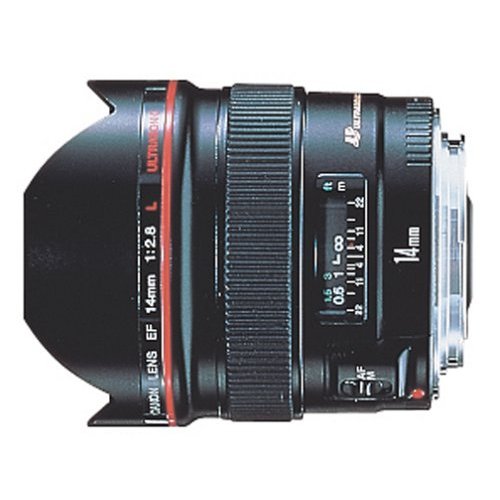
Canon chose to announce the availability of a new wide-angle lens along with the EOS-1Ds Mark III. It’s the new EF 14mm f/2.8L II USM prime, which upgrades the existing EF 14mm f/2.8L USM.

The lens will feature the same correction for rectilinear distortion, but with improved dust and water resistance, a round aperture for nice bokeh, and a better-designed cap, that’s held to the lens by a stopper. Having briefly used the existing 14mm prime, I can tell you the lens cap kept falling off, and it was a real hassle to get the lens out of a gear bag if the cap end was facing toward you. It would come off immediately, and then you’d inevitably touch the lens surface with your fingers, which required a cleaning.

The price for this lens will be approximately $400 more than the street price of the existing 14mm prime, at around $2,199.

More information:

Standard
Reviews

Robots (2005)

Robots (2005)Having just watched Robots (2005) for the first time, I’m amazed I didn’t go see when it came out. I don’t know what I was thinking, but now I know I’d have enjoyed it thoroughly.
The plotline sounds familiar: a small-town boy goes to the big city and makes good, in spite of all odds. But as we all know, it’s not the yarn, it’s how you spin it that makes it interesting. This story is told in a quirky, entertaining way that makes it worth our time. The boy is a robot, who goes to the big city to follow a dream, and in the process, saves all Robot World from certain disaster while instilling hope in the hearts of countless other robots.

That big metal world is brought to life on-screen, and although we’re constantly reminded the characters are robots, we personify and identify with them. A wonderful benefit of the robotic nature of the characters is the ability to pull countless gags, which is where the screenwriters leave no stone unturned. Fender, played by Robin Williams, is the main go-to character for gags, and he delivers on every one. Although Robin Williams’ riffs and improvisations are too much in real life, they’re perfect for voice-overs. He was great in all of Disney’s Aladdin movies, he was great in Happy Feet (2006) and he’s great in this movie as well.

Mel Brooks fit into the role of Bigweld surprisingly well. But other than him, I had a hard time recognizing the voices of the other famous actors employed for the voice over work. And that begs the question, other than the bragging rights, why hire famous actors for all of the major roles in a movie like this? It’s probably more expensive, and there are plenty of voice talents waiting in the wings who’d welcome the chance to shine.

I liked the animation, and loved the details on the robots, like the little rust spots, the almost real bolts, the glassy eyes, and the tinny, yet moldable faces. Like I said, the way the story’s told really makes it worth our time. Ligia and I were swinging along to “junk” by the end of the movie. You’ll know what I mean once you watch the movie! 🙂

More information:

Standard
Reviews

Camera review: Canon EOS 5D DSLR

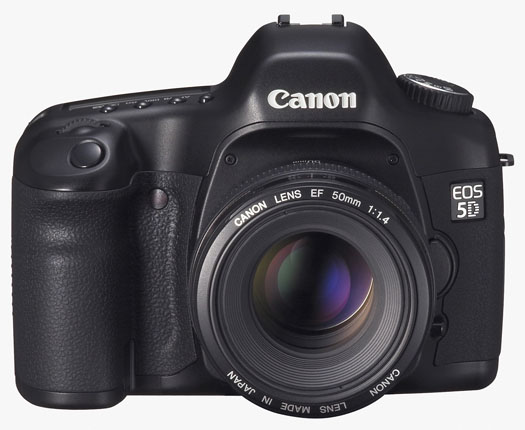
With the release of the new EOS 40D and EOS-1Ds Mark III, it’s easy to forget the camera that changed the entire market: the EOS 5D. It was the first affordable full-frame sensor DSLR ever. I bought it in April of this year, and I still don’t regret the purchase. As a matter of fact, I love my 5D!

Updated 2/1/09: I’ve also written about the new 5D Mark II.

Canon EOS 5D (front)

Yes, the newer models that came out have more resolution and low light sensitivity, in addition to the EOS Integrated Cleaning System, which shakes dust off the sensor. It’s annoying to have to clean my 5D’s sensor with swabs once in a while, and to get out my bulb air blower and make sure there’s nothing inside the sensor chamber, but I don’t mind it that much — except when I have to use the Heal brush to get that dust off my photos. Even then, Adobe Lightroom makes it a breeze with its wonderful Heal/Clone tool.

I went back through Canon’s PR section and dug up the 5D’s original press release. You know how we have a healthy amount of mistrust when we read press releases? Well, read through that one and tell me if anything written there turned out to be untrue.

All these new models make me wonder what Canon will do with the 5D. I don’t think the 5D will go away. It fulfills a very important role in the marketplace and it’s beloved by many photographers. But what will happen come November? Will Canon announce a second-generation 5D? I’d kind of like them to hold off on upgrading the 5D till next spring, and I recognize that I’m entirely biased when I say that.

Whenever they decide to upgrade it, here’s what I think will happen:

  • It will get the EOS Integrated Cleaning system
  • It will get Live View
  • The pixel count will go up, possibly to 16 megapixels, but not much beyond that. If they go up higher, the renowned low light sensitivity of the 5D will suffer. Remember, pixel pitch (the space that each pixel occupies on the sensor) has a lot to do with low light sensitivity. The more pixels you squeeze on that sensor, that harder it is to keep noise in check. The DIGIC III processor should help with this, and putting microlenses over each pixel should also help, but I don’t think the new 5D will get more than 16 megapixels. Keeping all this in mind, I’d really like the new 5D to be able to go up to 3200 ISO natively, and to 6400 ISO with expansion turned on.
  • The battery life will go up slightly
  • The body will get weatherproofing
  • The AF will get upgraded with the new system present on the Mark III cameras
  • Exposure metering will get more zones, possibly as many as the new 1Ds Mark III, or at least as many as the new 40D
  • Shutter durability will be increased to 300,000 cycles from 100,000 cycles
  • The LCD screen will be upgraded to 3 inches
  • The retail price will be around $3,300, just like with the previous model, and the street price will stick pretty close to that for the first few months after the launch

Meanwhile, the existing 5D cameras aren’t outdated by any measurement, and I look forward to using mine for a long time to come. It was a significant investment for me, and I’ll try to get at least 3 years from it before I upgrade.

Buy the Canon EOS 5D

Standard