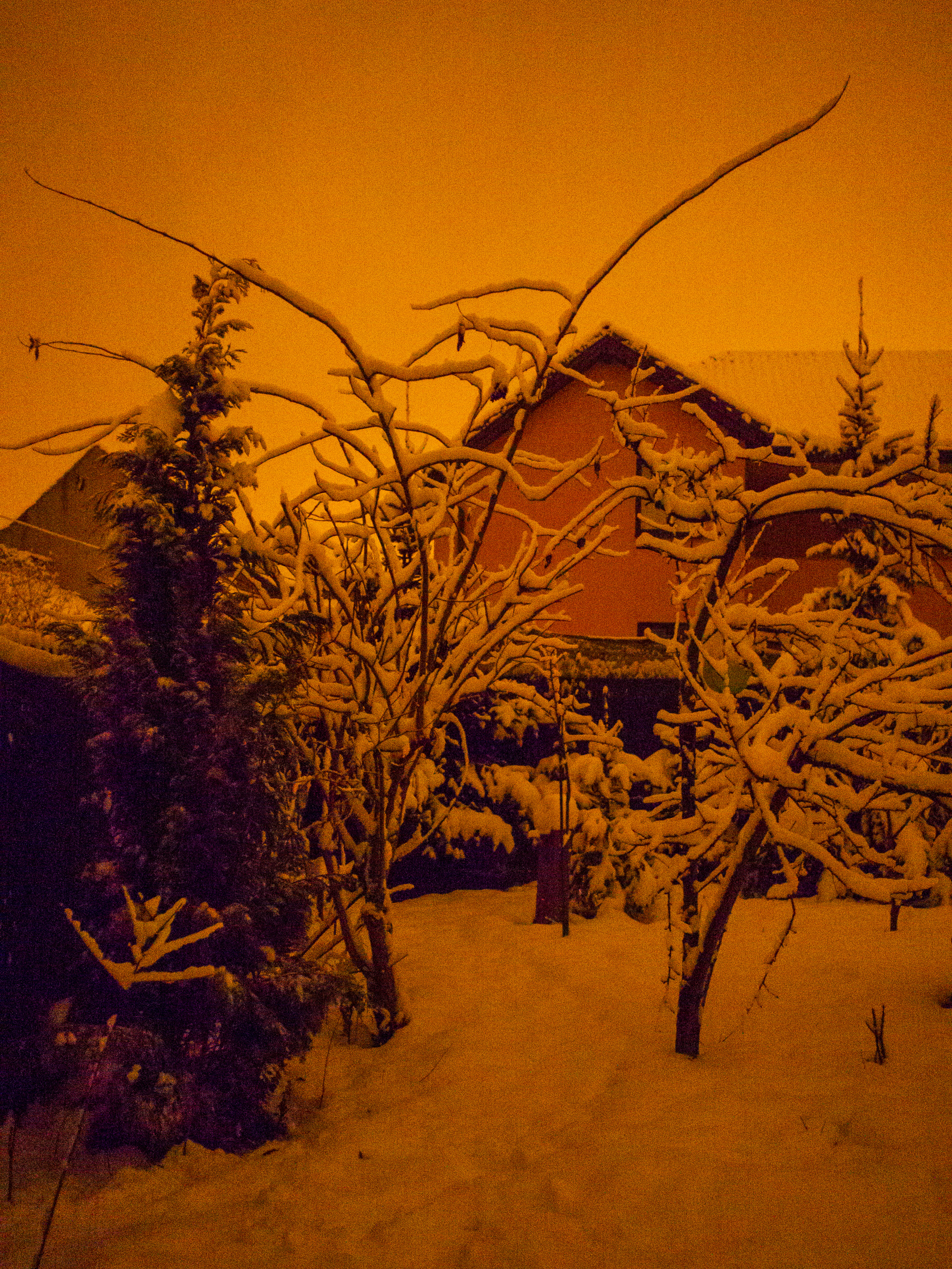
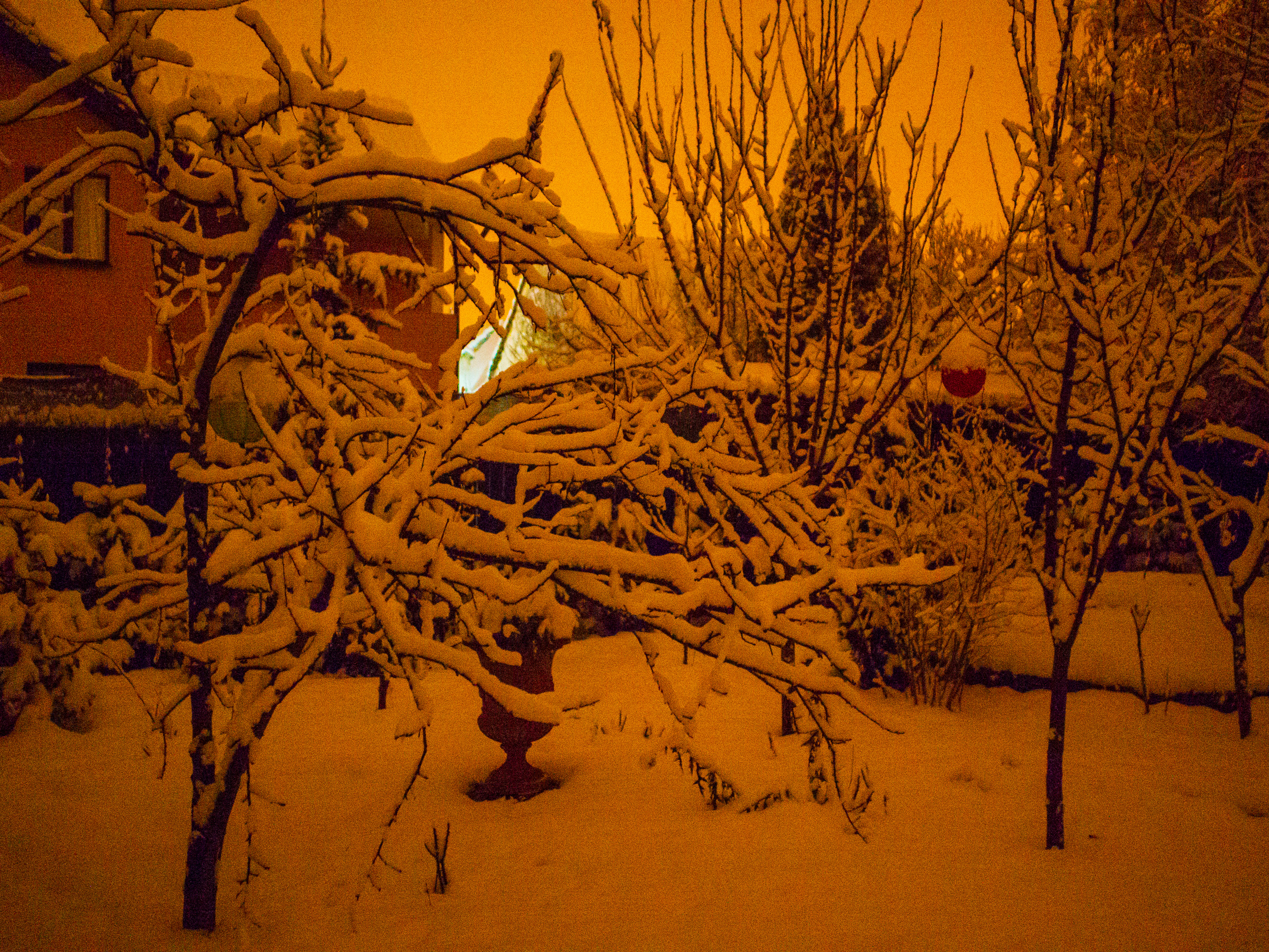
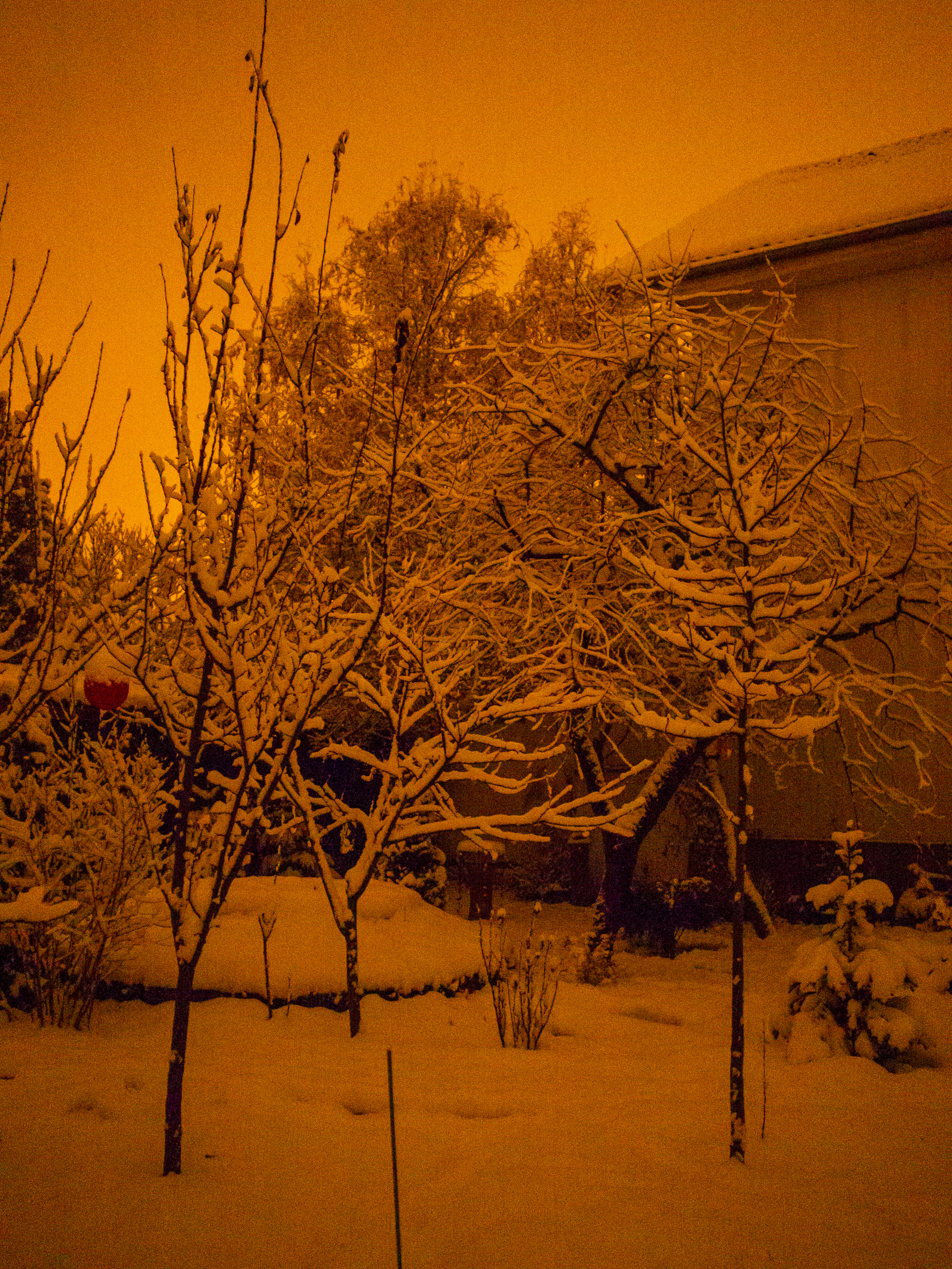
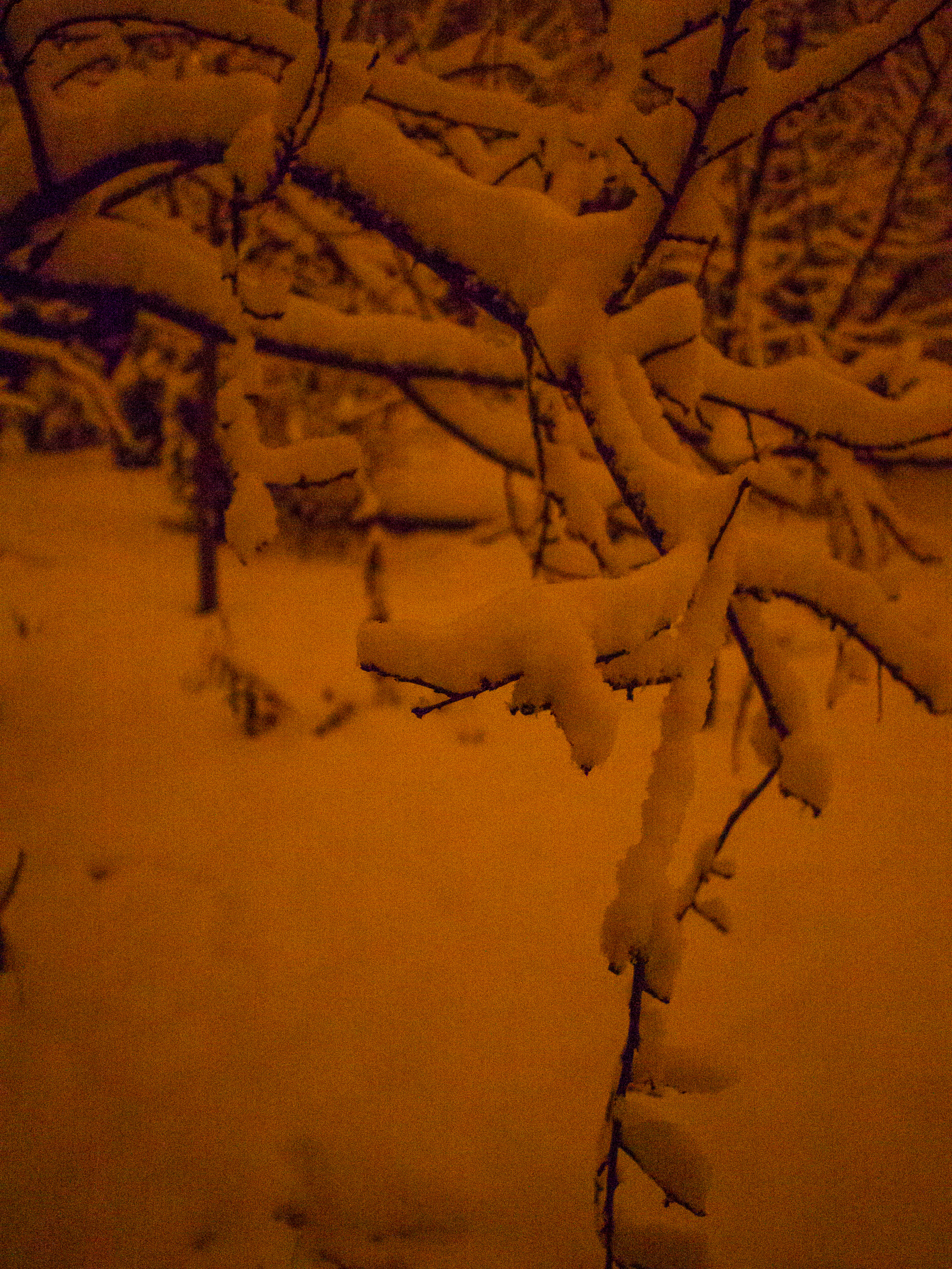
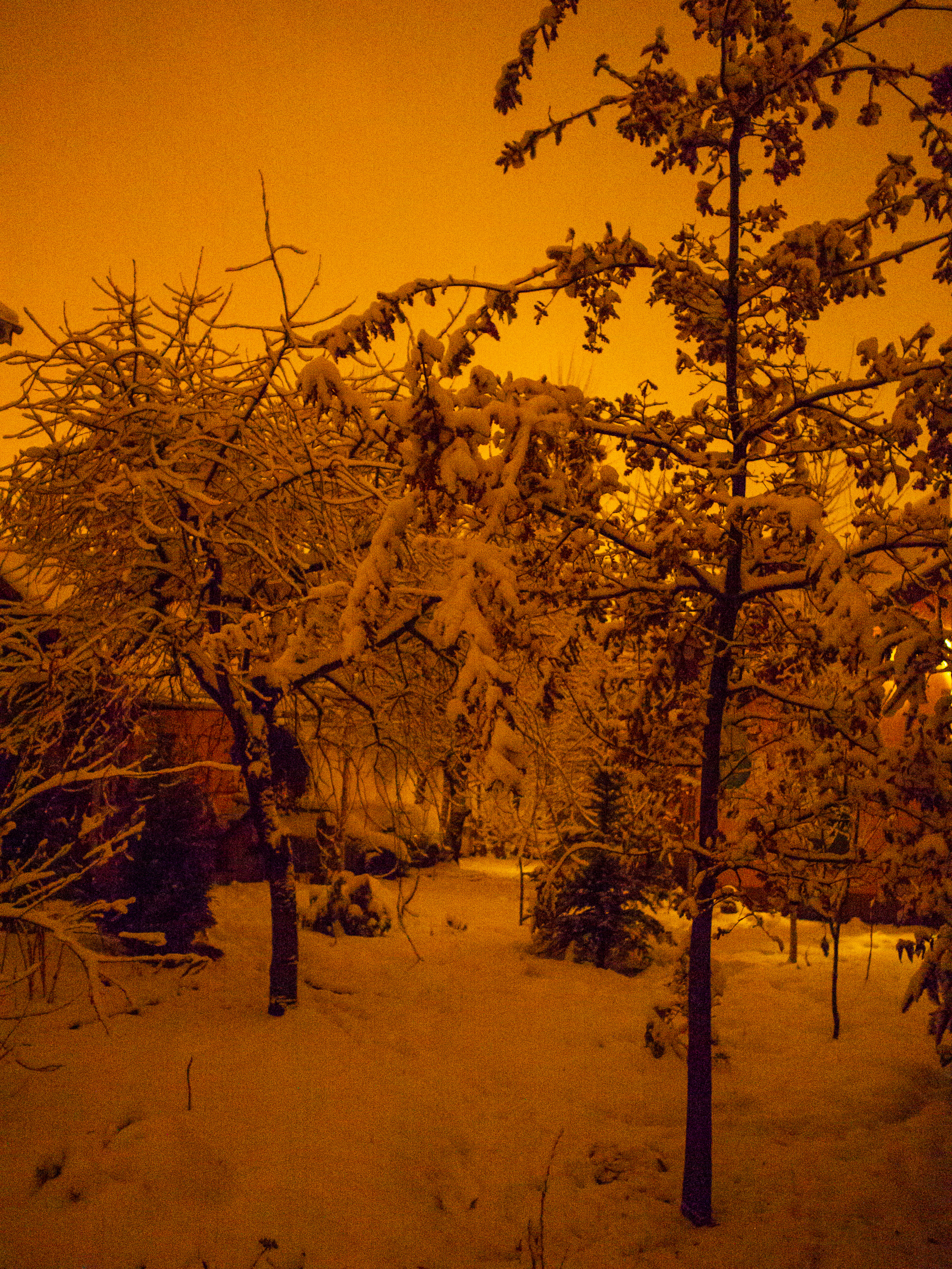
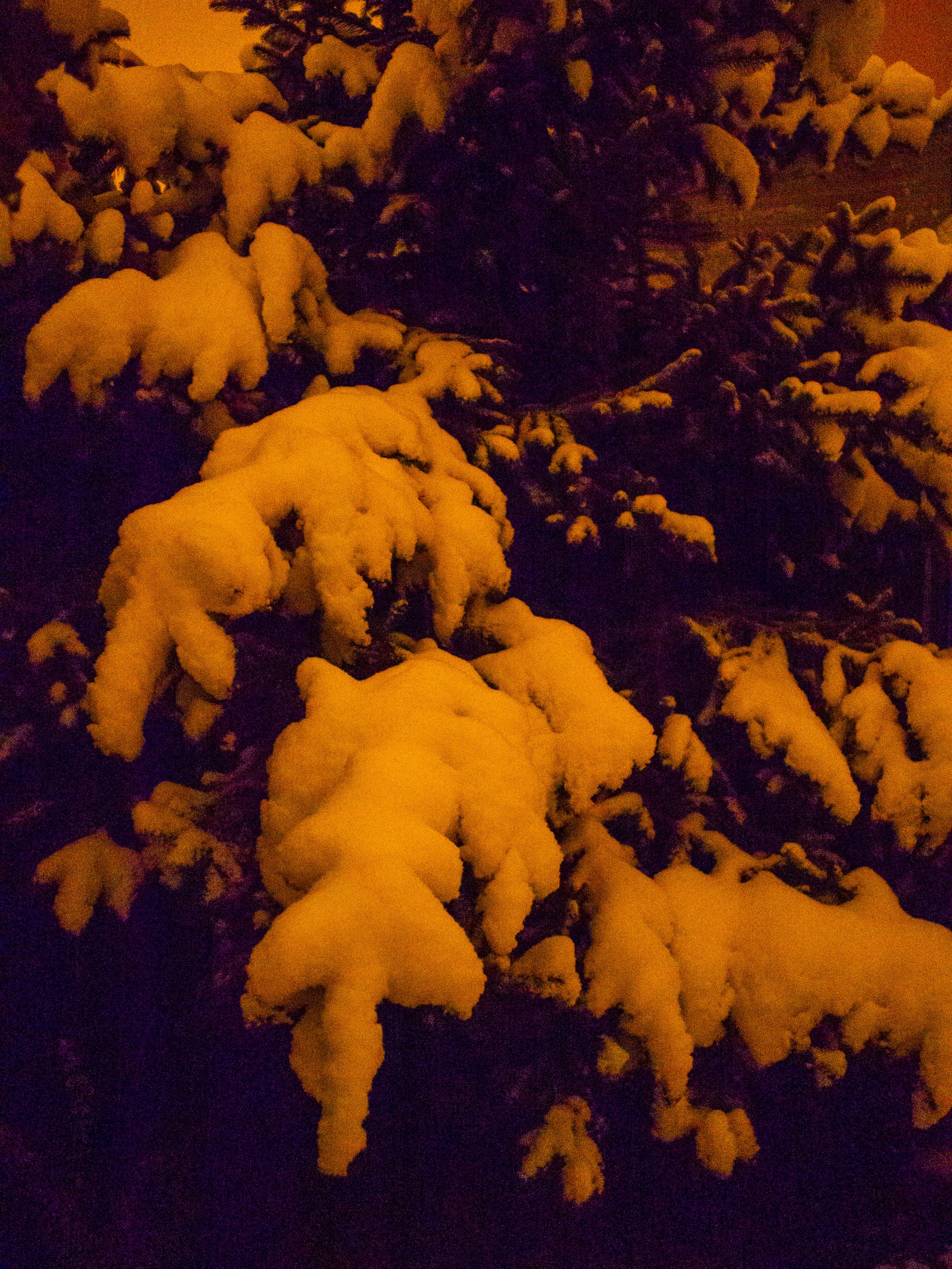
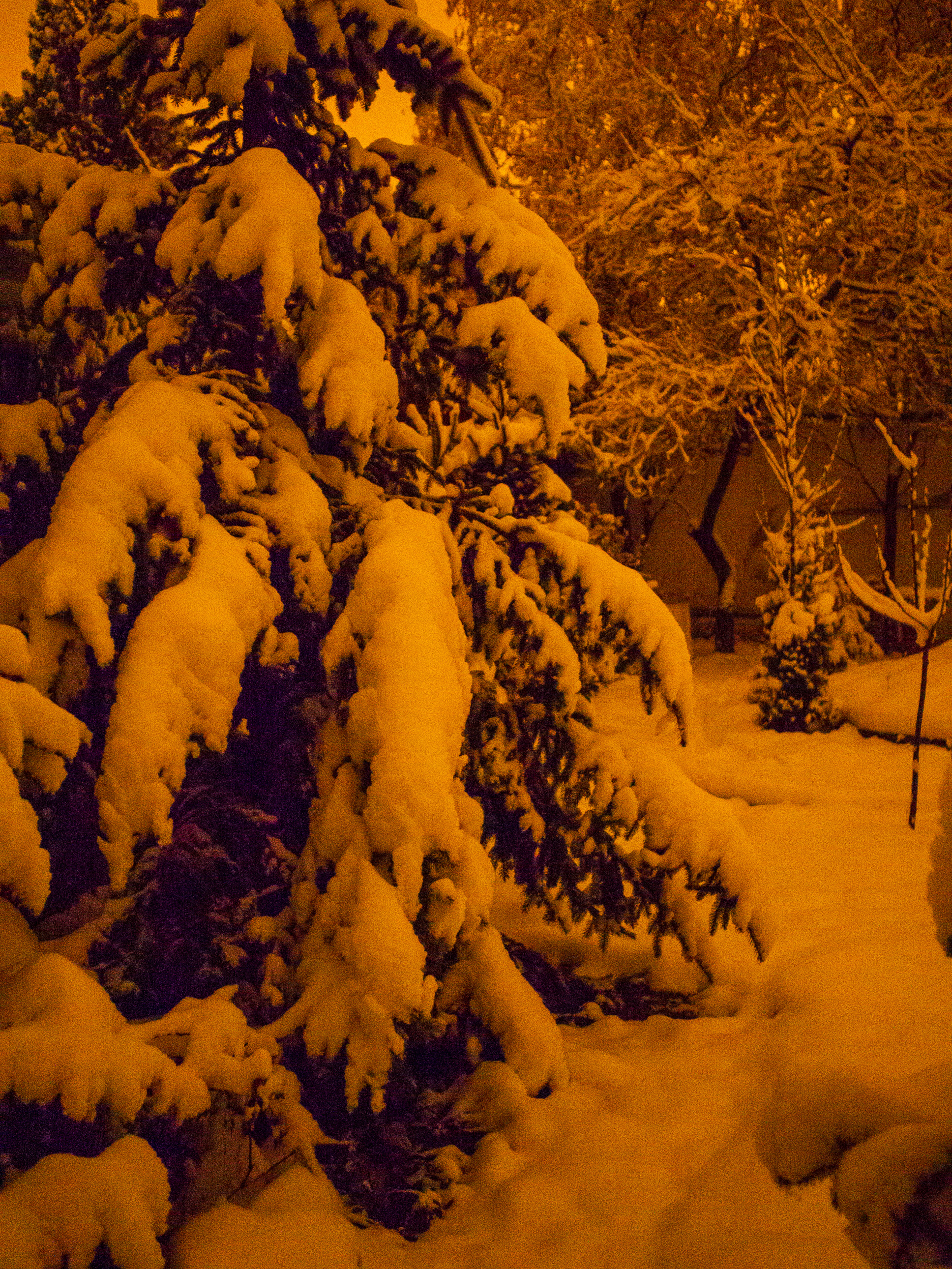
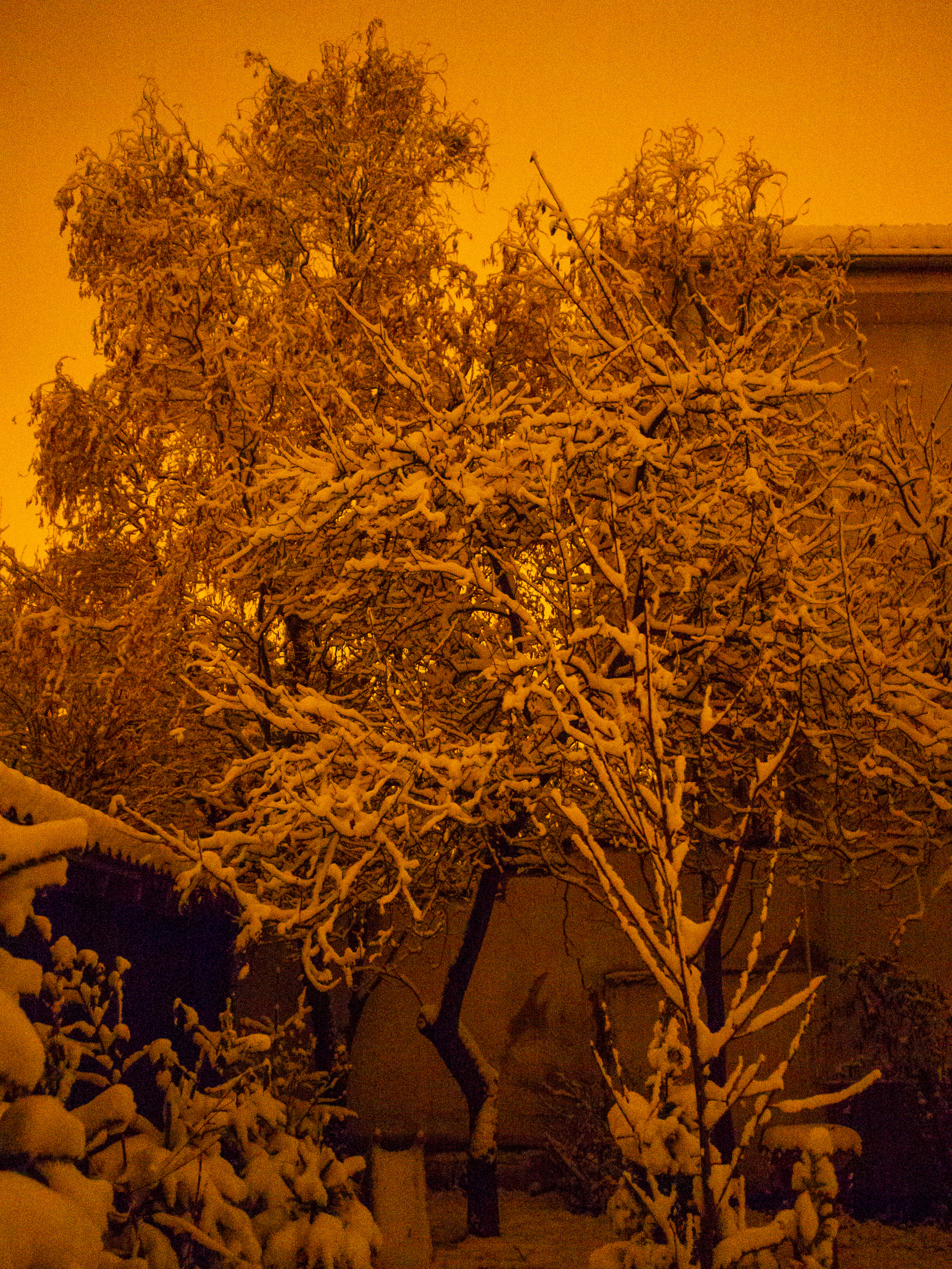
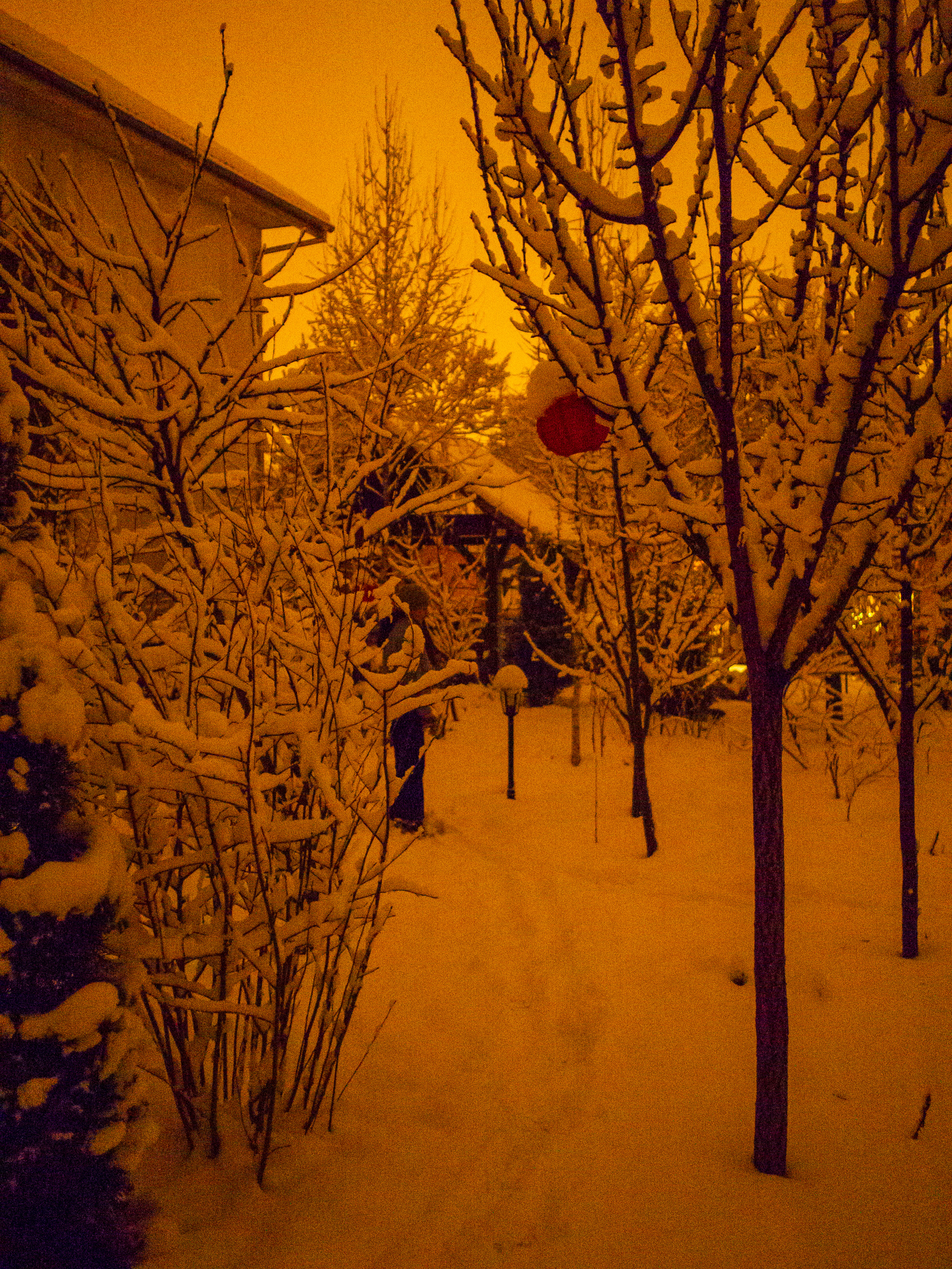
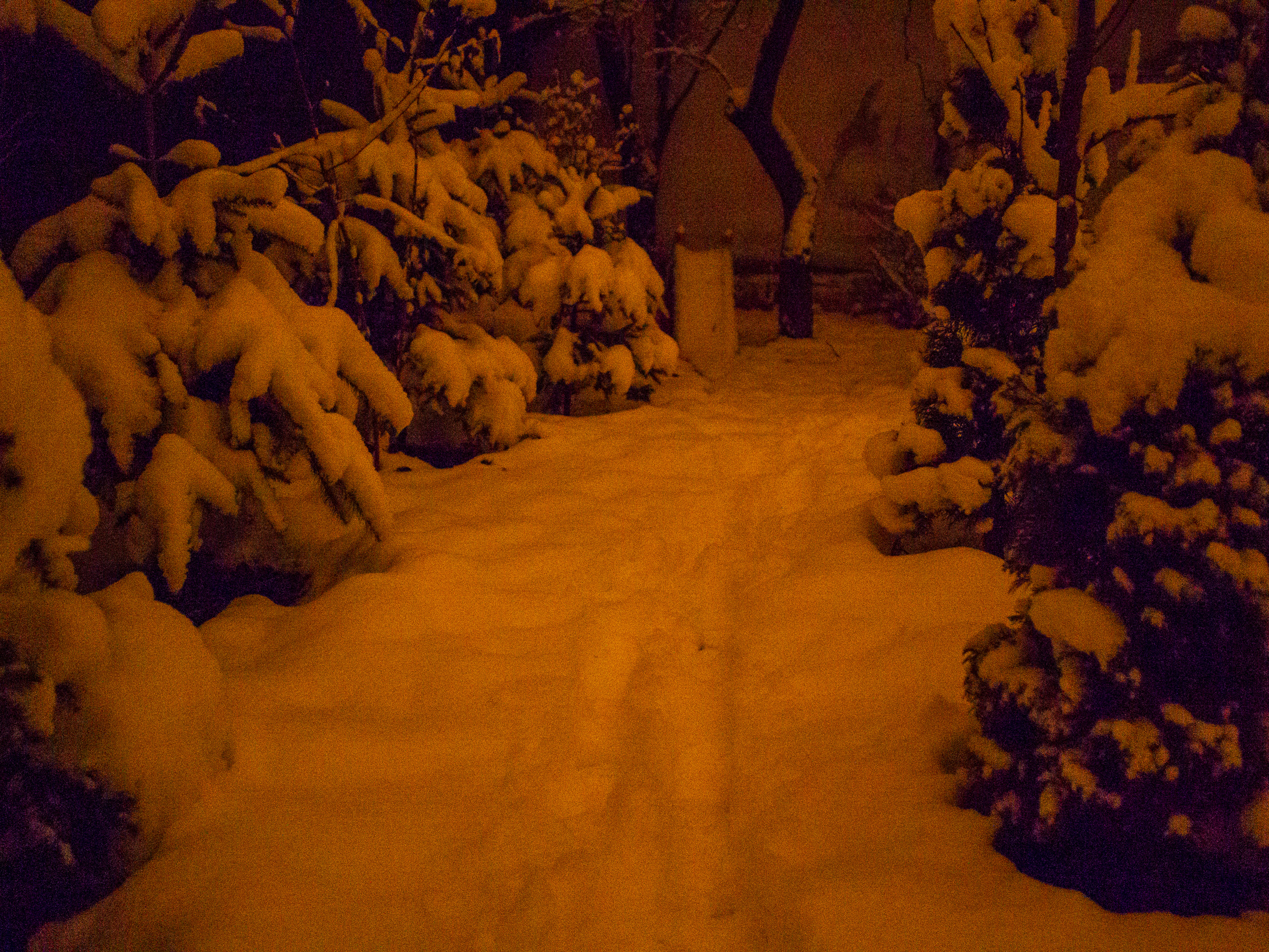
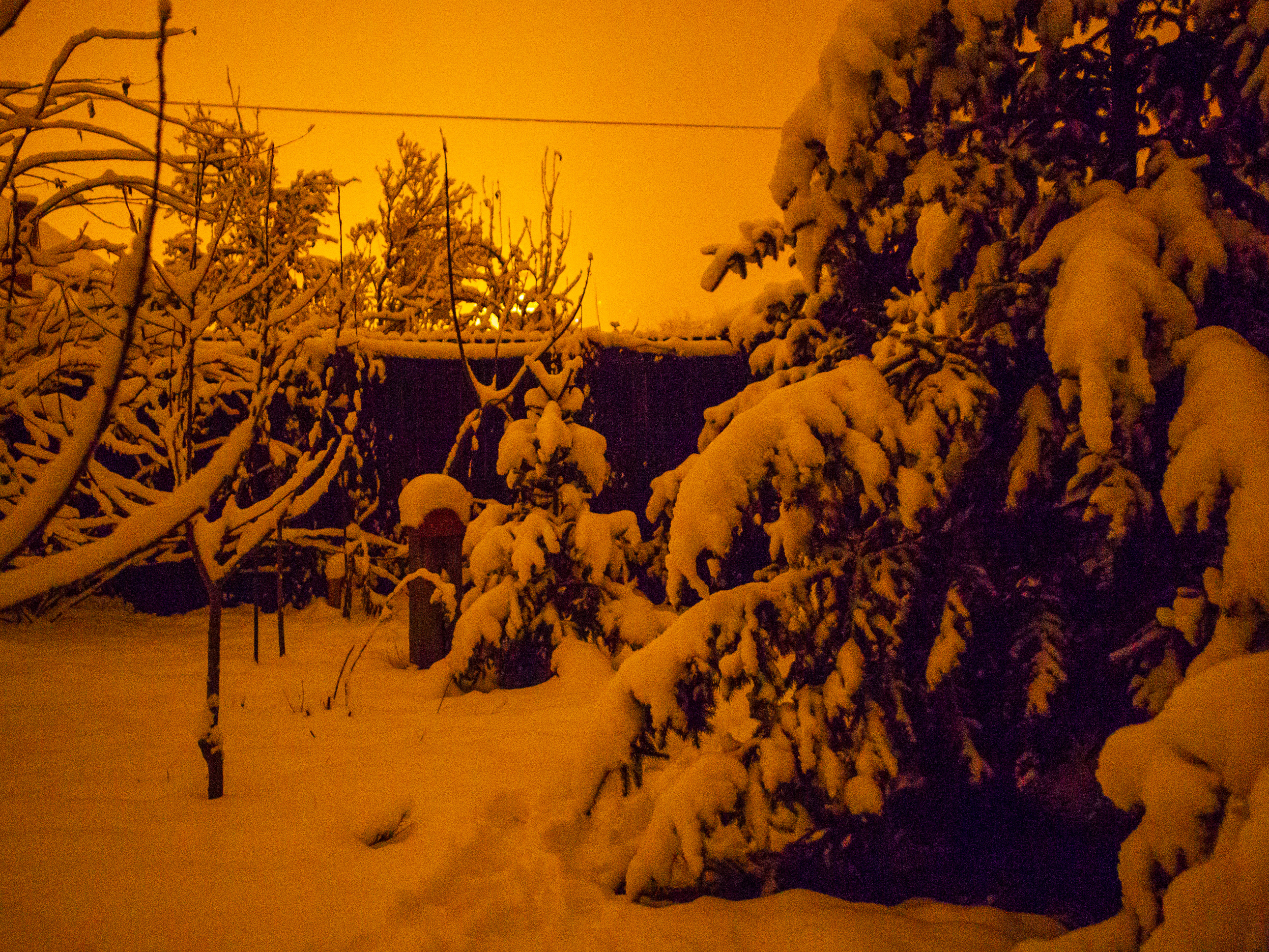
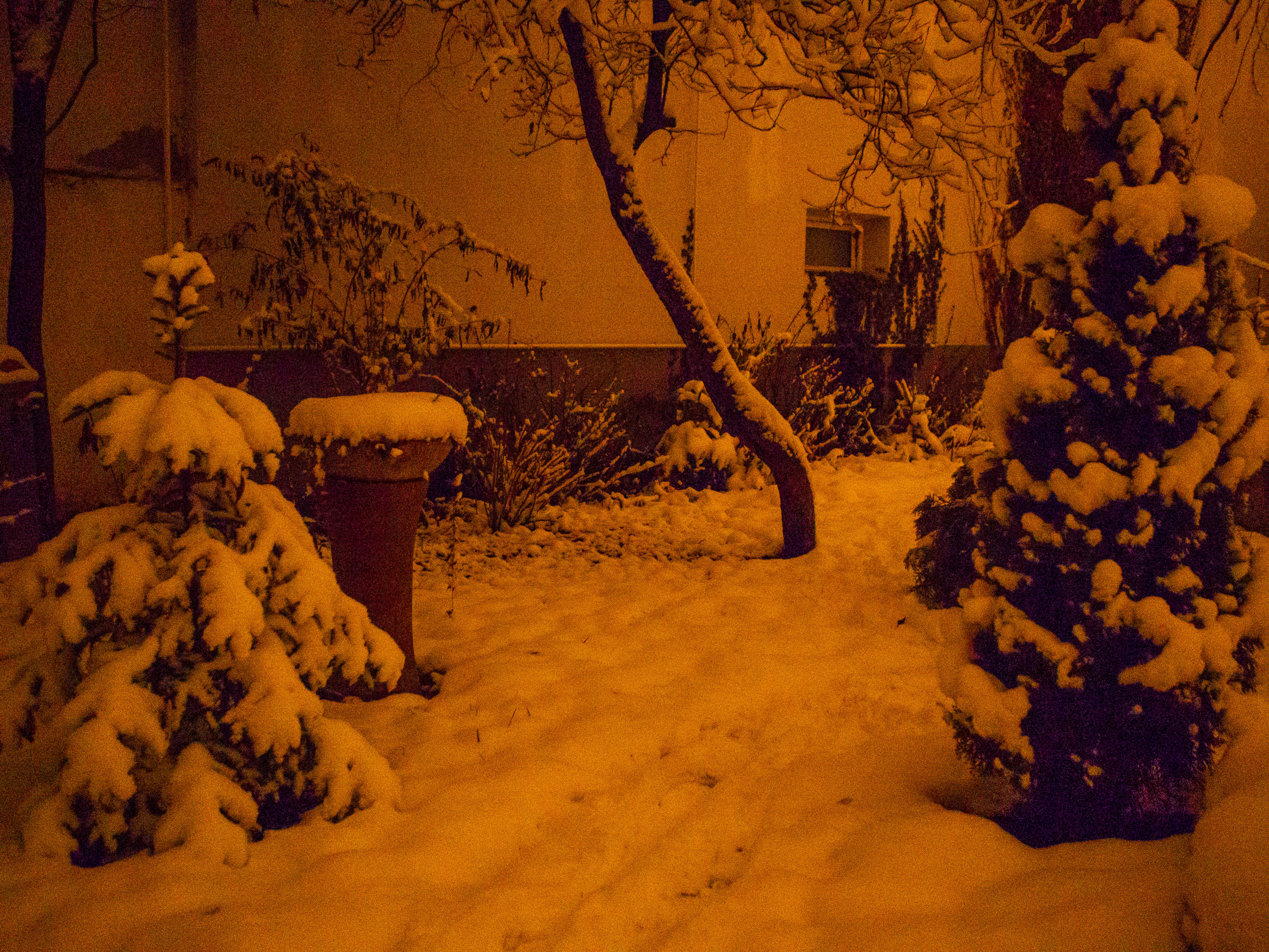
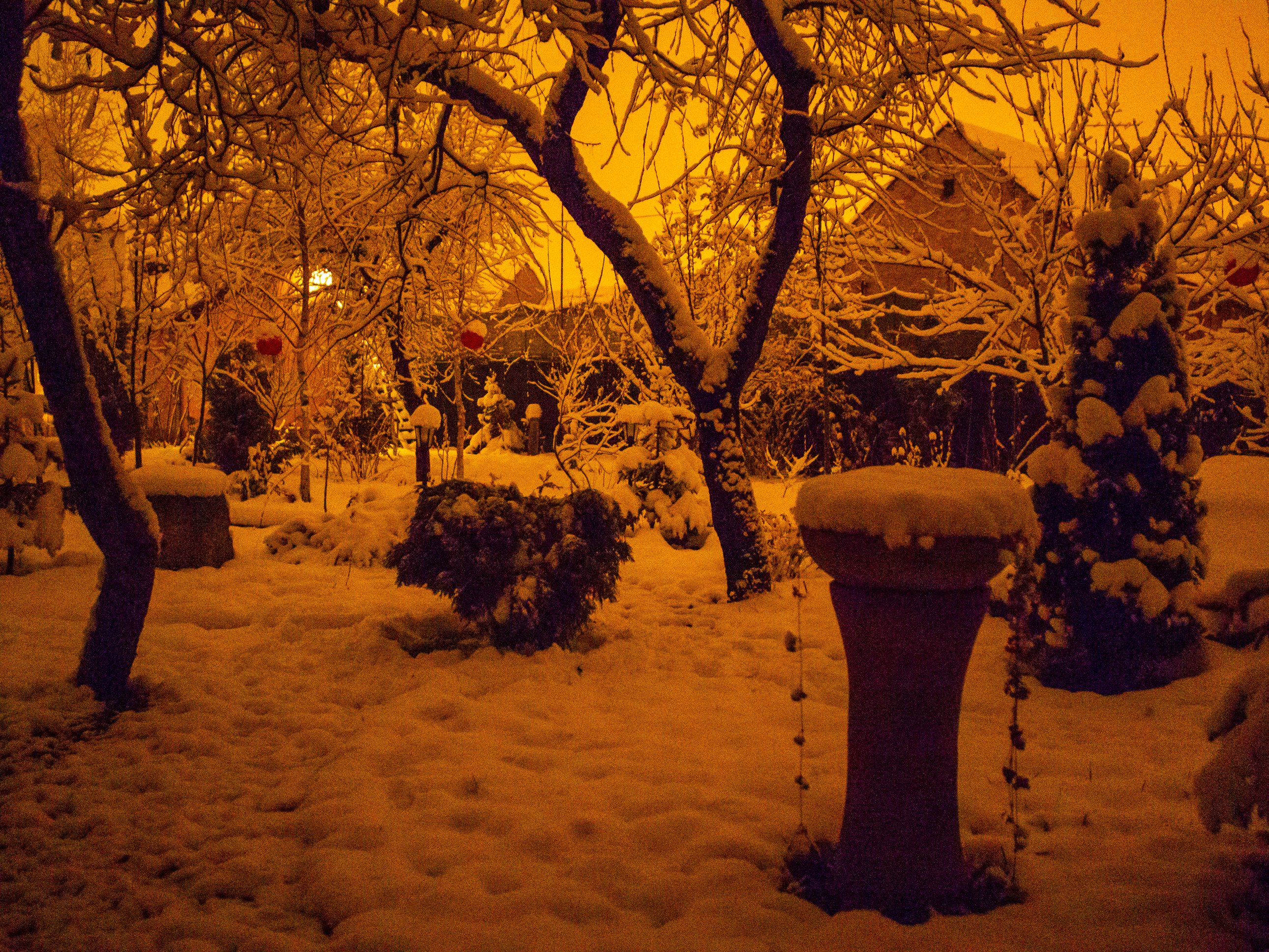
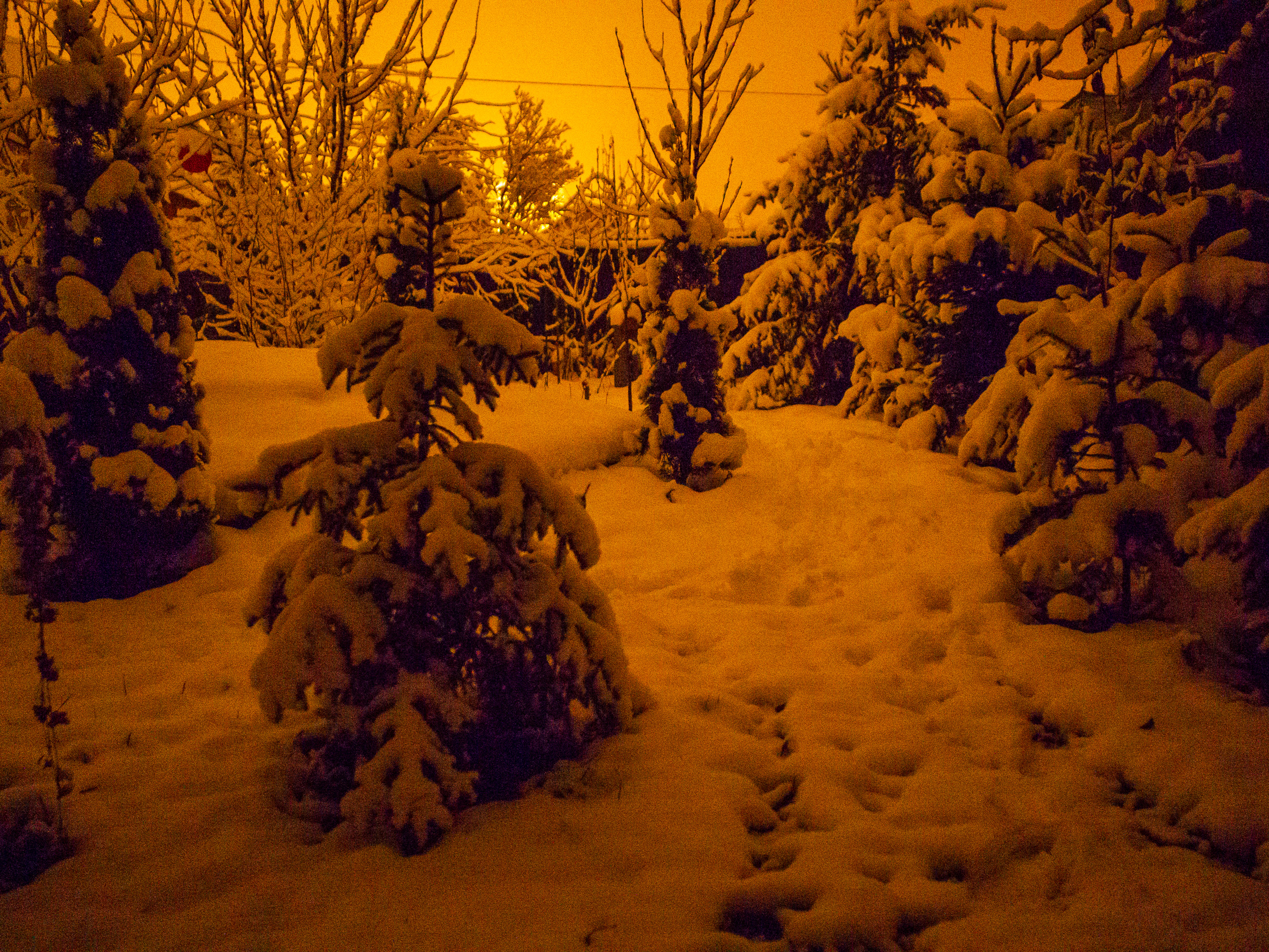
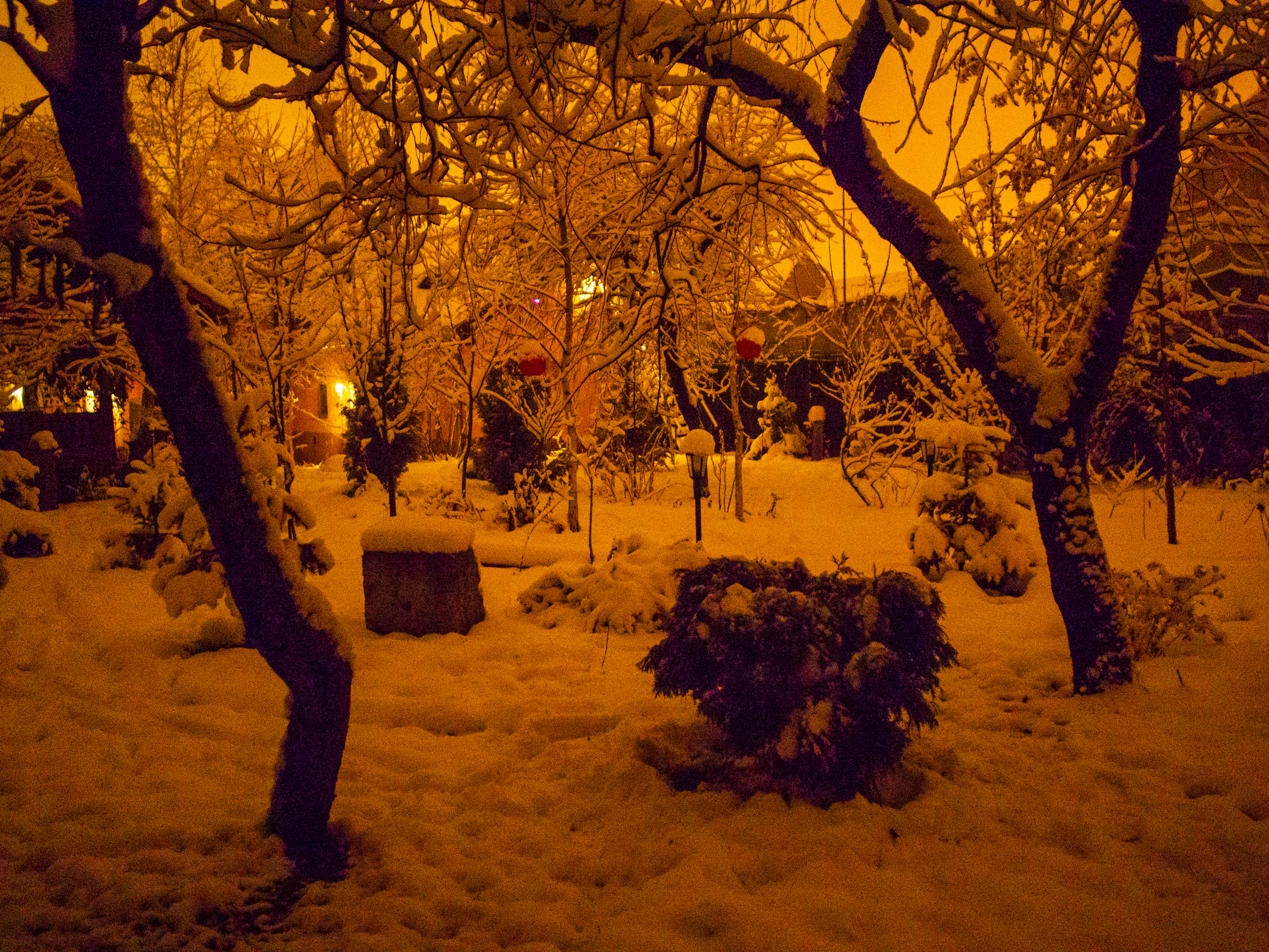
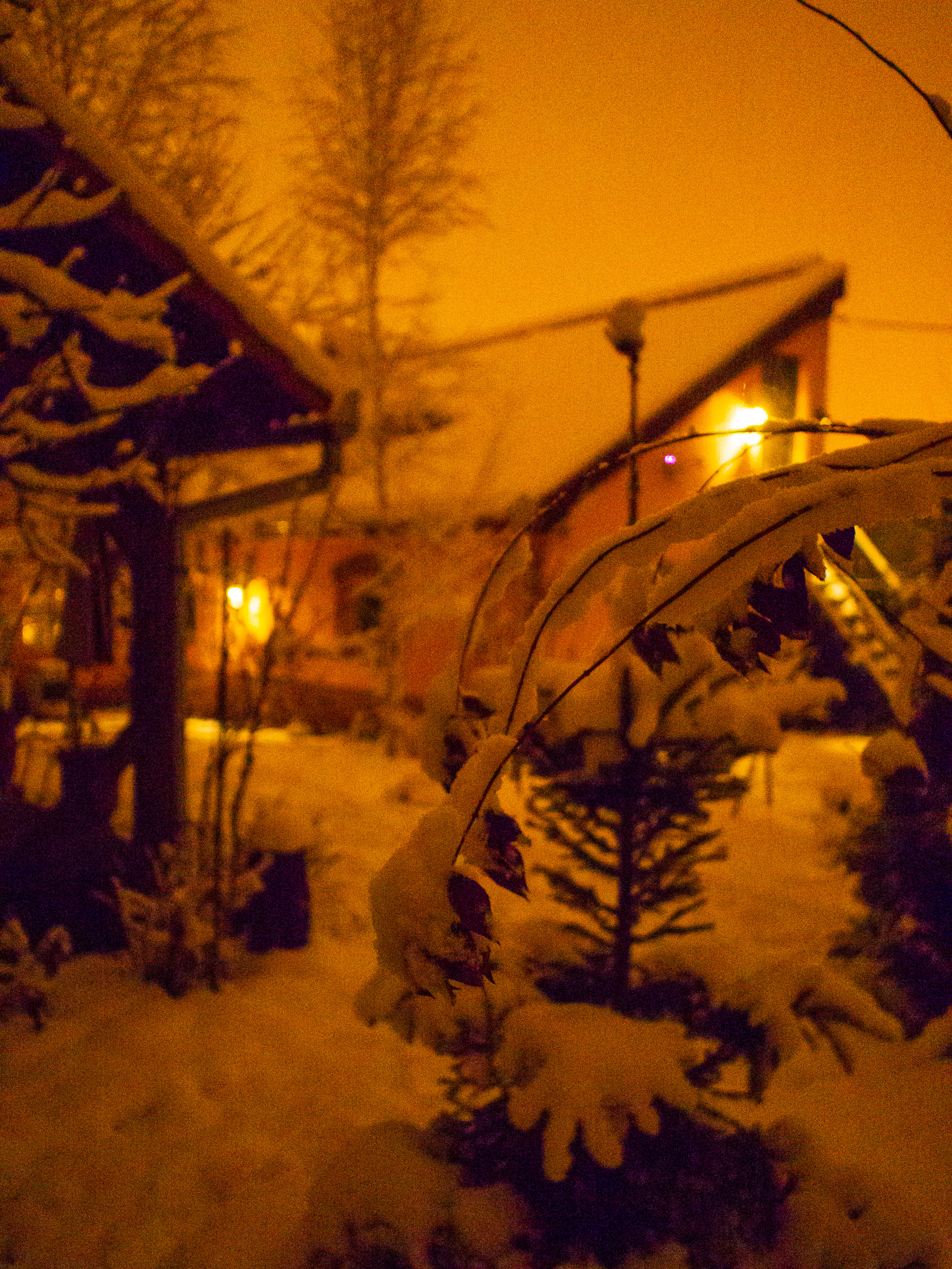
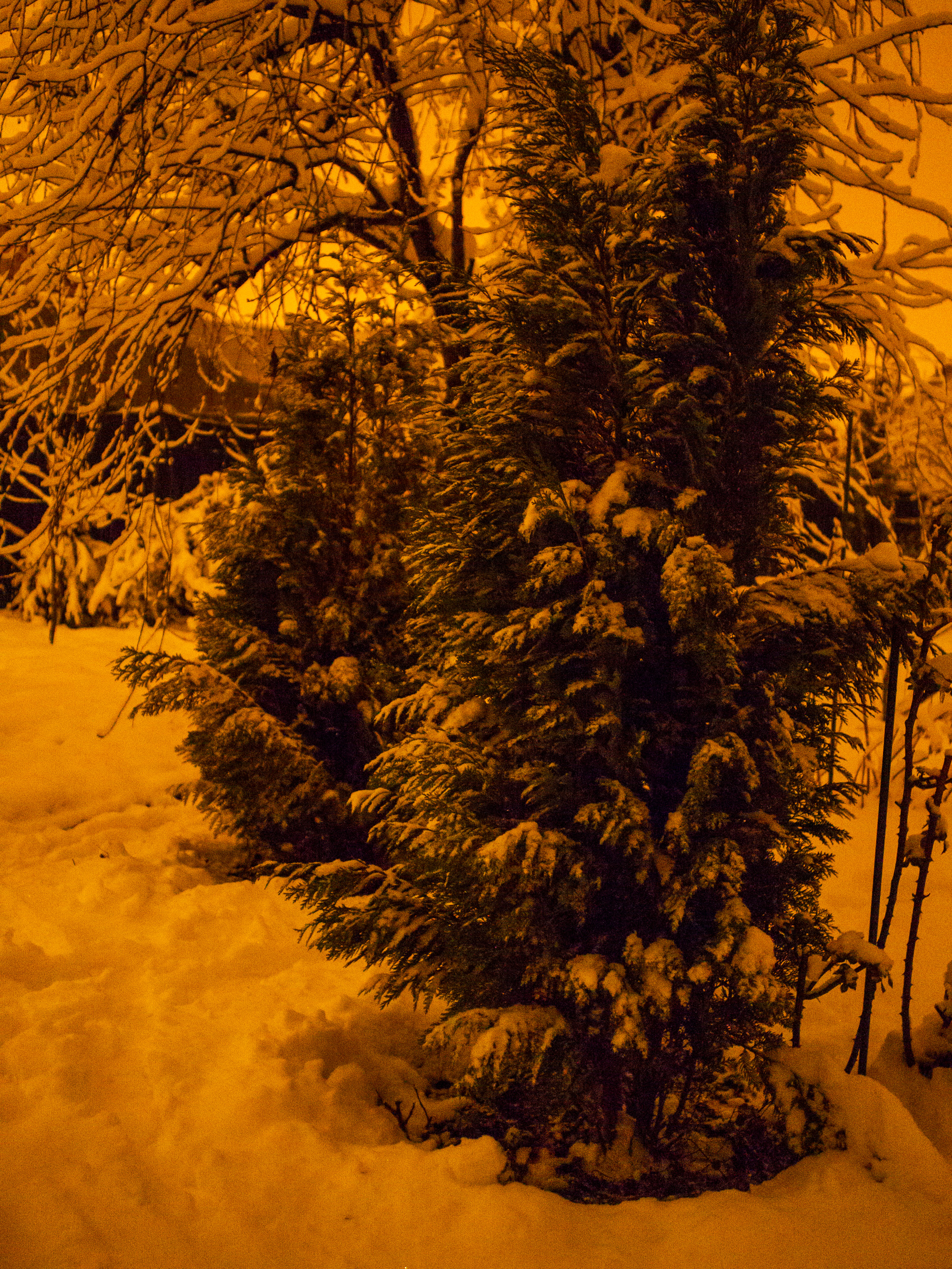
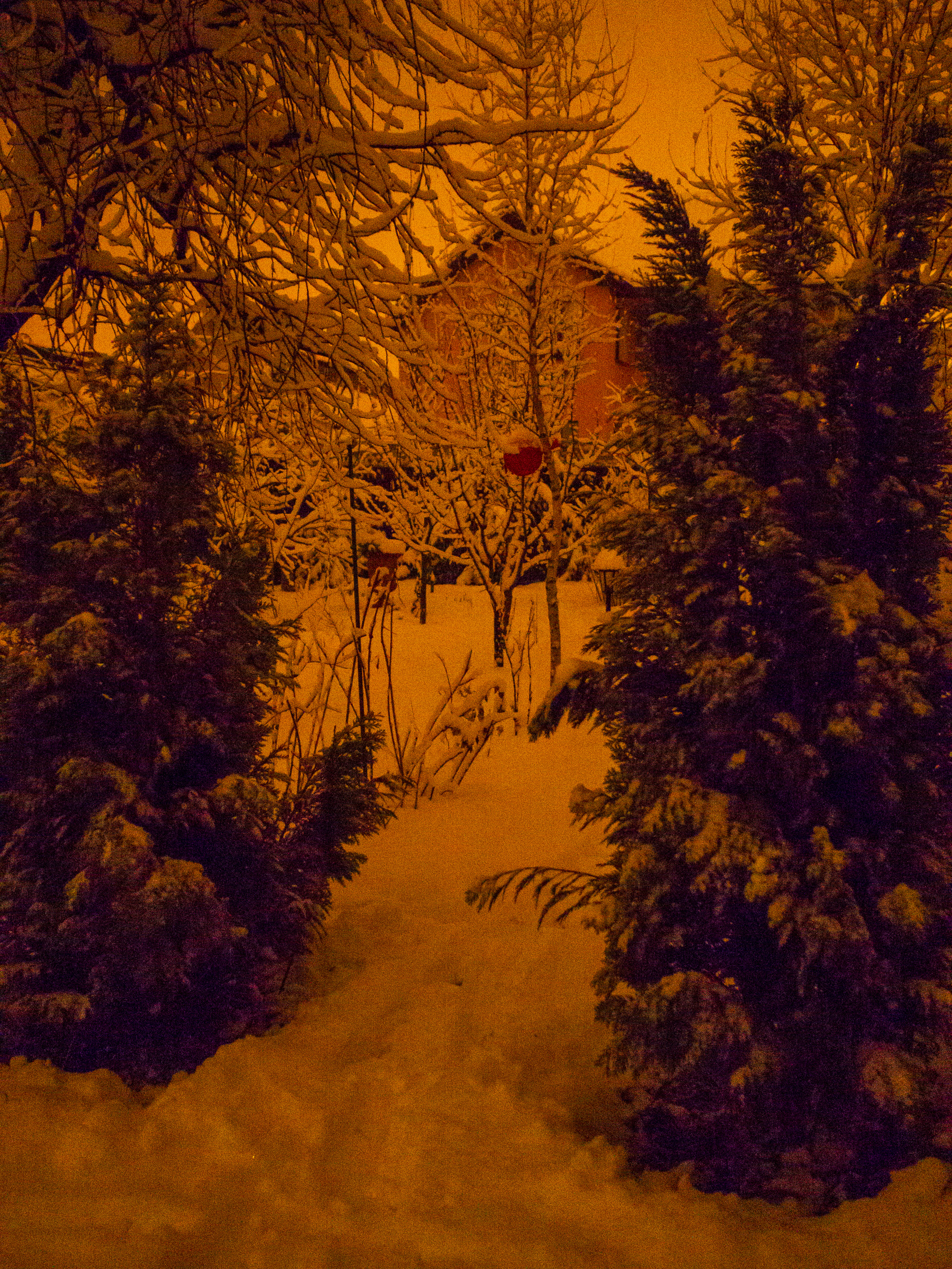
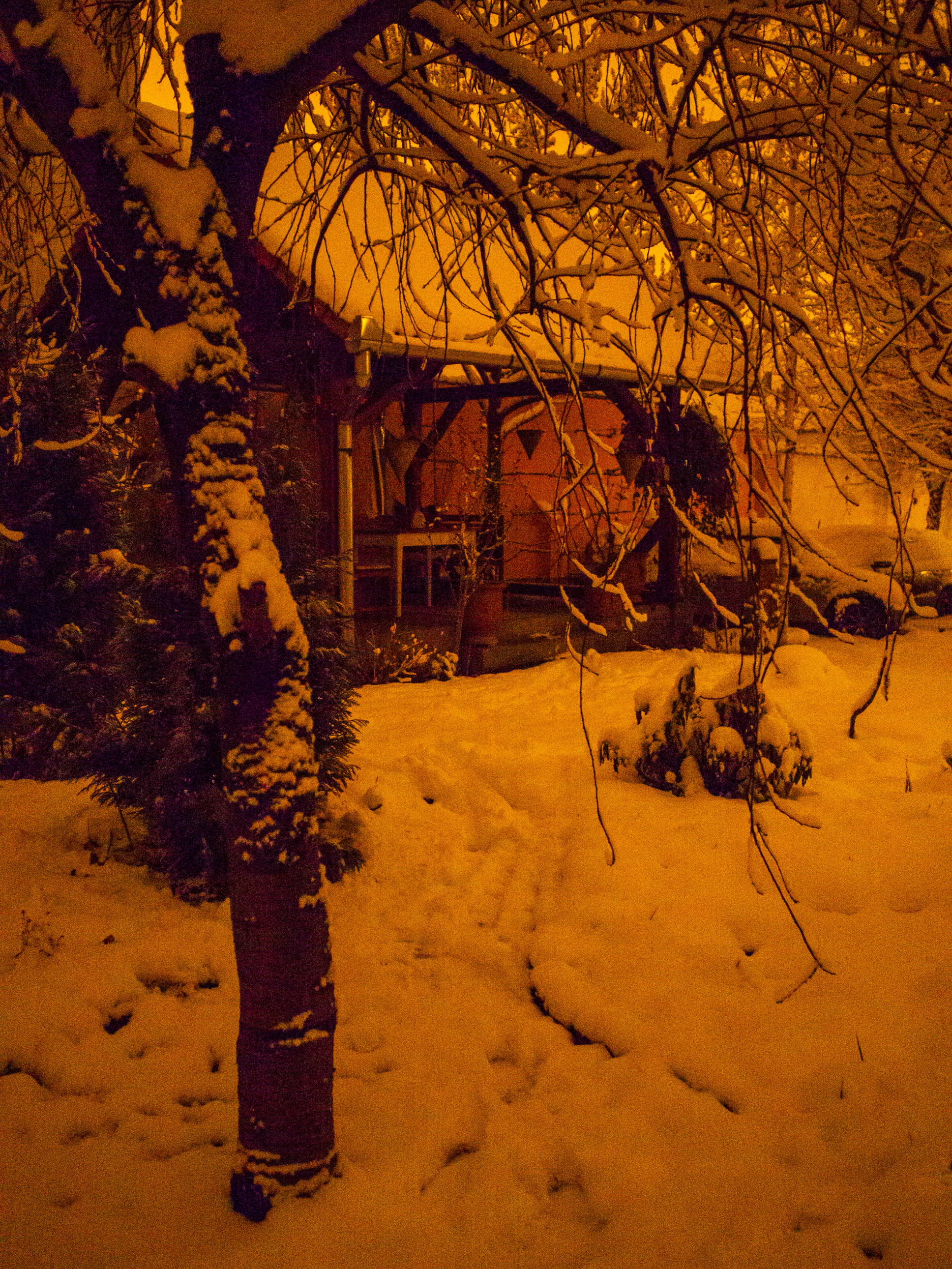
We had a beautiful night snowfall recently and even though it was after midnight, Ligia and I went out to walk through the garden. You may know these nights well if you live in a temperate climate. They tend to stick in your memory. Everything is quiet, eerily quiet. Even the sound of your own voice is muffled by the falling snow. If you’re in a town, the ambient light from houses and streetlights reflects off the blanket of white snow and shines right up to the clouds, which are near to the ground, weighed down by the water droplets that will become snow as they fall to the ground. So the whole sky typically shines a tint of yellow from the town lights, and it also reflects that light down onto the snow, lighting everything up even though there’s no moon in sight.

It was that kind of a night when we stepped out. Thick, well-defined snowflakes were slowly making their way down, stopping on branches, building up into impossible mounds on the thinnest of twigs. In the absence of a breeze, everything was frozen as if in awe, admiring the falling snow in concert. We walked through our garden, wading through the powdery white blanket, stopping to breathe the cold, refreshing winter air and to give thanks for the beauty before us.

I hope the photos reflect the atmosphere of that night. They were taken handheld with a 35mm lens at its widest aperture (f1.8) and at at a fairly high ISO (as high as 10000). That means not everything is going to be in focus and there is going to be plenty of grain. But that’s how I typically shoot: handheld, even in low light. I’m more interested in capturing the mood, the moment, than in having everything tack sharp or in setting up a tripod shot.

Events

A winter night

Gallery
Thoughts

The best of times

Isn’t it interesting how timeless and true good writing proves itself, even in our modern age, and even though it was originally intended for a different literary context?

It was the best of times, it was the worst of times, it was the age of wisdom, it was the age of foolishness, it was the epoch of belief, it was the epoch of incredulity, it was the season of Light, it was the season of Darkness, it was the spring of hope, it was the winter of despair, we had everything before us, we had nothing before us, we were all going direct to Heaven, we were all going direct the other way…

“A Tale of Two Cities” by Charles Dickens, 1859

We are indeed living in the best times of current recorded history and because every coin has a flip side, there are surely plenty of things to complain about. Yet I thought I’d point out some of the good things in this post.

Out of all our known and written history, I don’t believe we’ve ever had a time like this, when most of the world is enjoying a period of “not war” and when the options available to us in areas such as healthcare, living conditions, hygiene, infrastructure, learning, jobs, possessions, transport, personal freedoms and just about everything else you can think about are so many and so readily available. Yes, some of these options can get expensive, but they are there and they are available, whereas most of them simply did not exist in the past.

We get so caught up in our daily, mundane routines and our various disappointments that we allow to blacken our lives, that we forget we have it so good. I’d like to invite you to find and watch documentaries and TV series that portray our various periods of history with accuracy; there are quite a few these days. I’d like you to become acquainted with how people lived and how hard it was to simply get through a day and have some food to put on the table, much less be able to afford a few knick-knacks here and there.

Most people have never been able to afford what we call a proper home and have lived in sheds, hovels and small cottages for most of history. Most houses were a one-room affair in the past. The toilet was a pot under the bed or a communal outdoor hole in the ground. Chamber pots would be thrown into the street every morning. Think about taking a walk in those cities! Even in civilized cities, right up to the 1960s-70s, people would have to share a common bathroom or bathrooms in apartment buildings or subdivided houses. And now we’ve gotten to the point where we mind sharing a bathroom with our guests and we complain if our house has less than 3-4 rooms.

The capability to take a daily shower under hot running water, with a pleasant soap and shampoo, has been unheard of in all our recorded history, until recent times. And yet people still find excuses when it comes to maintaining proper daily hygiene and complain about water hardness and water pressure and soap quality, etc.

Dental care is so important. Without it, most of us would be toothless by our 40s and those who’d still have teeth would have some rather nasty decoloration and build-up on them. Should we be part of the majority of the population without teeth, we’d have to wear dentures made of wood or animal teeth, or of metals such as lead, dentures that wouldn’t fit properly and cause us daily pain. We now have access to orthodontics, fillings that match the color and hardness of our teeth and are almost invisible, crowns, implants and now stem cell implants, which can regenerate our own teeth! This was never available in the past. We’ve had to struggle with primitive tooth care for so long.

Of all healthcare options available, I would single out trauma surgery as the most important development. Nowadays we have the option of receiving triage and trauma care that allows us to fully heal without infection, including proper bone and joint surgery and for most of known history, we simply didn’t have this. Broken arms stayed broken. Torn joints stayed torn. Cuts and flesh wounds often got infected and led to death. Yes, healthcare is terribly expensive. Yes, good basic healthcare should be a right, not a privilege. But look at the bright side: it exists! How governments choose to make it available to their citizens is an open and ongoing discussion instead of a “No, we’ve never heard of that, it doesn’t even exist” kind of discussion.

How easy is it to learn things nowadays? Access to information is virtually free, and more resources (historical and modern) have become available online than we’ll ever have time to read, and yet I’m hard pressed to come across than a few learned, thoughtful individuals during the course of a day and sometimes even a week; (perhaps that’s also due to the way our educational systems are structured.) Various apps on our mobile devices compete to make learning as fun as possible for us. Universities and colleges post videos from their courses for free online access. For most of history, people didn’t know how to read or write. They were thirsty for learning but it was out of their reach. It was simply too expensive or just not an option for them. Trade secrets, for example, were closely guarded and only revealed to tradespeople in secrecy, after long apprenticeships. Now everyone can watch how-to videos and learn how to do something, but how many follow through and actually do those things or even more, persist at them until they get good? Most of us tend to confuse reading or watching the news with learning. Opening up our minds and pouring in the news isn’t learning, it’s just a deluge of unhelpful and depressing bits of information.

For most of our history, people couldn’t pick their jobs. There was little social mobility. If you were born into a peasant family, you were a peasant, end of story. Only the aristocracy could pick and choose what they wanted to do, but even if they were passionate about something, it could only be a hobby, because they were expected by all to be aristocrats, not do things (I know, boo-hoo for them…) Now anyone can be just about anything, and training for that job is within reach if they want it enough. One way or another you can make ends meet and get to do what you like in life. I know, I know, student loans are huge… that’s why it’s doubly important to figure out what you want to do before you start going to school for it, else you’ll be spending money you don’t have so you can get to do what you don’t want to do. While I’m talking about this, allow me to pitch you on choosing a career in the trades; good craftsmen are in severe demand these days.

The subject of possessions is huge, both figuratively and literally. We could talk all day about rampant consumerism and fake economies and fast fashion. The point is, it’s incredibly affordable to buy things today, and it simply wasn’t the case for most of our history. Even something that we often take for granted and is typically rusting in our garden sheds, such as a simple hand saw, was incredibly hard to make and buy during medieval times. Even an axe or a pick was hard to make. They cost lots of money, the equivalent of small cars nowadays, so people saved up for years to buy tools, then cared for them and handed them down to their sons and daughters. Clothes were made by hand, and that included the materials. You cared for them and mended them as long as you could. Someone would typically only have one change of clothing. Nowadays clothing is literally clogging up our homes and people are desperate to get help in order to clean them up and organize them.

In the last 100 years, means of transport have progressed tremendously. Whereas travel was slow and expensive, it’s now fast and inexpensive. We can travel by car, train, ship and airplane. We can even skip physical travel and visit locations virtually by looking at photos from those places, or street views in mapping applications. We can even immerse ourselves in 360 degree videos and virtual realities.

We find time to bitch about every little bump and pothole in our public roads, yet we’ve never had it so good. It’s true that Roman roads are legendary, but you have to remember they were cobblestone in a time where suspension hadn’t yet been invented. Every single bone and sinew in your body would have been shaken out of sorts by the time a day’s ride would be over. After Roman civilization degraded, we were back to mud ruts and dust for over 1500 years, plus frequent attacks from highway robbers. Now all but the most rural roads are paved and can be safely traveled.

How about personal freedoms? Have societies ever tolerated so much free speech, even when it’s hateful and offensive, and offered so much personal freedom for various lifestyle choices, even for something that we now consider so commonplace as divorce or adultery? Do you know how shunned people were for adultery in the past, or how impossible it was to get a divorce, even when situation was terrible and abusive? How about the open criticism and ridicule of politicians, business leaders and other figures of authority or fame that we now tolerate? When was that sort of thing well-tolerated in the past? And yet we still find ways to take these things to the extreme, and we keep pushing the boundaries till things get truly and downright brazen and defamatory, instead of celebrating the freedom of speaking out against someone and doing it with some sense of decency.

I do wish more people would realize how good we have it and would be more grateful for all of the opportunities, amenities and conveniences that modern times offer us. We certainly don’t want to put ourselves in a position where we lose what we’ve worked so hard for as a human race and civilization, because then we’ll have really failed ourselves. I think the way to become more grateful is to pay attention to the past, because it offers up enough contrast to the present to make us have those little epiphanies of conscience that raise our collective morale.

Standard
Events

The time a Drobo lost over 30,000 of my photos and videos

The following is an account of what happened to me in late 2012, when two of my Drobo units malfunctioned and corrupted or erased over 30,000 of my photos and videos, rendering them either completely unusable or making them vanish into digital ether.

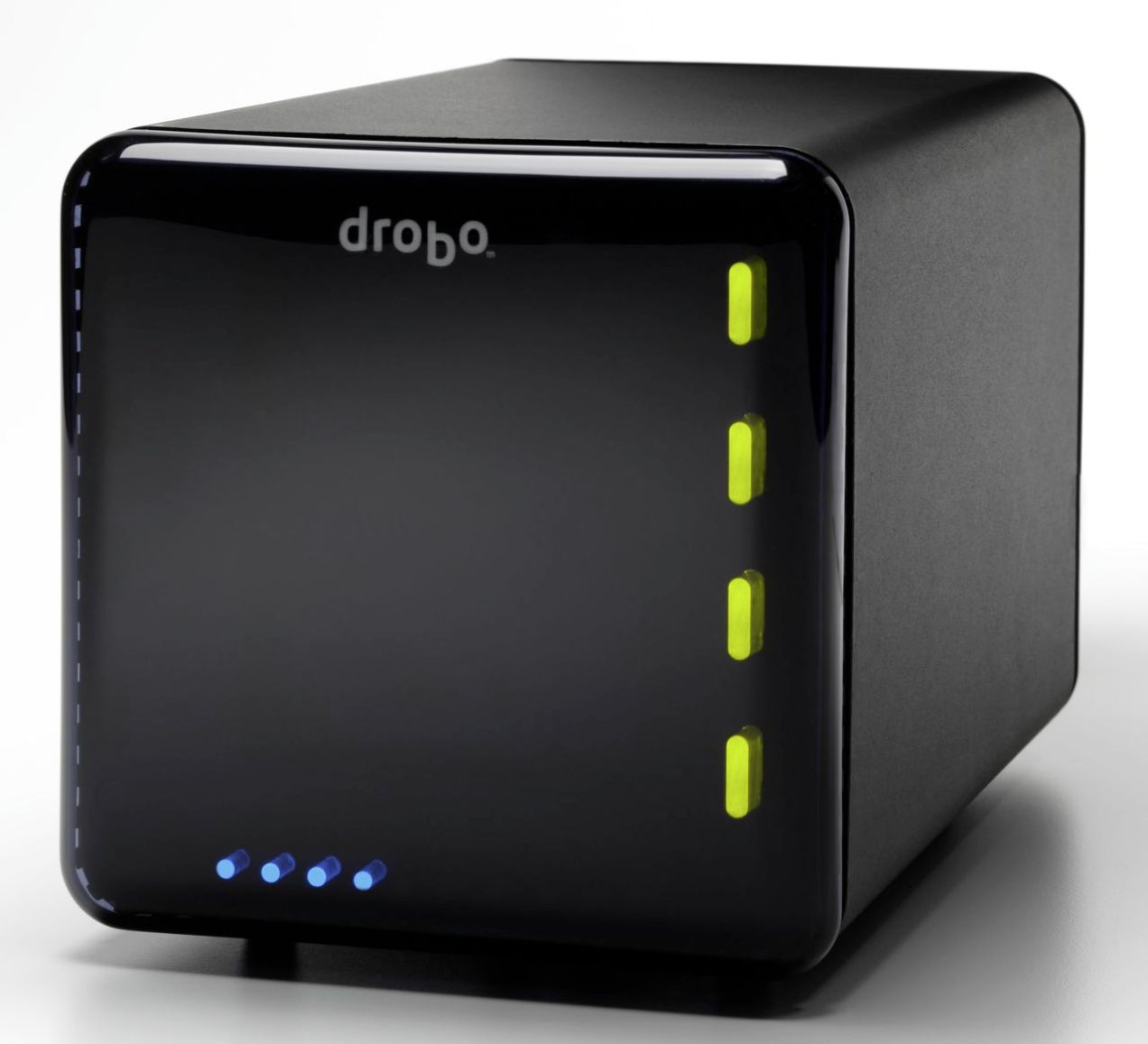
I have been a Drobo customer since late 2007, when I bought my first USB Drobo. I was glad to take advantage of the new storage possibilities it offered. Since then, I’ve bought one or two Firewire Drobos, two Drobo 5Ns and a Drobo 5D. After relying on my Drobos for several years, I experienced catastrophic data corruption on both of my Drobos at the time (a USB Drobo and a Firewire Drobo). That incident still haunts me to this day.

If you look through my past posts about the Drobo, you’ll see that I wrote about them and I defended them (speaking from my own experience at the time) when others said, among other things, that they “can’t be relied upon” and they often turn into “bricks” or lose people’s data. From my own experience, I had only good things to say about them. They hadn’t failed me for years, I hadn’t yet lost any data from them, the support was great and their design is beautiful. They are a pleasure to use when they work. Until recently, few things in hardware got me more excited than buying a new, bigger hard drive for my Drobo and sticking it in, then watching the capacity gauge show the new, larger volume and hearing it start to sync the data to the new drive…

Which brings me neatly right to the crux of the problem. I had bought a new 3TB hard drive for my Firewire Drobo and stuck it in, replacing an existing 2TB drive. The data sync had gone on for close to 30 hours and was getting close to completion (the Dashboard software was telling me there were only 5-6 hours left). All of a sudden, a red light next to the new 3TB hard drive went off. Before I had a chance to assess the situation, the Drobo crashed and rebooted. I thought, okay, it’s resetting itself and will begin to work once more. I waited for the reboot to complete, only to discover, to my dismay, that it rebooted again… and again… and again… During those brief moments when it was up, the red light switched places, moving from the 3TB hard drive to one of the existing 2TB hard drives. This wasn’t good. I decided to shut it off completely and unplug it. I filed a ticket with Drobo Support and waited.

This horrific experience came after I experienced catastrophic data loss on my USB Drobo just a couple of days earlier. That Drobo was and had been plugged into a surge protector (unlike my Firewire Drobo, which had been plugged into a UPS). The electricity had been cut off and when it came back up, the USB Drobo wouldn’t mount to the desktop. No big deal, I thought. The electricity had gone off before and when the Drobo wouldn’t mount, I would run Disk Utility on it and fix it right up. That’s what I did this time, only Disk Utility couldn’t repair it. Oh boy… I filed a ticket with Drobo Support. They told me they couldn’t help and that I should buy Disk Warrior or send it to a data recovery firm. I called the firm to get a quote, which they said would be anywhere from $1,200 to $7,900, depending on how much data they recovered. They told me that realistically, it would cost at least $4,000 if they recovered any data at all, and that it’s difficult to get the data off a corrupt Drobo volume, because of their complicated storage algorithms. They said it’s much easier with traditional RAID systems.

So I bought Disk Warrior and tried my luck. It was able to mount the Drobo temporarily, but couldn’t fix it. The error it gave me was that Disk Utility had messed up the catalog file when it tried to fix it and they couldn’t recreate it. I called their Tech Support and one of their technicians stayed on the phone with me for over an hour. We did a Screen Sharing session in iChat, where he kept running scans on the volume and checking the diagnostic files. Same result. Couldn’t be fixed. He suggested I get whatever data I could get off it directly through the Disk Warrior’s Preview feature. I started to copy off the data and got about 70GB off (onto the Firewire Drobo) which hadn’t crashed yet. Then the USB Drobo decided to call it quits and became completely unusable.

Out of over 3TB of data, I was able to salvage temporarily about 70GB. I lost the rest: over 15 years of personal and family information, photos, personal videos, letters, our movie collection (which I had painstakingly digitized and edited from VHS tapes and TV recordings over several years), our cartoon collection (also painstakingly digitized and edited from VHS tapes and TV over several years, and which I was looking forward to watching with our unborn baby — my wife was pregnant at the time; our daughter is now almost six years old) and other various files.

I decided not to send the Drobo to data recovery because the price to recover the data would have been higher than the price to buy all of the movies and cartoons on DVD once more, and because I don’t feel comfortable with other people rifling through my personal files. I didn’t know how much they’d be able to recover, if anything, and I consoled myself with the notion that at least my Firewire Drobo was still fine and I had my work files (my photo library of over 100,000 photos, the footage and FCP and iMovie events and projects from our shows (Romania Through Their Eyes and Ligia’s Kitchen), various other personal and published videos, etc. — basically, my creative work over the past 6-7 years.

Then, my Firewire Drobo went AWOL. As mentioned above, I filed a ticket with Drobo Support and waited to see what they would say. Their advice: buy Data Rescue 3 and run it on the 2TB drive that showed up with a red light next to it. Apparently the drive went bad during the data sync for the new 3TB drive. With Data Rescue 3, I could in theory clone it, then insert the cloned drive into the Drobo and recover my data. Well, I couldn’t clone the whole drive. I tried it a couple of times, but whenever the head came to a certain point on the platters, the drive would disconnect itself from the computer. So I did a reverse clone (where the cloning process begins at the end, not the start of the drive) to try and recover the rest of the data after the bad section on the drive. After that completed and with the blessing of Drobo Support, I called that a “best try” clone, stuck the new drive into the Drobo, put it in Read Only Mode and through Data Rescue 3, began to copy off my data.

Things looked good at the time. The software seemed to see all my files and although the copying process was slow, I had access to my data, which was the important thing. After 4-5 days of data retrieval, I was done and at Drobo Support’s advice, I reset the Drobo and formatted a new volume onto it, then began to copy my data back onto it. It was deemed healthy once again and I was sent a new power supply. I’m still not sure why the new power supply was needed, but alright.

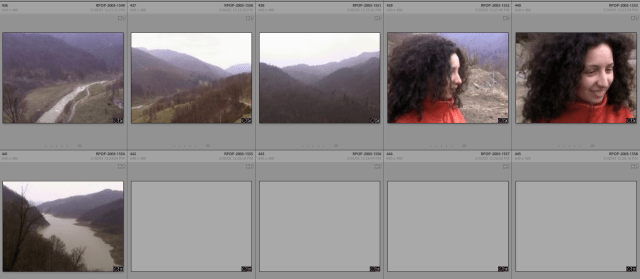
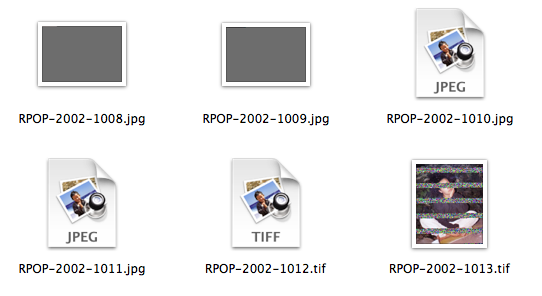
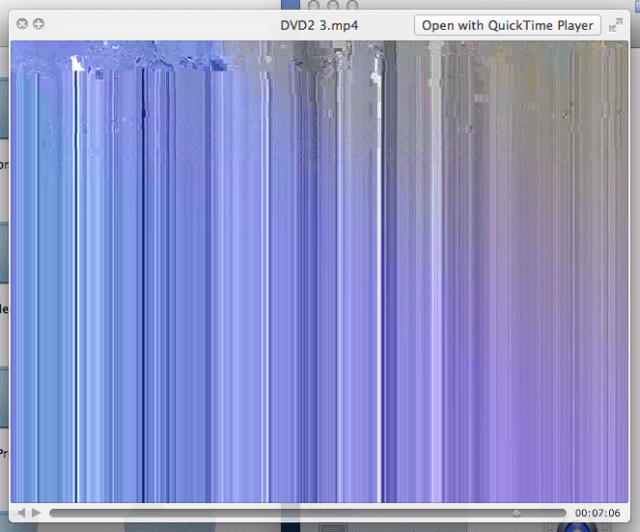
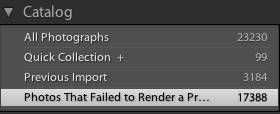
After all my data was back onto the newly formatted Firewire Drobo, I began to access it. Only then did I discover data corruption at the file level. Photos, precious memories which I’d trusted my Drobo to keep were now forever lost. Photos of when I met Ligia (my wife), photos from the wedding, from our first years together… they’re gone now. Videos have turned into audio files (the video track can no longer be seen by video players or video editing programs. Just from the year 2007, I lost well over 17,000 photos (about 80% of them). The same percentage applied to the years 2000-2006, when I took less photos but lost the same proportion of files (about 80%). I still don’t know the exact number of photos I lost, but I estimate it to be well over 30,000. I still dread to open older video libraries in Final Cut Pro, because when I access my projects, I always find video clips that are either missing or completely unusable.

When I updated my ticket with Drobo Support to let them know about this, data recovery services were once more suggested. Now I’m not a data recovery expert, but after you’ve formatted a volume and written a LOT of data to it, doesn’t that make it harder, if not impossible, to get the old data back?

If you’d like to see what file-level corruption looks like, it’s not pretty. Here are a few screenshots. Those thumbnails are all I have left of photos I wanted to keep forever.

Let’s look at this thing from both sides.

The pros:

  • These two Drobos worked for five years, flawlessly;
  • My experience with Drobo Support was good from 2007 till 2012; even though the warranty had expired on both of these Drobos, they took up my cases and tried to help me;
  • I should have had my data backed in other places, I know, I know; That’s exactly what I as doing as the Drobos failed. I was reorganizing files and reshuffling my archives when it happened. If you were to ask me, as an IT professional, what I would recommend to others, it would have been the following: have the data in its primary location on a reliable and fast device, back it up to a server or NAS on the local network and also back it up offsite. I was caught in-between, with no access to my old backups and no proper backup plan in place. Crashplan, the offsite backup company I was using at the time, had been throttling my uploads to conserve their bandwidth, and the offsite backups hadn’t completed. If they hadn’t been actively engaged in throttling user uploads, as was their practice at the time, I could have recovered all my files.
  • Drobos are easy to use and allow one to consolidate their data on one volume that can keep growing and growing and growing with the addition of new drives — that part I always liked;
  • Even if one drive fails, the data’s still safe; I had that happen to me once in years past and yes, the data was fine — that part I also always liked;
  • I should have had the USB Drobo plugged into a UPS, just like the Firewire Drobo. Should have, would have, could have…

The cons:

  • Two catastrophic failures within one week… c’mon, this is ridiculous to say the least…
  • I had no idea you could lose all your data from the Drobo if the power went out, and that it would cost upwards of $5,000 to get it back. Ugh… if it costs so much to get the data back, Data Robotics should seriously consider doing what ioSafe has been doing from the start: offering Data Recovery Services standard with every one of their products.
  • Apparently the newer Drobo products, like the 5D, the Drobo Mini and the 5N, have a built-in battery that protects against power outages, so what happened with my USB Drobo won’t happen to them, theoretically. Well… if they knew about this, couldn’t they have put that battery/capacitor in the older Drobos as well? I sure wish they had taken every step possible to make sure any data placed on a Drobo stayed safe. After all, they’ve been saying for years that they “protect what matters”. Do they really?
  • Earlier this year, a friend of mine wrote to me telling me of his experience with his USB Drobo. It was the very same thing that happened to mine, minus the power outage. He would eject it from the desktop and unplug it from the outlet, thinking that was safe. It was, for a while, until he lost all his data. At the time, I thought he must have been doing something wrong. Until it happened to me. Is it just me, or do we not do the same with a regular external drive? Do we not eject it then turn it off? Does the electricity not go off sometimes, and even if the Drobo is plugged into a UPS, the electricity may be out for more than 10 minutes, meaning the UPS will also go down? And when the electricity comes back up, could we not also lose our data even though we did everything right?
  • I remember jokingly asking someone from Data Robotics in years past what would happen if a drive went bad right after you inserted a new one and the Drobo was still in Data Protection mode. Their response: not very likely that could happen. The Drobo would know that a drive was about to go bad and would give me warning. It’s quite apparent to me now that that’s not the way things work sometimes. Sometimes a drive does go bad during Data Protection and not only do you get no warning, you also get catastrophic data loss. Double whammy.
  • Someone from Drobo Sales happened to write to me to invite me to a webinar as I was in the throes of my data loss. I replied and told him of my troubles, and that was the last I heard from him. Was that the way to treat a long-time customer? An adequate response would have been “Hey, I’m really sorry about that. Are you getting the help you need from Tech Support? If not, do you want me to step in for you?”

This whole affair left me exhausted and completely disappointed. I wasted so much time trying to recover my data and my bearings. The experience has taught me a few things, one of them being the loss of my trust in Drobo. It is a beautiful little black box. It works great and you begin to rely on it more and more, till you can’t do without it; till you think it works so good your data’s going to be fine all the time. Then it fails and your data is gone.

If you’d like to know how I recovered some of my data, I wrote about it here. I also experienced another major data loss event with my Drobo 5D just last month, and that was after more data loss with my 5D in 2015 and 2017. Add to that ongoing file system corruption in one of my Drobo 5N units and the “Drobo data loss package” is complete. I don’t know, I must have unlocked some kind of secret data loss level-up in the data storage game…

Standard
Thoughts

The flip side of digital photography

Should you be old enough, you’ll remember how different photography was before the arrival of digital cameras. Not only was it difficult to get great photos, the kind that were good enough for publication, but it was difficult to develop them and reproduce them. There were real barriers to entry and to success in the field. They weren’t insurmountable, but they were there.

Nowadays, digital cameras make it so easy for us. Even a novice can occasionally get a great photo simply by clicking the shutter button, because modern cameras can pretty much handle all situations. They don’t do everything, you still need to know what you’re doing in some scenarios, but they’ll get you pretty close to your desired result by themselves, most of the time. So not only is it easy to take photos, but it’s also easy to “develop” them using your computer, and you can reproduce them endlessly. The barriers to entry and success in the field are now almost gone.

However, one thing we all learn as we age is that everything comes with pluses and minuses. Just like film photography had certain minuses, digital photography comes with plenty of unpleasantries on its flip side.

Publications that used to hire photographers and pay them good wages are dwindling. How many do you know of that still have on-staff photographers, or hire photographers for their stories? And how do their salaries compare with those of photographers in the past if they’re adjusted for inflation?

Stock agencies are decreasing the payouts to photographers. There is a lot of competition in that market, paired with a real glut of photographs. And when the supply always outnumbers the demand, prices will fall. There are but a few stock agencies left. There are a ton of microstock agencies which sell photos for piddly sums and pay cents on the dollar to photographers, and they’re also getting bought out and merging with each other in order to survive. If it wasn’t clear a few years ago, it’s becoming painfully clear now that a photographer cannot make a living selling microstock. There are a few who manage to do it, but it’s clear that on average, microstock yields a non-livable income.

There are so many photographs being made that people don’t truly appreciate them anymore. Do you remember how we used to admire photographs in the past? We’d stare at them for 5-10 minutes at a time, taking in each detail. We’d cut them out of magazines and paste them in scrapbooks. We’d look at them and look at them and look at them… Now we’re lucky if a photo gets 5 seconds of someone’s time. There are so many of them that people just gloss right over a photo that took days or hundreds of tries to make. Perhaps you’ll understand this better if I compare it to a periodical cicada emergence. In just a few days, animals that would eagerly consume them as they came out, would become so glutted that they’d simply lay on the ground and watch them crawl around and over them, unable to eat a single morsel. That’s what’s going on with photographs now. Each of us has a rhythm, a rate of “ingesting” digital content and we’ve all reached our max, but the photographs just keep coming. They keep coming and their rate of production is actually increasing. We cannot keep up.

Digital photography gear is made to become obsolete, causing you to spend more money every few years. Remember how you could use the same film camera for 10-20 years, even a lifetime, if you took care of it? That’s not the case with digital cameras, which typically last about 4-5 years before something goes bad. Even if you’re willing to pay a repair shop to have it fixed, camera manufacturers stop stocking parts for older cameras after a certain number of years, because they want to force you to buy a new model. I wanted to send my Canon 5D in for repairs last year, but I couldn’t. The repair shop said I shouldn’t bother, because Canon actually doesn’t allow them to work on the 1st gen 5D anymore and they’ve stopped stocking parts. Not that Canon repair experiences were so great to begin with, but at least they got the job done. I also sent in my Olympus PEN E-P2 in for repairs last year, but it didn’t get repaired. It came back just as I sent it, with a message that offered apologies for the inconvenience and explained that they’d stopped stocking parts for that model just a few months back; support had been discontinued by Olympus. I don’t understand it: there’s money to be made with service and repairs, so why stop supporting a model? Why not keep servicing it for as long as the customer is willing to use it? That business model has been proven to work a long time ago by the car industry.

Cameras, lenses and flashes are getting more expensive each year. Manufacturers can call them inflation adjustments all they want, but price hikes still feel very much like price hikes. And when they’re coupled with no real way to make money from your photos anymore, what are you left with? Doing weddings? Yuck. I don’t know how photographers are coping with all of this. I have a nagging feeling that wedding photographers are pretty much the only ones making money from photography these days. They’re certainly the bulk of the paying customers for camera manufacturers. It’s them and the online “experts” that have sprouted like mushrooms after rain, offering “advice” about which camera model to buy on YouTube and other video sites. It’s a new model/brand each week of course, unless they’re getting paid by a manufacturer to promote a certain brand.

There are real costs associated with processing, storing and archiving digital photographs. We’re told that digital photographs are pretty much free and there’s never been a better time to take many, many photos in order to learn the craft, but there are significant costs that come into play when you add the price of a good computer and good software and the storage and backup solutions that you will absolutely need unless you want your photos and your hard work to go up in a puff of virtual smoke. I’d like to challenge you to add up the costs of your camera gear (camera, lenses, flashes, adapters, tripods, etc.) and computer equipment (laptop/desktop, external hard drives, backup equipment/services) and once you have a total, divide it by the number of photographs you’ve taken with your camera so far. That’ll give you a pretty good idea of the cost per image, and you’ll see that digital photographs are not free. Granted, that cost per image will go down the longer you keep your current equipment and the more photos you take with it, although the cost of storage and backup will still be there for your larger collection of photographs. Do you realize you’ll likely need to pay for a backup subscription for the rest of your life? It’s no wonder that more and more people choose to take photos with their smartphones and edit them directly on those devices, forgoing the cost of computer equipment. And when smartphone manufacturers also offer direct and almost instantaneous cloud backup of the images and videos taken with the phones (at somewhat reasonable prices) it becomes a very attractive offer.

It’s so easy to reproduce digital photographs that it’s actually a problem, because anyone can steal and plagiarize them. Theft of online photographs is rampant. It’s one thing for a fan to repost your photos on another site — I’d go so far as to say that’s fine… but it’s quite another thing for someone to download your photos, enlarge them in Photoshop and repost them on a stock site or use them in ad campaigns, and this is happening quite a lot.

There is no consistent way to attribute photographs online, which means a photographer’s name is likely to get lost in the shuffle. Sure, you can use a caption that lists the photographer’s name, but that only works if you’re the primary publication and you’ve worked with the photographer. Most software used to export and compress images for online publication generally strips EXIF and IPTC copyright information. And most online platforms also have no consistent way of keeping that information inside the photographs, instead offering excuses about file size and compression algorithms which sound very empty given how far we’ve come with computer technology. Have you ever tried to find a photographer’s name for a photo reposted on social media? Good luck… Unless they’ve got a tasteful watermark somewhere on the photo, the metadata’s been wiped clean by these sites. Even Flickr still does not keep a photographer’s name in the metadata of a photo. Should you be able to download a photo from a Flickr contact, you’ll get a link to the page where it was found and maybe a caption, but you will not get something as basic as the photographer’s name, much less the rest of the copyright information.

I’m not saying we should go back to film and analog equipment. I love digital cameras and their ease of use. And I love the various advances being made in digital camera gear. Some of the minuses listed above can even be fixed. I’m just not enthusiastic about their flip side. When photographs were harder to make, we appreciated them more and good photographers stood a good chance of making good money with them. Now that photographs are easy to make, we don’t appreciate them and income from photographs has gone down to pennies on the dollar, if at all. Thank goodness I take photographs for the sake of it, as a creative endeavour that relaxes me after working on my various projects, but I wonder how others are coping with these changes. And it’s also not to say that I wouldn’t mind making money from my photographs on my own terms.

Standard
Thoughts

Work

The single highest purpose in life.

The more one lives, the more they ask themselves about the meaning of life. What’s the point of it all? Why are we here? Who made us? We get into all these complicated discussions about origins and God and the afterlife, discussions that amount to just about zero. All the while life goes on, with or without our answers.

The point is, we are here. And if our lives are to have any meaning, if we are to get any enjoyment from them, we need to contribute. We need to do something. We need to work. It’s not an external mandate but an internal one. We ourselves get to find out that our lives have less and less meaning once we stop working. Even if it’s work we don’t like, it still gives some meaning to our lives. And when we do like it, oh boy, then our lives become wonderful!

Some of you will say, “Surely love is the single highest purpose in life. You’ve got your priorities wrong.” Nope. Love without work is dead. That’s a paraphrase, and I bet it sounds familiar to some of you. The actual quote is “Faith without works is dead.” A wise man wrote it. What is love but a kind of faith? The two imply each other. Faith cannot exist without love and love without faith just isn’t love. Furthermore, what would your love be worth to your partner without works? If you profess your love for them, but your deeds (your works) say otherwise or say nothing at all, then that love is dead. I’m not talking about esoteric things here, I’m talking about human love, the kind I hope you’re experiencing in your lives.

If all this talk about work is ringing false for you, then I am sure you don’t like your work. You see, for most of our written history, a lot of people have been engaged in doing unpleasant work. That’s still going around these days. Instead of each of us thoughtfully considering what work we should do, because we can do that nowadays, we jump at jobs for the wrong reasons, only to find out we hate them, and therefore we wrongly assume we hate work.

Even if we can’t pick our jobs, we can actively choose to do the jobs we have better. It’s a choice we can make every day, to do good work and let that be what makes us happy in our jobs. When we do that, the wonderful thing that will happen over time, is that our jobs will get better. We’ll find ways to make them better and new opportunities may open for us, perhaps advancement, perhaps other jobs that we’ll love. But we have to do good work first. We have to make that choice and we have to follow it through.

Rest assured when I tell you that work is the highest purpose in life, and that we can only find meaning in life by doing good work.

In recent years, research has been done on productivity that has shown that people who take proper vacations (where they break off from work completely) are more productive in their jobs. It’s easy to misinterpret those results and say that we need more vacations as rewards for substandard work, but I’d like to point out with quite a bit of personal certainty that vacations only make people who love their jobs more productive. In case you hate your job, you’ll simply dread going back to work and once you’re back, you’ll do the same crappy work you’ve done in the past. When someone loves their job, the contrast of being away from it is what charges them up. It’s the lack of work that winds them up like a spring-driven toy, and once they’re back, they unleash their newly gained energy on the work they love. That’s why we see increased productivity.

Instead of asking ourselves charged, difficult questions about the meaning of life and our origins, we should be asking questions like these, questions that will help us see right away that our lives have purpose and are worth living:

  • Am I working?
  • Am I doing good work? (Here I’m referring to the quality of our work.)
  • Is my work contributing to the greater good?
  • Do I like my work?

If the answers to those four questions are yes, then I’m fairly sure your life is good and you’re also feeling good. You wake up each day with a sense of purpose and at the end of the day, though you’re tired, you go to bed content because you’ve done good work. If not, then find out how you can turn that no into a yes. You know exactly what to tackle in order to get your life in… order.

These questions are also good criteria to be used when evaluating those in our societies who prefer to shirk work, the goldbricks, the ones who seek to be on social aid perpetually, the ones who complain about not having enough and about being downtrodden while they sit at home wasting their days glued to their TVs, making children so they get more aid from the government. Sadly, there are plenty of those human bed bugs around. What’s even more sad is that governments are willing to tolerate them and use them for cheap votes instead of requiring work from them. Those are exactly the kinds of people who deserve to do unpleasant jobs, because they’ve been living off the blood and sweat of honest folk and they haven’t contributed anything to the greater good. They need to go through plenty of tough work so they can compensate society for their squalid, useless lives where they’ve only consumed resources and generated trash and bodily waste.

Okay, back to pleasant things…

Let me entreat you to find work that’s meaningful to you. See if you can do work that contributes to society somehow, work that adds to our civilization, that builds upon that of others in order to yield even better results.

If you’re retired, see if you can do some consulting or mentoring work for 3-4 hours each day. Not only will you supplement your fixed income, but you’ll wake up each day with a renewed sense of purpose and you’ll contribute your lifetime of experience to those who need it, even if they’ll take a while to realize it.

Here’s to good work from all of us! 🤲

Standard