Thoughts

A new faucet design

I had an idea recently about a new faucet design. (If you’ve been reading my website for some time, then you may remember I post my ideas here — when I remember to write them down and don’t forget them.)

When you look at a shower, right after it’s been used, you’ll see the splash line is somewhere at chest or shoulder level. Very little water goes above that line, unless you’ve been monkeying around in there.

If you’ve also seen the pipes being put in for a shower, and the faucets also being put in, you’ll know that first the pipes have to be laid in the wall, then the tiles placed over them, making sure to leave two holes with the appropriate hot and cold water connections for the faucets. And these holes happen to be right at waist level, where it’s easy for most people to reach the faucets — and where most water also happens to splash.

What you’re essentially doing is piercing the water barrier (the tile or marble wall) with two big holes right where you throw the most water. If you’re concerned about water seepage into your wall, or if your walls already have water issues, then this isn’t the smartest thing to do. Plus, there’s a lot of mildew that accumulates around those two holes, and no matter how much silicone you put there, you still get mildew and overtime, you still have water seepage into the wall.

Behold my new faucet design, which does away with this problem. I scribbled it down on a piece of paper when I got the idea.
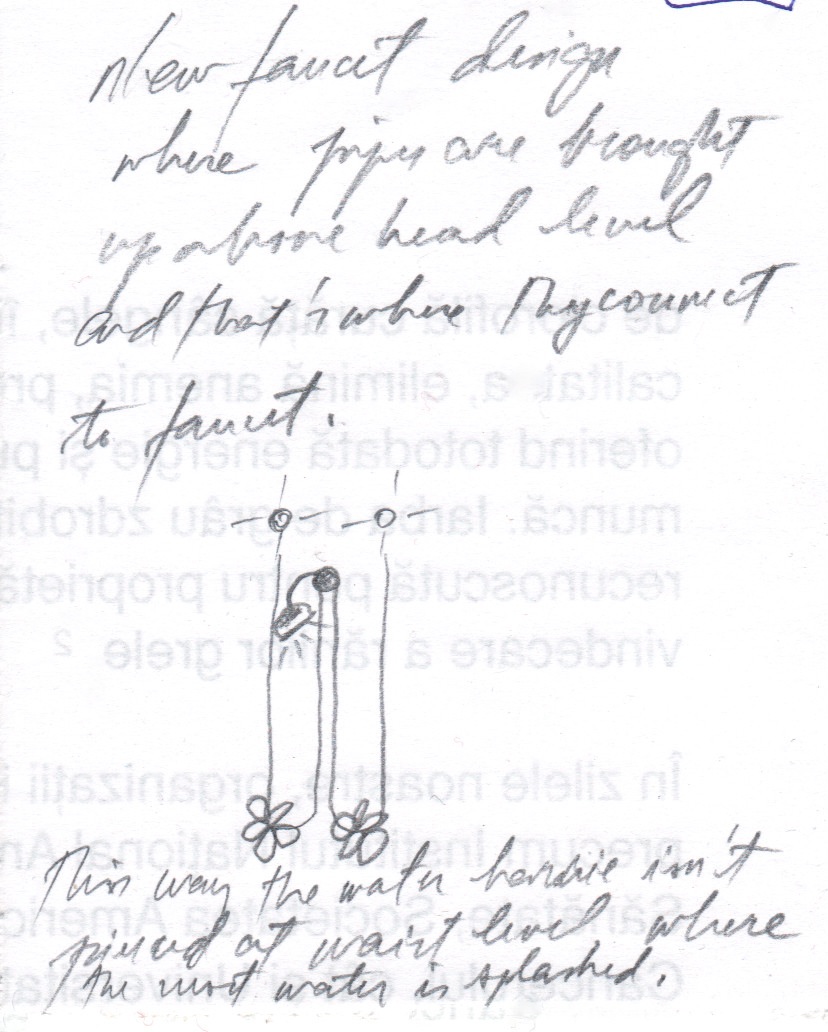
The point here is that the two faucet holes are brought up above head level, above even the shower head, where water is seldom splashed, if ever. The faucet design consists of its two attachment points at the pipes, with hot and cold water lines coming down, exposed, to waist level, where the faucets are located, then continuing upward to the spigot, where they unite (or they could unite down, in-between the faucets, then come up to the shower head as one pipe). The shower head can be included as part of the package, or you can attach your own shower head to the faucet assembly.

So, there are three points of attachment for this faucet assembly to the wall. Two at the faucet lines and one at the shower head. There are no screws that connect the faucets to the wall at waist level. There the faucet assembly has two contact points with the wall, dressed in rubber, which can be left as is or secured to the wall with a bit of silicone.

What are the implications of this design? Well, it will clearly be bigger than normal faucet designs. It’s also not going to be for everyone. It’s going to be for those discerning consumers who want to reduce the seepage of water between their shower cabinets and the wall, who want to protect the beauty of their shower walls, and who are interested in a new design.

It also means that the builders will have to be clearly instructed where to place the new faucet holes. This faucet will need to purchased ahead of time and its exact location determined before the bathroom walls are laid with tile or marble or precious stones. It also means existing bathrooms cannot be fitted with this new faucet unless significant modifications are undertaken to the shower cabinet.

Like I said, this new design isn’t for everyone. It’s for certain discerning consumers.

Standard
A Guide To A Good Life

Details of things in our home

You know how you get an urge every once in a while to grab your macro lens and go nuts photographing things? Well, this was one of those evenings when the macro bug bit me. It’s stuff I found in our home, way back in 2006. Enjoy!

Standard
How To

My bed frame comes to life in Latvia

Armands PodoÄĽskis, a reader from Latvia who saw my bed frame article and watched the videos where I showed how I made it, wrote to me recently:

I would like to thank you very much for your videos of how to make bed frame. They were very useful. I used them to make bed myself. I’m from Latvia, EU country. This is great that you can share something valuable and others can use it in the other side of the world 🙂

You’re welcome Armands, I’m glad I could help!

With his permission, here are a couple of photos of his bed frame.

If you’d like to make a bed like this one, feel free to do so. Read through my original article and watch the two videos I posted in it as well. (Just don’t ask me for the plans and exact dimensions of every part, because I lost them during some renovation work.) It’s easy, inexpensive, a lot of fun and you’ll end up with a very sturdy bed!

Standard
A Guide To A Good Life

An antique Audi at Tess Auto

We were at Tess Auto in Ghimbav (near Brasov) for service to our car recently, and we saw this beautiful antique Audi on display in the showroom. The car was so old the logo still said “Auto Union” across the four circles.

They sure don’t make cars with these designs any more. About the only company still around who makes such beautiful cars is Morgan.

I realize these designs aren’t aerodynamically efficient and they aren’t meant for high speeds. It’s also possible that the drag coefficient may be higher, meaning fuel efficiency could be better. But cars like these had something modern cars can never have: life — an organic feeling to the design which gave them life and draws our eyes to this day.

Standard
Thoughts

Why are we still syncing in iTunes?

What I have to talk about has to do with these two apps, which are closely related and happen to sit right next to each other in my Apps folder: iSync and iTunes. We could call it part 2 in a series of posts where I look at things that don’t sit right with Apple computers (here’s part one). I don’t intend to become a critic of Apple, but I think it only right to point things out when they don’t make sense.

I’ve always been bothered by the fact that the syncing of our devices (iPods, iPhones, iPads) takes place in iTunes and not in an application dedicated to the syncing of external devices, designed from the start for this purpose, like iSync.

Perhaps at the get-go, when the iPod had just gotten released, and there was only music on it, it made sense to tie it into iTunes. But now, when most iPods do a lot more, like sync contacts, calendars, TV shows, movies and apps like video games and more, why are we still syncing in iTunes? It makes no sense to shoehorn all those syncing functions into an app designed for the organization and playback of our music.

While I’m on the subject, why is it still called iTunes? It also organizes and plays podcasts, TV shows, movies and books. Shouldn’t it be renamed to something like iMedia? (Disclaimer: I haven’t given a lot of thought to the new name, but I know iTunes doesn’t quite fit anymore.)

Back to iSync — doesn’t it make much more sense to sync devices in it? Shouldn’t it be the go-to-app for all our devices? Shouldn’t it sit prominently in the dock, and be the button we click when we connect a device, whether it be through USB or through WiFi?

It’d be a fairly easy task for Apple to take the whole syncing process out of iTunes and place it within iSync. Then, we’d see something like this when we opened iSync.

Instead, what Apple did with the new OS X version, Lion, was to take iSync out entirely. I had to go back through my Time Machine backups in order to resurrect it and restore it to my Apps folder. Their move makes no sense whatsoever!

I’d like to issue a challenge to Apple: bring back iSync, properly re-written as a syncing app for all Apple devices, and slim down iTunes — also, rename it to something more appropriate that reflects the many media files it can handle these days.

Standard