How To

Do not allow websites to resize your browser window

Websites that resize my browser’s window or maximize it are completely annoying. When someone does that to me, no matter how interesting their content may be, I go somewhere else instantly. Fortunately, there’s a way to block anyone from messing with my browser windows or tabs in Firefox. Here’s how to do it:

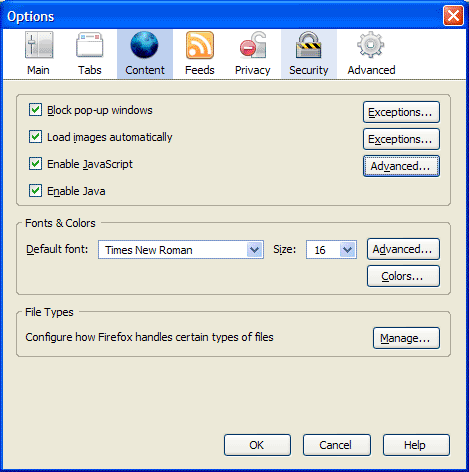
First, go to Tools >> Options, then click on the Content icon in that dialog box. It should look like this:

Firefox content options

Now click on the Advanced button next to the “Enable JavaScript” checkbox. You’ll get the following dialog box:

Firefox advanced javascript settings

Make sure to uncheck the following options:

  • Move or resize existing windows
  • Raise or lower windows

Click on the OK button twice to save the changes, and then you’re done. This will disallow any website to adjust the size of your browser window. It’s a great way to make sure your browsing experience stays yours.

Standard
Thoughts

When animation trash gets called art

Last year, I stumbled over the blog of one of the directors for the Ren & Stimpy cartoons, by the name of Vincent Waller. I subscribed, curious to see what one of the people who’d worked on that horrible cartoon was doing nowadays. It didn’t take long for me to find out…

A few days later, he blogged about a cartoon made by one of his fans. He lavished so much praise on it that I watched it. It was an utter bunch of filth, filled with suggestive sex, curse words, violence and bestiality. It was done in the style of the Ren & Stimpy cartoons — same sort of animation, similar character movement, similar colors, etc.

I left a comment on his post, telling him that I couldn’t believe he’d posted that garbage to his blog. I honestly thought the guy knew better than that, but I was wrong. He deleted my comment. I left a subsequent comment. He deleted that as well. I contacted him via email. He answered back and seemed somewhat rational. I thought I might have a decent conversation with him, and I asked him out of sheer curiosity why the Ren & Stimpy cartoons ever got made. What was the rationale behind them? I told him I found them depressing altogether, and I found the subject matter crude and filthy. I said that as a child, I wanted to see cartoons on TV, and very often, only Ren & Stimpy were on in the evenings, so I had to watch them if I wanted to watch any cartoons at all.

He told me to go away and not bother him again. He said that there was something wrong with me, that I should have watched something else, and that he and the series creator happened to like them, and that’s why they got made. That was the end of that conversation.

But, it got me thinking about the people behind Ren & Stimpy and the other horrible cartoons that our children can watch on TV nowadays, or were able to watch until not long ago — stuff like Beavis and Butt-head, for example.

These people make this horrible crap that appeals to their sick and twisted minds, filled with all sorts of suggestive behavior and language meant for adults, and they put it on TV, where it gets shoved by the cartload into the minds of our children. Do they take any responsibility for their actions? No, they do not. They blame the viewer for watching their stuff if he or she complains.

What they also do not want to recognize is that stuff that’s on TV carries weight with people (yes, it still does, in spite of widespread cynicism). If it gets shown on the air, people assume it’s been vetted and there’s some merit to it. It’s a false assumption, I know, but most adults don’t know this, much less the children. They don’t know the stuff is crap. If it’s on Nickelodeon or the Cartoon Network, it must be good, right? Wrong.

Generally speaking, crap cartoon shows get made because the creator is friends with a network exec, or he’s worked on a successful series and can now pitch his idea with some leverage. But that doesn’t mean that these shows are any good or that they’ve been vetted responsibly. It only means they got into the channel through the back door, and yes, they smell like it, too. What’s more, series creators and directors often get “artistic freedom” once a show has been approved. Execs don’t dare censor stuff, because that would stifle the series’ “creativity” — and I use that word very loosely in this context. So a bunch of weirdos with no self-control get to put together shows that get shown to children. What’s more, they absolve themselves of any blame whatsoever if children are influenced negatively by their work, and call people who protest “legless, armless lumps” (that’s the term used on me by that director I mentioned in the first paragraph), because they should know better than to watch their stuff.

They do not want to acknowledge, however, that children do not yet have the power to filter things properly. They don’t have a fully developed moral compass, and more often than not, choose to sit in front of the TV and hope that something good is on. Or, these thoughtless, immature “artists” also pull out the parent argument. They say that parents ought to monitor what their kids watch. Well, it’s a bit difficult to do that when you’re at work and your child is at home. Nickelodeon and Cartoon Network are supposed to be fairly safe channels, so you can’t just disallow them altogether. If you can’t even allow them, what can you allow?

But does any of this register with them? No. All they care about is making their crap, expressing themselves “artistically”, and getting paid for making their crap.

The sad thing is that the creator of Ren & Stimpy (whose name is not worth mentioning here) is now enjoying some sort of fame, since he was one of the few people who still adhered to the old animation methods (storyboards, character development, hand drawings, etc.) when he made Ren & Stimpy. He’s getting praised on various animation sites for that, and for contributing heavily to the ASIFA-Hollywood Animation Archive.

I think ALL of that praise is misplaced… You can follow all of the right methods, you can make all the storyboards you want, you can draw painstakingly well, but if your original vision is horrible, the end result will be horrible as well. Ren & Stimpy should have never made it to TV. It should have been released to tape, and I bet if that had happened, we’d have it archived in obscure, seldom-seen videos on YouTube, uploaded and viewed by a few animation geeks, because no one else would have liked it.

In spite of the fact that this man is doing his part to preserve a somewhat lost art in animation, he’s a poor example of putting that art to work. Judging by the stuff he’s created so far, he’s not fit to hold a candle to Preston Blair or any other of the Golden Age animators he is aping. There’s a LOT to be said about censorship in animation, and Disney, in spite of all his shortcomings, had a very, very bright idea when he kept an iron grip on what got made and put out at his company. He made sure it was okay to show to children. The man was a genius.

I’ve done a lot of talking about bad cartoons in this post. What about good cartoons? What cartoons do I think are appropriate for children? Well, it just so happens that I wrote a post on how to find cartoons for children last year. It’s a good read, so have a look at that. I encourage parents out there, and the younger folks as well, if you’re looking for good cartoons, don’t stop looking, and don’t settle for garbage. Go looking for better stuff. If you have to buy DVDs, buy them. You can also rent from Netflix.

Make sure the stuff you watch is good stuff. You’ll know it’s good stuff because it’s the stuff that makes you feel warm, fuzzy and comfortable when you watch it. When you get up after watching it, you feel happier and better. Look for the good stuff, and let the bad stuff go to waste, because that’s where it belongs.

Standard
Reviews

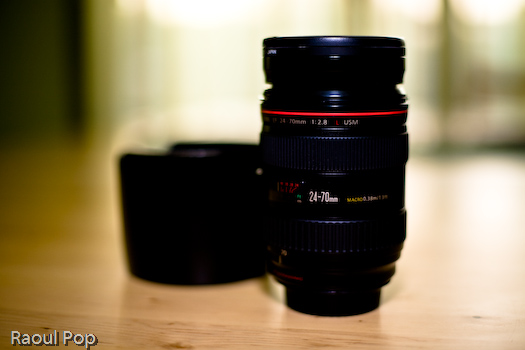
Lens review: Canon EF 24-70mm f/2.8L USM Zoom Lens

The EF 24-70mm f/2.8L USM lens is the professional standard zoom from Canon, and so far the golden standard for sharpness, contrast and bokeh in a zoom lens. Photographers drool over it and swear by it. Its focal range on a full frame sensor makes it very appealing for event photography. It goes from a wide 24mm to an almost portrait-length 70mm to allow for close-ups. It’s also plenty fast for a zoom — f/2.8 — just about the fastest a zoom lens can get these days. (I’d like to see an f/2.0 standard zoom, but I don’t know when that’ll happen, and the cost will probably be fairly high.)

I’m going to talk exclusively about the 24-70mm lens in this review, but if you’re interested, I also wrote a comparison of this lens and the 24-105mm f/4L zoom. You may want to read that as well, in order to get a better idea of how this lens performs.

As you know if you’re a regular reader, I write about how products feel and the results they give me. My reviews aren’t spec-heavy. I give you my honest opinion about a product, and tell you what results I got with it.

With that in mind, the 24-70mm zoom is a good lens. It’s plenty sharp, has plenty of contrast, and the bokeh is great. I liked it. But it’s heavy — really heavy. When you hold it in your hand, it doesn’t feel that heavy, but when it goes on your camera, your wrist really takes a beating, and it feels as if the camera’s body is going to give. This lens is incredibly front-heavy. That means there’s no chance of holding the camera with one hand for long when you use it. On my 5D, it’s really hard to use the lens without a vertical grip, which gives me more finger room. Without the grip, you have to support the lens itself when you take the shots, and then you have to be careful that you don’t grip the focus ring and impede the auto focus from rotating when you press the shutter button. I use a keyboard and mouse all day long, so I realize I may not be the strongest guy around, but I lift weights once or twice a week. Still, I tell you, this lens really took its toll on my wrist joint and finger muscles. It was a real workout. I didn’t expect this kind of weight from a standard zoom. I did expect it from the EF 70-200mm f/2.8L IS USM zoom. If you’re so results-oriented that you’re willing to overlook the weight, great, get it, you’ll love the results.

I mentioned the useful focal range above. Let me illustrate it with a few examples below. At the wide end, you can capture beautiful landscapes… or nice wide angle shots of buildings. At medium range (30-60mm), you can get photos like these. The lens also has a very useful close-focusing range (0.38m), which allows you to get close-ups like you see below.
Let’s talk about low light. This lens has no image stabilization (like the 24-105mm zoom) and that means the maximum aperture of f/2.8 starts to show signs of strain in low light. It means we have to bump up the ISO and make sure the shutter speed stays at or above the focal length, stabilize the camera, and/or use a flash. Like I said in the opening paragraph, this isn’t a fault of the lens — f/2.8 is the fastest aperture for a zoom lens on the market, so that’s just how things are.

I enclosed a few photos taken in low light above. The first was taken inside a piano store, and although there was plenty of fluorescent lighting, I found that it wasn’t quite enough to shoot freely, like I would have done with a faster prime lens. I can’t argue with the sharpness and bokeh though. It’s beautiful.


There’s a second interior photo, where I had to use a speedlite. I used the 580EX II, also from Canon, and bounced it off the white ceiling. The lens does fine with a good speedlite, so that’s no problem.

The last two low light photos were taken in downtown Bethesda at night. For the first, I stabilized the camera with both hands on a balustrade in order to take it. The second photo of a VW Bug was taken handheld from a lower angle.

A lot of photographers use this lens for portraits, so I thought I’d show you a portrait I took with it as well. It’s on my wife’s website, Fun Piano Lessons. The tele end of the focal range is just right for portraits, and the sharpness, contrast and bokeh are great, especially with a wider aperture like the f/4 used in that photo.

All in all, this is a lens that does not disappoint. I expected professional results when I used it, and got them, without a doubt. The only two things that I minded were the weight — in particular its front-heavy distribution — and the lack of image stabilization. But if you were to get this lens and the EF 70-200 mm zoom, you’ll have covered most of the useful focal range you’ll need with just two very versatile lenses. Some food for thought there.

More information:

Standard
Reviews

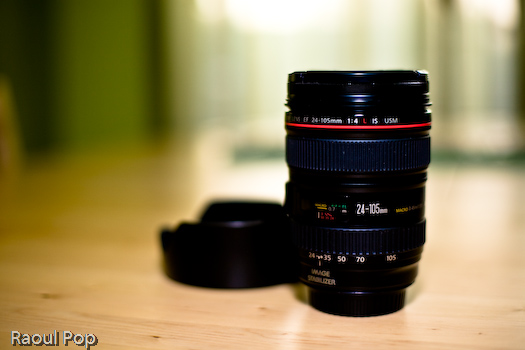
Lens review: Canon EF 24-105mm f/4L IS USM Zoom Lens

I’m going to talk about the Canon EF 24-105mm f/4L IS USM Zoom Lens in this review. It’s a wonderfully versatile L series zoom with surprising image quality and great image stabilization built right in. I’m also going to show you lots of photos I took with this lens, to illustrate the various points I’m about to make.

If you’re interested, I also wrote a comparison of this lens and the EF 24-70mm f/2.8L zoom. It might help you decide which lens to get if you’re interested in purchasing either of them.

EF 24-105mm f/4L IS USM Zoom Lens

So, that’s the lens, right there on my table. It’s not as tall as my 100mm macro, but it’s also heavier, which is to be expected. There’s a lot more glass in zoom lenses. When you turn the zoom ring, the barrel extends outward. There’s some zoom creep, but that’s pretty much a “feature” on all zoom lenses I’ve tried, including other, more expensive zoom lenses.

I found its range to be just what the doctor ordered. At the wide end, the 24mm is great for landscapes or other interesting compositions, like you’ll see below, and at the tele end, 105mm is great for portraits and for bringing in distant details. Believe me, there’s a ton of difference between 70mm and 105mm when you’re trying to focus on some distant object. That extra reach is great! (By the way, I just dropped a hint in this paragraph. Did you catch it? It has to do with the 24-70mm f/2.8L zoom… There’s a review of it coming soon.)

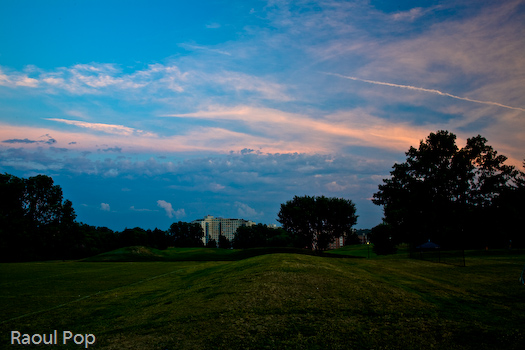
The photo below was taken at 24mm after sunset, on a tripod.

Dusk

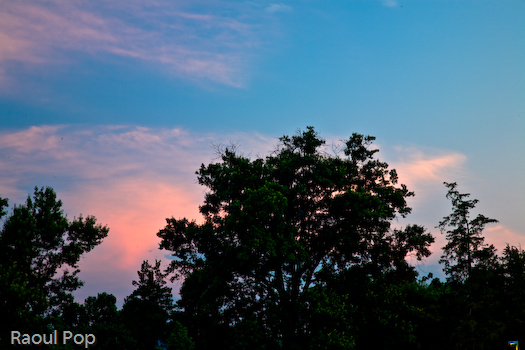
This one was taken from the same spot, but at 105mm. See how versatile the focal range really is?

Dusk II

I mentioned something about interesting compositions at wide angles above. Here’s one:

Goaty

I had doubts about this lens. After all, the 24-70mm L series zoom costs the same, yet it has no image stabilization and the focal range is shorter. How could a lens that packs in a longer focal range plus IS be as good as the other and at the same price? Let’s not also forget that Canon offers this lens as a kit lens for the 5D. Granted, it is an L series, but still… right? Well, prepare to be surprised.

I went to downtown Bethesda at night, and shot handheld, with the IS turned on. Keep in mind that the widest this lens will go is f/4.

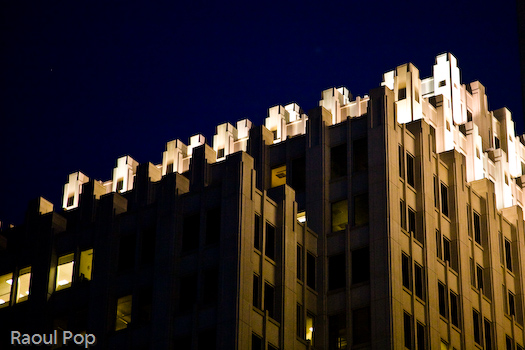
Crenels

The photo above was taken at a shutter speed of 1/15th sec, handheld. At 1:1, those crenels are still sharp. But wait, that’s not all… The photo below was taken at a shutter speed of 1/8th sec — I propped my elbows on a balustrade to take it:

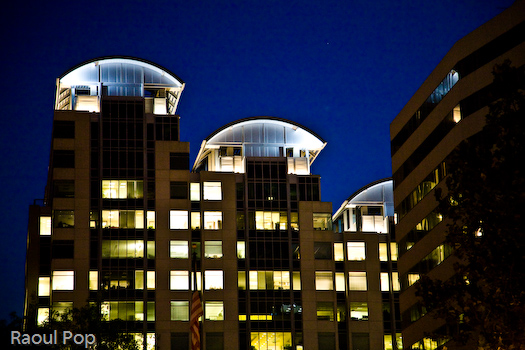
Arches

The details here are even sharper than in the previous photo. In my book, this means the lens is great in low light for a zoom. Nothing can beat my 24mm or 50mm primes at f/1.4, but there’s no mistaking the fact that the IS built into this lens does a great job of compensating for the smaller maximum aperture.

What about the contrast, sharpness and bokeh, you ask? Well, let’s look at a few photos:

Tiled

The photo above was taken at close range, almost macro range. I believe I switched to manual focus when I took the shot. I was so close the AF stopped working. I did very little post-processing to the shot, and certainly didn’t alter the colors. The lens plus the camera did most of the work, including enhancing the colors present on that old barn. Having been there in person, I know the colors were more faded.

Here’s another photo taken at close range:

Waking up to this

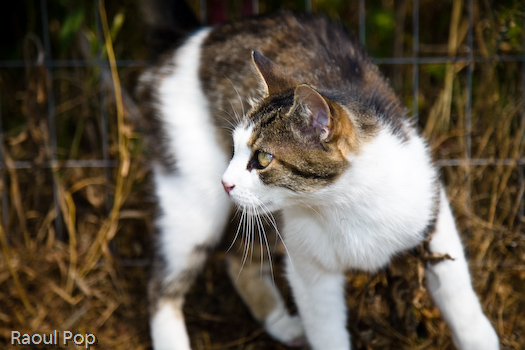
Look at the photo of the cat below. When I downloaded the photos from my 5D and looked at it, I was struck by how 3D it felt. The sharpness is all there, even at 1:1, the contrast is beautiful, the colors are great. That’s when it hit me: this lens is really good!

Mr. Whiskers

Let’s talk bokeh. Every lens has its approximate sweet spot when it comes to it. Stray from that proper distance to focal range ratio, and the bokeh looks all screwed up. Some lenses are better than others, and produce great bokeh across a larger focal range. I think this is one of those lenses. The bokeh isn’t entirely creamy, like you’d get with a fast prime opened up all the way — remember, it can only open to f/4 — but the bokeh’s there, and it does its job, which is to bring out the subject and fade out everything else pleasantly. Have a look at the photos shown below, and you be the judge:

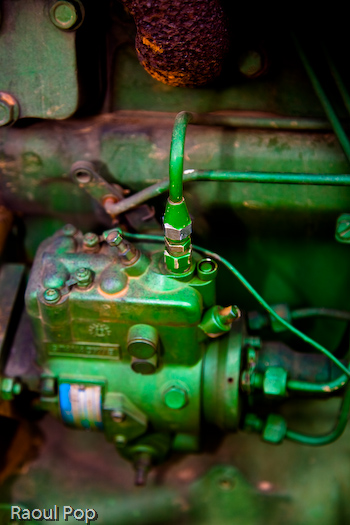
Thingamajig

Lily

Blackberries

I really appreciated its versatility. I love my primes, but let me tell you, there’s nothing more annoying than missing a shot because I have to switch lenses. Primes are great for controlled conditions — nothing beats them there — but when you’re out and about, you don’t want to be futzing around in your camera bag, looking for your lenses, while your photo op passes by.

Have a look at these next few photos. It felt great not to have to switch lenses and still be able to take all of them.

Silo

She thinks my tractor’s sexy

Lazying about

This is one lens that does not disappoint. It’ll likely stay on your camera body for 70-80% of the time. It’s an L series, so you know it’ll perform over a long period of time. It’s lighter than other L series zooms with similar focal ranges, and the image stabilization works just as I’d expect it. If you’re in the market for one, buy it.

You can find it at:

Peachy

Standard
Reviews

Lens review: Canon EF 70-200mm f/2.8L IS USM Zoom

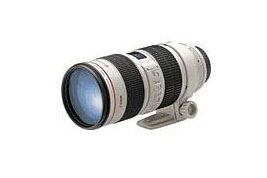
Canon EF 70-200mm f/2.8L Zoom Lens

I rented Canon’s premier mid-range zoom lens, the EF 70-200mm f/2.8L IS USM, and had the chance to play with it for a day. I put it through its paces: daylight, dusk, low light and early morning light. The result: I love it and plan to buy it. This lens works better for my needs than the EF 100-400mm F/4.5-5.6L IS USM, which I rented and reviewed recently.

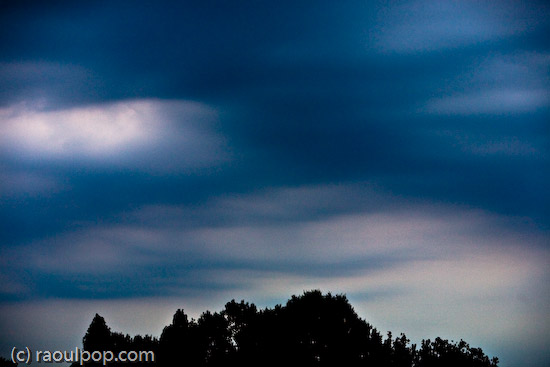
Created beauty

Oh, I rented the EF 1.4x II Extender along with this lens as well, and it worked great. It’ll decrease the aperture from f/2.8 to f/4, but I didn’t find that to be too much of a problem, even in lower light, while shooting handheld. I simply boosted my ISO and switched to Shutter Priority, to make sure my shutter speed stayed above 1/60th of a second.

Deposit

On a full-frame sensor like my 5D, I got exactly 70-200mm, and 98-280mm with the aid of the 1.4x extender. On a cropped sensor like that in the 30D or the Rebel, you’ll normally get 112-320mm, or 157-448mm with the extender. Those are pretty nice ranges indeed.

Slanted

Even though I shot mostly handheld, and for most of the time, in fairly low light (thick forest, ground-level), the image stabilization built into the lens worked great, even with the extender attached. I was able to get clear shots while keeping the shutter speed even below the focal range of the lens. We probably all know about that simple rule of thumb of keeping the shutter speed equal to the focal length, right? Well, I was able to get crisp shots at 1/80 while the focal length was over 100 mm and more. For example, the shutter speed of the photo enclosed below is 1/100 while the focal length was 150mm (with the extender attached). Still, the photo is plenty sharp at 1:1, and that’s pretty good to me.

Taking a break

I have only praise for this lens. It works great! I love the short travel of the focal length selector. It’s amazingly short given the large focal range. I love how crisp and sharp my photos come out. The bokeh is great. The lens handles just like it should, and autofocus times are pretty small. But, it is heavier than the 100-400mm zoom. A LOT heavier. You won’t realize just how heavy it is until you go out there and use it for a couple of hours. Your biceps will get a workout!

Harried hare

I plan to buy it at some point in the future. At $1,500-1,600, it’s not cheap, but it sure is great!

White lily

Nature, unruly

Just ducky

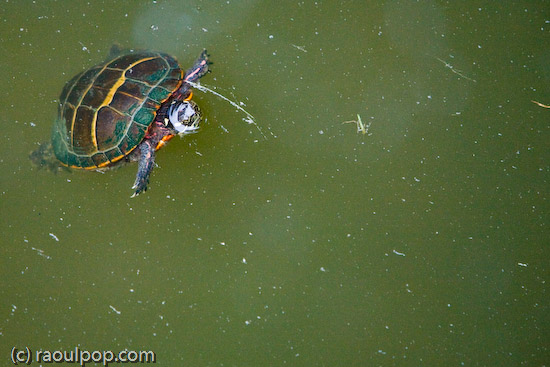
Mr. Turtle comes up for air

White flower bokeh

Burgundy lily

More information:

Standard