Places

Time-lapse videos from Lake Vidraru

We recently visited Lake Vidraru, located in Romania’s Carpathian Mountains, alongside the famed Transfagarasan Road. We hiked, drove off-road, went boating, visited nearby landmarks, so look for more photos in future posts, but in this post, I want to show you two time-lapse videos that I made using photographs taken during the trip. These are my first time-lapse videos, so it is a special occasion for me. I hope you enjoy them!

The first is a record of our boating trip on Lake Vidraru. It’s made up of 628 individual photographs, which I obtained by setting up my camera and tripod up on the bow of the boat, securing it to the mast with a rope and setting my remote to take photos every 10 seconds. It was a bit tricky to get the photos because the boat’s engine made the tripod vibrate quite a lot, plus I didn’t have a straight horizon line, because of the boat’s yawing. It required a bit of post-processing work but I think it came out alright.

The soundtrack is “Sonata No. 5 in E minor – IV Allegro” by Vivaldi, interpreted by Keith Lewis on the cello and Carol Holt on the harpsichord. It is public domain, available from MusOpen.

The second video came out much better, mainly because I had a steady surface on which my tripod could sit (that’s really key in time-lapse photography). It shows landscapes of Lake Vidraru, recorded over the course of three days from the vantage point of the Valea cu Pesti Hotel, which overlooks it. It’s made up of 1,920 individual photographs, taken at 5, 10, 20 and 30 second intervals.

The soundtrack is “Piano Concerto No. 3, Op 37, 1st Mvt” by Beethoven, interpreted by the Davis High School Symphony Orchestra. It is also public domain, available from MusOpen.
Standard
Thoughts

A new faucet design

I had an idea recently about a new faucet design. (If you’ve been reading my website for some time, then you may remember I post my ideas here — when I remember to write them down and don’t forget them.)

When you look at a shower, right after it’s been used, you’ll see the splash line is somewhere at chest or shoulder level. Very little water goes above that line, unless you’ve been monkeying around in there.

If you’ve also seen the pipes being put in for a shower, and the faucets also being put in, you’ll know that first the pipes have to be laid in the wall, then the tiles placed over them, making sure to leave two holes with the appropriate hot and cold water connections for the faucets. And these holes happen to be right at waist level, where it’s easy for most people to reach the faucets — and where most water also happens to splash.

What you’re essentially doing is piercing the water barrier (the tile or marble wall) with two big holes right where you throw the most water. If you’re concerned about water seepage into your wall, or if your walls already have water issues, then this isn’t the smartest thing to do. Plus, there’s a lot of mildew that accumulates around those two holes, and no matter how much silicone you put there, you still get mildew and overtime, you still have water seepage into the wall.

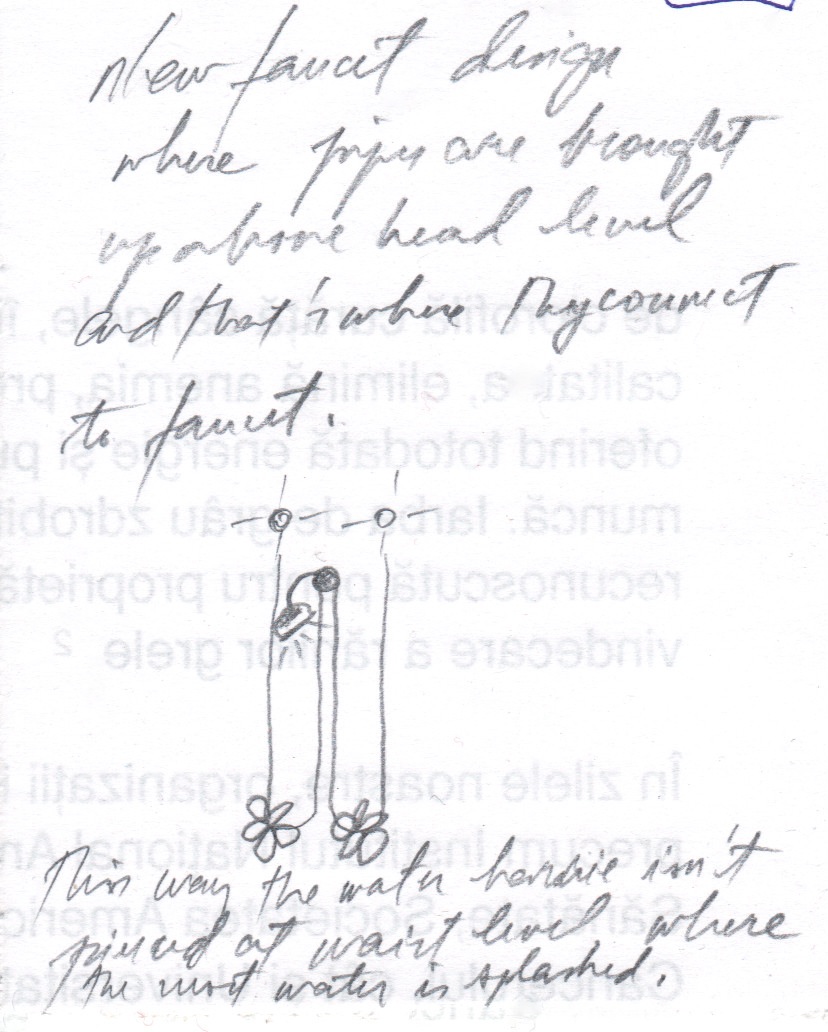
Behold my new faucet design, which does away with this problem. I scribbled it down on a piece of paper when I got the idea.

The point here is that the two faucet holes are brought up above head level, above even the shower head, where water is seldom splashed, if ever. The faucet design consists of its two attachment points at the pipes, with hot and cold water lines coming down, exposed, to waist level, where the faucets are located, then continuing upward to the spigot, where they unite (or they could unite down, in-between the faucets, then come up to the shower head as one pipe). The shower head can be included as part of the package, or you can attach your own shower head to the faucet assembly.

So, there are three points of attachment for this faucet assembly to the wall. Two at the faucet lines and one at the shower head. There are no screws that connect the faucets to the wall at waist level. There the faucet assembly has two contact points with the wall, dressed in rubber, which can be left as is or secured to the wall with a bit of silicone.

What are the implications of this design? Well, it will clearly be bigger than normal faucet designs. It’s also not going to be for everyone. It’s going to be for those discerning consumers who want to reduce the seepage of water between their shower cabinets and the wall, who want to protect the beauty of their shower walls, and who are interested in a new design.

It also means that the builders will have to be clearly instructed where to place the new faucet holes. This faucet will need to purchased ahead of time and its exact location determined before the bathroom walls are laid with tile or marble or precious stones. It also means existing bathrooms cannot be fitted with this new faucet unless significant modifications are undertaken to the shower cabinet.

Like I said, this new design isn’t for everyone. It’s for certain discerning consumers.

Standard
Places

A swan preens itself

A large white swan preens itself while floating on a pond, on a hot summer day. I filmed this at the same location as the stag.

I’ve never seen a water fowl hold one of its feet so persistently in the air while preening. I’ve seen geese do it from time to time, but only for a few seconds. This swan was bent on doing it for a long time! 🙂

Standard
Places

The dancing Fountains of Bellagio at night

Most people will likely tell you the Fountains of the Bellagio Hotel and Casino are easily the coolest thing in Las Vegas. I agree. They are spectacular. I have never seen excess put to better use — and let me tell you, a huge lake that shoots water hundreds of feet in the air, in the middle of the Nevada desert, where any water demands a high premium, is excessive. These fountains left me breathless, awestruck, every time I saw them, and we made sure to catch several shows while we were there.

This is one of those shows, filmed by me at night, from the Northeast corner of the lake, at the intersection of Las Vegas Blvd and Flamingo Rd. The fountains danced to a famous tune crooned by Frank Sinatra, called “Luck Be A Lady”. Enjoy!

Watch video on YouTube | blip.tv

Wow. That is one word that really says it all when it comes to this.

Standard
How To

How much water should I drink daily?

Falling upwards

Several years ago, the common advice was 6-8 cups of water a day. Lately, I’ve been hearing 8-10 cups a day. Thankfully, there’s a easy formula you can use to calculate the amount you need.

½ * bodyweight = x ounces of daily water

I didn’t come up with this on my own. It’s a formula you can find on the Hippocrates Health website. So let’s see, for my 160 lbs. body, I’d need 10 cups of water per day.

½ * 160 = 80 ounces / 8 = 10 cups of daily water

For those of you on the metric system, 1 ounce is about 25.6 ml, and 8 ounces (1 cup) is 237 ml (or a little more than a quarter liter).

For my needs, that would work out to 2.36 liters per day. It’s really not that much, particularly on these hot summer days. The sad thing is I’m not drinking enough, and then I end up with these monster headaches. The lack of water may not be the main reason, since I’ve got plenty of other things going on, but it sure is one of the contributing factors.

Standard