Those of you who follow my blog know I love color. I always look for ways to increase the intensity and range of the colors in my photos. I like to call it WCR (Wide Color Range). Who knows what it’s really called… Since I’m self-taught, that’s what I call it. I wrote recently about one of the ways I post-process my photos, and have gotten a lot of great feedback on that method. But it’s not suited to every situation. While it works very well for architecture, some nature, and even some portrait photography, the colors get to be too harsh in other situations.
So I started to experiment, and found that Lightroom is quite capable when it comes to achieving most of my post-processing goals. I really like the ability to make tonal and individual color adjustments without opening Photoshop. For example, I find Lightroom’s heal tool much easier to use than the heal tool in Photoshop. There’s a very practical reason for preferring to work in Lightroom as well, and it’s this: every time I transfer a RAW image to Photoshop, it turns into a 45MB file. Add an extra layer, and it doubles in size. That means every finished PSD or TIF file gets to be anywhere from 90-135MB or more. Compare that with 7-8MB for the original DNG file, and you can see how quickly hard drive space becomes an issue, particularly when a typical photo session of mine yields about 300-400 photos or more.
The key to using Lightroom (at least for me) is to be bold, to not be afraid of potentially ruining a photo. There’s always the reset button in case my results are off the mark. That means I can experiment all I want, non-destructively, which is hugely beneficial.
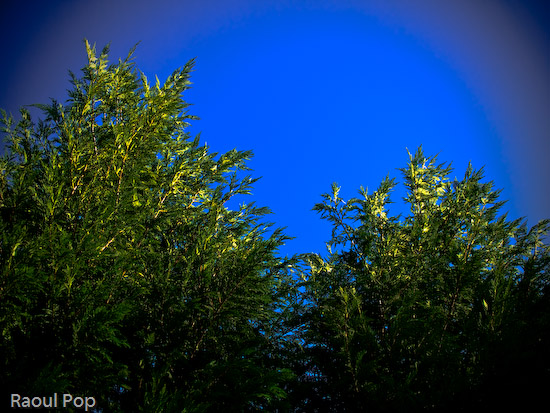
Here are a few of my recent results with Lightroom. In this photo, the sky was a fairly colorless light blue, though there were some tonal differences that allowed me to change hues and their intensity and really bring out the greens.
Here the sky was a light blue, but I wanted a different look, since I have tons of tree photos in my library.

This was fairly simple, just slight vignetting with blue and green color enhancements, but I really like the result.

This one was a bit more complicated, with lots of tonal, hue, saturation and lightness adjustments. I really like how all of the trees are straight, spaced closed together, and yet still allow a nice view of the horizon. That’s why I photographed them.

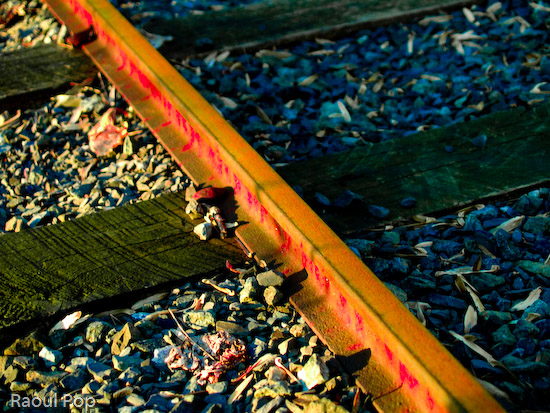
There was no blood on the tracks in this photo, nor was there any red paint. There were some dark orange rust spots though. I changed their hue from orange to dark red in Lightroom, then increased that particular color’s saturation. Finally, I decreased that color’s lightness in order to darken it. In real life, those railroad tracks look perfectly normal, though rusty from a winter’s disuse.





 Raoul Pop