Reviews

The Ambassador's Daughter (1956)

The Ambassador’s Daughter (1956)We watched it tonight and liked it. It’s a funny romantic comedy full of light laughs. The script’s somewhat thin at times — some of the plot twists are sewn with white thread, as they say — but the acting’s great, in particular that of Olivia de Havilland, who plays the title role. What’s also a rare treat is the location: Paris in the 50s — need I say more about that? The movie’s in color, in spite of the black and white screenshot (which was the only one I could find).

Overall, the movie’s easygoing, and it’s really a wonderful movie for a quiet evening at home. It’s about an innocent, unlikely romance between the daughter of the American ambassador to Paris and an American soldier on leave. It starts out as an experiment for her, but ends up serious, and with a very happy ending.

The movie also has Myrna Loy, and that’s a treat as well. If it only had Bill Powell, too, but you can’t have everything, can you? John Forsythe plays the American soldier. I’d never heard of him before this movie, but he played his part very well.

Pick it up and relax with your significant other while you watch it. It’s a quiet, nice little movie that’ll let you have a peaceful night’s sleep afterwards.

More information:

Standard
Reviews

The future of image resizing is here

If you think you’ve got it pretty good with Photoshop and Genuine Fractals when it comes to image resizing, think again. Here comes a new technology, developed by Dr. Ariel Shamir, called Content-Aware Image Sizing, that will literally blow away our current concepts of image sizing and cropping. Yeah, it’s that good! I don’t often gush about products, but I would absolutely LOVE to see this software integrated into Photoshop.

You can see the original video here, but know that it’s really slow to load, at least today. It’s also been uploaded to YouTube.

Adobe, are you listening? Please buy this and integrate the functionality into Photoshop.

Standard
Reviews

Lens review: Canon EF 24-105mm f/4L IS USM Zoom Lens

I’m going to talk about the Canon EF 24-105mm f/4L IS USM Zoom Lens in this review. It’s a wonderfully versatile L series zoom with surprising image quality and great image stabilization built right in. I’m also going to show you lots of photos I took with this lens, to illustrate the various points I’m about to make.

If you’re interested, I also wrote a comparison of this lens and the EF 24-70mm f/2.8L zoom. It might help you decide which lens to get if you’re interested in purchasing either of them.
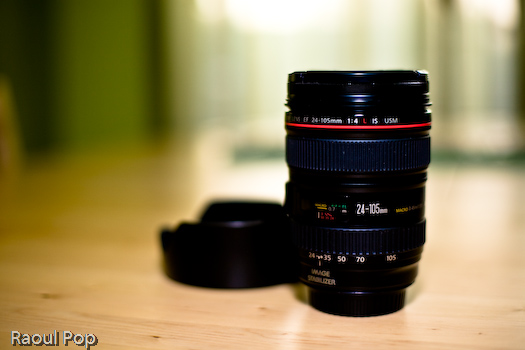
EF 24-105mm f/4L IS USM Zoom Lens

So, that’s the lens, right there on my table. It’s not as tall as my 100mm macro, but it’s also heavier, which is to be expected. There’s a lot more glass in zoom lenses. When you turn the zoom ring, the barrel extends outward. There’s some zoom creep, but that’s pretty much a “feature” on all zoom lenses I’ve tried, including other, more expensive zoom lenses.

I found its range to be just what the doctor ordered. At the wide end, the 24mm is great for landscapes or other interesting compositions, like you’ll see below, and at the tele end, 105mm is great for portraits and for bringing in distant details. Believe me, there’s a ton of difference between 70mm and 105mm when you’re trying to focus on some distant object. That extra reach is great! (By the way, I just dropped a hint in this paragraph. Did you catch it? It has to do with the 24-70mm f/2.8L zoom… There’s a review of it coming soon.)

The photo below was taken at 24mm after sunset, on a tripod.
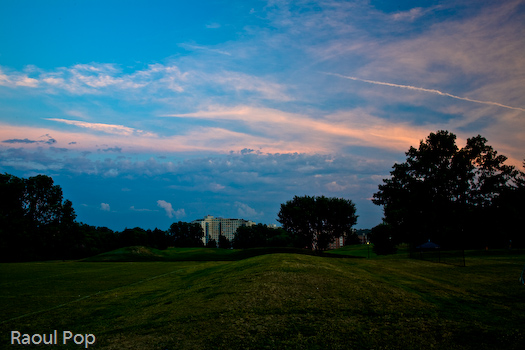
Dusk

This one was taken from the same spot, but at 105mm. See how versatile the focal range really is?
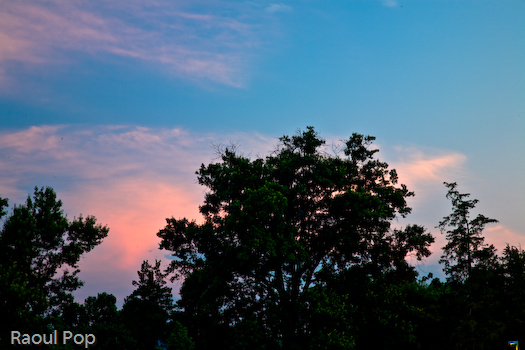
Dusk II

I mentioned something about interesting compositions at wide angles above. Here’s one:

Goaty

I had doubts about this lens. After all, the 24-70mm L series zoom costs the same, yet it has no image stabilization and the focal range is shorter. How could a lens that packs in a longer focal range plus IS be as good as the other and at the same price? Let’s not also forget that Canon offers this lens as a kit lens for the 5D. Granted, it is an L series, but still… right? Well, prepare to be surprised.

I went to downtown Bethesda at night, and shot handheld, with the IS turned on. Keep in mind that the widest this lens will go is f/4.
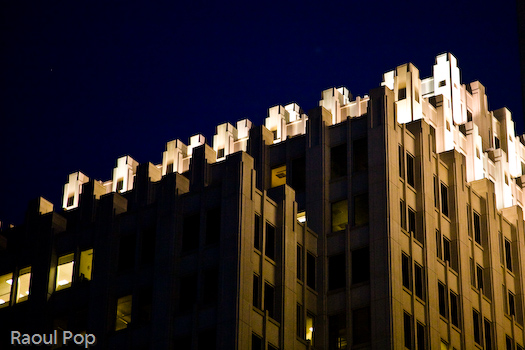
Crenels

The photo above was taken at a shutter speed of 1/15th sec, handheld. At 1:1, those crenels are still sharp. But wait, that’s not all… The photo below was taken at a shutter speed of 1/8th sec — I propped my elbows on a balustrade to take it:
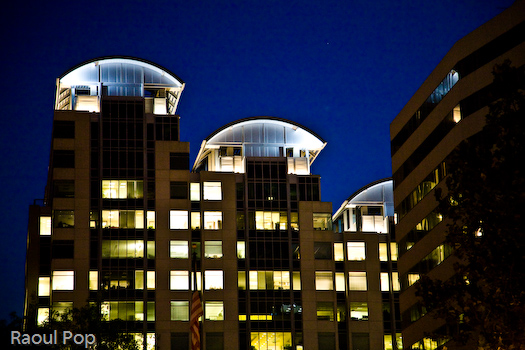
Arches

The details here are even sharper than in the previous photo. In my book, this means the lens is great in low light for a zoom. Nothing can beat my 24mm or 50mm primes at f/1.4, but there’s no mistaking the fact that the IS built into this lens does a great job of compensating for the smaller maximum aperture.

What about the contrast, sharpness and bokeh, you ask? Well, let’s look at a few photos:

Tiled

The photo above was taken at close range, almost macro range. I believe I switched to manual focus when I took the shot. I was so close the AF stopped working. I did very little post-processing to the shot, and certainly didn’t alter the colors. The lens plus the camera did most of the work, including enhancing the colors present on that old barn. Having been there in person, I know the colors were more faded.

Here’s another photo taken at close range:

Waking up to this

Look at the photo of the cat below. When I downloaded the photos from my 5D and looked at it, I was struck by how 3D it felt. The sharpness is all there, even at 1:1, the contrast is beautiful, the colors are great. That’s when it hit me: this lens is really good!
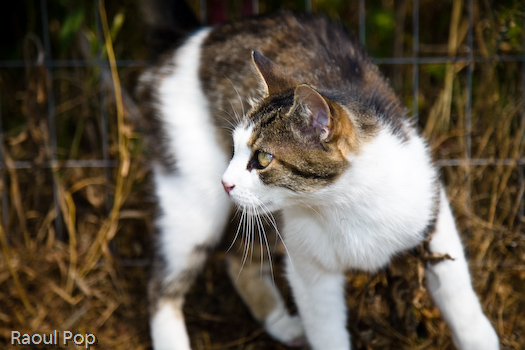
Mr. Whiskers

Let’s talk bokeh. Every lens has its approximate sweet spot when it comes to it. Stray from that proper distance to focal range ratio, and the bokeh looks all screwed up. Some lenses are better than others, and produce great bokeh across a larger focal range. I think this is one of those lenses. The bokeh isn’t entirely creamy, like you’d get with a fast prime opened up all the way — remember, it can only open to f/4 — but the bokeh’s there, and it does its job, which is to bring out the subject and fade out everything else pleasantly. Have a look at the photos shown below, and you be the judge:
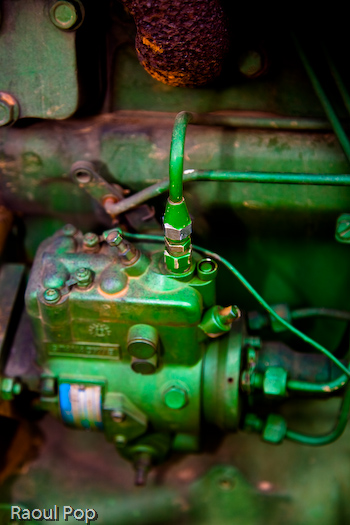

Thingamajig

Lily

Blackberries

I really appreciated its versatility. I love my primes, but let me tell you, there’s nothing more annoying than missing a shot because I have to switch lenses. Primes are great for controlled conditions — nothing beats them there — but when you’re out and about, you don’t want to be futzing around in your camera bag, looking for your lenses, while your photo op passes by.

Have a look at these next few photos. It felt great not to have to switch lenses and still be able to take all of them.
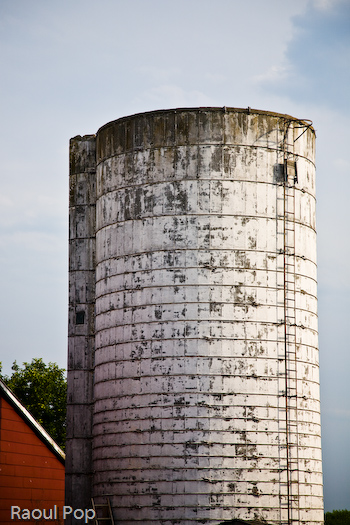

Silo

She thinks my tractor’s sexy

Lazying about

This is one lens that does not disappoint. It’ll likely stay on your camera body for 70-80% of the time. It’s an L series, so you know it’ll perform over a long period of time. It’s lighter than other L series zooms with similar focal ranges, and the image stabilization works just as I’d expect it. If you’re in the market for one, buy it.

You can find it at:

Peachy

Standard
Reviews

Talk of the Town (1942)

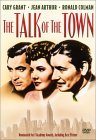
Talk of the Town (1942)This movie features two of my favorite actors: Cary Grant and Ronald Coleman. I thought I saw every one of the Cary Grant movies till I discovered this one at Netflix. When I added it to my queue, I had no idea Ronald Coleman was in it. Imagine my surprise when I started watching it!

Jean Arthur rounded out the cast. While I don’t much care for her looks or voice, I have to appreciate her comedic talents, which had me laughing the whole movie through. Her scenes with Ronald Coleman at the start of the movie are some of the best comedy I’ve seen in a long time.

The plotline goes like this: Leopold Dilg, played by Cary, is unjustly accused of burning down a decrepit old factory and supposedly causing the death of the foreman as well. Only things aren’t that way. Knowing he’s going to get a dud trial, he escapes from jail and hides in a house just outside the town. The house belongs to Nora Shelley (Jean Arthur). She agrees to help him hide out in the house, but unfortunately she has already rented it to Michael Lightcap (Ronald Coleman).

Lightcap is a distinguished professor and dean at an unnamed Boston law school. He arrives early, and hilarity ensues. Meanwhile, the town is whipped into a frenzy by the factory owner, who burned down the factory himself while in cahoots with the foreman. Leopold hides out at the house while disguised as a humble gardener, and works out a plan with Nora to convince Lightcap to take part in his defense. I won’t spoil the rest of it for you. All I’ll say is that we gave it five stars at Netflix.

It was a treat to watch these three talented actors carry scene after scene so elegantly. Cary looks a bit funny as the town activist. It’s always a odd to see him in roles that change the image we’ve come to know and love, even temporarily. I didn’t think I’d gotten so addicted to his classier roles, but there I was, wincing as he put on ordinary clothes. Grant’s darker side also comes through at the start of the movie, and for a few tense seconds, he’s so believable we’re not sure what to think.

The movie also makes a powerful commentary on social justice, and the importance of adhering not only to the letter but to the spirit of the law. The ongoing debate between Leopold and Lightcap throughout the movie serves to outline the differences between these two sides very well. I was glad to see true justice prevail, and to see Lightcap’s metamorphosis from dry scholar to lawman. The truly wonderful thing is that this commentary is all accomplished while the audience is kept laughing. That’s a testament to the great direction of George Stevens and the wonderful story by Sidney Harmon and screen adaptation by Dale Van Every, Irwin Shaw and Sidney Buchman.

More info:

Standard
Reviews

Camera preview: Olympus E-3 DSLR

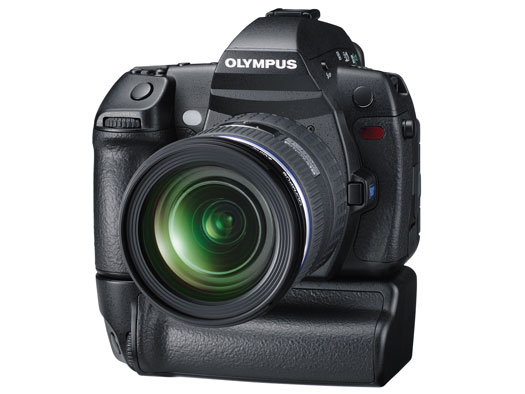
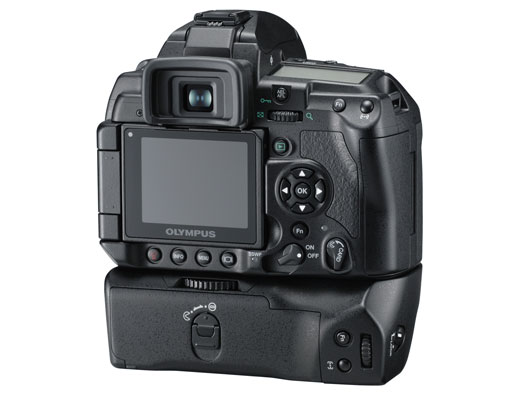
Olympus has been working on their new flagship DSLR, the “new E-1”, now called the E-3, for some time, and word is that it’s going to be launched later this year, possibly in November, or sooner. I’ve seen some concept photos of the new E-3 body, and it looks pretty sweet. They’re not the final version of the camera, but still, I think the E-3 will look pretty close to the photos you see below.

New E-1 (side)

At the Olympus press event I attended on 8/1, I got to play with an old E-1 that belongs to Gene Hirschel of Internet News. The body was surprisingly light and sturdy, and I liked the various on-camera buttons that gave me direct access to functions like ISO, bracketing, white balance, etc.

I really liked the shutter action. It was unlike any other DSLR shutter I’ve tried. The movement was soft and made very little noise. It was muffled, but it felt great to keep pressing the shutter button. I took quite a few photos with it in the span of a few minutes. This is the body of the old E-1:

Old E-1 (front)

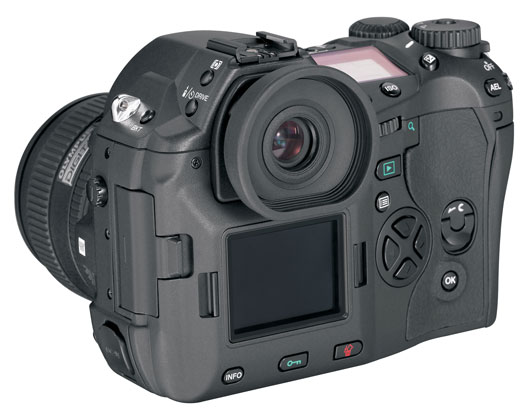
Have a look at the rest of the photos posted below and compare the existing E-1 body with what could be the new one. I’ll be very interested to test and review the new E-1 when Olympus launches it this year.

As you can see, the old E-1 came with a round eyecup, but the new one will likely get the more standard rectangular eyecup. The LCD screen will also be bigger, and quite possibly swivel out, since it will have the innovative Live View feature.

New E-1 (back)

Old E-1 (back)

It also looks like the new E-1 will have a recessed function dial, like Canon DLSRs. I really do think that’s more useful than the fully exposed dial. Having it right there, next to your index finger, saves time, as you don’t need to take your hand off the grip to adjust settings. As a matter of fact, it looks like both function dials will be recessed, which is something I haven’t seen on other cameras. I also like the new On/Off switch.

New E-1 (front)

I also spy an on-camera flash, which would be a new addition. The old E-1 had no flash, much like the Canon 5D. Personally, I prefer no on-camera flash. It’s always better to use an external speedlite, but I guess it is useful for most people to have a simple little flash they could use if they needed it.

All in all, I’m pretty excited about it. If it looks anything like the concept body in these photos, it should be a wonderful design.

Standard