Here are this week’s seven cool gadgets. Did you see last week’s edition of Gadget Monday?
Parans luminaires
A company called Parans has come up with a way to bottle sunlight and deliver it inside office spaces or homes as natural lighting.
The concept is remarkably simple yet works wonderfully. They have sunlight collectors sitting on the roof or exterior walls of a building. They look like this.
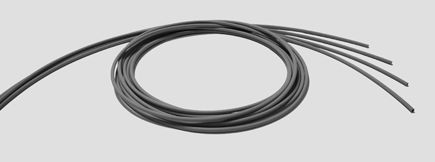
The light then gets concentrated and carried through special fiber optic cables created to preserve all of the light’s characteristics.
These cables are then connected to special light fixtures that diffuse the natural light indoors. They can be panel lights or floodlights.
With this new lighting method, employees or home owners get all of the benefits of natural sunlight in rooms where they normally can’t get it and don’t need to spend money on electricity or electric lighting appliances. I’m not sure what the cost is, but I’d love to see companies take up this new lighting method. Just think, all those employees sitting in tiny cubicles under fluorescent lighting, not seeing the light of day, all day long, all week long, could instead be bathed in natural light, which would cheer them up and boost their productivity.
Someone has come up with this world clock, built in Flash. It shows the time of day where you are in the world, but it also lists all sorts of important statistics, like world population, births, population grown, divorces, cancer incidence, forest lost, species extinct, and deaths. The death statistics are interesting because they’re broken down by reason, such as TB, AIDS, malaria, cancer and others. You can click on buttons that re-calculate the statistics per year, month, day or now. It’s definitely worth a look.
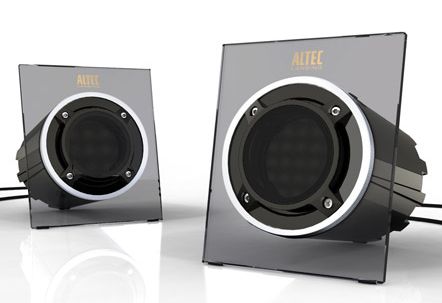
Altec Lansing expressionist CLASSIC speakers
These speakers would go great with an iMac or an all-in-one PC. They have a clear, square face that holds the cylindrical enclosure for the speakers. They connect to your computer through a regular 3.5mm audio cable, and they have an auxiliary input for iPods or other MP3 players as well. The output is 7.5 Watts per channel.
This little device, slightly bigger than a C battery, will turn any USB external drive into a network drive. You simply plug the USB cable into the Addonics NAS Adapter, and you connect the adapter to your router with a standard network cable. Its USB port is powered, which means you can even plug in a small portable USB drive, and you won’t need to worry about connecting it to a separate power supply.
The adapter is compatible with any version of Windows, Mac OS X and Linux (2.6.x and higher). It supports the Samba protocol for up to 64 clients, has a built-in FTP server for up to 8 clients, and can be used as a print server or Bit Torrent client. You can manage it through its built-in web interface. The best part is that it retails for only $55. At that price, it’s a must-have.
This new turbine, created by Massachussetts-based FloDesign, uses jet engine aerodynamics to extract more energy from the wind. It is still a horizontal axis turbine, but its patent-pending design focuses air flow and speeds it up, which means its blades can rotate at lower wind speeds. Because it uses jet engine technology, which is an enclosed design, this means it can also rotate at much higher speeds, and is also safer to be around. The blades orient themselves to the wind automatically because the turbine is equipped with a fin that acts as a windvane. The product hasn’t launched yet, nor is the company taking orders yet, but I for one look forward to seeing this on the market.
There’s also a demo video on YouTube, which explains the technology in more detail.
This neat gadget has rechargeable batteries inside. You plug it into an outlet while you’re at home to recharge its batteries, then take it with you while you travel. If you run out of juice for your iPhone or iPod, you simply plug those devices into the musicPower Encore, and they recharge using the energy stored inside. It’s a neat way to transport the energy you need to keep your toys working. It sells for $20 at ThinkGeek.
The next-generation SD cards, called SDXC (Xtended Capacity), will have increased storage capacity, up to 2 TB, and will have increased read/write speeds as well, anywhere from 104-300 MB/sec. The official specs are due to be released by the SD Association in Q1 of this year, 2009.
A 2TB SDXC card will be able to store about 480 hours of full HD recording, or about 136,000 high-quality photos. Keep in mind the USB 3.0 spec has also been released recently, which means we’ll have USB 3.0 card readers. We’ll be able to store and transfer more data than ever before. I for one wonder if CF cards will continue to be the staple storage device for DSLRs, or whether SDXC cards will replace them altogether.
Look what my sweetheart gave me for Valentine’s Day. It’s a gingerbread heart with the words “I love you” written on it, in Romanian.
This means more to me than any expensive gift. I like practicality. I like that I can eat this gift, and in the act of consuming it, I’m showing her that I love her gift. On the plus side, it also won’t sit around afterward on a shelf, gathering dust, fulfilling no practical purpose than that of decorum.
I think that’s what Valentine’s Day ought to be about. Not necessarily about gifts one can eat, because we should all watch our waistlines, but about gifts that show the other person that they’re loved — small gestures that mean a great deal.
Interestingly enough, those sorts of gifts never really cost much. As a matter of fact, showing your loved one that you still care can be a simple as holding her hand, or hugging her more often, or kissing her. How about treating her nicely, all the time? That doesn’t cost any money, but it does cost you some pride if you need to swallow some harsh words instead of speaking them.
Here’s a photo of us in Predeal, a winter destination for Romanians. It’s nestled in the Carpathian Mountains, and it’s the easy access to skiing and other winter sports that draws people there. We visited it recently. We are at the top of one of the peaks, at the end of the telechair ride, when we took this photo. I sat the camera on a ledge, which is still visible in the lower left corner, and put it in self-timer mode, then stepped back to join my wife.
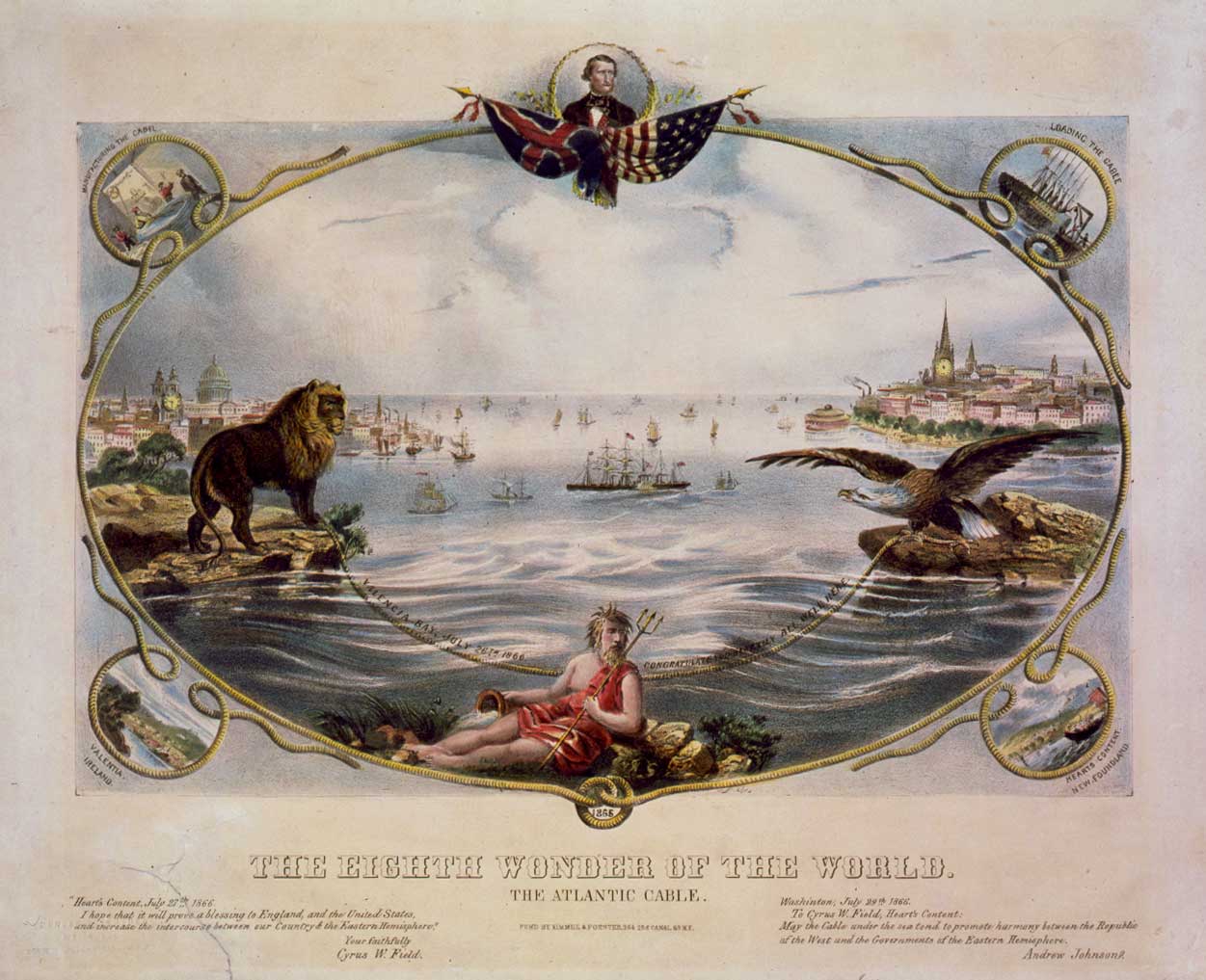
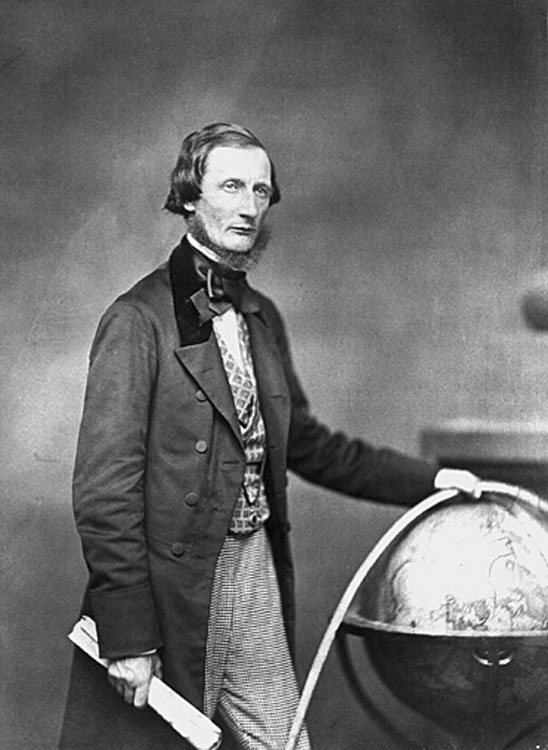
In July 1866, after the successful completion of the project which undertook to lay a single undersea cable through the North Atlantic, from Newfoundland to Ireland, this following commemorative print was created:
The Atlantic Cable was the idea of the New York merchant and financier Cirus W. Field, who wanted to communicate with Europe in hours, not weeks, and in 1854, conducted the first trial of laying a 2,000 mile cable between the US and Europe. The first three attempts were not successful, but in 1866, his persistence paid off, and his cable worked. Needless to say, he was showered with due praise and honors for his efforts — one of them being this print.
When you look at Cirus W. Field, the man, he wasn’t that imposing. He seems to have been of average height and thinner build, and yet, this is the man that laid the foundation of long-distance communication. Isn’t it wonderful what one person can achieve if they set their mind to it?
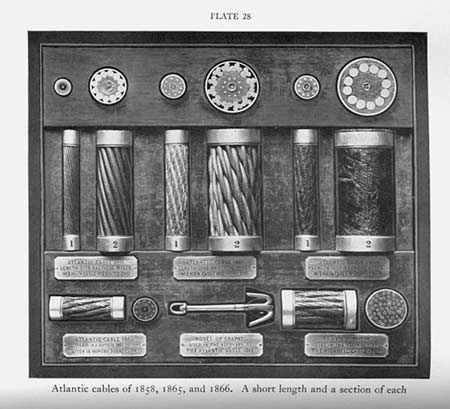
Just how did those trans-Atlantic telegraph cables look? You can see longitudinal and transverse sections of each size in this print:
The cables are quite complex, as you can see above. When you think that 2,000 miles of these cables had to be made, from scratch, in the mid 1800s, it’s no wonder they were at the time called the Eighth Wonder of the World.
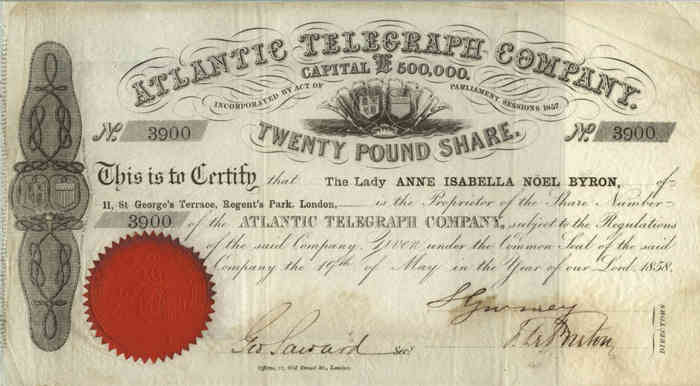
The failures to lay working cables before 1866 attracted controversy. You see, Cyrus Field didn’t finance the matter himself. He’d have been bankrupted many times over. He used other people’s money by selling shares in the venture. Here’s one such stock certificate, sold to Lady Anne Isabella Noel Byron, Lord Byron’s widow. This certificate lost most of its value after the failure of the 1858 cable, then became worthless until the formation of the companies which handled the laying of the 1865 and 1866 cables.
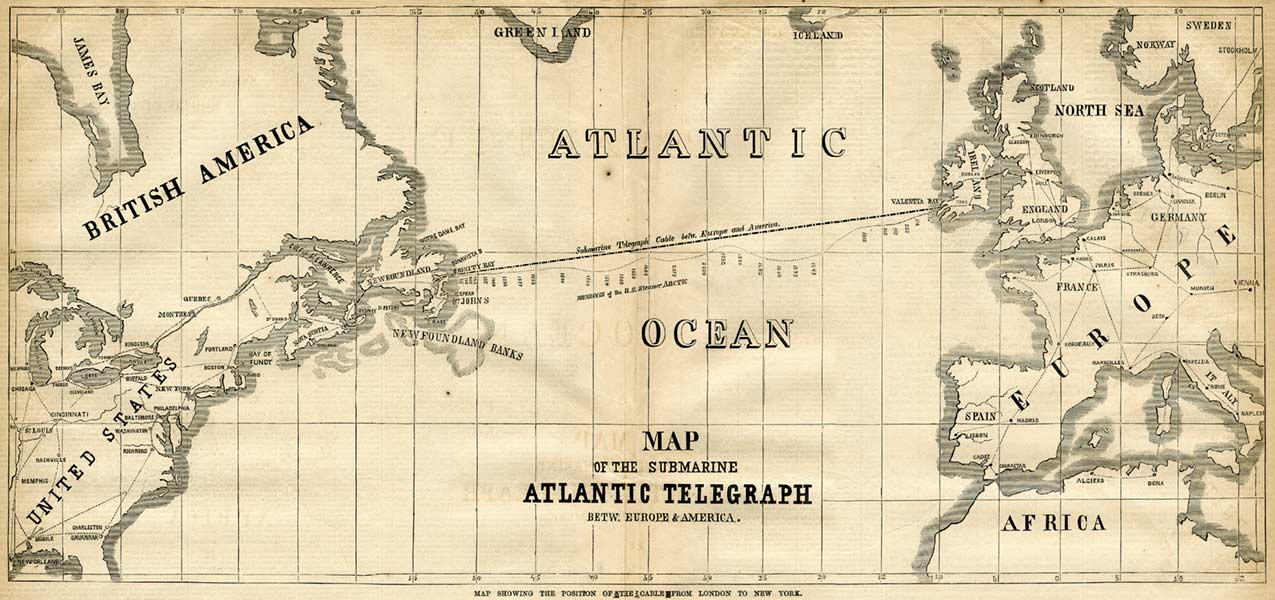
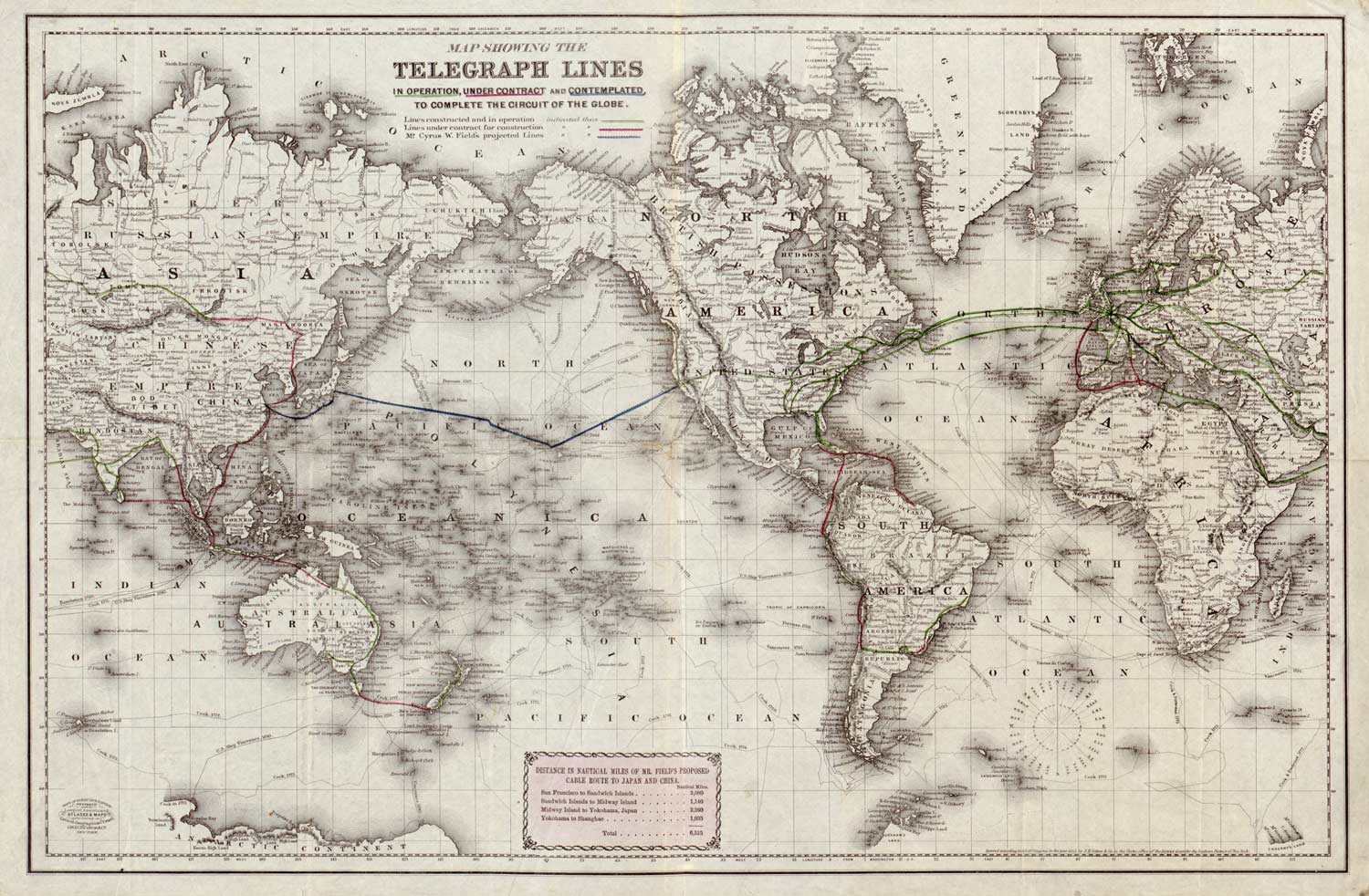
The route of the 1858 cable can be seen in the map included here:
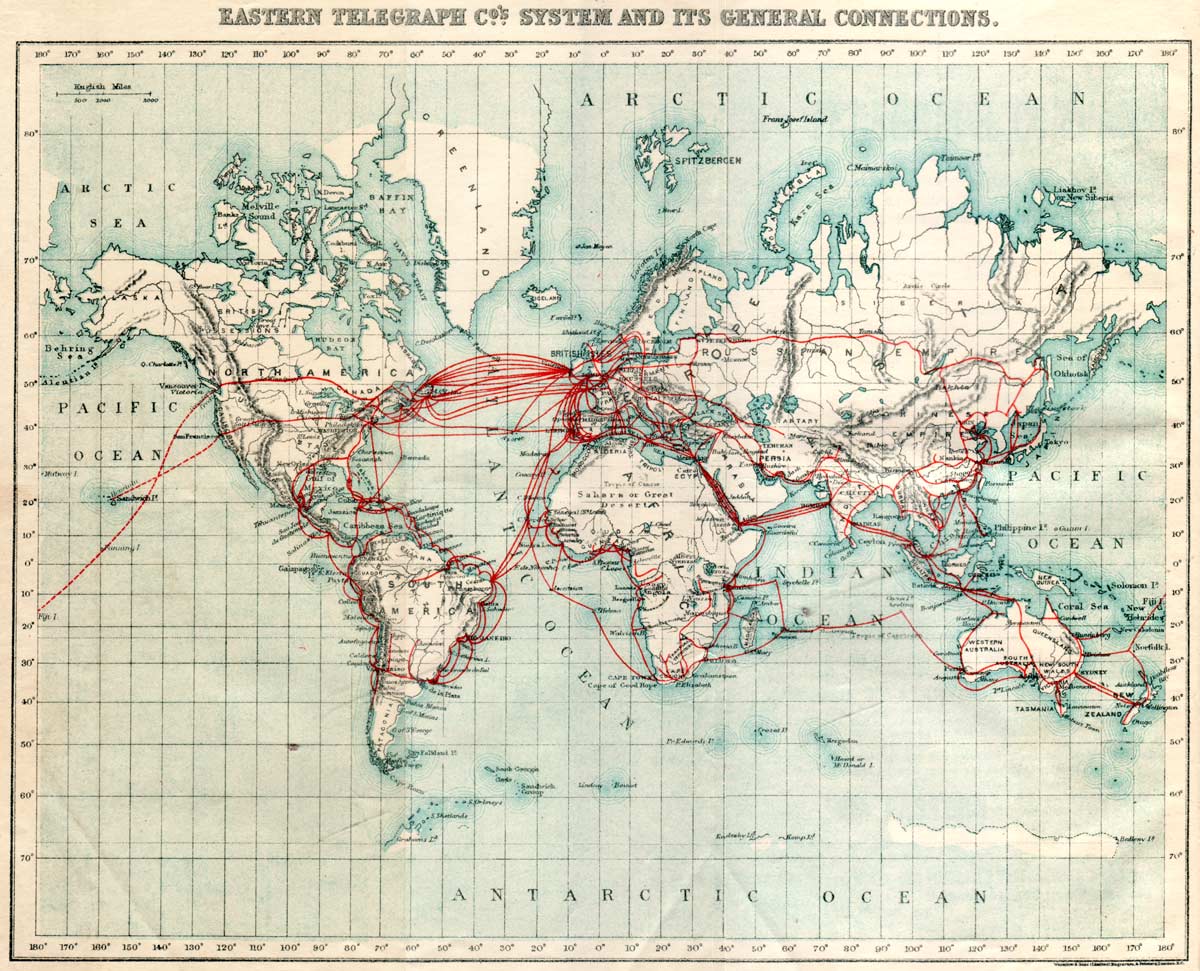
The routes of the cables available in 1870 can be seen on this map:
Pause here for a bit and think about this: in the late 1800s, these were all of the communication routes available in the entire world. That was it. There was no internet, no telephone, no TV, no radio, only written letters and telegraph. Oh yes, they also had Indian smoke signals, but they weren’t as widely used, and those communication lines aren’t marked on these maps as each transfer hub was assembled and disassembled on the fly.
It’s easy to complain about how much faster and more reliable our Internet access could be, but the fact of the matter is that we’ve made amazing strides in communication over the past century and a half. As I write this, I’m sitting at a desk in a village in rural Dobrogea, Romania, and am storing these letters or bits or whatever you want to call them on my server back in the United States, instantly, each and every time I press the “Save Draft” button in my WordPress Editor. That’s amazing, in and of itself.
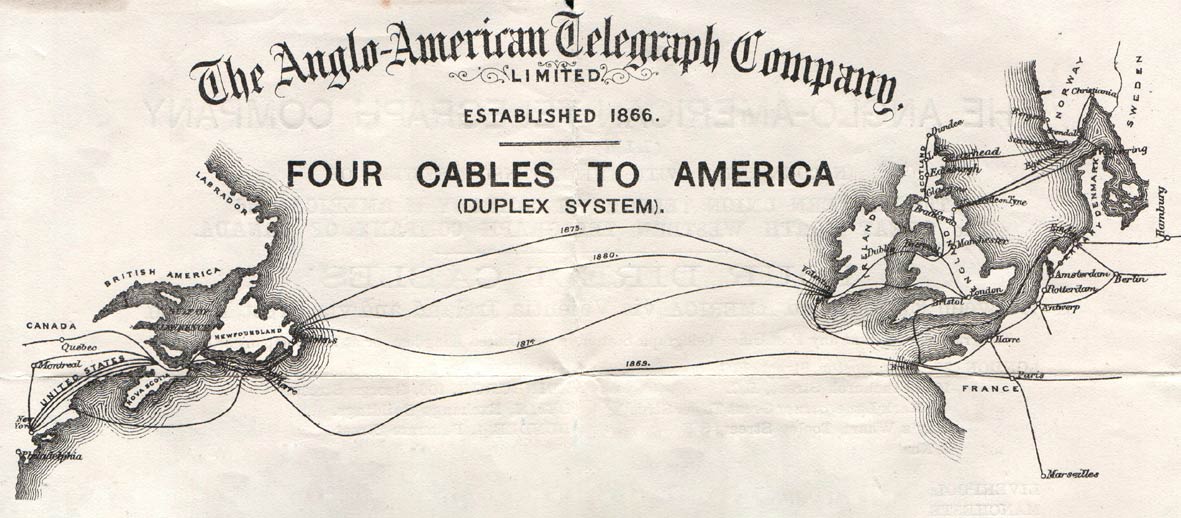
Let’s fast forward and see how fast things progressed from that single cable laid in 1866. By 1880, there were four cables already.
By 1901, there were 14 cables. That’s right, fourteen, from four just 20 years earlier.
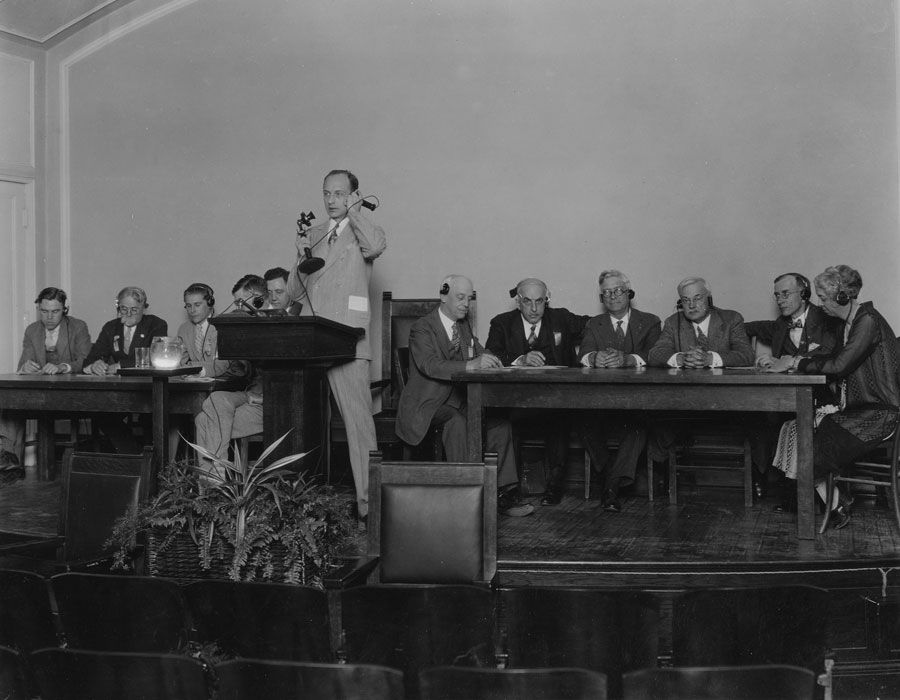
Although trans-Atlantic telegraph communications progressed quite fast, the first trans-atlantic telephone call did not occur until 1927. It was made from Columbia, Missouri, to London, lasted six minutes and cost $162, which was quite a large sum for that time.
Just think, now we can talk anywhere in the world for pennies a minute, or do audio or video chats with applications like Skype or iChat for free. We sure have come a long way!
Sources
For more information about the trans-Atlantic telegraph cables, please visit History of the Atlantic Cable & Undersea Communications. It’s a wonderfully informative site, packed full of knowledge and images from the history of the telegraph.














 Raoul Pop