Thoughts

Why not, Apple?

Finally got around to watching the Apple Special Event from 9/9/09, and was very glad to see Steve Jobs back at the helm. As I mulled over what I’d seen, two questions came to mind:

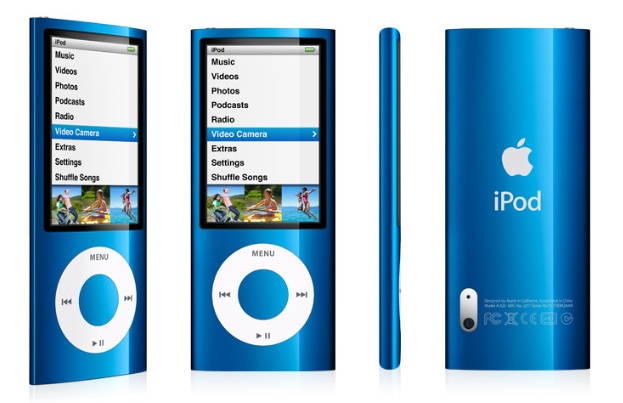
  1. If Apple could place a niftly little camera in the new iPod Nano, why couldn’t they do it sooner for the iPhone? Why so much hedging on that issue? After all, it’s not like video cameras in smartphones were such an exotic item, even back when the first generation iPhones came out.

    ipod-nano

  2. If the iPod touch and the iPhone are such great gaming platforms, and they run a pared down version of OS X, why can’t I play those same games on my MacBook Pro or my iMac? Granted, I could understand they’re not made for the higher resolutions of a laptop or desktop machine, but still, they’d be running on much better hardware, so they should be screaming fast. Apple’s always had a bad rep for not being a good gaming platform. Seems to me like an easy flick of the switch to let people run those same iPod touch and iPhone games on their Macs and get more bang for their bucks. Or is this coming down the pike in the near future?

    ipod-touch-games

Images used courtesy of Apple.

Standard
How To

Finally, an update for Apple's Bluetooth problems

Updated 8/26/09: It turns out the firmware update didn’t fix the Bluetooth issues. But OS X 10.5.8, which also came out recently, seems to have mostly fixed the problems. I still get the occasional Bluetooth connection error, but it’s nowhere near as often as before.

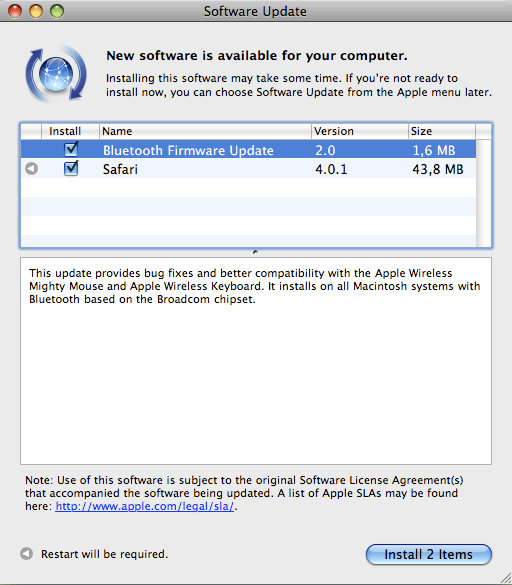
A software update noticed popped up on my MBP today, telling me Bluetooth Firmware Update 2.0 was available for download and install.

bluetooth-update-1

The update explanation says the following:

“This update provides bug fixes and better compatibility with the Apple Wireless Mighty Mouse and Apple Wireless Keyboard. It installs on all Macintosh systems with Bluetooth based on the Broadcom chipset.”

Finally! If you’re unfamiliar with the Bluetooth crashing problems on Mac computers, then you’re one of the few lucky ones. But the rest of us with late generation laptops like the MacBook Pro have had this issue for at least a few months now. This, for example, is just one of the many threads in the Apple Forums dealing with this persistent Bluetooth issue. On June 9, I’d had enough and vented on FriendFeed about it.

Basically, Bluetooth communications stopped working after a Mac was woken up from sleep mode, necessitating either a turn off/on cycle of the Bluetooth hardware, or another quick sleep/wake cycle. I for one didn’t have too many problems with the keyboard and mouse not working, but I did have a serious issue maintaining connectivity with my Nokia N95 via Bluetooth. My MBP kept refusing to connect to it, and I can’t remember how many times I removed and re-added it from my preferred Bluetooth devices. I even thought my N95 was to blame, until I tried turning Bluetooth off/on and realized my MBP could connect to it just fine after that.

From the looks of things, Apple’s been at work on a fix for the problem, and it’s now available for general install. So, by all means, download away and see if it helps you. I for one will be on the lookout for any more Bluetooth issues, to see if this firmware update has truly fixed the bug.

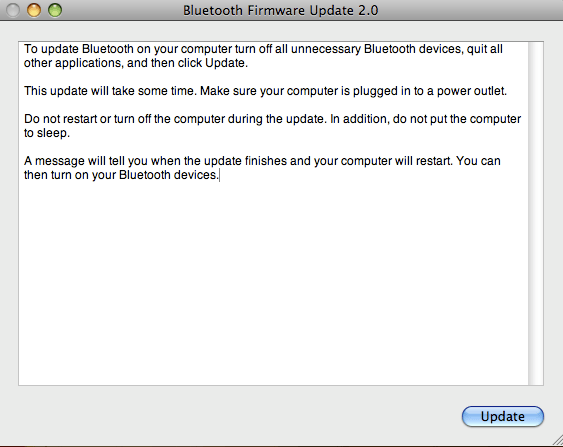
Before I close, I’d like to point out that even though a restart is not announced for the firmware update, you will most certainly need to restart your Mac. Once the Safari update installs, and your Mac restarts, the following dialog box pops up on the screen, informing you that the Bluetooth update will now begin, and your machine will restart once it’s finished. Just FYI.

bluetooth-update-2

Standard
Thoughts

The iMac: not so great long, long after

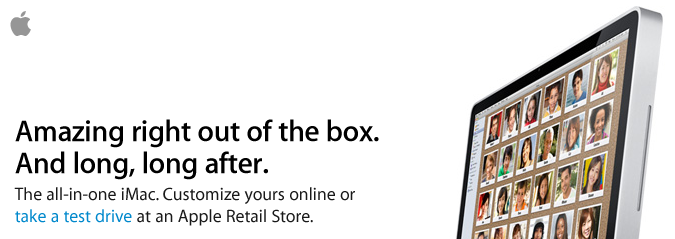
I received an email from Apple a couple of days ago, advertising the new iMac. The title of the ad was: “Amazing right out of the box. And long, long after.”

imac-ad

I disagree with that characterization. Perhaps it’s true of the new iMac, but it’s not true of our iMac. First, let me get something out of the way. I’m a Mac guy. I love Macs, I use a Mac all day long, I love their design and performance, and I love OS X. Unfortunately, my long-term experience with the Mac hardware, particularly when it comes to our iMac, isn’t so positive.

You see, we purchased an iMac G5 in late 2006, with an Apple Care plan. Thank goodness we did that, because we had problems with it from the get-go. A year after owning it, I wrote a post where I detailed the problems I’d been having. At the advice of some of the readers, I took it into an Apple Store to have it checked out. They replaced the motherboard and did a couple of other things. The repair experience was problematic in itself. Then, a short while afterward, the computer died again. This time we took it into a different store, where they replaced the motherboard again and did some other repairs.

Although that second repair experience was more positive, I had to take it into the store once more in 2008, for related issues. I can’t find the repair receipt at the moment, so I don’t know the date and I don’t know what they fixed, but yeah, that was the third time I had related repairs done to it, very likely for the same problems.

Then, inconveniently, about two months after the Apple Care plan expired in September 2009, our iMac died, just as it had died a couple of times before. It refused to boot up altogether. When I’d plug it in and press the power button on the back, nothing would happen. But, if I was extremely lucky, every once in a while, some noises would be heard in the back of the machine, as the cooling fans and hard drive started rotating, only to die a second or so later.

When this last hardware failure occurred, we were packing for an extended stay in Romania. I took the iMac along, since we had data on its hard drive that we needed. Once here, I was able to open it and retrieve the data from the hard disk. Unfortunately, the computer itself is still dead. What’s worse, I’m nowhere near an Apple Store. There are no official Apple stores in Romania. None at all. Where do I take it for service? And will I have to pay for the repair? A logic board replacement on an iMac G5 is somewhere around $900, and that’s only for the parts. It hardly seems fair to pay for a lemon repair, because that’s basically what I have — a lemon. Our iMac G5 has had repeated hardware failures of the same parts (at least three failures) while the Apple Care contract was still valid. The right thing for Apple to do would have been to replace it with an equivalent model, or to offer me a significant rebate on a newer model, allowing me to upgrade as painlessly as possible to more stable hardware. But none of that happened, and now I’m stuck with dead hardware.

So yeah, I don’t think the iMac is so great, long, long after. I’m sorry I spent our money on it, actually, and sorry it never worked as it should have, from the get-go.

Standard
How To

The fastest way to back up with Time Machine

I wrote about backing up your Mac and PC in January of 2008, and I said Time Machine was a great way to back up your Mac. A year later, I still think so, though I have some reservations.

There are three ways to back up your Mac with Time Machine. There used to be only two, but thanks to Drobo Apps, we now have three. I’ll list them in descending order, sorted by backup speed. Here they are:

To External Hard Drive (USB, Firewire, eSATA)

This one’s easy, and it’s the fastest way. You get a dedicated external hard drive, you connect it to your Mac, and you let Time Machine do its thing. You can leave it connected all the time, or you can disconnect the hard drive and only back up when you want to. Time Machine won’t complain unless you haven’t backed up for a few days.

This is the backup strategy I’ve come to use, and believe me, it’s the one that gives me the least amount of headaches. I have a 500GB LaCie Mini hard drive that connects over USB. I plug it into my laptop, and within minutes, my backup is done.

Keep in mind that I’m a photographer, and I also shoot short videos every once in a while, so it’s pretty much a given that I’m backing up gigabytes of data every time. When the backup’s done, I eject the drive and put it away. This way I’m not bothered by hourly backups, which I don’t need.

To External Hard Drive via Time Tamer

Time Tamer

Go download Time Tamer, a very handy little app created by the folks that make the Drobo, and you can create an image file on your Drobo that is limited to twice the size of your Mac’s hard drive. This is useful because there is no other way to control the size of the Time Machine backup sets. There’s is no way to set a quota via its System Preferences panel, and so it’ll keep balooning until it fills the backup drive. Obviously, when you have a Drobo or another larger drive, that’s a problem.

I for one don’t want to fill up my Drobo with Time Machine backups — I have other more important uses for it. I did, however, want to limit the amount of external drives that sat on my desk, and thought I could eliminate one of them by using Time Tamer with my Firewire Drobo. Did that for a few months, but I can tell you it’s not optimal, at least not for me. It boils down to the amount of data one has to back up, really.

As it turns out, the throughput when writing to the image file just isn’t fast enough when you work with several hundred megabytes or more. Even though writing to the Drobo is usually a fairly fast operation, somehow writing inside the image file isn’t. From my own experience, it would sometimes take a whole hour to do an hourly backup, which meant that as soon as one backup finished, another would start.

To make things more annoying, the throughput to the Drobo itself, and my Mac’s general peppiness, were also affected negatively during backups. Everything churned at a slower pace. Getting at my photos or other files stored on the Drobo was a pain. If I happened to be playing a movie and a backup started, playback would stutter or stop for a few seconds. It just wasn’t a feasible way for me to work, so I stopped doing this and returned to doing my backups directly to a dedicated external hard drive.

To wireless or networked hard drive (such as Time Capsule)

This will usually be the slowest way to back up your Mac via Time Machine. Think about it: you’re going to be pushing your bits via WiFi, and even though your hardware may be “n” specs instead of “b” or “g”, you’re still not going to get above 50 Mbps at best. Realistically, you’re looking at speeds somewhere between 15-45 Mbps, which is less than Fast Ethernet (100 Mbps) and nowhere near Gigabit Ethernet (1000 Mbps).

For comparison purposes, I have observed transfer speeds which approached USB 2.0 speeds when using a direct, wired, Gigabit Ethernet connection between two Macs (MacBook Pro and iMac G5). If you have a wired Gigabit network at home, this might be the only way to actually get decent backup speeds with Time Machine without needing to use USB or Firewire hard drives. But if you’re using WiFi, your transfer speeds are going to be anywhere between 15-20 times slower than Gigabit speeds, which means you’ll be sitting there a long time waiting for your backups to finish, should your backup set be anything over 100-200 MB.

When Time Capsule came out, I was tempted to buy it, just like I bought the Apple TV, only to regret that later. I’m glad I didn’t end up spending my money on Time Capsule, because it just isn’t suitable for me, or for anyone with larger backup sets. It certainly looks good, but that’s about all it does and all it’ll do until WiFi speeds approach Gigabit speeds.

Takeaway message

When one of my friends shared an article from Louis Gray via Google Reader, where he complains about how slow it is to back up to Time Capsule, was I surprised? Given all I’ve written above, do you see why I wasn’t?

Do the smart thing: if you’re using Time Machine, get a little portable drive like I did and run your backups that way. They’ll be fast, and you’ll be the one deciding when to back up, not Time Machine. I don’t know when Apple will decide to give us more configuration options for Time Machine, but until they do, those who care about their time should back up directly to an external drive.

Standard
Thoughts

Gmail, please stop messing with my contacts

When I sync my Gmail Contacts with my Mac’s Address Book, I always discover “uninvited guests” — occasional people with whom I converse but who don’t need to be in my Address Book. What happens is that Gmail will identify people to whom I reply and insert them in my Contacts automatically.

It used to be that it couldn’t be helped, and it was called a “feature”… Now these contacts are grouped together in a separate section called “Suggested Contacts”. Unfortunately, when I run a sync operation, these suggested contacts appear in my Address Book. I don’t want them there. I believe one’s Address Book ought to involve positive effort — effort put toward adding in contacts as they’re needed — not negative effort — effort put toward removing unneeded contacts because software can’t leave things well enough alone.

Gmail's Suggested Contacts

I run the sync operation via my iPod Touch. The sync option is otherwise unavailable to Mac owners, which is unfortunate. There’s something I call the entry tax for being able to run this sync: either you buy an iPod Touch or an iPhone, or you pay for Mobile Me. I don’t like it, but there it is, that’s Apple for you.

There is a company called Soocial which will also let you do this, as well as letting you sync your phone’s contacts with the Address Book. They were in Beta when I looked at them. By now they’ve opened their website to the general public.

At any rate, the problem with Suggested Contacts lies with Gmail, which presents those contacts as part of the normal set of Contacts to the sync software. It should store them separately, aside from the normal contacts, so that the sync software never sees them.

Standard