Places

A mockingbird calls for mates

During the summer of 2008, we had a fairly constant companion in a small tree right outside our building. It was a male mockingbird, who spent most of the month of June calling out for mates. He was loud, insistent, and didn’t scare easily. He sat in that tree day in, day out, exposing himself to danger from passing hawks and other predatory birds, braving all of that in order to propagate his genes.

I recorded his calls one sweltering afternoon, and only now got around to editing the video, 2½ years later.

Enjoy!

Standard
Places

Blackbird sakura

A blackbird rests on a branch in bloom. Taken in Washington, DC, USA, during the 2008 Cherry Blossom Festival.

A blackbird rests on a branch in bloom. Taken in Washington, DC, USA, during the 2008 Cherry Blossom Festival.

Standard
Places

Green heron chicks in the parking lot

Guess what I saw in the parking lot at work? Fledging green heron chicks [reference]. (My thanks to Jorge for identifying them properly.)

I’d noticed the herons flying in and out at times during the past few months, but never even heard or saw the chicks before this, so I didn’t know they’d nested there. Around lunchtime, my colleagues told me they’d seen them, and even showed me photos they took with their cellphones, so I went outside and took a few of my own with my DSLR.

There weren’t just one or two, but six or seven of these little green heron chicks, standing about in the parking lot, unsure of themselves, eyeing me warily, wondering what I wanted to do with them. I guess it was their time to get weaned, so their parents either kicked them out of the nest, or they jumped out by themselves.

According to Wikipedia, they leave the nest at 16 days of age, and can’t fully fend for themselves until they’re 30-35 days of age. This means they’re going to be vulnerable to predators until then, and may even die of starvation if they can’t figure out how to get their food.

Photos taken in McLean, VA. Here’s hoping they’ll make it!

Standard
Places

Parking lot goose

This past spring, I took a few photos of the goose you see below. It had been resting in the middle of that parking lot for several days, driving away any other geese that wanted to be there as well. The odd thing for me is that I’d never seen a goose defend a parking lot before. Who in their right mind would stake their food supply on a filthy hot and dry piece of asphalt, good for nothing but global warming?

Parking lot goose

Parking lot goose rests on asphalt

As I approached it while taking photos, it got up and waddled away, unwillingly, knowing it couldn’t really do much to drive me away. It was so sad to see it attached to that useless piece of land when there was a pond surrounded by plentiful trees just 30 feet or so away.

Parking lot goose

Parking lot goose waddles away

In a month or so after I took the photos, I saw the same goose had managed to acquire a mate. How, I don’t know. What can you say to another goose to make the union appealing? “Come join me in ruling my asphalt domain?” Not exactly the best pickup line… Nonetheless, they were both waddling alongside each other through the parking lot, though they stuck a little closer to the pond, so I assume they nested there.

Standard
Thoughts

Goodbye little bird, goodbye

As I was about to walk into work at the start of May, I saw a little bird on the ground, trying to walk but unable to do so. The poor thing was convulsing, and its head kept rotating wildly. Two other birds were nearby, a blue thrush, and an orange-chested robin. At first I thought they’d ganged up on the poor little bird, but no, they were concerned and eyed me with fear, worried that I’d hurt it.

They didn’t have to worry about me. I picked it up and held it in my hands, hoping it would recover. I sat down on a bench and waited for about 10 minutes, and the little bird was thankful. It nested in my hand. Its eyes would close, then open again, and its breathing was heavy while its little beak was wide open. It was obvious that it had problems breathing. What had probably happened is that it flew into one of the windows, but really slammed into it. It seems to happen most every day at work, but the other birds are fine — slightly dazed, but otherwise okay. It wasn’t so with this poor little bird. It had suffered major internal injury. There were little stains of blood on my hand.

The human in me wanted to nestle it in my hands until it recovered, but the photographer in me quickly grabbed the camera and took a few photos. I couldn’t change lenses, and I had to use my wide-angle 24mm, which was already mounted on my 5D. Now I’m so glad I took the photos, because they’re the only things I have left to remind me of it.

Goodbye, little bird, goodbye

Since the little bird wasn’t getting any better, I figured I’d take it upstairs to my office and keep it safe there for at least part of the day. I was worried that it would make a quick meal for cats or hawks. Upstairs, I tried to give it some water, but it didn’t want to drink. Its condition was getting worse by the minute. I held it in my hand as it breathed its last breath. Needless to say, I don’t count that day as one of my happiest. Later, I took it outside and buried it at the root of this tree:
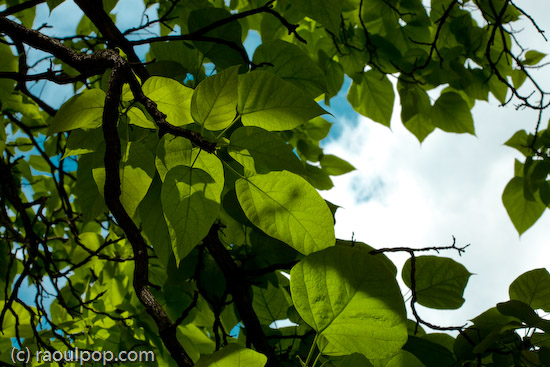
Under the sun

Goodbye, little bird. Goodbye. Rest in peace.

Standard