A recent Akamai survey, which I shared here and here, ranked US in the 33rd spot (globally) when it came to broadband internet connections above 2 Mbps. Sure, it moved up two spots compared to last year, but it’s still lagging behind countries such as Monaco, Slovakia, South Korea, and believe it or not, Romania — which is where I’m living these days.
That’s sad. It’s very sad because a country such as Romania, with fewer resources than the US, and with a LOT more corruption at every level, has managed to provide better Internet services than the US. It just goes to show you how much pork barrel legislation and ridiculous lobbying can slow down an entire country’s Internet access. Why, every time a company tried to improve the way broadband worked in the US, it was eventually bought out or dragged down and kept down for the count.
Remember Telocity? It was one of the first companies to offer DSL service in the US, ahead of Ma Bell. Even though it was paying hefty amounts of money for the right to transport Internet traffic on Ma Bell’s lines, they had enormous problems with the same Ma Bell, due to problems that would somehow just happen to crop up on the same wires or the switching equipment. Then they’d have to pay more money so Ma Bell could fix their own equipment, which they’d say Telocity broke, etc., ad nauseam, and so on and so forth.
That’s just one example. Another was the more recent push to restructure the way cable services are provided (both TV and internet). One of the efforts was the a-la-carte programming initiative, and another was the push for faster and more reliable cable Internet services. You wouldn’t believe the advertising, PR and lobbying blitz the cable industry started and kept up for several months — actually, I’m fairly sure you saw their ads on TVs and buses everywhere, particularly in the Washington, DC area.
Or what about when they got together in late 2007 and 2008 to ask for an Internet tax? Remember the tiers of traffic they wanted to create? They wanted all the big websites to pay them for the traffic, as if they weren’t already getting enough money from the customers for their slow and unreliable services. They also wanted large chunks of money from the federal government in order to upgrade their infrastructure. No matter how much money they make, they’re so greedy they always want more, more, more.
What I’d like to know is how all these other countries, including Romania, can manage to offer faster and more reliable Internet services without asking for money from their countries’ government, without charging big websites for their traffic, and also by charging less per month for better broadband? How is that possible? Could it be that these companies actually know how to run their businesses while their counterparts in the US are filled with lazy, greedy idiots?
I still vividly remember an incident which happened while I was a director of IT at a Florida hospital, several years ago. A BellSouth technician had been called in to check the phone boards, and my network and servers kept going down and coming back up. The Medical Records system kept giving errors when employees wanted to access forms to fill in patient data, not to mention that other network services, like file sharing and printing, kept going on the fritz. I checked every one of the servers and they were fine. I finally walked into the switch room, at my wits’ end, only to find the moronic BellSouth employee with his fat, lazy butt on our UPS, jiggling it back and forth as he chatted with someone back at BellSouth HQ, plugging and unplugging the power supply that fed one of the main network switches. I went ballistic, grabbed him by the collar and threw him out of my switch room. Was he that stupid that he didn’t know where he was sitting? Was he such a pig that he couldn’t feel the plugs underneath him as he sat on them? He didn’t even want to apologize for taking out an entire hospital’s network during daytime hours. That’s BellSouth for you.
I don’t know how the US can get better broadband, unless it’s legislated. An ultimatum must be given by the government, one that can’t be overridden by any lobbyists or CEOs shedding crocodile tears in front of Congress. These companies simply will not get their act together until they, too, are grabbed by their collars and shaken about. They’ve gotten used to the status quo, they like it, and they’re clinging to it with all their might.
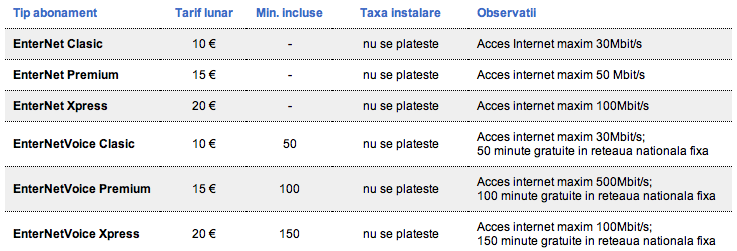
Meanwhile, here’s a sample of the Internet plans you can get in Romania right now. For comparison purposes, 1 Euro is worth about $1.4 these days.
Romtelecom (the main phone carrier, provides ADSL services):
- 2 Mbps, 2084 kbps/512 kbps, 4.88 Euro/month
- 4 Mbps, 4096 kbps/512 kbps, 7.02 Euro/month
- 6 Mbps, 6144 kbps/512 kbps, 9.40 Euro/month
- 8 Mbps, 8192 kbps/768 kbps, 14.16 Euro/month
- 20 Mbps, 20480 kbps/1024 kbps, 24.87 Euro/month
[source]
Birotec (provides fiber optic services, all plans include phone line with varying amount of minutes based on plan price):
- 3 Mbps up/down, 10 Euro/month
- 4 Mbps up/down, 15 Euro/month
- 6 Mbps up/down, 20 Euro/month
- 8 Mbps up/down, 29 Euro/month
- 10 Mbps up/down, 49 Euro/month
[source]
RDS (provides fiber optic, cable, cellular modem and dial-up access — prices not readily available on website):
- Fiber optic access up to 2.5 Gbps
- Cable access up to 30 Mbps
[source]
The lowest internet access plan in Romania is 2 Mbps. Cellular modems are advertised at speeds up to 3 Mbps. Meanwhile, in the US, you can still find 512 Kbps plans at prices twice or three times as much as the 2 Mbps plans in Romania. That’s the price of complacency and excessive lobbyism.
26.011201
-80.149490


 Raoul Pop