Thoughts

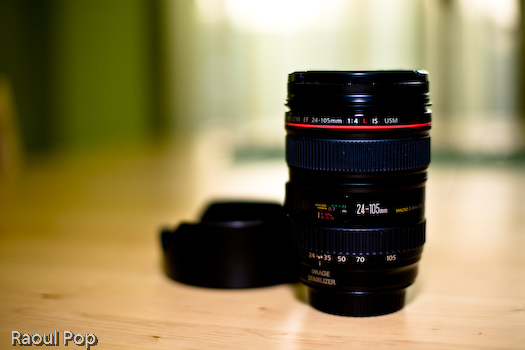
Finally got the EF 24-105mm f/4L zoom

It was introduced by Canon on 8/22/2005. I reviewed it back on 4/19/2007. I compared it with the EF 24-70mm f/2.8L lens back on 10/5/2007 and deemed it superior. I complained that I didn’t have it on 9/14/2008, after coming back from our trip to Austria. Now I finally bought it, and I am not sorry. At long last, I have a versatile zoom I can use just about anywhere. I am giddy with joy.

Standard
Reviews

Camera preview: Canon EOS 5D Mark II DSLR

I’m a little late to the table with my thoughts on the new 5D, but I have an excuse: I’ve been traveling abroad (see this, this and this) and only now managed to sit down and think about it. There’s also an advantage to this: I got to read through the other reviews that have come out before I wrote mine.

So, what sources did I consult?

  • The Canon website was the first place I looked. There’s the official press release for the new 5D, and then the 5D Mark II pages. (I looked at the press release back on September 20th, when it came out.) Canon has also published 1080p HD video clips shot with the new 5D on their website, and they’re definitely worth checking out. They make a point to specify that the clips were shot with a pre-production 5D Mark II, so they may not accurately represent the quality of the production camera.
  • Digital Photography Review put together a very detailed review of the new 5D, as usual. Their review was very helpful to me.
  • The Online Photographer talked about the quality of the 5D’s HD video, and he brought up a good point. I’ll mention it here because I felt the same way when I saw Vincent LaForet’s video: it just wasn’t very good in terms of realization. It didn’t tie together, it felt empty… In a way, this was to be expected when there were only two days to write it, produce it, film it and edit it. But the quality of the video from the 5D Mark II was definitely worth seeing.
  • Robert Reichmann from the The Luminous Landscape posted pre-production video shot with the new 5D and gave his first impressions of the camera. He was in a hurry as well, as he was leaving for a trip to Africa and had only 48 hours with the camera. He says that the video is very high quality (so high that MBPs playing the full resolution video will skip frames), and there is no jellocam effect, where you see balooning artifacts due to slow recording of the data by the CMOS.
  • PopPhoto chimed in with a quick preview that did a little feature comparison between the old and new 5Ds.
  • On Taking Pictures had an interesting first reaction. He pointed out that the AF system should have been improved. It’s still the same 9-point AF found on the original 5D, and it has its limitations, as I can attest.
  • Thomas Hawk wrote up his impressions. He’s excited and plans to get one as soon as they’re available.
  • I found out about a new review aggregation site while I was writing this post. It’s called TestFreaks, and it’s one of the places where I looked for other reviews of the 5D. So far, they’ve posted links to four reviews for this camera, out of which an Italian review was worthwhile, particularly their side-by-side comparison of the old and new 5Ds. The rest of the linked reviews simply spewed the press release, which involves no effort or thought whatsoever. But I think the site is useful as a place to check for reviews when you want to learn more about a product.

What about me? Well, I wrote about the original and new 5D back in August 2007, when I took a shot a predicting the features of its new iteration. And I also wrote another article a little over a month ago, on August 28, where I talked about the coming convergence of DSLRs and video, and predicted that after the launch of Nikon D90’s 720p HD video capabilities, 1080p HD video wouldn’t be far off. Amazingly, Canon had already been at work on that very same feature, and launched it with the new 5D shortly afterward.

Let me first indulge myself and see how right (or wrong) I was in my own predictions about the 5D Mark II:

  • EOS integrated cleaning system (YES)
  • Live View (YES)
  • 16 Megapixels (NO, even better)
  • Up to 3200 ISO (NO, even better)
  • Increased battery life (YES)
  • Weatherproofing (YES)
  • AF upgrade (NO, unfortunately)
  • Increased zones for exposure metering (YES)
  • Shutter durability up to 300,000 cycles (NO, but still increased to 150,000 cycles)
  • 3″ LCD (YES)
  • Retail price $3,300 (NO, it’s $600 lower)

What I did as I read through the official specs found on Canon’s website and through the other reviews was to take notes of the interesting differences between the original 5D and the new 5D.

Original 5D 5D Mark II
12.8 megapixels (4368×2912 pixels) 21.1 megapixels (5616 x 3744 pixels)
DIGIC 2 processor DIGIC 4 processor
12 Bit A/D conversion 14 Bit A/D conversion
Pixel size 8.2 μm Pixel size 6.4 μm and reduced microlens gap
Native ISO capabilities 100-1600;
expanded capabilities 50-3200
Native ISO capabilities of 100-6400;
expanded capabilities 50-25600
Frame rate 3.0 fps Frame rate 3.9 fps
Shutter life 100,000 cycles Shutter life 150,000 cycles
Full HD (1080p) movies encoded with H.264 codec and PCM sound;
1080p movie mode (1920×1080) records clips up to 12 minutes;
480p movie mode (640×480) records clips up to 24 minutes;
Single file size (for movie clips) is limited to 4GB
No internal microphone/speaker;
No microphone input socket
Has microphone input socket to record higher quality audio for video files;
internal microphone on front of camera, and built-in speaker on back of camera
Viewfinder coverage 96% Viewfinder coverage 98%
Can use infrared remotes
Battery BP-511A;
up to 700 shots per charge;
1390 mAh
Battery life LP-E6;
up to 850 shots per charge;
1800 mAh
No additional batter info other than remaining charge improved battery status displayed on screen; camera can memorize batteries by their S/N and show you exactly how much power you have in each one.
RAW shooting enabled in Auto mode
Exposure bracketing +/-2 EV Exposure bracketing up to up to +/-4 EV
Creative Auto mode makes depth of field and exposure adjustments easier (for those that don’t bother to learn the basics…)
Auto Lighting Optimizer evens out harsh highlights and strong shadows
Peripheral Illumination Correction minimizes vignetting effects
Can embed copyright info but not intuitive at all Easier embedding of copyright info and photographer name in each photo taken with camera
Accessory shoe painted black, which leads to paint scratches as speedlites are mounted to camera Accessory shoe now left bare (metal-colored), which is better
2.5″ LCD, not very good at all in sunlight, low resolution 3″ LCD, great in sunlight, high resolution
Uses CF Type I and Type II cards Uses CF Type I, Type II, UDMA and CF+ cards
Auto ISO (100-3200);
can be turned on everywhere but in M mode, which is the way it should be
AF microadjustment
Live View with three AF modes: passive (mirror flips down briefly to focus), contrast detection (mirror stays up) and face detection (self-explanatory)
No water resistance, although I have taken my 5D out in the rain and it did fine as long as I didn’t get it completely wet Water resistance (10mm rain in 3 minutes)
Some dust resistance
2.5″ LCD, not very good at all in sunlight, low resolution 3″ LCD, great in sunlight, high resolution
No Quiet Shooting mode;
mirror slap is pretty loud
Quieter shooting mode available;
mirror will either lock up, or it will move slowly to the halfway position and close normally from there, creating less noise

How could the new 5D be even better?

  • AF should have been upgraded to something faster and more accurate
  • RAW files still CR2 format; it would have been nice to standardize on the DNG format
  • Color space options are still only sRGB or AdobeRGB; what about ProPhotoRGB?
  • HDMI Out miniport puts out great video but NO audio, which is unfortunate
  • Hand grip now slightly thicker, but space between grip and lens barrel slightly smaller, which means you may end up jamming your fingernails into the lens as you hold the camera, should you have thicker fingers. This was a point of contention with the 30D, was addressed in the 40D, and now I see it potentially coming back (though to a lesser degree) in the 5D Mark II.
  • No controls for video other than focus and exposure compensation once you start recording. It really does seem like the video mode was grafted onto the camera, as Luminous Landscape puts it in their review. Plus, the microphone input socket isn’t a pro-level socket, but a plastic one that can easily break if you’re not careful.
  • Recording video will drain the battery a LOT faster than shooting photos. And it will take up space. You’ll go through a single 4GB CF card in about 11-12 minutes if you’re shooting video. I guess this is to be expected given that the camera records full HD video on a huge 35mm sensor.

On the plus side, it’s interesting to note that I paid $100 more for my original 5D back in April of 2007 than what the new 5D Mark II will cost at retail when it hits the market. I bought my 5D for $2800 from Costco, and the new 5D will cost $2,700, but it will have all these incredible new features. Something to think about. I suppose I shouldn’t complain, since I did get about 1 1/2 years about of my 5D before it was rendered outdated by its successor.

So, will I be getting one? Not at the moment, no. My original 5D is still very usable, and I don’t have the deeper pockets of some other folks. I’m still without a good zoom lens. Coincidentally, the same great zoom lens that I like (EF 24-105mm f/4L IS) can be bought as a kit lens with the new 5D, so I definitely encourage you to get it if you don’t have it in your inventory. It will prove its versatility over time, and you will be glad you have it.

At some point in the future, I will be glad to buy the new 5D. Perhaps by that time they’ll have made the video mode more streamlined, and integrated it a little better within the menus and external buttons of the camera, not to mention that I’ll have had a chance to save up for it.

If you’d like to get it though, don’t let me stop you:

Photos used courtesy of Canon.

Standard
Thoughts

Just give me a good zoom lens, thanks

Greetings from Osttirol! My wife and I have been vacationing in Austria for the past week. It’s a gorgeous place to visit and, needless to say, I took tons of photos here. I’ve been carrying my Canon 5D and my lenses with me everywhere, and let me tell you, I’ve been sorely in need of a good zoom lens.

The lens inventory in my camera bag is woefully short at the moment. I started out with three primes: EF 24mm f/1.4L, EF 50mm f/1.4, and EF 100mm f/2.8 Macro. I sold the 24mm prime with the intention of buying the EF 24-105mm f/4L Zoom, but other circumstances intervened, and now I’ve only got the 50mm and 100mm lenses.

There are some who say it’s better to have prime lenses. I disagree. I’d like to see them carry five or six prime lenses in a backpack up and down a mountain in order to get the range that one or two good zoom lenses would give, and then tell me if they still feel the same way. And by the way, try changing lenses in swift mountain breezes, with insects buzzing around you and just dying to get inside the sensor chamber and leave smudge marks (which happened to me). Oh, and don’t forget to throw in a few other accessories such as polarizers and UV filters of various sizes for the different diameters of each lens, plus one or two water bottles and a fleece jacket plus an umbrella in case the weather goes bad, and then we’ll talk…

In a way, I was glad to only have to carry two lenses; I’d have really felt the weight of a third one. But I felt so limited in the photos I could take, because I could only use the 50mm or the 100mm lens to frame my photos. In some instances, I could walk back and forth to get a better view or angle, but in others, there was no way to get a better photo without also being able to fly — which incidentally, would be very nice, but I haven’t figured out how to do it yet. And no, I don’t believe in cropping. I only do it when I absolutely have to. I didn’t pay $2,800 for a full-frame sensor that can take 12.8 megapixel photos so I could crop them and get the same resolution I can get from a $500 camera.

To this day, I slap my head when I think that I could have had the 24-105mm zoom lens as a kit lens with my 5D for a little over half its usual price. I was such a fool not to get it! It’s a light and sharp zoom with more range than the EF 24-70mm f/2.8L, and you can easily walk around with it for hours without getting too tired.

So far on this trip (which ends very soon, unfortunately) I took 1904 photos with the 50mm prime, and 471 photos with the 100mm prime. If I had had (don’t you just love the English language) the 24-105mm zoom on my trip, it’d have stayed on my camera 95% of the time, because that’s the range I use the most, particularly on the wider end of that focal spectrum, which was not available to me, each and every day, how stupid could I be, ugh…

Look, I’m not knocking the 50mm prime, which is a great prime, and very cost effective given its low light capabilities and sharpness. And I’m definitely not knocking the 100mm prime, which is versatile and a fantastic macro lens with gorgeous bokeh. But I really didn’t need f/1.4 or macro capabilities for landscape photography, which is what I did on this trip. I needed a zoom lens!

So, if you’re not sure what lenses to get, don’t do what I did, or you’ll be frustrated to no end as well. First get a good, lightweight zoom lens, one that won’t kill your wrist as you carry your camera around taking photos. Later, as you find that you need more specific capabilities, such as being able to take handheld photos at dusk or dawn, or more bokeh, or macro photos, then spring for those primes that have the features you need.

Standard
Thoughts

DSLRs and video to converge

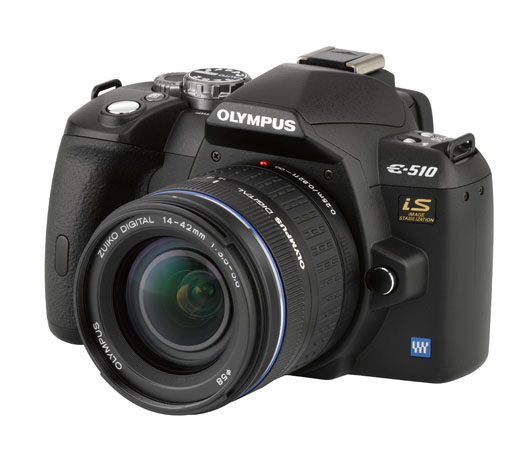
On September 24, 2007, I published my review of the Olympus E-510 DSLR, one of the first prosumer cameras on the market to feature Live View (TTL video preview, directly off the same CMOS sensor used for photographs). Unless people were to jump to conclusions, I wanted to make it clear that it won’t let you record videos — but I knew that market forces were aligning to bring some sort of video capability to DSLRs.

I myself was opposed to that idea. I thought it would bastardize a DSLR to make it record video. After all, a DSLR takes great photos, and it should only do that. I also thought that video camera manufacturers would squeeze photo-taking capabilities into video cameras, which would result in crappy photos being taken by gadgets that should have stayed video cameras. Well, I was wrong. I forgot all about how the market delivers what the consumer wants, and has a way of sometimes exceeding expectations.

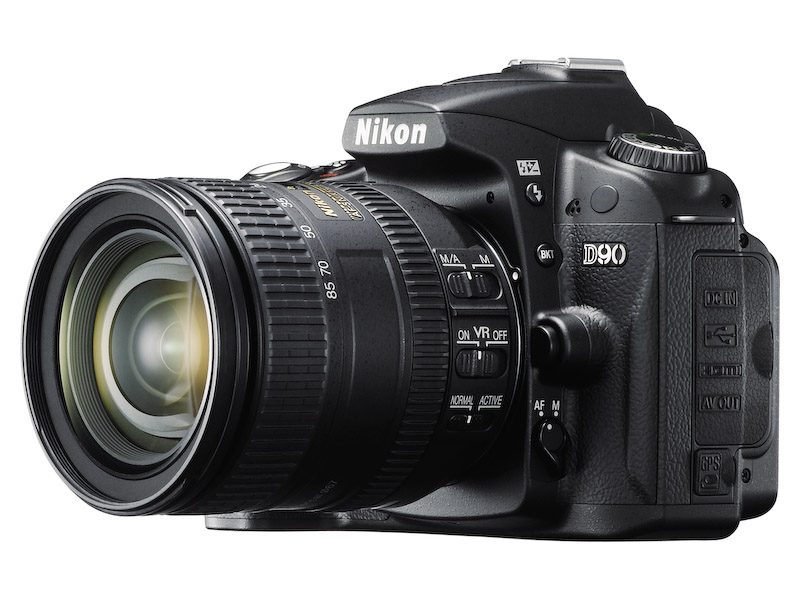
Behold the Nikon D90. It is the first DSLR that takes video, and it’s not some low-res video that you can get from a point-and-shoot digicam; it’s 720p HD video. What’s more, it lets you control depth of field by manually adjusting the focus while shooting. Best of all, you’re already using a sensor that takes great photographs, and the expensive glass you already paid for. You don’t need to spend yet more money on a dedicated video camera. You get the best of both worlds: the interchangeable lenses of a DSLR, and the quality of a decent video camera.

I am truly blown away by the D90’s specs. If I hadn’t already invested in the Canon 5D and Canon lenses, I would be sorely tempted to get the D90. I crave (badly) the ability to take quality photos and video with a single device, but unfortunately, up to this point, that was not possible unless I carried both a DSLR and a video camera.

As good as the D90 is though, it will soon be eclipsed. Why? Market forces. How long do you think it will be before we’ll have a DSLR that can record 1080p HD video? Or how about an even smaller and thinner DSLR than currently possible? How about a DSLR that looks and weighs about the same as a point-and-shoot, but gives you photo quality that’s equivalent to (or exceeds) today’s DSLRs? It’s all coming.

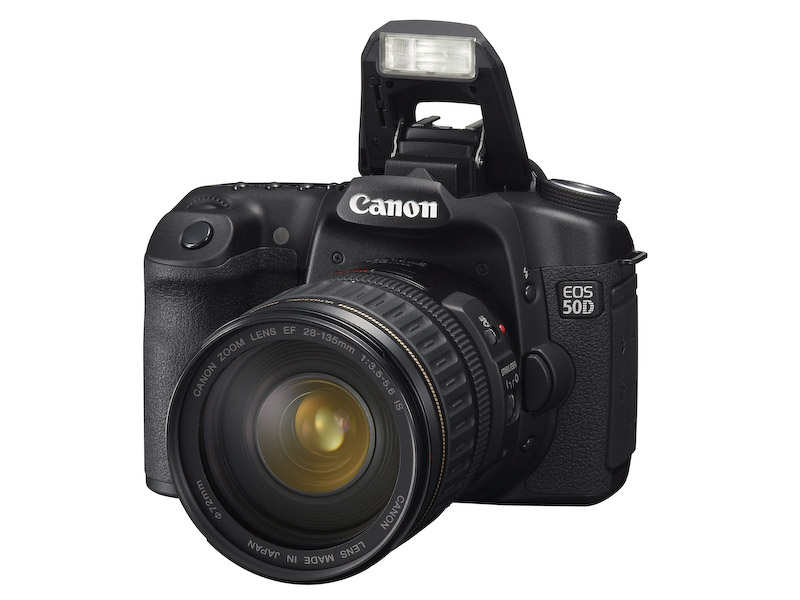
Let’s look at what’s currently available. First, we have the new Canon 50D. You may think it’s been eclipsed by the D90 or the D300, but you’d be wrong. You see, Canon took things further than I thought possible with it, by giving us 15 megapixels in a cropped (1.6x) sensor that also shoots (natively) up to 3200 ISO. I didn’t think that was possible on a cropped sensor. I thought 12 megapixels was the max at that sensor size. I was wrong.

You know where else I’ll be proven wrong? Back when I attended the Olympus E-3 launch party, I talked about the camera’s (somewhat) limited 10 megapixel resolution, and I thought they had reached the limitations of the Four Thirds 2x cropped sensor. I thought the sensor’s surface area was too small to get more resolution out of it. But now that Canon has proven you can get 16 megapixels out of a 1.6x cropped sensor, I don’t see why you can’t get 12 megapixels or more out of a 2x cropped sensor.

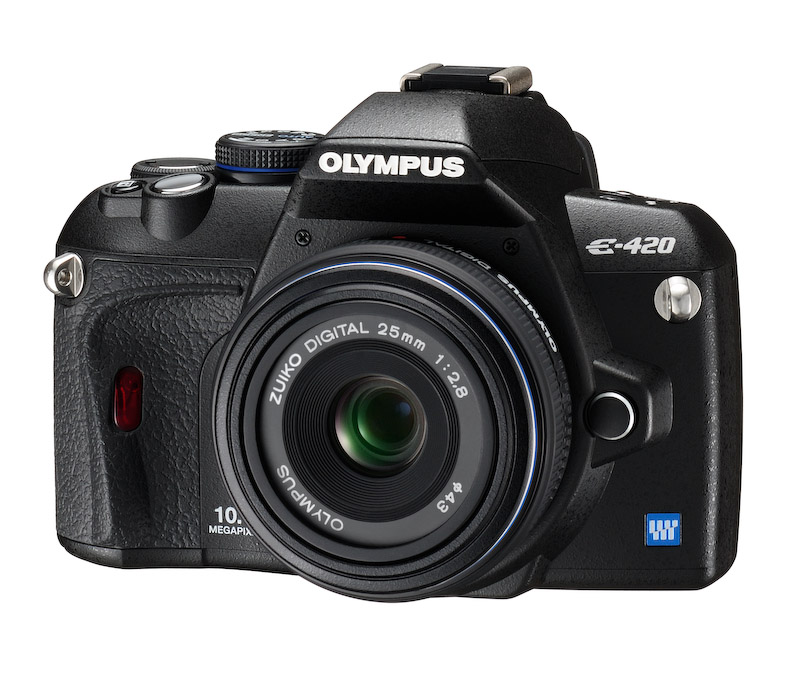
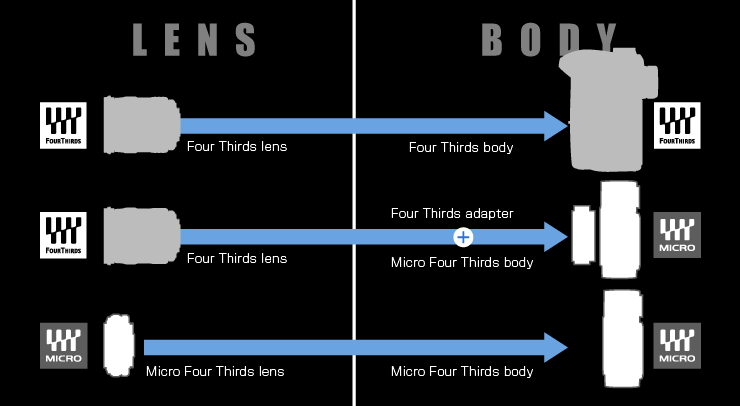
Here’s where I get to the last part, smaller and lighter DSLRs than currently thought possible. Currently, the smallest DSLR on the market is the Olympus E-420, pictured below. Do you know what the Four Thirds consortium has come up with? It’s the Micro Four Thirds standard, which allows for thinner, shorter lenses, and thinner, shorter camera bodies. A Micro Four Thirds camera will look and weigh just about the same as a point-and-shoot camera with a decent zoom lens.

Wait, it gets even better. The current aspect ratio of Four Thirds cameras is 4:3. The aspect ratio of Micro Four Thirds cameras will be 16:9. That’s the same aspect ratio used in movies. Where do you think that’s going? It means your photos and your videos will have the same aspect ratio, and the line between photography and videography will get even more blurred, and it’s quite possible that in the near future, we’ll have 1920x1080p HD video recorded by a tiny little DSLR with a tiny little lens on it.

That’s just what seems logical to me, and I’m a fairly conservative estimator. You wait and see what the market will do. We’ll have some very interesting DSLRs to play with in the next few years.

[Images used courtesy of Canon, Nikon and Olympus. ]

Standard
Places

Shenandoah Valley panoramas

You are about to see several panoramic photos that have taken me well over 35 hours to create — and I’m not counting travel time, setup time, time it took to take the photos, and the time it took to write this post.

This slideshow requires JavaScript.

A couple of weekends ago, Ligia and I got into our MINI and drove up to Shenandoah National Park, for a single purpose: to take a few panoramic photos of the valley from the tops of the Appalachian Mountains. Fortunately, that simply meant driving on beautiful, scenic Skyline Drive and stopping at various points to set up the tripod and take series of shots that would later be stitched together. Unfortunately, the weather wasn’t exactly collaborating, in spite of the cheery weather report. The day was neither sunny nor cloudy. The light was diffuse and had that washed, in-between quality that doesn’t really make it good for anything. But, I was there, and if that’s what I had to work with, so be it.

As it turned out, driving out there and taking the photos was the easiest part of the whole thing. Like I mentioned in the opening paragraph, putting together the panoramas was by far the longest, most excruciatingly slow stretch of processing work I have ever done. I do not recommend it to anyone, for multiple reasons, which I’ll mention below. If you just want to see the photos, skip ahead.

A few thoughts on the whole thing

I will not do panoramas very often in the future, unless I’m commissioned to do specific ones. If and when I do another panorama for myself (not for a client), it will likely only be a 5 to 10 photo image, simply because it takes an enormous amount of time to stitch and process them on the computer if they’re made up of more images than that.

For one thing, you would need a super fast, quad-core or better computer loaded to the gills with RAM to get any sort of decent speed while processing panoramas. A Mac Pro worth about $7,000 or better should do the trick. Seriously, every single simple operation, like cropping or rotating, took at least 10 minutes or more to execute. Sometimes just assembling a single panorama in Photoshop (through the Photomerge feature) took about 45 minutes. I have the latest MacBook Pro laptop (2.5 GHz Intel Core 2 Duo processor, 512 MB video card, 4 GB RAM), and it still took what seemed like forever to get through each panorama.

The resolution of the photos also matters. My individual photos are 12-megapixels each, at 240 dpi, made by a Canon 5D. Just imagine how much processing power is needed to put together 20 or 30 of these photos into a single image!

People don’t appreciate panoramas. I bet you most people will skim this post, unimpressed, and move on. You can’t really appreciate panoramic photos unless they’re printed out in their full size and spread out on a wall, right in front of you. You can’t appreciate their size on your computer monitor, no matter how large it might be. The largest single monitors nowadays are 30″ and have a maximum resolution of 2560×1600. That’s equivalent to about 6 megapixels at 72 dpi. You can’t possibly appreciate a 12 megapixel photo at 1:1 size on a current-day monitor, much less a panorama made up of 20 of those photos.

As an aside, don’t confuse monitor size with resolution. There are LCD HDTVs on the market that are 42″, 46″ or more in size, but they can only display up to 1920×1080 pixels, which is much less resolution than a 30″ monitor.

I can’t show you the full panoramas on my site, because of photo theft. Not that I think my panoramas (these ones in particular) are spectacular and would fetch amazing prices, but I know for a fact that if I post my panoramas at full resolution, there will be people who will steal them and try to profit from them.

How does the new Lightroom 2 Beta handle panoramas?

After I processed the photos in Photoshop CS3, which worked without crashing for the whole bunch, although it ate an amazing amount of space on my hard drive for its scratch disk, I imported them into the new Lightroom 2 Beta, to see how it would handle them.

Most of the photos were over 1 GB in size, uncompressed. Because I saved most as TIFs, using ZIP compression, their file size on disk was significantly lower. Lightroom did amazingly well to start with. It created small previews very quickly, and also created the 1:1 previews much quicker than Photoshop would have been able to render them. I was able to use the spot heal brush to remove sensor dust spots, and also used the new selective retouching brushes, without any problems. Lightroom 2 was able to do these things without significant delays, and would show the effects instantaneously.

LR2 only started hiccuping when I started to add some meta-data to the photos. As I went through and added meta-data, then opened them at 1:1 size once more, it would hang, literally forever. I had to keep force quitting it, and had to do that regularly, for each and every photo that I wanted to look at. Interestingly enough, when I wanted to export the panoramas to use them here on my site, it did it without any problems, and without crashing. It’s certainly odd behavior, but it is in Beta after all.

On to the photos

While I cannot post the panoramas at full resolution here, I did post them at higher sizes than I would normally post, in order to give you a better idea of what they look like. I also created 1:1 previews of regions of each photo, to help you realize how big they really are.

If you click on each panorama (not its 1:1 detail), it will take you to its photo page, where it will tell you how large it is (in megapixels), and how many photos went into making it. If you click on it again (on that page), it will take you to its larger size. Sorry for the double-clicking, but that’s how things work in WordPress these days.

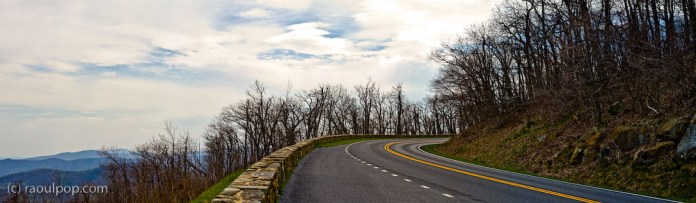
First, a panoramic of Skyline Drive itself. This road is amazing, and I’m so glad the US government decided to build it back in the 1930s. It literally hugs the tops of the Appalachian mountains and lets average John and Jane drive on top of the world (as high as possible in this area of the world, anyway).
We stopped along Skyline Drive, parked our car, and took a hike through the forest on one of the paths marked out there. In the middle of nowhere (literally), we found this cabin, called Range View.

It was a darling little place built out of stone and off the grid (in spite of the fact that wires ran right above it). The fireplace was outside the cabin, by the front door. While the place was locked up and the windows equipped with thick wire and netting, Ligia and I could spot beds and various pieces of old furniture inside. Don’t know what it’s used for nowadays, but it is used, because there was an open bottle of wine standing in plain sight near one of the windows, and it was of recent vintage.

The rest of the photos, including the 1:1 previews, are found in the gallery below. Click on each to get to the photo page, then click again to see it in a larger size. Enjoy!

Standard