Thoughts

Price wars are bad for everyone

I believe a lot in equitable pricing. A product’s price should be able to net its creator a decent profit — not a huge profit, not a tiny profit, because that makes it hard to go on, and certainly not a loss. That’s why I’m really annoyed with the recent price wars in the hardware industry. Scoble reports tonight on his blog that Seagate didn’t meet its projections in this last quarter because of horrendous price wars among hard drive manufacturers. An unnamed manufacturer was willing to lose over 100 million dollars just to maintain their foothold in the market. Beta News reports that AMD lost half a billion dollars in this last quarter, and that’s directly related to its price war with Intel.

This is bad. In the end, what was gained by the price wars? Companies lost money, their employees were overworked (to meet R&D and production deadlines), and everyone ended up stressed out. Did any company emerge as a winner? No, they didn’t.

I would love to see the frenetic pace of business and competition slow down to something more rational, more sustainable. I for one can imagine how stressful it must be to work in companies where you’re constantly pushed to meet deadlines, and more deadlines are coming at you down the pipe. I treasure the sense of accomplishment that I feel when I’ve just finished a project and know I’ve got a lull before the next one lands on my desk. No such thing goes on at these companies. Not only do they constantly have to find ways to tighten their belts and “restructure” by firing people, but at the end of the day, their bank accounts don’t really show the results of their efforts. What’s worse, they may even end up in the red.

I for one am willing to pay a little extra for my hardware, if I know that the pace of work at these companies is rational, and that employees there are treated well. Remember, we are all employees in one way or another. How would we like it if we had to work extra every day or got fired just so some Joe Blow can brag that he got his hard drive for $20 less?

[Added 4/20/07] Lest you think the consumer wins, think again. What we as consumers get out of this is bad design or bad quality control or bad customer service and support, or any combination of these three. The companies cutting prices have to skimp on something. You can’t rush things, cut prices AND provide a wonderfully designed and reliable products with great customer support. If you don’t believe me, see Julie’s comment below.

Standard
Thoughts

Solid State Disks aimed at wrong market segment

People are making a big to-do about Solid State Disks (SSDs) like this one. While I agree a 128GB size is impressive for SATA-connected flash memory, they shouldn’t be marketed as replacements for regular laptop hard drives. Yes, I think HD damage due to drops is a valid reason to try and use SSDs, but they’re still flash memory: they have an inherently limited number of uses before they die. Hard drives last longer, especially ones made nowadays. They can handle more read/write cycles. And, the biggest thing of all, they more capacity, especially with perpendicular bit storage.

You know where I think SSDs would work great? As secondary storage in addition to a regular hard drive. They could figure as a secondary drive on laptops or desktops, and be used for storage of all sorts of things that don’t need to be stored on the drive itself or that get fragmented quickly, like the page file, or the scratch disk in Photoshop. They could also be used to hold all of the temp files that the operating system generates. While you’re working on a file, say a Word document, the OS should store it automatically on the SSD, then transfer the saved document to the hard drive when you hit Save. Things like this could really help cut down on the HD fragmentation.

The SSDs could also be used to store vital OS files that are needed for boot-up (as was suggested a couple of years back, when flash storage was still too expensive and small). That way, computers could potentially start up instantly. The regular files would be stored on the HD, of course. But to say SSDs are hard drive replacements is a stretch. Their application as such, while suited for certain environments and laptops like the Panasonic Toughbooks, military equipment, or media players like the iPod, is ill-suited for regular laptops and computers, where storage needs are growing exponentially.

We should really focus our efforts on developing bigger, quieter hard drives for laptops and desktops, not on replacing them with expensive flash memory of unproven long-term reliability.

Standard
Reviews

WD Passport Portable Hard Drive: a new kind of sexy

These new Western Digital portable hard drives have me drooling. They’re reasonably priced, and they come in various sizes: 60 GB, 80 GB, 120 GB and 160 GB. They’re powered solely by the USB port, and they’re bundled with encryption software and a bunch of Google software (probably the Google Toolbar and the Google Desktop.) Not that I give a hoot about that — the design is much too cool for me to care about anything else. Wowza!

If you don’t like the prices on the WD site, PC Mall is running a sale on these and other WD drives.

Standard
How To

Do you want to know how long your hard drive will last?

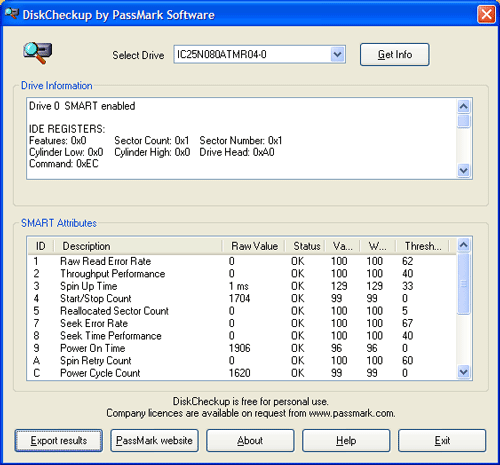
If you do, then use the DiskCheckup software from PassMark. This software is free for personal use and $15 for business licenses. Just download it, unzip it and run the DiskCheckup executable to get an instant report on the health of your drive. The software reads the data put out by the S.M.A.R.T. feature standard on most hard drives nowadays and can tell you through a simple to read report if it’s time to really back up the files on the drive and get ready for its demise. I ran a report on my laptop’s drive, and it passed with flying colors. I’m alright for now!

DiskCheckup Test Results

Standard
Thoughts

Get Perpendicular

Hitachi’s gone disco to explain the new hard drive technology, which allows for 10x the capacity. See the linked flash movie. Cute! 🙂 Here is the link.

Standard