Reviews

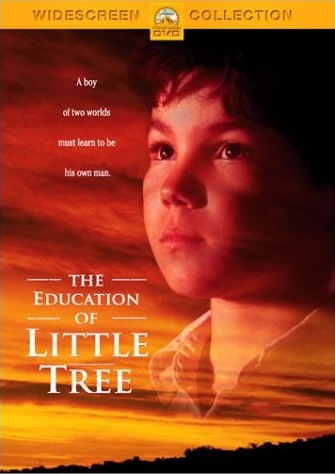
The Education of Little Tree (1997)

A little boy loses his parents during the depression, and his grandparents take him to live with them in their mountain cabin. The premise is simple, but the lessons are many. I liked this movie because it taught respect for native Indians.

Let’s face it, the “red skins”, as they used to be called, owned this land. It was theirs long before it was ours. The early American settlers drove them out of their homes and used every possible means to push them aside, to disown them of their inheritance.

That was shameful. And what added insult to injury was the way they tried to “integrate” them into society after they’d been pushed aside for so long. This film tells the story of one such boy. Half-Cherokee, he is forced into an “Indian” school, where he is treated like an animal. The idea is to erase all sense of individuality and family out of him, and to get him to become an “American”.

You might think the subject matter is outdated, but only recently, the Canadian government has had to issue an official apology to Canadian Indians for their treatment of their children.

Quoting from the article: “Between 1870 and 1996, an estimated 150,000 indigenous children were wrenched from their homes and sent to Christian boarding schools, where many were sexually and physically abused.”

The movie offers a solution that I only wish more Indian children had taken. The little child runs away from the school (aided by his grandfather) and spends his teen years hiding from government officials who want to put him back in what they call “schools”. He gets a real education from his uncle, an experienced Cherokee who acts as his surrogate father and prepares him for a solitary, sometimes troubled, but free life in the mountains.

I get raised hackles every time I hear the word “freedom” trumpeted about, yet find clear proof of forced behavior or oppression. For all its talk of freedom, the US has always managed to oppress certain of its population, throughout time. First it was the native Indians, then it was the slaves, then its Japanese and German citizens during WWII, then the presumed Commies during the vile McCarthy trials, then various other groups during the 20th century. Now, this oppression has culminated into the mass reduction of our liberties through the so-called Patriot Act, a filthy lie of a misnomer if I ever heard of one.

The real patriots always stand up for the rights of all, and they always question the system in order to keep it in check. Sometimes, the best statement a free person can make is to stay free, even if it means thumbing your nose at idiotic rules and policies and living in the mountains, outside of society. Because eventually, the government comes around to realize its idiocy, and issues an apology. By the way, the American government is long overdue on just one such apology.

If you want to find out more about the movie or buy/rent it, you can find it at Amazon, Netflix and IMDB.
Standard
Reviews

Three classic movie duds

If you follow along with my classic movie reviews, you may think I have only good things to say about them. Truth is, I don’t usually choose to write up movies I don’t like. But I’ve recently seen three classic movies that were so bad I needed to point them out. I’ll look at each in the order I’ve seen them.

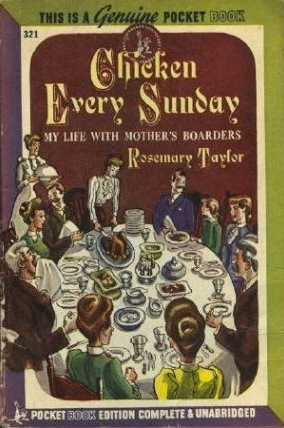
Chicken Every Sunday (1949)

Made after a book which can still be found in print (at least the book was good), this movie is a convoluted, drawn-out, syrupy mush that does not entertain. It only frustrates.
One good thing is that it has Alan Young, one of my favorite actors, but he’s stuck in this horrible, lily-livered role that has him meowing and crying his way through the movie, and it’s just sad.

Individually speaking, the actors are good. They’re talented, they can play good parts when they get them — but this movie’s script doesn’t have a single good part in it. It just plain sucks. Stay away from it. Did I mention it’s long and you’ll be sorry if you’ll watch it?

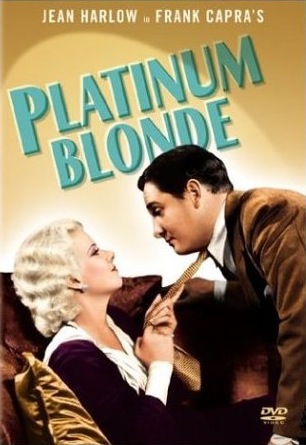
Platinum Blonde (1931)

This is one of Frank Capra’s earlier movies. Any movie by Frank Capra ought to be good, right? WRONG. This movie is a real stinker. The direction is off. The dialogue is slow. The editing sucks. The script is pathetic. There are long, dead pauses, and the chemistry between the actors is non-existent.

As if that’s not bad enough, the movie’s principal roles were miscast. We have Jean Harlow playing the part of an aristocrat. Excuse me? JH?! A platinum blonde best suited for the more tawdry, tough roles, playing an innocent, educated, mannered, high class lady?! That’s a riot… Every move Harlow makes is a verdict against the part she’s playing. Every sway of her hip convicts her, calls her a liar. She simply wasn’t made for that role. It’s the antithesis of her.

Then we’ve got some dude I’ve never seen before in the principal role. Who he is, I don’t know, and I don’t really want to know. He’s not likable, and he’s not meant for principal roles, end of story.

The movie’s saving grace is Loretta Young, who’s stuck as Gallagher, the office girl men see as one of them, until the dude in the principal part gets things right in the last scene. You’ve got to be kidding me… Loretta Young is NOT a man and you can’t look at her that way. Frank Capra was cuckoo to cast her in that part, sorry — although she made the best of it and was the one shining actor in the whole movie.

How can I put it? This movie stinks. Don’t watch it.

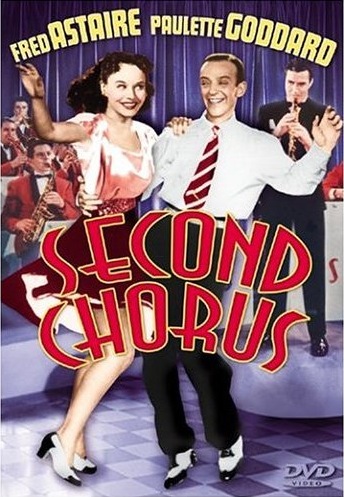
Second Chorus (1941)

Here we’ve got another example of a movie that should have been good, but it’s most definitely NOT. You’d have to get a really crappy writer and director to mess up a movie with Fred Astaire and Paulette Goddard. Guess what? They found both “geniuses” for this movie.

The plot is just pathetic. Two guys fight for the affections of one girl. Should be good, under the right circumstances, but it’s horribly complicated, and the plot devices are terrible and amateurish, the sort of stuff that made me cringe. The writing, the lines: yuck.

You know who else is in this movie? Rocky’s trainer — Burgess Meredith. He looks pretty much the same in 1941 as he did in 1976 for Rocky, and for the sequels. He was like George Burns. Looked old from his youth. And he’s unlikable in this movie.

There’s one scene that’s good in this movie, and it’s when Fred and Paulette dance together. Why couldn’t they do more of that throughout the movie? Why did they stick Fred Astaire, a dancing man, in a trumpet player role? Why do they have him trying to conduct an orchestra while dancing and playing the trumpet?

The movie is full of hair-pulling questions like these. It made me want to get a bunch of rotten tomatoes and start throwing them at the director and the other people responsible for making this idiotic waste of time.

Standard
Reviews

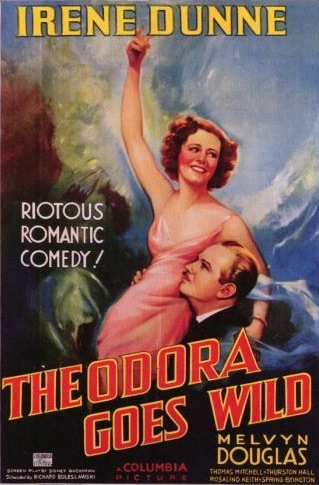
Theodora Goes Wild (1936)

Movie poster for Theodora Goes Wild.

One of the many wonderful comedies made during the Great Depression, Theodora Goes Wild explores a young woman’s quest for freedom in a society where tight constraints are the norm. The film’s humorous and entertaining look at some of the hang-ups of the period is a very fun way to spend about 90 minutes. Interestingly enough, we discover that not many things have changed since. Gossip still rules, small town folk are always too interested in each other’s lives, and people still yearn to live their lives the way they see fit.

Theodora Lynn, a respected daughter of the town’s prominent family, has written a book called “The Sinner”. It’s a wildly successful look at the life of an imaginary woman who does things her own way, very much unlike Theodora. She has penned it under the name Caroline Adams, to protect her identity. Meanwhile, the town is in an uproar over the scandalous morals of the book’s main character, all the while unaware that the very same young woman that plays the organ in church every Sunday morning and obeys her aunts to the letter is the author of said scandalous book.

Theodora visits her publisher on an occasion, and while there, meets Michael Grant, played by Melvyn Douglas, a debonair artist who works for the publisher but is very informal. He takes an immediate liking to her, and coaxes his way into having dinner with her and the publisher that evening. During dinner, he gets her to drink (which she never does) and as she unwinds and lets loose, he enjoys his little game more and more. He decides to pursue her back to her town and “free” her, as he puts it. He succeeds, but he has unleashed a force greater than him. She now intends to “free” him.

The film’s gloriously funny twists and turns had us in fits of laughter throughout. And the skewering of the old biddies in that small town was great fun too! The film showcases Irene Dunne’s incredible talent for comedy and sexiness (it’s no wonder she made such a great on-screen pair with Cary Grant), and fits Melvyn Douglas to a tee. He has an endearing quality that shows through his devilish smirks and his on-screen antics. That same quality made him perfect for the role of Leon in Ninotchka (opposite Greta Garbo) three years later. I can safely say that he’s become one of my favorite actors.

Just one year later, Irene Dunne made The Awful Truth (1937) with Cary Grant, one of my all-time favorite movies. It’s so funny to see her honing and refining the same skills she used to great success in that movie while watching this one. The same little trills of laughter, the same thin smiles, the same looks, glances… It’s wonderful to catch great actors doing some of their best work. It’s time well spent to watch them act.

There’s an important lesson to be learned from the movie as well. It’s easy to forget nowadays how stifling society used to be, and how scandalous certain behaviors were considered just a few decades ago. To some extent, that was a good thing, but it must have driven some people mad with frustration. Nowadays, things are much more relaxed, although we still tend to be judgmental. It seems we always want to tell others what to do and what not to do. Sure, it’s important to point out what’s morally and ethically wrong, but that’s the duty of our parents and families, NOT our neighbors and townsfolk. I don’t believe in the saying that “it takes a village to raise a child”. No it does not! That sort of a village would be the quickest way to get me to rebel if I were still a child.

It’s also important to point out that while Theodora rebelled against the gossipy old biddies and against society, she did it all with a purpose, all while not compromising her own morals. She did not demean what she saw as her true worth. She simply put on a show to prove a point, and she certainly proved it. That’s something to keep in mind for the young people of today, who are so ready to step over any rules they might have set to get at what they want. Sometimes there are horrible consequences to that sort of behavior. If you watch the movie, you’ll remember that Theodora kept “both feet on the ground”. Keep that in mind. Have your fun, achieve your dreams, prove your point, but don’t do something you’d later regret.

More information

Standard
Reviews

Awakenings (1990)

Awakenings (1990)

We watched Awakenings (1990) tonight, and I was left with a newly found appreciation for life. This movie drives home the following point very well: you don’t know what you have till you’ve lost it.

Imagine watching your life, as you know it, become unavailable to you, which is what happens to people who suffer from neurological diseases. Imagine sitting there, trying to fight it, but knowing there really isn’t anything that can be done, while you slowly lose your coordination, balance, speech, senses, and become a catatonic mass, a vegetable, a ghost of what you once were. Through it all (and this point is debatable) you are aware of what happens around you, of what others are trying to communicate to you, but you cannot respond in any way. As one character in the movie puts it, it is “unthinkable”.

As I sat there, taking it all in, a photo of Ligia and I stood by the screen, and my eyes kept jumping to it. What we have is so precious. Much more precious than anything else out there. We not only have life, but we have love. We have so much. So much more than many others. And even if I didn’t have her, I’d still have my life and my health. These are both amazingly precious, and I always fail to realize it until either of them is in danger. Only then do I begin to see all of the things I take for granted.

I can’t put this into words properly. Every once in a while, I get a glimpse of my life from an outside perspective, and then it hits me: I’m a fortunate person. I should stop worrying about the little things. I should be happy. All the time. I have so much. The other things: gadgets, technology, computers, income — these are all insignificant without love, life and health.

Let’s face it, computers may have made our lives a little better, but they’ve also made them more miserable, busier, and more complicated. Gadgets are cool, but we don’t really need them. Technology is nice, but without human interaction and common sense, it only makes things worse. Income is nothing more than an enabler, something that lets you have a place to live and buy food and other things. When you start seeing it as something else, you’ve got problems.

What really matters is life — experiencing it to the fullest, gaining the realization of the gift that it is and being thankful for being alive. It’s so easy to get caught in the busy-ness of life that we lose our self-consciousness, that child-like sense of wonder at the things around us. I know I do that, and I shouldn’t. Every time I get caught up in pointless things, I waste precious time, which adds up. Life is so short… too short.

There was a scene in the movie which was telling for me. It was at the end. Dr. Sayer was typing an article, and the nurse, Eleanor, got ready to head home for the night, but lingered, hoping he might ask her out. He continued working, so she left, quietly. As soon as she closed the door to his office, he fidgeted nervously, knowing what he should have done. Then he jumped up, opened the window, called out to her, and ran out to invite her for coffee. But this wasn’t what struck me. After all, this was what we, as an audience, expected him to do. No, what I found interesting was the way he saved his work. He simply stopped typing, got up and left…

Think about that for a moment.

More information

Standard
Reviews

Wedding Present (1936)

“Wedding Present” (1936) is a wonderful romantic comedy made toward the end of the great depression. Cary Grant plays an ace reporter named Charlie Mason, in love with his partner in “crime”, Rusty Fleming (played by Joan Bennett). Cary would reprise the role of an intrepid reporter/editor in “His Girl Friday” (1940), opposite Rosalind Russell, although his role in that movie would be somewhat darker.

The “Wedding Present” starts with Charlie attempting to get a wedding certificate but mostly goofing around, which leads to Rusty calling off their engagement. The tagline is “We’re almost married… and we want to stay that way!” Of course, that doesn’t work, so the tension builds up as Rusty is wooed by a pilot, then by a well-known writer of success books, called Dodacker, played by Conrad Nagel.

Seeing Conrad Nagel in the role of Dodacker, one wonders why he had been a matinee idol in the era of silent movies. Not much here endears him to the viewer. Then again, his role in this movie was meant to be unlikable, so who knows… Joan Fontaine certainly saw something in him, since she had an affair with him not long after this movie was made — she was barely 20 while he was well over 40.

There is a wonderful optimism that pervades this movie. It seems nothing can go wrong — except Charlie and Rusty’s relationship — but even that’s rescued in the end. Charlie and Rusty both act as if their jobs don’t matter — and I suppose when you’re both award-winning reporters, you can get a job anywhere you like. They slack off, they skip out on work, but since they always get the first-page stories, things work out alright for both of them.

Although there’s some awkwardness between Cary and Joan, they complement each other very nicely. It’s a lot of fun to watch Joan on screen. She manages to appear charming, intelligent and sexy, all while fitting the part perfectly. It’s hard to imagine that she didn’t want to go into acting when you watch her on screen. She’s so natural — but then that should come as no surprise considering she’d been born into a family of actors with roots in that profession going back to the 18th century.

Cary is still in his pre-polished era. You can see his youthful enthusiasm here, and some of his slightly rough, unpolished edges still show through. Although he looks great in a suit, he’s still not quite comfortable in it, not like in his later years, when his suits became an integral part of his screen persona, a part of who Cary Grant was and always remain. But the youthful Cary is a lot of fun to watch. There’s a sense of unpredictability about his next move. One wonders, how will he handle the next line, the next scene? Much like throwing a pebble in a pond and watching the ripples disturb the water’s surface, watching the young Cary act, one can see the little ripples that belie the thought process behind the role’s mask. This would later solidify into a shiny, pristine, glamorous and timeless surface. In his later years, Cary reached perfection. Cary was the role and the role was Cary.

Although the movie is somewhat anticlimactic in some scenes, and some judicious editing could have fixed it, it’s really wonderful. It’s relaxing to watch and it’s quite entertaining. The ending is spectacularly wonderful, and it alone makes the entire movie worth watching. When you add in everything else — the comedy, the superb acting, the gags, the dialogue, the interaction — you can’t help but realize that you get your money’s worth here. Give it a try, you won’t regret it!

More information

Standard