Thoughts

Healthcare in Romania


There are two options for the person requiring care: the public healthcare system, financed by the government, where one is supposed to be cared for without cost if they hold medical insurance, and the private healthcare system, which is not really a system but is made up of different, unrelated private clinics or hospitals, where one must pay all expenses out of pocket. Let’s look at each system in more detail.

Public healthcare

I believe there are three main problems plaguing public healthcare in Romania:

  1. Widespread corruption at all levels of care. Bribes must be paid to hospital directors, managers, doctors and nurses, and sometimes even to hospital guards, if you are to get any competent care other than a daily temperature and blood pressure check until you check out or expire, whichever comes first.
  2. Incompetent personnel, due to:
    1. An inefficient medical education system, staffed with teachers and professors who care more about furthering their own careers, brown-nosing and getting bribes than teaching students how to be proper nurses and doctors.
    2. An unwillingness on the part of most students and medical personnel to put in the effort to acquire the knowledge they need to do their jobs right.
  3. Old facilities and equipment. Hospitals and clinics lack the funds to maintain the infrastructure properly, so all of them are run-down, cold in winter, hot in the summers, with drafty rooms and hallways where you’re likely to catch pneumonia, with bathrooms that have leaky faucets and leaky toilets, mostly left uncleaned, smelly, wet and old, with metal beds that date way back from the 1st or 2nd world war (I’m not kidding about this), and with mattresses that have seen more than their fair share of human bodies and bodily fluids. When it comes to equipment, it’s mostly non-existent, other than basic X-ray machines.

Sure, there are exceptions. There are some doctors and nurses who don’t ask for bribes. And there are some medical personnel who are competent at their jobs — they know how to do them and take the time and effort to put their knowledge to good use. But if you think the two groups contain the same people, you are probably mistaken. It’s usually the doctors who are the most competent that demand the bigger bribes, though it could be that a really good doctor or nurse may also be the one who doesn’t ask for or accept bribes. There’s no way to tell, really. It’s like taking a potshot in the dark. You’ll go to get some care and may end up with a butcher or a blundering fool who only makes things worse, and you may also end up paying him or her plenty of money for the shoddy treatment.

On some level, I understand why the corruption exists. Salaries for government-paid doctors and nurses are very low — janitors at profitable private businesses usually make more money than doctors in government hospitals — but that’s still no excuse for the endemic corruption. While salaries are low, medical personnel have also gotten used to asking for money from each and every patient, to the point where they expect it for the littlest thing and won’t help you if you don’t pay. There’s a ridiculous, infuriating sense of entitlement among most, if not all of them. Somehow they’ve gotten to think you owe them money simply for looking at you. That’s not right.

If only they’d take the time to study more, to get better at their craft, I, along with the millions of Romanians who visit hospitals, would feel better about paying extra to get care, but most are ignorant of any new developments in their fields. They only know enough to get by on routine matters. As soon as there are complications, they’ll take your money for a consultation, then tell you to go see this other doctor, who’ll ask for his share, then send you along to another, and so on and so forth until you’ve seen seven, eight, nine, ten doctors, have spent a month’s or two months’ salary on bribes, and you’re still no closer to getting treated right or cured. They’ll all nod their head, promise to help, take your money, run their tests, then scratch their heads and say they’re not sure what’s going on, that you’ll need to come see them again in a little while, etc., while happily fleecing you.

When it comes to government nurses, they won’t administer the injections or infusions or obey the doctors’ orders if you don’t slip them a bill, or some coffee, or chocolate, or whatever. It has to be something a little more expensive than just some candy or a trinket, and let me tell, when you’re being seen by four or five nurses and you need to make sure each of them gets something, it gets expensive. It’s so sad to visit hospitals and see all the old people on small pensions walk about with sad looks on their faces, mostly ignored by the nurses who are supposed to care for them, simply because they can’t afford to bribe them.

Private healthcare

There is hope when it comes to Romanian healthcare, and as is usual in a free enterprise system, it’s found in the private arena, where there are financial incentives for those willing to take some risks and make some investments in buildings, medical equipment and qualified personnel.

There are private clinics and hospitals, completely separate and unrelated to the government, where you can get competent care if you have the money to pay for it. Truth be told, it may end up costing you less than government healthcare if you add up all the extra costs involved with bribing government personnel.

Only the best doctors and nurses get hired in the private clinics and hospitals, are paid good salaries, are forbidden from taking bribes, and these facilities are equipped with the latest devices needed for proper patient care. There are entire hospitals and sanatoriums placed in beautiful locations in the mountains, where you can go to spend a few weeks to relax and get allopathic or natural, holistic treatments. There’s an entire gamut of options available to those willing to pay out of pocket.

For example, let’s say you need to run a whole battery of tests to see how your body is doing. You can go to the local government hospital, see and bribe a doctor to get some tests, then go to five or six different labs inside the hospital to run those tests, bribe your way through each place, then come back to the doctor in a few days to give him or her more money to look at the test results and tell you what’s going on. Or you can check into a private clinic, where for a fixed cost, you will spend a few days in a clean, private room with proper heating and cooling, pick your food from a menu, have your meals served to you, be able to take showers in a clean bathroom, be seen by caring, competent doctors and nurses, and get accurate test results interpreted properly. That’s the difference.

I should mention that private doctors’ offices aren’t the same thing as privately-run clinics and hospitals. Many government doctors also keep private offices, and will actually force people who come to see them in hospitals to go to their private offices and pay out of pocket to get the same care they could get for free in hospitals, but the care patients get there is just as bad as inside hospitals, and the facilities are usually just as unhygienic and inefficient. No, you must seek out professional private clinics and hospitals if you want to get the serious care I mentioned above.

Possible solutions

I think you know by now which option I would pick if I were to get sick in Romania, and for good reason. That’s not to say public healthcare can’t be fixed. In recent years, there’s been a serious push against corruption in Romania, at all levels of government, not just in healthcare, driven by the EU, but they haven’t made much headway other than talking about it and putting up posters in government agencies. Much more needs to be done, and it needs to start first with better salaries for medical personnel, probably double or triple what they are now.

Corruption in Romania is a very serious problem, one that requires an organization with teeth, one that can and does take immediate action against infractors, and where the identity of the person reporting incidents of corruption is kept top secret. Sadly, the system is still stacked against those willing to report it. Think for a moment what happens to someone who wishes to report a doctor who asks for money. First, they won’t get the treatment they need, and they may have an urgent medical problem, and then, if their identity is leaked, word about them spreads like wildfire, and no medical personnel at that hospital will want to treat them — and it may be the only government hospital or clinic in town. So people usually shut up and pay up, because they want to get on with their lives, not cause problems for themselves and for others.

Until the problems of corruption and salaries and public healthcare infrastructure get resolved, I would encourage people to use private healthcare options, if they can afford it. The more people use private healthcare, the more affordable and accessible it will get over time, and the more incentive there will be for the government to fix public healthcare.

Standard
Thoughts

Constitutional court strikes down Berlusconi's immunity

World Leaders Attend First Day Of UN General Assembly

Glad to see Berlusconi won’t have his way when it comes to the brazen immunity he granted himself a couple of years ago. Italy’s Constitutional Court threw out his immunity law as unconstitutional. This means he will now be subject to two ongoing trials and a probe into an alleged prostitution ring.

What can I say, Mr. Berlusconi… at some point all the stuff you’ve been doing has got to come back and bite you in the rear.

Standard
Thoughts

Gotta give them something to do

It’s easy to decry TV, movies and sports as nothing more than a time suck, as a constant push toward looser morals and a consumer culture, but they also provide a benefit that’s not often discussed — that of giving people something acceptable to do with their time. Among other things, they redirect energy that would be spent on real life behaviors into vicarious behaviors, and in some ways, that’s a good thing in today’s world.

You look back through recent history, and you’ll see that as societies became more civilized, people distanced themselves from nature and segmented their existence not only in terms of time but also in terms of space. When economies were based solely (or mostly) on agriculture and crafts, people had plenty to do all day long. Life and work followed a natural cycle, and they intermingled. (You see some of that these days with telecommuting.) People had homes, and they had land, and they worked on that land and around their homes all day long. They put in long hours during the spring, summer and autumn, and relaxed during winter, at home with their families. Nowadays, very few people still live on that cycle. Most people have office jobs and live in apartment buildings, particularly in the larger cities where the costs of owning a home are prohibitive. When they get home at night, what’s there to do? Little, really. When you have an apartment, what are you going to do? Stare at the walls? Vacuum the floors? Re-organize your sock drawers? I suppose that’s how the need for mass entertainment developed, first with sports, then movies, then TV. When you have (roughly) five hours of free time per day, you’ve got to spend it somehow, so why not become a sports fan, or why not watch movies or TV?

As one follows the progress of their favorite sports team or TV show, they live in that world, through those characters or stars, and experience the highs and lows of that microcosm. Some would say that’s a form of population control, of dumbing down the population, of occupying their time with nonsense so they don’t wake up and start something. In some ways, it is, but it’s also needed. What would people do with the energy and time they spend on sports and TV if those outlets didn’t exist? Some would spend it in positive ways — with their families, on books, arts, hobbies, games, newspapers, trips and the like — and yet others (and this is a number that can’t be quantified) would spend it in negative ways — and the variety of those ways is something that would boggle the mind. For that group of people, the fact that they spend their time in front of the TV or in the stands, cheering for their sports teams, is undoubtedly a good thing.

So, beside the fact that there are very real benefits to TV networks and advertisers as more people tune in to see TV shows and sports matches, or to movie studios as more people go to see their latest creation, or to sports teams when fans fill their stadiums, there are arguable benefits to be gained for society in general as more people tune out the outside world and turn on their TVs. The issue is clearly more complicated than that, and I’m oversimplifying things, but I wanted to point out this particular aspect. It’s but one view among many that can be taken when you talk about this subject. The more I think of this, the more I realize its complexity can’t possibly be explained in a single post, so don’t expect an overarching conclusion here — just an observation.

Standard
Reviews

Christoph Rehage's China hike

Christoph Rehage walked through China for a year, on foot, while letting his hair and beard grow. The total distance walked was 4,646 km. He took photos of himself along the way, then put them together in a wonderful time lapse video which you can see below. He also kept a travel log, which he’s been posting to his website.

I bookmarked his video a few weeks back and meant to blog it. Now it’s already making the rounds. If I hadn’t procrastinated, I wouldn’t be in the me-too group…

It’s a great video, and a great achievement. It’s amazing to see Christoph’s face change through his trip. He emerges a changed man at the end, and exclaims as he puts up a photo of himself at the start of the trip, “Who was this man? Was it really me?” Good question.

The Longest Way 1.0 – one year walk/beard grow time lapse from Christoph Rehage on Vimeo.

Standard
Thoughts

The pain and importance of communication

During the past several months, I’ve had to work with people much more than before, and I learned a few things, one of which is the importance of communication.

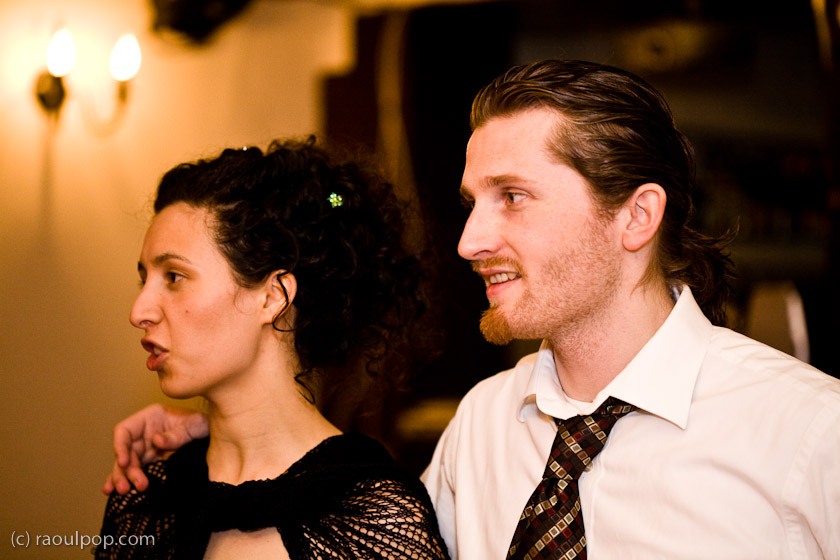
Ligia and Raoul, talking

It’s one thing to sit in front of the computer all day and communicate via email and the occasional meeting, as it happens in IT work, and it’s quite another to only do it in person, face to face, explain concepts and ideas, try to get your vision across, then see how well others understood and delivered on the stuff you needed. More often than not, I’ve been disappointed, but I’m told that’s par for this course.

So where does communication help?

Where there’s tension, it helps deflate anger and potential conflict. I’ve been in situations where the tension had built up so much the hair stood up on my back and I was ready to punch someone, and yet if we were able to communicate rationally for a few minutes and hash out the various problems that we faced, all of that pent-up anger literally melted away. Of course, if the other person can’t communicate rationally, that’s another story altogether…

I can’t overemphasize the importance of communicating with each other as you work on a project with other people, particularly when it’s new territory for either one of you. Most people aren’t good communicators. They’d rather just do their work, but if they’re not taking the time to understand what it is you want them to do, being faced with an end result that differs from your expectations can lead to bad situations all around. So what I’ve had to do is to initiate communication most of the time, and to get these people to explain to me each stage of the work they were doing, several times a day, just to make sure they’re on the right track.

In the past, when I worked on IT projects, I had to do the same thing sometimes, but more often than not, I got too frustrated with the capabilities of others and brushed them aside, preferring to do the work myself, knowing I could do it faster and better. That wasn’t possible this time. I’ve been involved in construction/renovation work, and even though I could do the work myself, I couldn’t allow myself to do it because I needed to get results on a tight schedule. Doing things myself would have meant pushing deadlines into the future, and that wasn’t an option. The teams I worked with could deliver the stuff on time, but I had to make sure we were communicating properly. It was a real challenge, and I gained a new-found respect for general contractors and project managers. It’s very stressful and exhausting to work on construction projects and ensure everything gets done according to plan and to your vision when you’re dealing with people. Unfortunately, until we invent robots that can do all manner of construction work to spec — and I doubt that’ll ever happen — that’s what we have to work with.

In IT work, if something isn’t right, you can go back in and change things. You erase or modify the code, re-adjust the software options, etc. You’ve only wasted time, not materials. (Yes, you can also waste resources and others’ time, but let’s not bring that into the equation for this analogy.) In construction work, you not only waste time, you waste materials, and that can really add up. There’s also the painful cost of tearing down stuff that wasn’t built right and starting from scratch, and you pay for this in more stress.

So yeah, communication is vital, but there are some serious flip sides to it.

I’ve found out that you can still be misunderstood and judged even when you do your best to communicate as much as possible — and here I’m not talking about construction work, but life in general. Your every action can be perceived as the opposite of what you meant it to be. You’ll try to help someone else and they’ll think you’re trying to hurt them. You’ll do a good deed and it’ll get mocked or your kindness will be abused when others seek to take advantage of you. It is so painful to deal with this crap, and yet there’s no way around it unless you go live someplace away from everybody — and let me tell you I’m sorely tempted to do it.

There is so much potential in each of us to create, to do good things, lasting things, beautiful things, to achieve lofty goals working in harmony, but we’re stuck using language to communicate what’s inside us. There’s no better way to transfer information and ideas between us. Unfortunately, words can be sorely lacking in the power to transfer information and vision, in most situations where it’s really important for them to convey that. And yes, this is coming from a writer, someone who loves using words. It’d be so much easier if we could communicate what’s in our hearts, unequivocally, when we needed to do it, so there would be no doubt in the mind of the other person of what our true intentions really are. Of course my vision is somewhat utopic. After all, many people simply don’t aspire to do good things. Their goals stop at the ordinary or downright sordid aspects of life, and you can’t do much good with those people. You’re better off avoiding them, unless you welcome extra stress in your life.

I suppose one antidote for all this pain caused by living and working among people is to not care. By this I don’t mean we should be callous. I mean we shouldn’t care what others think of our actions or of us. We should stand rooted in our morality and do what we know is right, treat others the way we want to be treated, and let others think what they will of us. As long as we’re true to our own moral compasses, nothing else should matter. Right? But somehow it does, doesn’t it? And it’s so damned painful, too.

Standard