Reviews

Camera preview: Canon PowerShot SD780 IS

I had the chance to look at the Canon PowerShot SD780 IS Digital Elph camera recently, and was impressed by the beauty of its design, its diminutive size, and its features. This camera is truly small. Being used to holding DSLRs, holding this camera in my hand was an unusual experience for me. It’s so small, I thought I might drop it or break its buttons when I pressed them. But that’s just an initial illusion. It works fine, it’s sturdy, and its matte, non-slip finish means you won’t easily drop, unless you’re Mr. Butterfingers.

I’ve always liked Canon’s Elph line. I owned their 1st gen Elph camera, which recorded images to APS film, and I still have it, though I don’t use it any more. What I like about this camera is how the Elph legacy, combined with modern technology and design cues, all comes together to create a truly wonderful little camera. This camera is a stunner. The logo, the lettering, the buttons, the lens and all of its other building blocks form a beautiful whole where everything falls into place.

And how could I not be impressed by its features as well?

  • 12.1 Megapixel Resolution
  • 3x Optical Zoom Lens
  • Optical Image Stabilizer Technology
  • DIGIC 4 Processor with iSAPS scene-recognition technology
  • Face Detection Technology
  • Face Self-Timer
  • Advanced Red-eye Correction
  • Intelligent Contrast Correction
  • High ISO Sensitivity (up to 3200 ISO)
  • HD Video Recording (1280 x 720 @ 30 fps) with HD output through mini-HDMI connector
  • 20 Shooting Modes and My Colors Photo Effects
  • Smart Auto Mode
  • High-Resolution 2.5″ PureColor II LCD

The only things that bothered me somewhat were the 3x Zoom and the maximum f/3.3 aperture. While the 3x zoom has been standard on the Elph cameras from the start, I’d like to see a 5x zoom already. It would be a helpful feature for many situations. The aperture could also be f/2.8 or who knows, maybe even f/2.2 or f/2.0. I realize the physics of it might get tricky given the camera’s diminutive size, but I’d like to challenge the Canon engineers to do it. It would help greatly in low light conditions, and would add extra bokeh to portraits and macro photographs.

I’d have loved to test out the camera’s HD video feature, as I’ve been looking for a small HD camera, but I didn’t get the chance. At any rate, I was very impressed to see a camera of that size offer HD video. That in itself is an achievement, given that it’s already got a ton of other circuitry crammed in that very limited space. Ideally, one hopes the quality of the HD video is good, without banding or compression artifacts, like that of the HD video from other digital cameras. If anyone’s used this feature on the SD780, please do let me know how good it is.
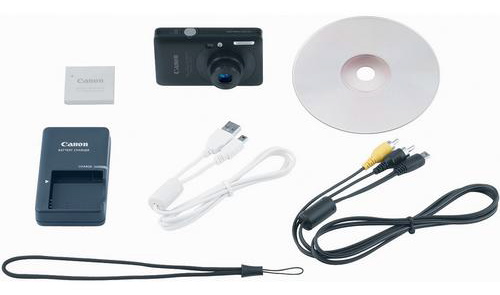
The SD780 IS comes with all the accessories you see above. You can get a good idea of how small this camera really is by having a look at the charger for its battery, which is a good deal longer and thicker than the camera itself.

The Canon PowerShot SD780 IS is available for purchase from B&H Photo and Amazon. (Amazon is currently selling it for $199, which is a pretty good deal.)

Photos used courtesy of Canon.
Standard
Places

Espresso at Pensiunea Stejarul

A few days ago, on Tuesday, we’d woken up early to drive to Cluj, and we were passing a place I’d often wanted to stop at, but never found the time. The place is called Pensiunea Stejarul, and they’re open 24/7. The setting for this restaurant is quite beautiful. It’s high up on the tallest hill outside the city of Tarnaveni, in the middle of an oak forest.

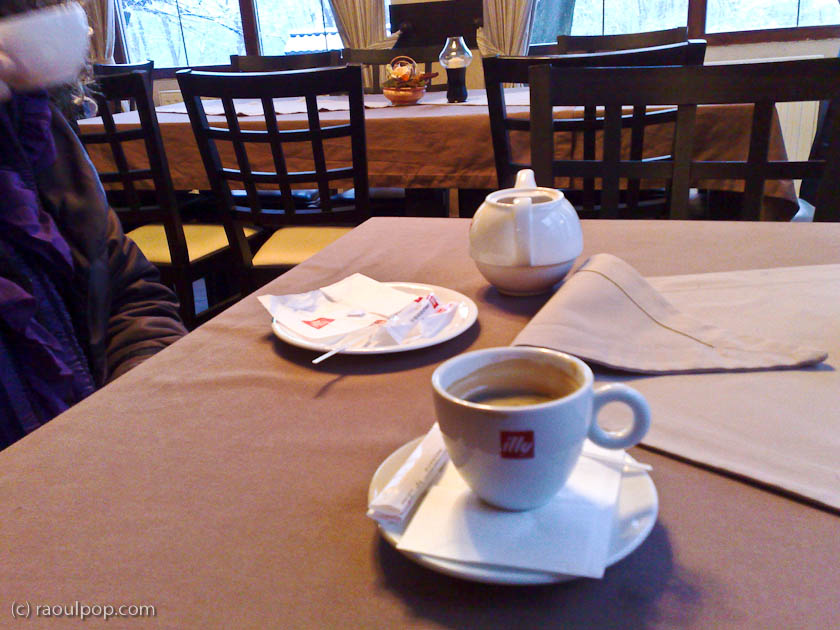
That day, we had the time. It was freezing outside, it was snowing slowly, we were driving slowly, and wanted to stop and take in the scenery for a bit. So we did. I had an espresso, and Ligia had a tea. My N95 refused to focus properly, and all the photos I got were rubbish. This was the best of the lot.

The espresso was almost great. Much better than this one, but not among the best I’ve ever had.

This is what the restaurant looks like from above, courtesy of Google Maps. And this is their exact location.

Standard
Places

Espresso at Hotel As

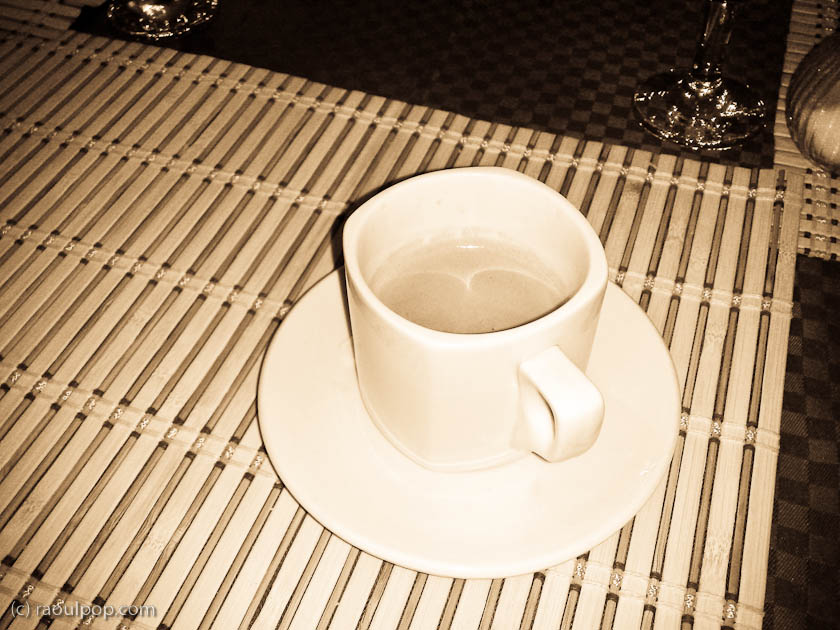
The photo you see below doesn’t tell the whole story, but I like photographing espresso cups, what can I say…

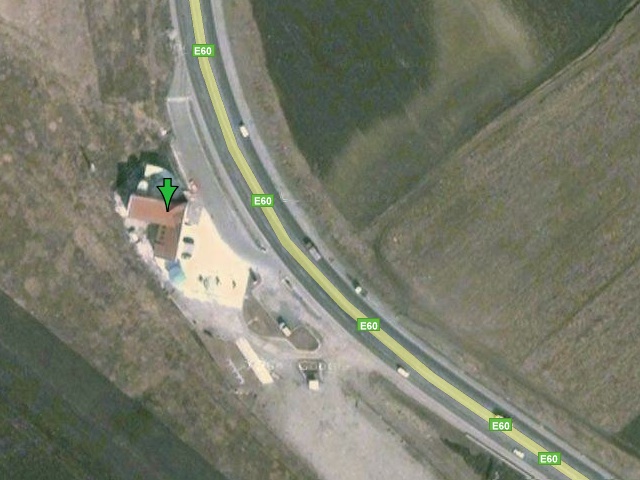
It was a little past 6 o’clock in the morning this past Thursday, we’d been driving all night, it was snowing and freezing outside, there was black ice on the road, and we needed some warm breakfast. We stopped at a hotel/restaurant called Hotel As, on E60, between the villages of Tureni and Copaceni, north of Turda, in Transilvania, Romania.

We had scrambled eggs, I had the espresso, Ligia had a tea, and we walked around the restaurant looking at the beautiful paintings they had on the walls, depicting quaint medieval streets and buildings. Unfortunately the waiter couldn’t tell me who the artist was, and didn’t have any contact information for him/her. We wanted to buy one of the paintings.

I suppose I need to rate the espresso: it was barely decent — nothing special, but at least it had a modicum of caffeine to keep me awake. Got a screenshot of the hotel from Google Maps below, and this is their exact location. We’ll probably stop there again at some point in the future — if for no other reason than to look at the paintings once more.

Standard
Reviews

The Ferrari FXX

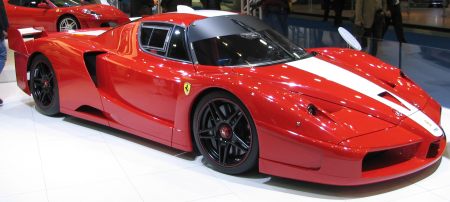
Today was the first time I saw and heard the Ferrari FXX. While I’m not wild about its looks, the sound of its engine is amazing. It floored me. It’s pure adrenaline. I’ve heard the sound of plenty of sports cars in my time, but I don’t know, there’s something that sets the FXX apart for me. Perhaps it’s just the way the sound was mastered for the videos, who knows, but it blows me away.

Here it is in a video where Michael Schumacher drives it around a race track with French football star Zinedine Zidane in the passenger seat.

And here it is being driven by Ferrari test driver Dario Benuzzi for a Top Gear show.

Only 30 of these monsters were made by Ferrari from 2005-2007, and it’s essentially a souped-up Ferrari Enzo with an 800 bhp engine. Here are the detailed specs:

  • Engine: Longitudinal, rear-mounted, 75 degree, naturally-aspirated aluminium V12
  • Valvetrain: DOHC, 4 valves per cylinder with continuously variable timing
  • Fuel system: Bosch Motronic ME7 Sequential Electronic Injection
  • Horsepower Max: 800 hp (597 kW) at 8500 RPM
  • Specific Output: 127.75 PS (93.96 kW; 126.00 hp) per litre
  • Drive system: RWD w/TCS
  • Construction: Carbon fibre body over carbon fibre tub with rear alloy subframe
  • Front brakes: Brembo CCM (carbon-ceramic) discs w/6-piston calipers, power assist ABS
  • Rear brakes: Brembo CCM (carbon-ceramic) discs w/4-piston calipers, power assist ABS
  • Front wheels: 483 mm (19.0 in) x 229 mm (9.0 in)
  • Rear wheels: 483 mm (19.0 in) x 330 mm (13 in)
  • Steering: Rack and pinion with power assistance
  • Suspension: triple wishbones with push-rod actuated coil-shock units, adaptive dampers, electronic shock absorbers, anti-roll bar
  • Wheelbase: 2,650 mm (104 in)
  • Front track: 1,660 mm (65 in)
  • Rear track: 1,650 mm (65 in)
  • Rear view is provided by a roof mounted video camera displayed on a small inboard screen.
  • Top Speed: 217 mph (349 km/h)

There’s more info about it on Wikipedia or on the Ferrari website.

Standard
Places

A lakeshore in winter

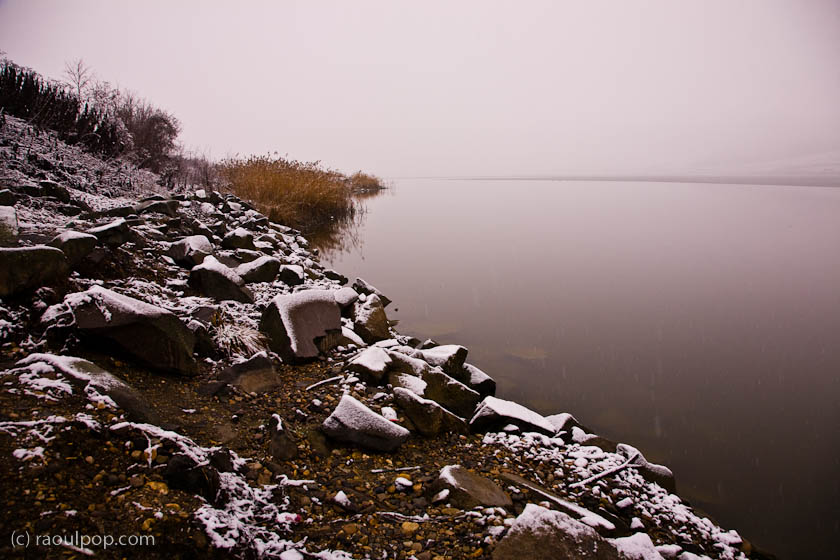
On the rocky shore of a fishing lake during a winter snowfall. In countryside of Transilvania, Romania, in the lake and hill region located somewhere between the cities of Ludus and Apahida, in the county of Cluj.

Standard