
- Apple Announces iPhone 2.0 Software Beta http://tinyurl.com/2jvvem #
- Apple Announces iPhone 2.0 Software, featuring SDK and Enterprise…for June release http://tinyurl.com/2u23zw #
- Apple Announces MS Exchange ActiveSync Support for iPhone http://tinyurl.com/3bpxqm #
- Expression Studio 2 beta adds PHP, Silverlight 1.0 support http://tinyurl.com/3bhmoa #
- SurveillanceSaver http://tinyurl.com/2wdzsq #
- Google to launch consumer health care service later this year http://tinyurl.com/2nak6q #
- In-Stat: Average downstream connection is 3.8 Mbps http://tinyurl.com/38s3a3 #
- Google Earth Flight Simulator http://tinyurl.com/3exsrf #
- Police Can Be Intense (Funny Pics) http://tinyurl.com/2tgz8e #
- Google Calendar Sync http://tinyurl.com/37k6xj #
- Brits Britproof Britain for Texters http://tinyurl.com/2f9atm #
- Why I’m Done With the iTunes Store for Music http://tinyurl.com/2nx93z #
- Olympus reveal E-420: the world’s smallest interchangeable lens digital SLR http://tinyurl.com/2tyynv #
- Broadband Speed Test: How Fast Is Your Internet Connection? http://tinyurl.com/2jjgr4 #
- Teardown: a look inside Apple’s Time Capsule backup appliance http://tinyurl.com/2mdatb #
- 2010: Greening Vancouver http://tinyurl.com/2lhxa5 #
- How to Prevent Identity Theft — Deter, Detect, Defend http://tinyurl.com/35xr2z #
- Champ for President: 1912 http://tinyurl.com/354qnq #
- Watched a few American Idol videos, and I’m disgusted with the choice of songs and contestants this year. Glad I’m not following it. #
- New Mitsubishi displays will have built-in TV Guide http://tinyurl.com/yr9laj #
- Apple misses goal of 1,000 rentable movies on AppleTV http://tinyurl.com/353ct3 #
Tag Archives: privacy
Block anonymous calls with SkypeIn
You may or may not know that Skype offers a service called SkypeIn, which lets you get a local number that people can call to reach you anywhere in the world, provided you’re logged into Skype. I’ve had a SkypeIn number for the past couple of years, and I love it. Want the number? It’s +1 (301) 637-6885.
Do you know why I can give it out so freely? First, because all my calls go right to voicemail. I get that bundled with SkypeIn. I screen all my calls that way and delete all of the annoying telemarketing calls. Second, because of a great feature that I’ve discovered yesterday. It’s hidden away in the Advanced settings for Calls, and it blocks most telemarketing calls automatically.
Here’s how it works. Open Skype and go to Tools >> Options. Then click on the Calls icon, located in the sidebar of the Options dialog box. You’ll get the following screen:
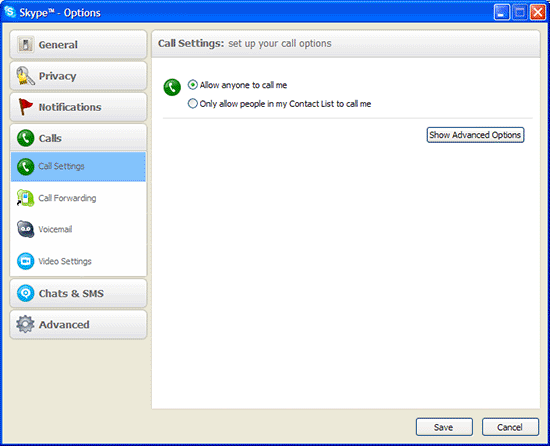
Now click on the “Show Advanced Options” button. You’ll get this screen:
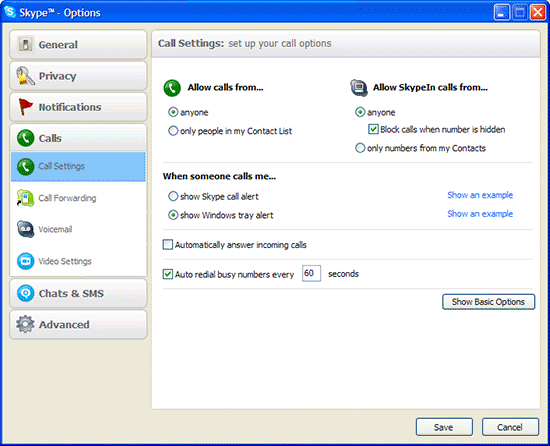
Now look for the option that says “Allow SkypeIn calls from…” and select “anyone”, then make sure to check the option called “Block calls when number is hidden”.
Doing this will block most telemarketing calls, since they usually hide their numbers. Isn’t that beautiful?
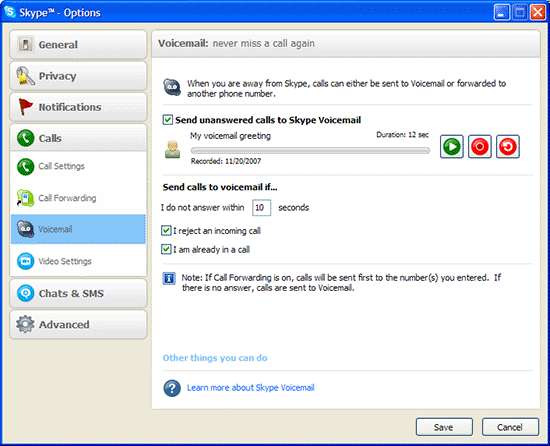
If you want to make sure none of them get through to you, just go to the Voicemail section and look for the “Send calls to voicemail if…” option, then change the number of seconds to 1 or something really small. That way everything that makes it past the initial call filter goes right to voicemail. This allows you to listen to the messages later and hit delete without wasting your time. I have my threshold set to 10 seconds. If I’m logged into Skype, that usually gives me enough time to see who’s calling and decide if I want to take the call or not. If I’m not logged in, then all the calls go directly to voicemail anyway.
Hope this helps!
A look at culture and technology through sound effects
I was listening to the radio one morning, and realized the sound effects they were using to advertise a website were the clicks of a keyboard likely made in the 80’s — you know, long key travel, spring-loaded action, hard clicks. But it worked.
More importantly, it is the only sound that can approximate a keyboard well, and transmit that action to an audience. Think about where keyboards are going today though. Apple is putting out keyboards that barely make any sounds — for example, see the new slim iMac keyboard, or the MacBook or MacBook Pro keyboards. Other hardware manufacturers are following suit, each advertising softer keys, more muffled sounds, etc. How do you record that? It can’t translate well over radio as a sound effect.
Remember how they used to advertise accessing the internet just a few short years ago? Through the sounds of modems. Tell me, could anyone afford to advertise internet access like that any more? No, they’d get laughed out of business, because most everyone is using high-speed access now. But is there a sound that can represent an Internet connection now? How do you represent it or record it?
What about the sound effects for phone calls? They were the simple, old-fashioned ring, right? Everyone knew what it was, and there was no confusion. Not any more. Although people still recognize the old phone ring, children growing up nowadays have so many choices when it comes to ringtones, that soon enough, the old phone ring will no longer be a recognizable sound effect for phone calls.
In some of the older movies or radio commercials, beeps, flashing lights and loud sounds were used as sound effects for computers. The starts and stops of tape reels were well known as well. What about the sounds of the punch cards, rolling through the machines and getting processed? Those are all things of the past. The only sounds computer hardware makes nowadays is the drone-like noise of the hard drives and cooling fans. It may be the representation of an efficient computing machine, but it’s pretty boring as a sound effect. Desktops or laptops (the newer ones anyway) make no sounds at all. We prize them based on how little sound they make, and rightly so, but we’ve lost the sound effects.
Remember the sound of switching TV channels? There was the manual, hard click of the round knob on the TV set (not many of you know about those anymore). If you were using a remote on older televisions, there was a sound pop, followed by a short period of static and the sound of the new channel that accompanied each channel switch. On newer televisions, that’s no longer the case. There’s no pop, click or jarring sound transition during channel switches. It’s all handled smoothly, and on some, the sound is gradually brought up to listening volume so as not to disturb you. But how do you represent a channel switch in a radio ad? You can’t, not anymore, not unless you use a decades-old sound effect.
The point of all these examples is to illustrate how technology is outpacing culture. I wanted to look at this through sound effects, but there are many ways in which it can be done. Just think of social networking sites, their invasion of privacy, and the new expectations of online behavior if you want to look at another aspect of this same issue.
One thing’s for sure — our culture has some catching up to do. While I love technology and embrace it (for the most part), we have to recognize that we’re in uncharted territory nowadays, in many, many areas of technology, particularly at its intersection with people and general culture. The rules aren’t even getting written, because no one is sure just how to grasp the situation. We each understand but a little portion of what’s going on — and that’s both scary and exciting, depending on your point of view.
Some interesting documentaries
Here are seven interesting documentary-type videos found on YouTube:
You’ve probably heard that Geek Squad technicians snoop around on customers’ hard drives and copy photos and other files for their own use. But have you also heard that they overcharge ridiculously for simple little repairs? Have a look below:
The metro bridge over the river Tyne at Newcastle, UK, was recently outfitted with LED lights that are programmed to never shine in the same sequence. The result is a mesmerizing light show that goes on and on:
Bill Crosby did a documentary in 1968 called “A Boy Like Me”, where he pointed out racial inequalities between black and white children. But he did it in such a poignant way that it’s really, really hard to miss the point. Watch this segment in its entirety, it’s only 3:28 minutes long.
The Falkirk Wheel is an advanced bridge for boats. It connects two bodies of water that are separated by a great height in a very interesting way:
Whether you may or may not agree with this first part of the documentary entitled “The Great Global Warming Swindle” (the other parts can be found on YouTube as well), I think you’ll realize it raises some interesting and valid points. I watched the entire documentary, and if you’ve got the time, I would encourage you to do the same.
The next video is pretty geeky in its approach, but it was made to demonstrate how IT security works for non-techies, and it does a great job of it. It’s entertaining, so you won’t get bored, either.
This last video is controversial, and I don’t know what to make of it. It’s actual news footage aired immediately after the crash of United Flight 93. It shows the crash site and surrounding areas, but the strange thing is that the place looks very much unlike a plane crash site. There are no large pieces of fuselage, no bodies, nothing — just a small hole in the ground, and that’s what makes it unusual. It just doesn’t look like a plane crashed there at all.
How is your private data getting used?
I read the Red Tape Chronicles over at MSNBC on a regular basis, and one of their latest posts really struck a chord with me. We really have become a nation where everything gets tracked, whether we like it or not. To some extent, I don’t really care. If the government wants to tap into my phone calls, fine. Been there, done that. I grew up in communist Romania, and our phone was tapped. There’s nothing of real interest to strangers in my phone calls anyway. And besides, you’d have to be a sort of a peeping tom to want to listen in on strangers’ conversations, anyway. Not my type of job.
What really irks me is that every little footstep off the beaten path gets documented somewhere. Not that it’s happened to me, but say I get in a brawl and get locked up overnight, then sort things out in the morning. That little brush with the law may affect me for years to come, even though that’s not the type of person I am. I may regret it, I may not usually do those things, it may be that it just sort of happened, but it’s going to stay on my record. And the payback’s brutal. I may not get new jobs, and if I want to attend classes at some school, I may not be able to get in. It may even affect my credit history. It’s all because of a stupid system that tracks one’s every legal move with no discernment.
This whole mess wouldn’t be a bad thing if there were only one system, and updates to that system were handled properly. But no, there are hundreds and thousands of various government databases, and data from those databases flows into private background check databases and clearinghouses, until there are copies of that single incident all over the place. I may be able to get the government to edit out that little troublesome incident, but there’s no way to track down all of the other digital copies of that record and make sure they get changed. That’s VERY disturbing.
Just do a search on Google for background checks. There are a ton of websites where you can check details about anyone. It used to be that only law enforcement officials were able to conduct such searches, but now any Joe Blow with a credit card can find out information about anyone. That really gets my goose! What right does some freak somewhere have to know stuff about me? Exactly how have our public officials let this happen? You can find out anything: properties, debts, criminal record, demographic information and possibly income, address, phone number, marriage and birth information, anything. I find this VERY DISTURBING.
What’s worse, who knows where these businesses get their data from, and how often they update their information? Looks to me like most are fly-by-nite operations that only care about having a record about someone, not the record. If they list bad information about me, how do I go about changing it? I can’t possibly contact every single one of these shady operations. Yeah, I call them shady, because I think they have absolutely no right to my private information. Only licensed law enforcement officials (read certified and cleared government employees) ought to have the right to view my aggregated private information. Yet these people profit from MY private information by selling it to whoever wants to get it. This disgusts and angers me.
Anyway, what got me started down this warpath? Those of you who know me know that I like old movies. Remember scenes from those movies where people would get into brawls, or there’d be some misunderstanding, and they’d get booked? They’d spend the night in jail, get out in the morning, and be done with it. Everyone would laugh about it. That’s how it should be for the occasional offense. It should NOT affect one’s career, education and finances. Everyone messes up here and there. These mistakes should not be recorded for posterity, or if they are, they should not be made available to every idiot that wants to look at them. It just isn’t right. And no, I’m not talking about serious or repeat offences.
We may have modernized our data storage and retrieval, but we’ve lost our good, old common sense about how to use it.
 Raoul Pop