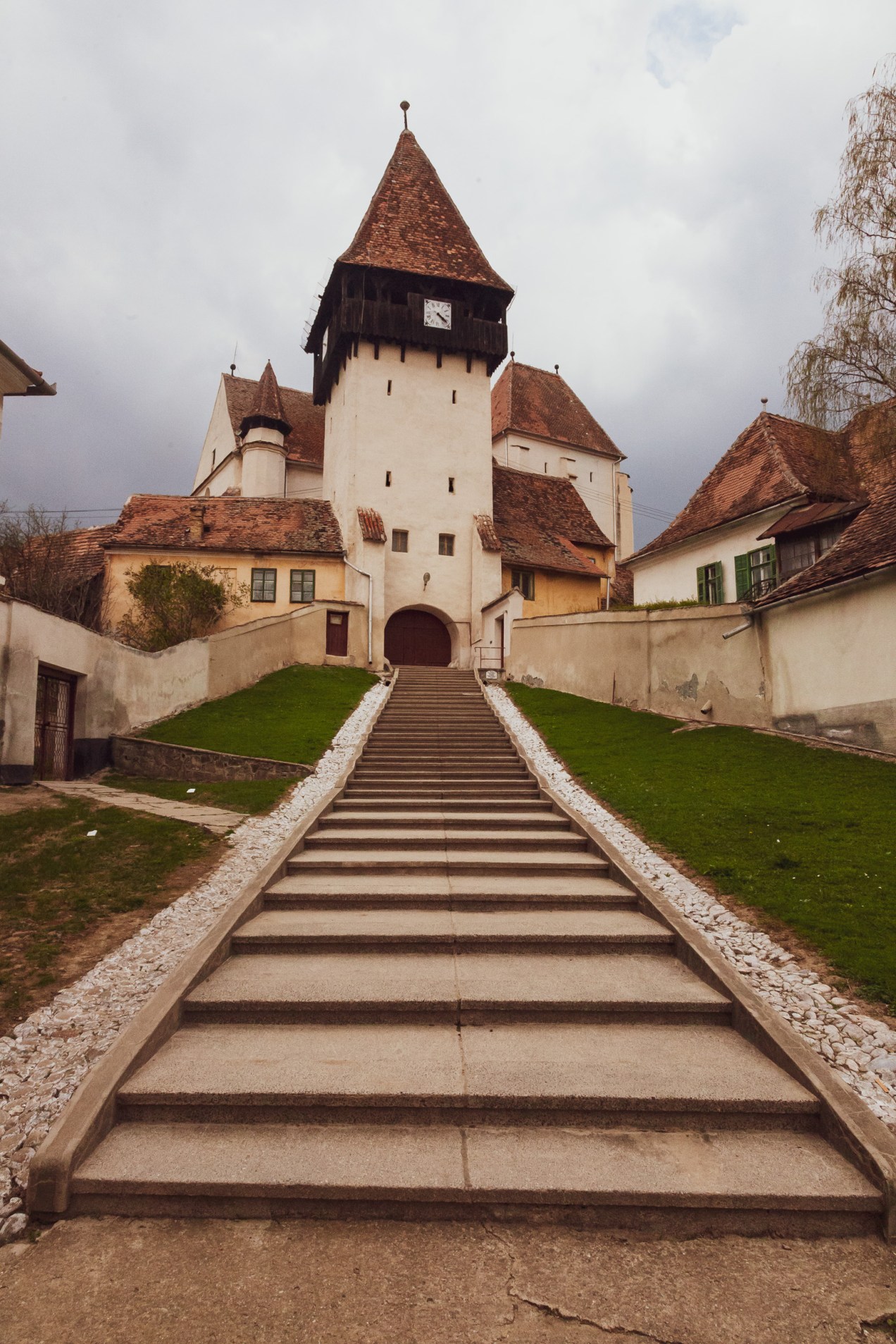
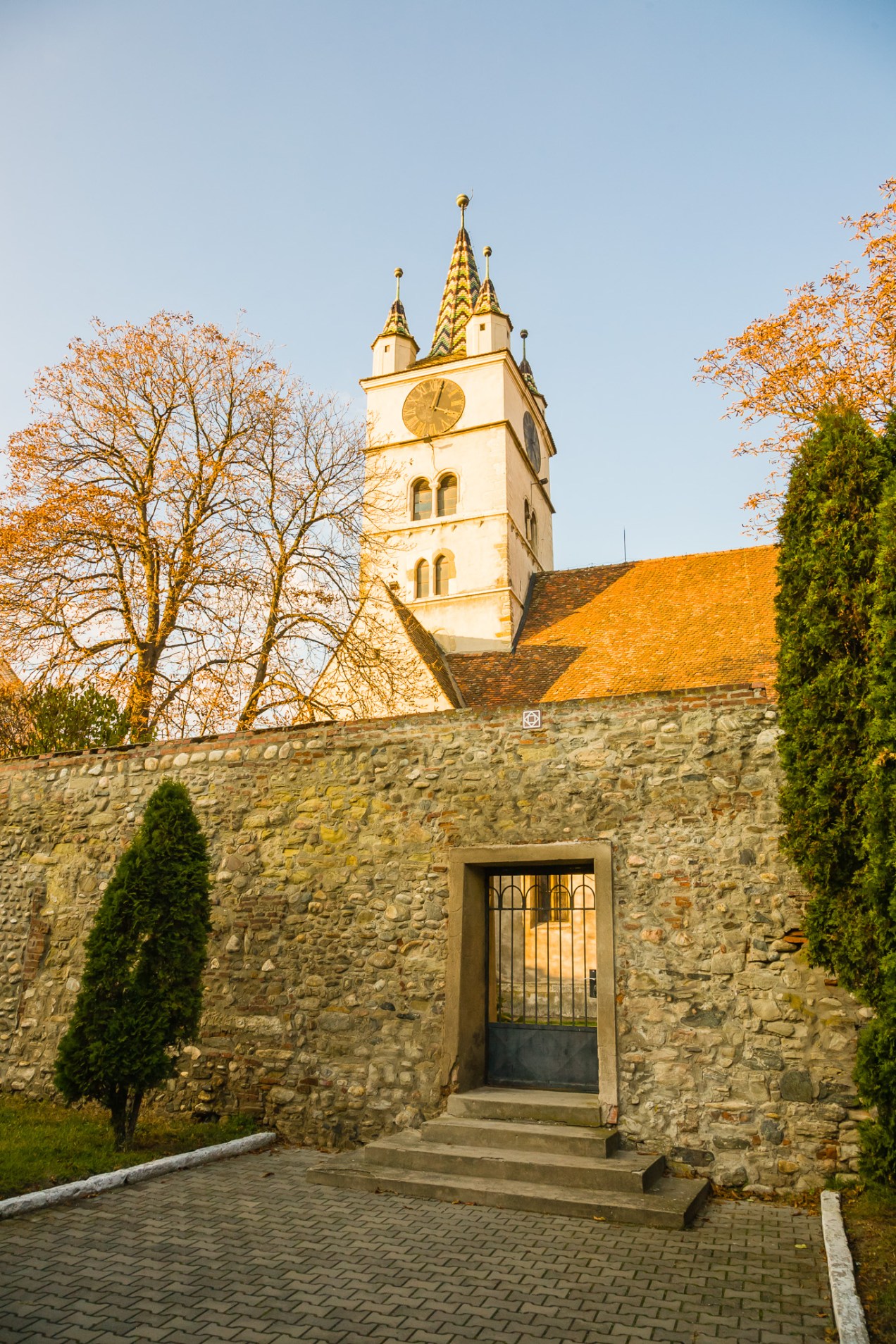
This fortified church looked quite different when it was first built using the Romanesque style in the beginning of the 12th century AD. It was soon destroyed by the Tartar Invasion of 1241-1242. Afterward, the work progressed more slowly and in the Cistercian Gothic style which we see today. Parts of the older structure were used and integrated into the new architecture, resulting in a larger, unified whole where you can still see that some things don’t quite belong. For example, at one of the main entrances you get to glimpse part of the older, lower entrance to the left of the Gothic arches.
The chorus balcony dates back to 1370, is 23 meters tall and the columns which support it are 11 meters tall. The main structural work ended around the year 1420, the Saxons having made a lot of progress in the late 14th century due to a period of prosperity. The church itself was fortified and an impressive defense wall was built around the edifice. A separate chapel was built on the side of the church where religious objects and clothing are stored.
In the 15th century, Sebes entered a period of Ottoman occupation that lasted 40 years. Somehow the guilds prospered in this period and that meant the church was further developed and decorated. The Renaissance altar is 13 meters tall and 6 meters wide and dates to 1520. The Gothic ceiling supports are decorated with sculpted Green Men, mythological and biblical creatures. The church has a beautiful and functional organ built in 1791 by the brothers Reiger and a black grand piano built in the second half of the 19th century. When we skip forward to WWI, we find out that the church bells were confiscated and used for cannonballs, but they were replaced in 1925. A restoration effort in the mid-1960s brought the church somewhat modern amenities such as electric lighting and it took care of various structural and decorative issues.
Services are still held in the church (see the schedule posted in the photo gallery) but very few Saxon parishioners are left (about 20 of them attend regularly).
Enjoy the photographs!

At the fortified church in Sebes, Transilvania, Romania

At the fortified church in Sebes, Transilvania, Romania

At the fortified church in Sebes, Transilvania, Romania

At the fortified church in Sebes, Transilvania, Romania

Above the gate at the fortified church in Sebes, Transilvania, Romania

At the fortified church in Sebes, Transilvania, Romania

At the fortified church in Sebes, Transilvania, Romania

At the fortified church in Sebes, Transilvania, Romania

The wall was originally as high as it remains in the right side of the picture. It was lowered during the renovations, in order to make the church more visible from the outside. At the fortified church in Sebes, Transilvania, Romania.

At the fortified church in Sebes, Transilvania, Romania

At the fortified church in Sebes, Transilvania, Romania

At the fortified church in Sebes, Transilvania, Romania

At the fortified church in Sebes, Transilvania, Romania

At the fortified church in Sebes, Transilvania, Romania

At the fortified church in Sebes, Transilvania, Romania

At the fortified church in Sebes, Transilvania, Romania

At the fortified church in Sebes, Transilvania, Romania

At the fortified church in Sebes, Transilvania, Romania

At the fortified church in Sebes, Transilvania, Romania

At the fortified church in Sebes, Transilvania, Romania

At the fortified church in Sebes, Transilvania, Romania

At the fortified church in Sebes, Transilvania, Romania

At the fortified church in Sebes, Transilvania, Romania

At the fortified church in Sebes, Transilvania, Romania

At the fortified church in Sebes, Transilvania, Romania

At the fortified church in Sebes, Transilvania, Romania

At the fortified church in Sebes, Transilvania, Romania

At the fortified church in Sebes, Transilvania, Romania

At the fortified church in Sebes, Transilvania, Romania

At the fortified church in Sebes, Transilvania, Romania

At the fortified church in Sebes, Transilvania, Romania

At the fortified church in Sebes, Transilvania, Romania

At the fortified church in Sebes, Transilvania, Romania

At the fortified church in Sebes, Transilvania, Romania

At the fortified church in Sebes, Transilvania, Romania

At the fortified church in Sebes, Transilvania, Romania

At the fortified church in Sebes, Transilvania, Romania

At the fortified church in Sebes, Transilvania, Romania

At the fortified church in Sebes, Transilvania, Romania

At the fortified church in Sebes, Transilvania, Romania







 Raoul Pop