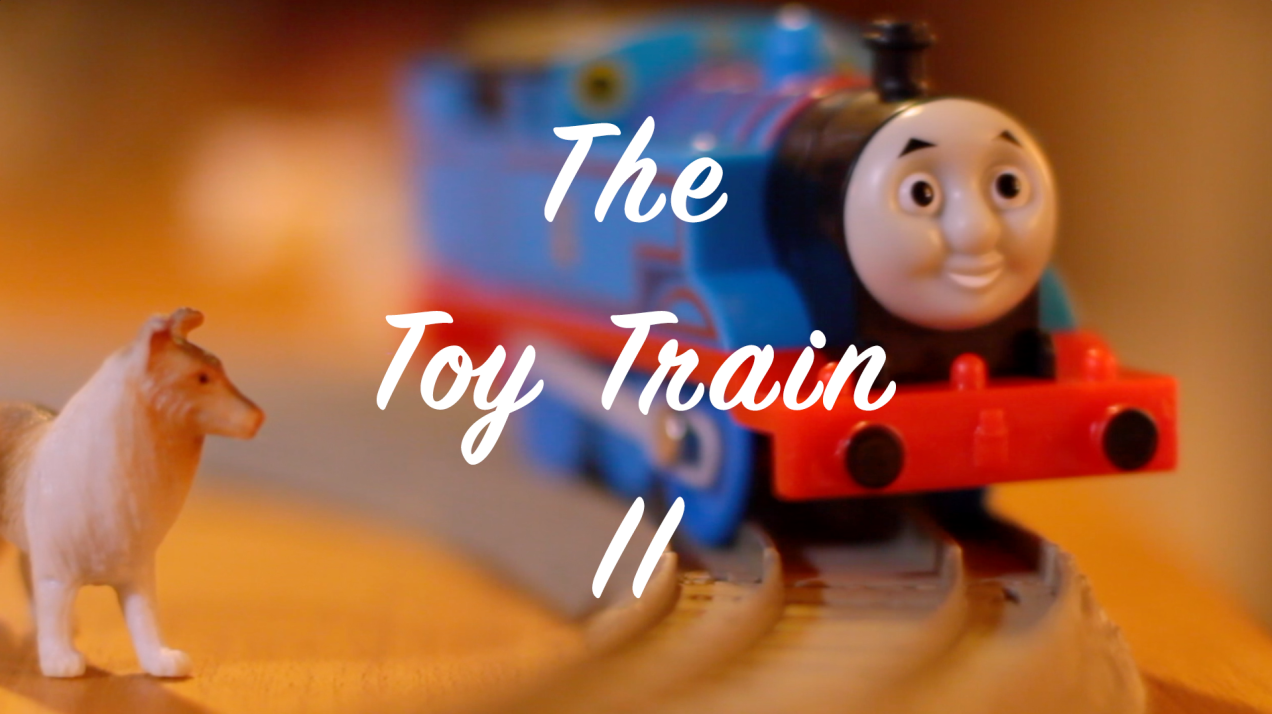
Back in 2009, I made a little video called “The toy train” and published it to YouTube. As 2017 turned into 2018, that video was seen more than 25,000,000 times. Almost ten years later, I made a follow-up video that can see it here or on YouTube.
The tracks were set up for my daughter, who loves playing with trains. It’s Thomas the Tank Engine and Sir Handel, running on two track sets, Elsbridge Station and Runaway Boulder. The various toys used to decorate the set belong to her.
If you were to put yourself in my shoes, you’d have an interesting perspective on the phenomenon that can be loosely called “children’s videos on YouTube”. When I posted my original toy train video, there was no such thing. I simply made a fun little video that I liked and that I thought children might like. I was thinking forward to the time when I might have a child of my own.
It’s now 2018 and the demand for children’s videos has exploded around me. Some of the big YT channels aimed at children get views that number in the billions and revenues that are in the very healthy millions (see this article). There are even YT channels that don’t even bother to make real videos; instead they use computer algorithms to mash together video clips and audio clips in order to create somewhat watchable gibberish, in the hope of racking up views and revenues (see this article). That’s disturbing. Children need simple, logical storylines to their videos; their young minds are thoroughly confused by computer-generated gibberish.
Rest assured my videos are real and they’re made by me. Enjoy!
I thought I’d write a lighthearted, cheery post, sort of a gift that keeps on giving throughout the year ahead, so naturally, I wrote (and made a video) about how complicated life is and how we’re all afraid of dying, but we shouldn’t be, because zombies and vampires… Wait, what?!
“We trouble our life by thoughts about death, and our death by thoughts about life.” ― Michel de Montaigne
“It is not that we have so little time but that we lose so much… The life we receive is not short but we make it so; we are not ill provided but use what we have wastefully.” ― Seneca
“You are mistaken, my friend, if you think that a man who is worth anything ought to spend his time weighing up the prospects of life and death. He has only one thing to consider in performing any action – that is, whether he is acting rightly or wrongly, like a good man or a bad one.” ― Plato
Here’s (more or less) what I talked about in the video.
Whatever your beliefs about life after death, one thing is for certain: this life you’re living now will end within the span of a few decades. That’s pretty short and it’s no wonder we have a hard time dealing with that notion.
I’d like to submit to you that one way we grapple with death is through the introduction of death-less characters into popular culture. Nowadays, those characters are vampires and zombies. We call both of them undead and we’ve made up all sorts of fiction to explain their existence and ways they survive this event that scares us so much. And yet, neither character is something we’d choose rationally, if we were faced with that choice. Both vampires and zombies must continually kill in order to survive and in that sense, they’re terribly selfish: they sacrifice the lives of many innocent others in order to preserve themselves. In escaping death, they force it upon others. And zombies, those putrescent, barely alive corpses, are never first on anyone’s list of ways to prolong existence.
Both these characters though, are ways in which we’re not only dealing with the question of death, but with the question of life. Both offer simplified ways to view and treat an existence which many of us find to be complicated and stressful. Zombies are the perfect example. Instead of dealing with life’s mind-numbing complexity and options, upon becoming a zombie, you have only one option: eat brains. That’s it. No more jobs, bills, taxes, children, etc. Vampires are a bit more complicated and I think that is because they were invented earlier, in the 19th century, whereas zombies, as a manifestation of popular culture, only appeared midway through the 20th century. The more complicated real life will be, the more simplistic the escapism tends to be.
If we’re to stack these deathless characters by level of complexity against others invented throughout history, we find them on the lower rungs of life. If we step back in time, we find that people invented many deathless gods, most of which led far more interesting and complex lives than the humans who believed in them. But as life started to move faster and became more complex and harder to deal with, as we experienced world wars that terrified and scarred entire continents, we began to look for simpler characters and the unfortunate “best” we came up with were blood-sucking parasites that slept in coffins and blabbering, putrid corpses that dragged their rancid meat through cities and the countryside looking for brains. It’s quite sad really, to see where we’ve arrived.
I for one miss the more lofty deathless characters of old, gods who lived interesting, full lives, were articulate, powerful, higher and better than man (though sometimes just as petty and vindictive) and gave us something to look up to. Now we’ve got coffin-sleepers and tomb-climbers… It makes for good escapism through books, TV shows and movies but it does not make for a good alternative to death, nor does it ultimately help us deal with the complexity of life. Instead, we end up terrifying ourselves even more with the various “end of days” scenarios that are fed to us when we watch or read about these characters.
There’s no easy solution to this. Life is only getting faster and more complex. At least it seems that way, because we haven’t yet learned to filter all that is coming our way, and we haven’t learned to only deal with things that are of immediate concern to us. That’s what people did 100 years or more before our time. They didn’t have access to all that we have now. We should do the same. Just because we can have access to something, it doesn’t mean we should introduce it into our lives. We need to turn off the TV more often, put our phones away and spend more time with our selves, getting to know who we are, developing the skills that we deem valuable, exploring nature, sitting in silence. This won’t take us all the way, but it’ll put us in a much better place so we can deal with life. As long as we continue to be terrified by its complexity and by its quickly-approaching end, we’ll continue to look for quick fixes that are sorely inadequate and unrealistic, grotesque versions of ourselves that end up inflicting yet more of the pain and suffering that’s been scaring us but (in theory) take us out of the routine of daily living and offer us a simpler way to see our existence.
In much the same way that too much sugar will give you diabetes and too many calories will make you fat, bass-boosted music ends up being a hollow, crappy experience that will make you deaf and piss off your neighbors. And hopefully, it will also bring you lots of fines for noise violations, fines which you will thoroughly deserve.
Manufacturers are sticking more bass into everything with speakers these days. Singers and studios are busy boosting the bass on their songs too — hey, it doesn’t matter if your song is tired and it recycles the same rhythms and loops used by every talented music creator in the past… just stick a few reverse beats in there (they freshen up the whole mess) and turn up the bass! Bass bosted songs are all over the internet, much like pigeon poop is all over rooftops and statues in busy cities. You’ll find tons of these “improved” songs and you’ll also find tons of tutorials on the subject. So in that sense, this article is going against the grain. I’m aware of it. But I’m sure I’m going to be made aware of it repeatedly by some of you.
The problem is made worse by the people listening to these cacophonies. It’s the wrong type of people, isn’t it? It’s the screw-ups, the ones who don’t amount to much in life, the ones with no regard for those around them. The idiot son of the neighbors a couple of houses away, the one who can’t hold down a job and mooches off his parents, he’s got speakers with lots of bass and he plays them loudly. The no-good neighbors who practically live off social aid and whose idea of a good time is grilling pork in the yard, getting drunk and listening to loud music, they’ve got speakers with lots of bass and they love their bass boosted songs. Any dumbass, jackass or just plain ass who buys a car nowadays and drives it with the stereo turned up and the windows down, they’ve got speakers with lots of bass and they’re sure to let you know. They want everyone to know! Heck, they’ll also stick a subwoofer in the trunk, to ensure the whole bodywork rattles with every shitty bass beat.
Even the partially deaf and elderly neighbors who just bought a new TV, they’ve got speakers with lots of bass, even though they didn’t ask for them when they bought their TV.
The problem is two-fold:
Adding anything extra to the music as it was recorded and as it’s meant to be played ruins the music, the inherent goodness of the song (well, if the song is any good at all, anyway). Mind you, I’m not talking about sprinkling a little salt on the soup! Boosting the bass on a song, both in the studio and on a stereo is the equivalent of heaping shovel-fulls of salt onto the soup. Let’s face it, if all a song has going for it is the boosted bass, then it’s a crappy song.
Excessive bass angers everyone around you, no matter how low the volume on your bass-bosted stereo is kept. The bass sounds travel through anything, and that’s all that your neighbors will hear.
A great speaker is supposed to reproduce sound just as it was recorded, with all of its frequencies, not just the low ones that are collectively called “bass”. A good speaker comes fairly close to it. An idiotic speaker made for dimwits will have thumping bass sounds and little else. Even if you listen to an idiotic speaker at low volume, it’ll still transmit the bass sounds through walls, disturbing everyone around you, because all they’ll hear is the thump-thump-thump noise, the beat, without any of the accompanying sounds. Even if the song is great, it’ll still sound like shit as the beats pound the neighbors’ brains, boom-boom-boom, until they get a migraine.
The situation is made worse by the compressed music of today, sold mostly as MP3 and AAC files, which cannot reproduce all of the frequencies of the sounds that were recorded in the studio. It muddles them with the compression algorithm. So the producers rely more heavily than necessary on bass and beats in order to make the songs catchier. I realize this is an oversimplification, but it is true.
I would like excessive bass to be outlawed, just as excessive noise is currently outlawed. I’m not kidding. I realize I’m going completely against the grain here, but this has become a constant nuisance and these people who go on abusing our ears and our laws are everywhere. I’d like you to begin to notice them as you walk through a city and you’ll soon realize there’s a constant cacophony of bass beats that pollutes our lives, whether we’re indoors or outdoors, whether we’re awake or trying to sleep. If it’s not the neighbors playing music or watching a movie, it’s some douche driving down the street with the music turned up in his car; even if he’s got the windows up, the bass beats travel through the body of his car, across the street, through the walls of your house and into your brain. Why do we tolerate this nonsense?
To me, this thing is akin to a deranged hobo who throws poop at people as he wanders the streets. Bass beats may not be made of physical poop, but they’ll stink up your life and leave a mess behind. You may not need to wash them off, but even if you wanted to, you couldn’t. As the years go by, you’ll be able to see those same crappy beats as furrows on your forehead, as white hairs on the temple of your head.
Civilized cities already have very good noise regulations in place but they do not address excessive bass. In Europe, noisy cars aren’t even allowed to enter certain city centers, which I think is a wonderful thing. And yet no one directly addresses the problem of excessive bass. I don’t think the measures to be put in place should be complicated. Let’s not have to measure the decibels or the frequency of the sounds. The measure to be used should be as simple as possible. Is the sound traveling through the wall or the window of the house? Can it be heard on the street, or by the neighbors? Then it’s too loud. In the case of cars, is the sound of their stereos coming through the car’s body? Can it be heard on the street, even if the windows are up? Then it’s too loud.
Let us start to penalize excessive bass with excessive fines. The manufacturers, the studios and the people listening to music will follow suit, unless they enjoy paying hefty, wallet-burning fines.


 Raoul Pop