Reviews

Adobe’s many-tentacled grip on its users

I’ve been using Photoshop since the late 1990s and Lightroom since its launch in 2007. I’ve been a user of Adobe software for some time, and have owned various software packages from them since that time. But in recent years, I’ve begun to be repulsed more and more by their greedy grip on their users. Their move to subscription-based software was the beginning of my discontent, which was only furthered by their constant attempts to constantly monitor what we do with their software and how we use our computers. I know of no other software company that does this so much, and I find it despicable. I think what they’re doing is a clear invasion of user privacy. Some might say it’s benign, that they’re only trying to keep track of their software licenses, but when you find out that they make most of their money with a suite of services they call Experience Cloud, where they offer “AI-driven solutions for marketing, analytics, advertising and e-commerce”, you get the sense that we’re the guinea pigs for their solutions, and their many “helper” applications that are supposed to only monitor software licenses are likely doing a lot more than that on our computers.

I am also a Mac owner, and in stark contrast to Apple’s constant marketing-speak about user privacy, they never mention Adobe’s many applications that are constantly talking back to the Adobe servers, and they never go into the details of what the many Adobe helper applications actually do on our computers.

At best, the many “helper” applications that get put onto your computer when you install Adobe software can be called sloppy programming, and at worst, you have to wonder exactly what they’re doing with each and every one of those pieces of software under the guise of “keeping Adobe applications up-to-date” and “verifying the status of your Adobe licenses”. Most people probably assume those apps are the various components of the Creative Cloud suite and even though they’re numerous and they can probably tell those apps are in constant communication with Adobe, they choose to tolerate them.

I know things may be different on Windows, where software gets installed in multiple places, but on Macs, applications are and have always been packaged into single files that contain all that a piece of software needs in order to work. Even Microsoft Office on the Mac functioned this way and only used one additional piece of auto-update software to make sure everything stayed that way, and after it moved to the App Store, even that went away. They let Apple handle all their updates now.

Not so with Adobe… They have to be “special”. They have to stick their tentacles everywhere on your computer, doing and monitoring who knows what. I absolutely hate the fact that their Creative Cloud software has to run all the time and talk to their servers all the time, just so I can use their software occasionally. I find it abusive and overreaching and questionable, but for some reason, we’ve chosen to go along with it because we want to use the software.

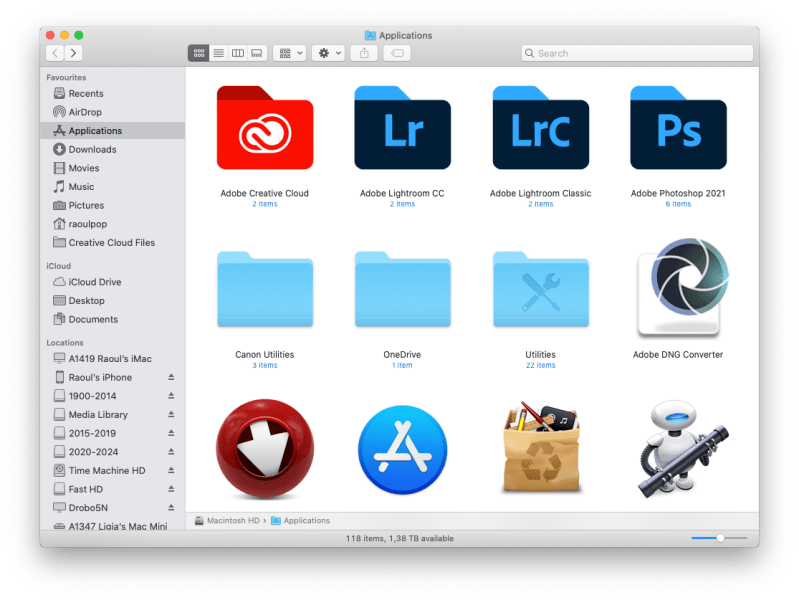
Have a look at what gets installed with their Photography Plan, where only two apps should be present.

You of course will get Creative Cloud, even if you don’t want it, with its many little apps that invade your computer. Then you get Adobe Lightroom CC, the app that hardcore Lightroom users never asked for and don’t want, because all we really want is Lightroom Classic. You then also get Photoshop, which I might use to create a logo once or twice a year, and I infrequently use to blend different frames together into a single photograph (for focus stacking). If that functionality were offered in Lightroom, I’d barely need to open Photoshop. It’s overkill for me.

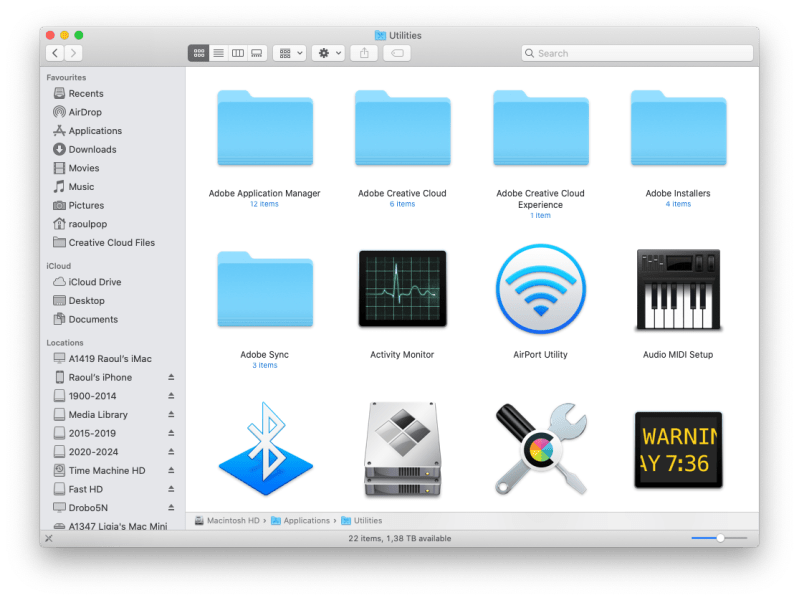
Let’s see what we get with Creative Cloud, because that’s the crux of this post. Most people won’t realize that the little red folder called Creative Cloud in the Applications folder isn’t really the whole of it. No, Adobe also puts a lot of helper apps in your Utilities folder.

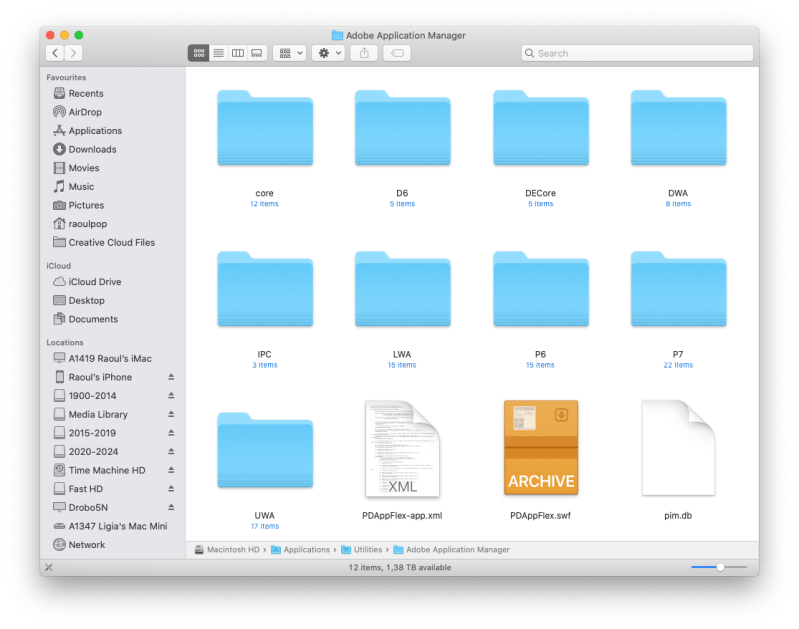
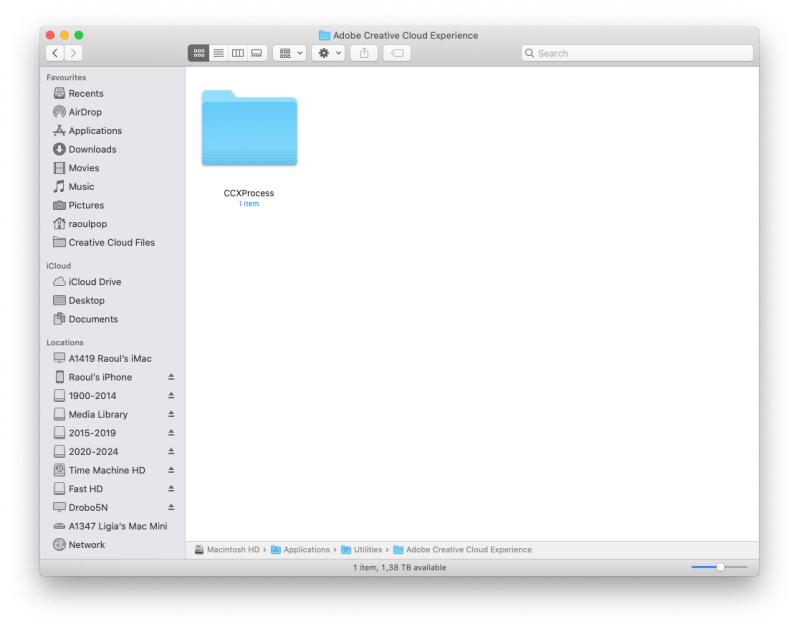
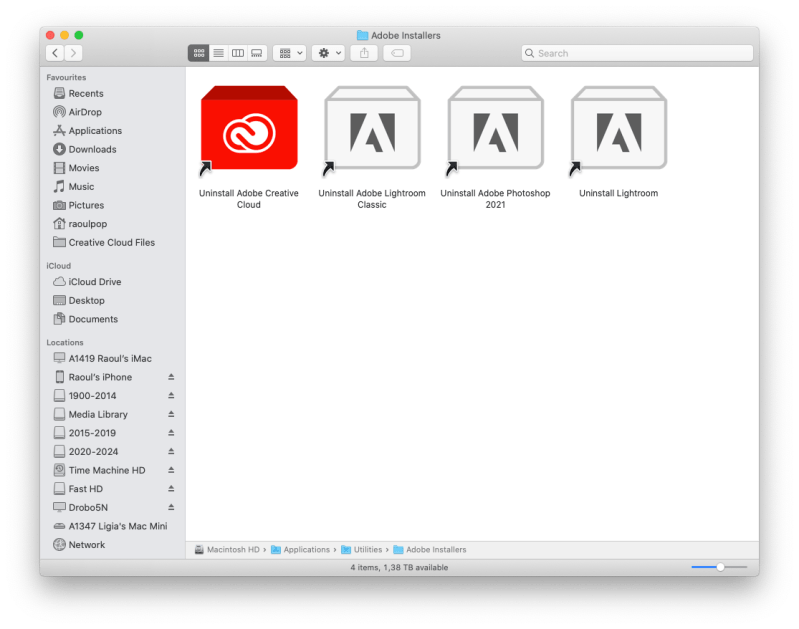
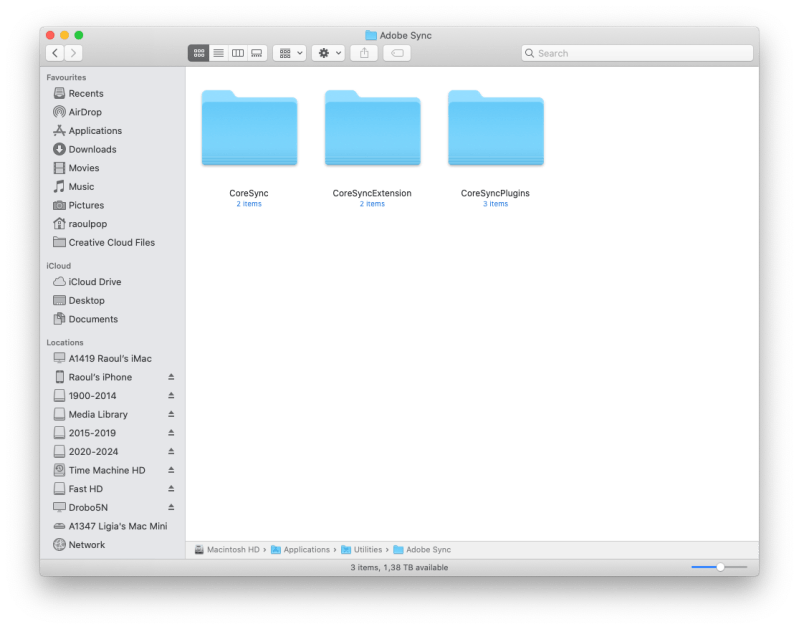
Whether you want them or not, you get Adobe Application Manager, a second Adobe Creative Cloud folder, Adobe Creative Cloud Experience, Adobe Installers and Adobe Sync. Let’s have a look at each of them.

Look at all the “goodies” you get in the Application Manager folder. Yuuuummmy… I didn’t effing ask for all this, Adobe!

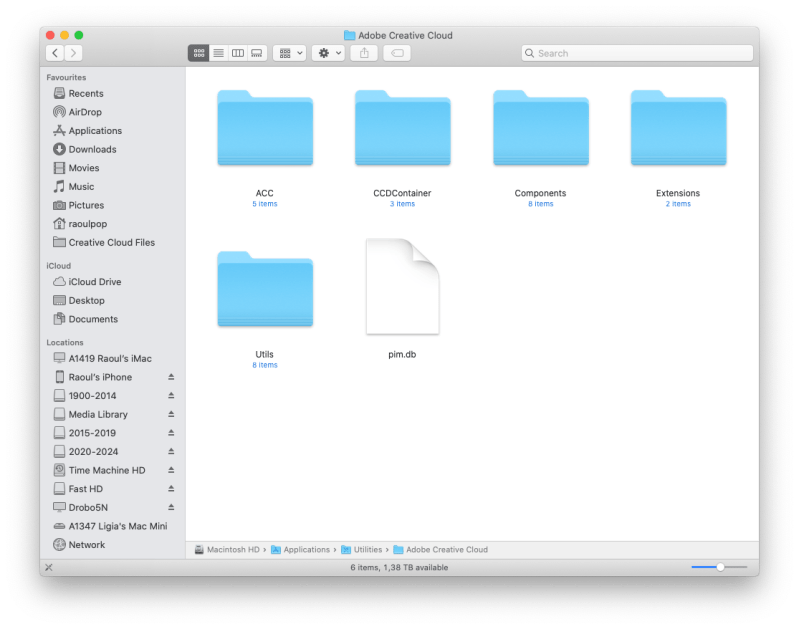
Let’s see what else we get. We get more stuff we never asked for in the Creative Cloud folder.

We also get to be part of a Creative Cloud Experience that we never opted into.

We also get the uninstallers. Fine, okay… although on the Mac, we should simply be able to drag an app from the Applications folder into the Trash (sorry, the Bin) and “bin” done with it.

We also get Adobe Sync, which is another application/service I don’t want and didn’t ask for. Never mind that sometimes it’s stuck on syncing a few photos for weeks on end. I guess it’s thrown in as padding to justify the cost of the subscription plans. “Look, you’re getting the good software, and you’re also getting storage space and a website”… I didn’t ask for it. I just want Lightroom and nothing else!

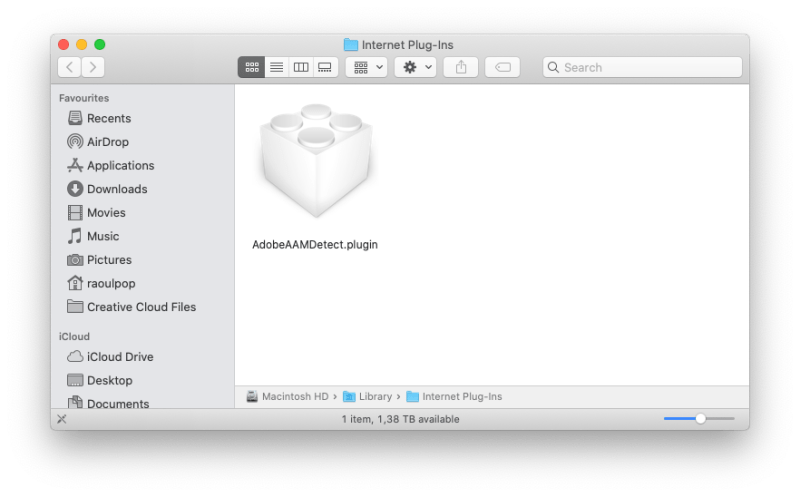
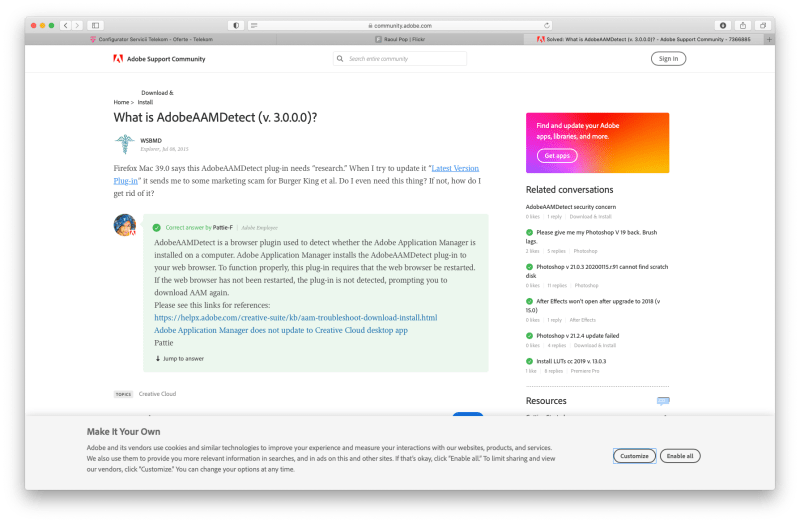
By now you might think we’re done, but no, you also get a special plugin that monitors your online activity, um, “detects whether you have Adobe Application Manager installed. I bet you didn’t know about this little goody from Adobe, did you? It’s called the AdobeAAMDetect.plugin.

Ostensibly, it’s used to detect whether the Adobe Application Manager is installed onto your computer, but who knows what else it does without looking at its code? All I know is that when I go to my Safari plugins, it’s not openly and transparently listed there. No, it’s hiding in the /Library/Internet Plug-ins/ folder, so you have to know where to look in order to find it. Why? And what else is it doing? Is it monitoring my online activity, just like the apps installed on my computer are monitoring my application usage and who knows what else?

I find all this deeply disgusting, and without opening up each of those apps that Adobe sticks on our computers and looking at the code, we won’t know what they really do. If I didn’t like Lightroom so much, I’d switch to another piece of software in an instant. But I have yet to find a single piece of software that:

  1. Doesn’t have a subscription plan,
  2. Lets me easily edit my photos and, this next one is really important to me,
  3. Lets me easily edit the metadata across all of my photos and update it as needed, and finally,
  4. Lets me import my catalog from Lightroom while keeping my collections, smart collections and collection sets intact, so I don’t have to sort through hundreds of thousands of photos manually.

After 13 years of using Lightroom, the interface is very familiar. I know exactly where to find what I need, but I sure find Adobe’s business practices despicable and would gladly switch to something else. As far as I’m concerned, they’ve stepped over the line long ago and have been invading the privacy of their users intentionally for years.

Standard
Thoughts

On the automation of surveillance

We are seeing an increased use of surveillance at every level of our lives (on the street, at work, online, on our phones, etc.), and we see increased use of automation (simple, algorithmic and AI) to sort through all our activities. It’s a worrisome trend. We should be asking questions such as:

  • Who’s surveilling us and why? It’s easy to answer this with two terms: government and big tech, but the answers can be and should be much more granulated.
  • Who’s keeping track of that data? Exactly who are the players who have access to our data, who are running analysis on it and who are storing it, backing it up, etc.
  • How long is our data kept and where?
  • When algorithms decide our human fate, is that just? Should we tolerate it?
  • Who wrote the algorithms and are they skewed in some way? Given the recent censorship issues on Facebook and Twitter, I think algorithms are clearly written with an agenda in mind and they can be easily skewed to fit the needs and wants of the companies who apply them.
  • And many more questions like this…

I’d first like to point out the following: we live in a human world, and we’re meant to relate to each other in human ways; it doesn’t work well otherwise.

However, as I’ve pointed out in past posts, the world is too full of humans, and there are many complications that arise from that. Chief among them is this: an unusually large proportion of them aren’t relating to their fellow humans in human (or humane) ways and they are engaging in violence, murder, kidnappings, rape, pedophilia and other perversions, vandalism, theft, looting, corruption at all levels, drugs, road rage, terrorism, con schemes, etc.

That’s when law enforcement and governments, unable to keep track of every one of these so-called “humans” with existing personnel, turns to computers, mass surveillance, facial recognition, algorithms that identify suspicious behavior, etc., in an effort to sort through the mass influx of human faces, some of which are engaged in criminal/inhuman activities. The issue of why personnel cannot be ramped up in these institutions so that humans can sort through and keep track of these activities is up for debate, but I think we can all agree that when surveillance and automation are used to flag and identify the activities listed above, so that humans can sort through them, it is probably okay, and it is probably to be expected.

It is not okay when automation of surveillance is used to:

  • Spy on our private activities simply for the purpose of keeping track of everything we do, “just in case” we do something wrong,
  • Restrict freedom of speech, such as when social media algorithms simply won’t allow us to post certain links or words on our accounts, or will outright censor certain subjects or people,
  • Dig through our online activities and disqualify us from obtaining a job simply for having posted something questionable in the past, or to destroy our lives altogether, as today’s cancel culture and supposed race inequality movement is actively trying to do to so many people,
  • Monitor all our communications, such as our messages, emails and telephone calls, in the name of national security,
  • And the list can probably go on and on…

Here’s my understanding of the direction of this trend so far: as long as humans will continue to grow in number and to present a very complex environment where it’s thoroughly difficult or outright impossible for a limited number of people involved in law enforcement to keep track of illegal activities, the arguments for the use of automation in surveillance (to the point where artificial intelligence will handle a large part of it) will continue to mount. Also, as long as hidden agendas will continue to be tolerated in government, in the media and in academia, hidden surveillance will continue, for various nefarious purposes, such as persecution, extortion, a building up of arguments to support certain policies, etc.

The solution as I see it is to decrease the world population till we stop being numbers and countless faces and we become communities once more, where we know everyone who lives around us, where we are not one nameless face in a mass, in a ridiculously large throng of people, but a meaningful, contributing member of a neighborhood, a village or a town. That’s when surveillance and its automation will no longer matter. It won’t even be an issue anymore. We’ve got to stop multiplying like rabbits. We’ve got to stop focusing on large numbers. We’ve got to focus on quality, not quantity. We’ve got to focus on meaningful human interactions and meaningful numbers when it comes to our communities and our towns. To those of you who live in smaller communities, what I’ve just said is obvious, but to those who still prefer to live in large cities, I think my words will sound quite strange. And for them and because of them, mass surveillance and the automation of surveillance will continue…

Standard

These are photos of summer and autumn flowers from our garden.

Places

Today’s images

Gallery
20 Years
Thoughts

Twenty years

This website turned 20 on the 7th of August. I didn’t notice, nor did I remember, although I’d looked forward to this milestone since its 12th anniversary back in 2012. Life has a way of refocusing one’s attention, and this year, of all the recent years, I think we can all say has been… a little nuts (or completely crazy, depending on where you live in the world).

For those of you interested in how this website came to be, they details are listed on my about page (scroll down to the last paragraphs there).

That’s all: I get a virtual pat on the back — from myself — and we’ll all carry on. Thanks for being a subscriber (where applicable)!

Standard
Thoughts

Once again, on the problem of noise

I’ve written repeatedly about noise issues in distant and recent past. Noise is something that affects me deeply and not in pleasant ways, so it’s an issue that’s always boiling beneath the surface, so to speak. Particularly during the quarantine, I was able to enjoy such quiet times, that I found the contrast between that period and these once-again too-busy times extremely jarring. I’m writing about it this time because I may have come up with a better way to word the noise laws, for those that are interested. There are two parts to it, as detailed below.

First, here are three posts I’d like to point out:

I was prompted to think about this by a recent incident, where the noise violator took advantage of a loophole in the Romanian laws against noise violations. It’s an optional loophole that the police can choose to apply in cases where the violator has relations on the police force or the local government, namely to require the use of a special device that measures the decibel level of the noise, which in Romania involves scheduling a visit from a special police team from another city, instead of relying on the complaints of a person or persons, or the observations made by the police officers who’ve responded to the call. In short, if you’re bribing someone at the mayor’s office or on the police force, you can get away with some serious noise violations. I hope you can also see how not solving a noise violation on the spot and requiring a scheduled site visit from a police team with special equipment is clearly a loophole that’s meant to be misused. In this particular recent case, I’m talking about a habitual noise violator with a history of more than 8 years of disturbing the peace of the historic city center.

Part 1

My proposed wording for noise violations is this: if the noise can be heard outside the perimeter of the noise violator’s property, it must be fined; by the same principle, if the noise can be heard outside of the noise violator’s car, it must be fined. This would force these callous, incredibly insensitive people to adjust the volume of their music, events and/or arguments so that their neighbors cannot hear the noise. If it can be heard, it can and should be fined. The only loophole I would put in is for construction or other work noises, which I find to be the only noises that are justifiable. Construction must occur, whether it’s new construction, renovation or restoration, and work such as mowing the lawn or doing various house repairs must also go on and is, I would say, necessary, so it must be tolerated and understood, within reason. But any of the non-work stuff must and should adhere to the simple principle of not disturbing the neighbors, whether they’re in the house next door or the car in the next lane, or passersby trying to enjoy a quiet walk through town. I think the current schedule of “quiet hours” that exist on the books in most countries, such as 10 pm – 8 am and a “siesta” from 1 pm – 2 pm in the afternoon, is a good schedule and should be kept, but it should be literally enforced by the book, not left up to the interpretation of corruptible policemen and local governments. And I think that even if a noise violation occurs outside of those quiet hours, as long as it meets the very simple criteria described above, it still qualifies as a noise violation and it must be fined. Someone else’s loud music or screaming is still extremely bothersome, no matter if it happens at 3 pm or 3 am. Should they want to blow out their eardrums, let them do so with the aid of headphones, not loudspeakers.

Enforcing the new wording should also be very simple: using the guidelines above, first-time noise violators must get a written warning. Any time after that, no matter what, they get fined, by the book. In other words, noise violators with a long history of breaking the law should never get a break. They should always get fined. The time for warning them has long since passed.

Part 2

I would also suggest a restriction on the use of amplifiers and speakers for public events organized by local governments to only those venues that are specifically equipped for noise abatement and/or are physically distanced from residential areas, such as concert venues. This would do away with loud events that are heard throughout entire neighborhoods or towns. I’m not saying public concerts shouldn’t happen in town squares, or that musicians shouldn’t be allowed to play on the streets, but the noise they generate must not be amplified artificially. It must be generated solely by analog musical instruments or their voice. No microphones, no speakers. That way, it simply wouldn’t travel as far and as artificially as the deafening stuff blared through loudspeakers, and would become a more natural sound that can be enjoyed within its physical context.

I think those governments that are so inclined to apply these rules would quickly see a much-needed improvement in the noise levels in their cities, and I know for a fact that most working people would appreciate having more quiet time to focus on their tasks.

Standard