This video of mine is quite popular on YouTube. It’s of the Lamborghini LM002 SUV. Not too many of these were made and you don’t see them on the road these days. They’re quite rare. I filmed this one at Funktion Auto in Virginia, with their permission.
When I think of shaving razors currently on the market, I think of cartoon fights where everyone pulls out a bigger gun. Razor companies are constantly trying to outdo each other with more blades. If it’s not the blades, then it’s a “microcomb”, or a vibrating handle… which brings all sorts of other imagery to mind, the kind that has nothing to do with shaving, unless you’re into weird fetishes.
It’s the same kind of approach that software companies use these days. Their code gets so bloated, because they never take the time to clean it up, that all they can hope for is that hardware manufacturers can throw more RAM and MHz at the problem so they don’t have to optimize their code. Apple took a different approach with the Snow Leopard operating system: they took almost a year to clean it up, throwing out the junk. That’s why I admire Apple.
Made better through improved design? Not really.
On the other hand, companies like Gillette and their competitors lost sight of the art of shaving and figured everyone was a nitwit who couldn’t learn to shave properly and couldn’t take care of their razor, so they overdesigned their razors for the lowest common denominator. In the process, the razor became a plastic toy, not a tool, a crappy little thing you throw away instead of something you respect and maintain, because it keeps you looking civilized.
Designed for profit? Thank you sir, may I have another?
Because it became a throw-away toy, their profit margins increased. Because the razors no longer lasted a lifetime, they could sell more of them. You just look down the line of razor models from the Gillette over the years, and you’ll see they get more and more plasticky, with less metal parts. If they have metal in them, it’s not in the head (certainly not where the cartridges attach to the handle); that part needs to be plastic so it breaks after a while.
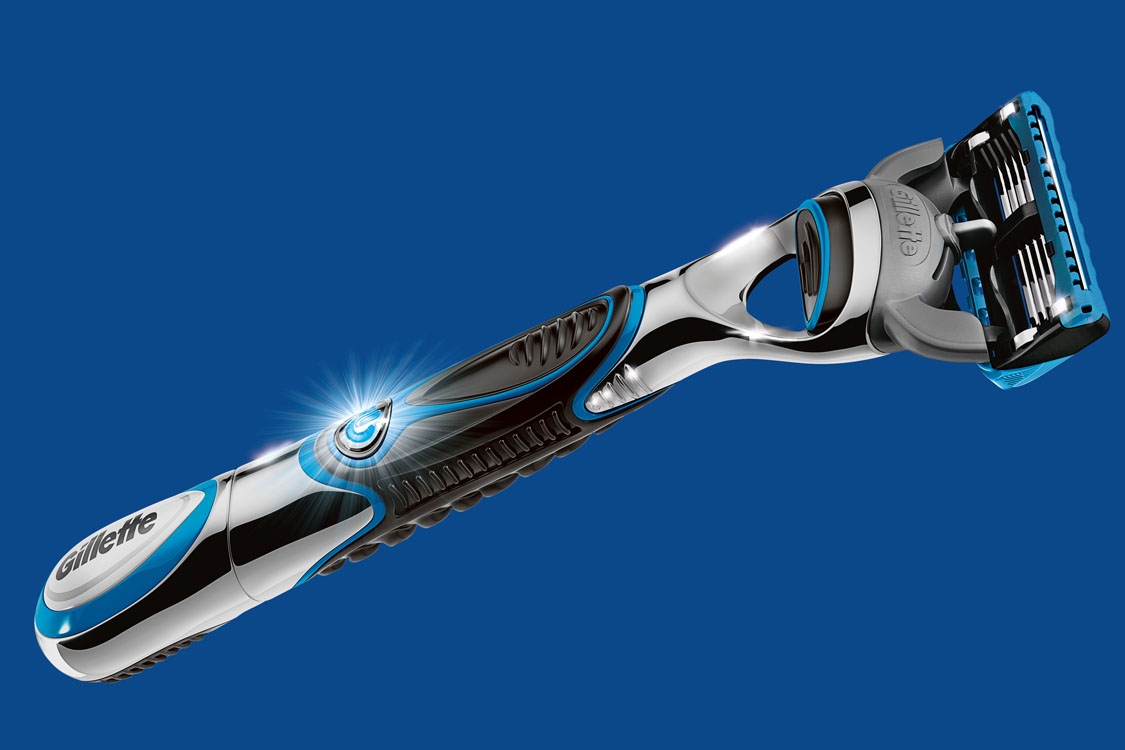
Don't let its flashy looks fool you. It just can't compare to a good safety razor.
The cartridges have started to cost more as well. A pack of eight cartridges for the Gillette Fusion ProGlide razor (the latest flashy gimmick from Gillette) runs about $30 at Amazon. That’s $3.75 per cartridge, and from my experience, they last about 3-4 shaves. By contrast, a pack of 60 assorted safety razor blades costs $18. That’s 30 cents per blade, and they last about 6-7 shaves. (By the way, I’d recommend that pack for those learning to shave with a safety razor, because it’ll let you try different brands to see which blades work best for your face.)
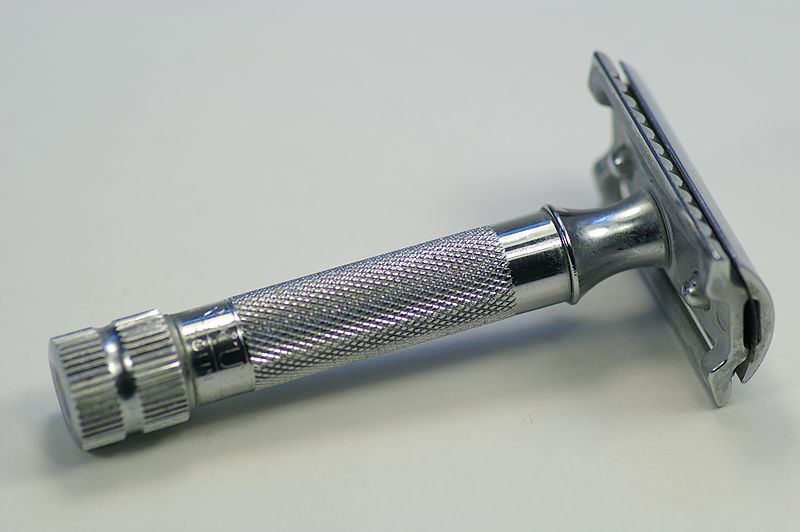
The real deal.
Wait, it gets worse
They also polluted the environment with all that disposable plastic crap. Now you throw away the razor, not just the blades. And the blades aren’t just steel, which is perfectly recyclable, but they’re plastic and metal, which is annoyingly difficult to recycle, because you need to separate the two materials from each other, and it’s just not worth the trouble.
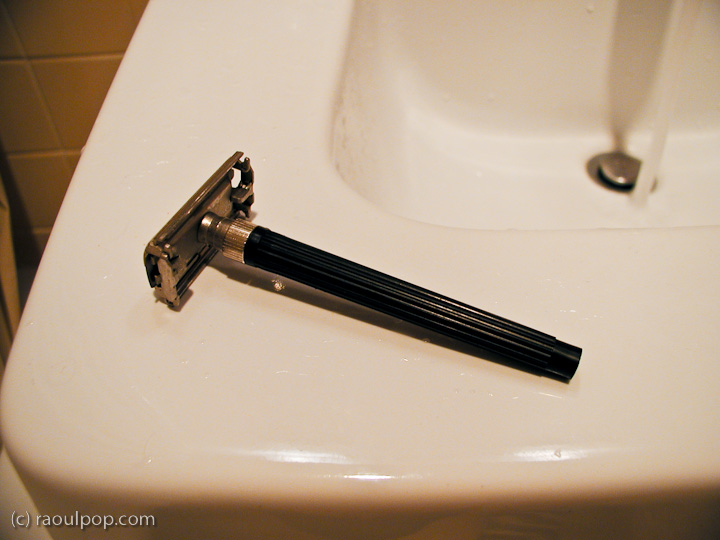
It’s such a shame. I used to admire Gillette about 10 years ago, before I got disappointed with all the stuff they’re doing these days. I still shave with a classic Gillette Safety Razor, pictured below. I still keep my grandfather’s Gillette Heavy Duty Safety Razor, and plan to use that when my own breaks down. Things used to be simple and beautiful. Where did they go wrong?
The classic Gillette safety razor.
If you’d like to learn how to shave properly, check out my wet shaving guide. And there’s also a video, embedded below.
Image of ProGlide Razor courtesy of Gillette. Image of Merkur Heavy Duty Safety Razor courtesy of Wikipedia.
As debates about the direction of educational systems take place in the US and other countries, it’s worthwhile to take into consideration the possibility that we’re teaching the children too much theory and too many arcane concepts rather than practical things which will prepare them for real life.
There’s nothing wrong with knowing physics or calculus or biology, but if you have a child, wouldn’t you rather they leave compulsory education knowing the following practical things?
How to speak and write properly
How to balance a checkbook
How to budget their money
How not to fall prey to scams or predatory financial practices
How to maintain proper bodily hygiene
How to protect themselves from STDs and how to respect each other’s bodies
How to respect others and their beliefs
How not to fall prey to peer pressure
The importance of individuality and of having a backbone
How to put fashion second and budgets first
How to keep their homes clean and organized
How to avoid a consumerist mindset
How to respect the environment
How to recycle
How to purchase sustainable, highly recyclable, durable products
How to cook and wash dishes
How to garden
How to build things
How to paint
How to fix things
How to change a flat tire
How cars work
How to buy quality furniture
How to eat healthy
How to stay in shape
How to have fun without a TV or a movie
How to play sports
How to camp
How to explore the wilderness
How computers work and how to service basic hardware like memory, cards or hard drives
How to avoid viruses, spyware and other crap you find online
How to find true love and how to keep that love
How to take care of babies
How to find a job and how to do a good job
The importance of honesty and being forthright
How to accept responsibility
How to finish something they’ve started
How to investigate politicians and vote according to sound moral and ethical principles
How to drink responsibly
How to take care of pets
How to travel light
How to respect other cultures
How to draw
Basic art history
Basic anatomy and first aid
Basic preventive health
I believe this list of practical things is much more worthwhile for a child to know when he or she leaves school than other, more esoteric things, like what books a 19th century writer published, or the strength of the magnetic field generated by some electric motor. They’ll be much better equipped for life this way. Let’s leave the more advanced, the more scientific topics for those children who are interested in them, and for optional education, like college and graduate programs.
When a child finishes high school, they ought to know how to live as an adult, and that means knowing how to face the real world. I’m afraid we’re not equipping them to do that. That’s why we have so many people who fall prey to predatory scams, or who don’t know how to organize their homes, or who end up in abusive relationships or abuse others, because they don’t know better.
Now that we have the technology to scan movies shot on film into high-definition digital formats (720p and 1080p), and we’ve already done it for some movies like Casablanca, North by Northwest, The Italian Job, It’s a Wonderful Life or Home Alone, wouldn’t it be great if we’d re-scan and re-master more of the older movies, some of which are about to disintegrate in Hollywood vaults?
I’ve made a shortlist of films I’d like to see in HD below, culled from my movie collection. These, along with many other movies, ought to be scanned to 1080p HD. They’re wonderful movies, each in their own way, and they shouldn’t rot in some vault, degrading to the point where they’re no longer usable. They should be seen in all the glory and detail in which they were shot.
As a matter of fact, even 1080p HD is a poor substitute for the quality which properly exposed film affords. A 35mm film cell can be scanned at a resolution of up to 20 megapixels, which means the potential resolution of any movie shot on film greatly exceeds what we know as HD (high definition) these days. I’m sure the technology will catch up at some point, but it still has some way to go.
Meanwhile, ponder this: in terms of visual quality, the boon of television during the past 60 years or so has been a veritable dark age. Most everyone other than big budget productions switched to using cameras which recorded to tape, at resolutions of 400-600 vertical lines — the equivalent of 480p. Compare that with 720p or 1080p HD, or for a real shocker, the potential 3000-3500p of a fully equivalent digital reproduction of film quality. It’s sad, really. We’ve cheated ourselves out of visual quality for the sake of convenience, and only now are we starting to regain some of the lost ground.
A couple of other things I’d like to see when it comes to the movies I’ve listed below, or rather, in general when it comes to digital reproduction of analog films: I’d love to see them made into digital, downloadable files instead of optical discs, and I’d love to see some consistently lower pricing. I don’t know how many people will pay $40-50 for a 1080p movie, but I bet a lot more people will pay $15-20 for it. And I don’t know about you, but I’m not really interested in indulgent extras, or extensive behind the scenes productions that crowd out the actual movie.
Without further delay, here’s my list of movies I’d like to see in glorious 1080p HD:
While in Bucharest on a day filled with meetings and traffic, we stopped at the Ramada Majestic Hotel to relax and have a couple of drinks at the bar. Ligia had a hot chocolate, and I had an espresso.
The espresso was pretty good. It had the right aroma, though it was a bit on the bitter side, and there wasn’t enough crema. The aftertaste was about right.
The bar was a welcome break from the stress of the day. I loved their large couches. I sunk into one and didn’t move for 15 minutes. When we got up, we were ready to take on the town again.




 Raoul Pop