
If you’re looking for a cogent comparison of evolution and creation, then watch this video. Dr. Doug Batchelor does a great job of presenting both topics in as fair a light as each deserves.
Apple's notebook market share is now 12%
Among other news, like their 48% rise in profits, helped by the iPods, Apple has also proven the dominance of their hardware and software market by achieving a 12% share of the notebook market. That’s double its previous share of 6%, as measured from June of ’05 to January ’06. Over 75% of the new notebooks sold used Intel processors, which showed, beyond a doubt, that Apple’s move to Intel chips was the right one.
If you’re sneering at 12%, and saying that Dell or some other PC company might have more, think about why people buy Dells. Not one person I’ve talked with who owns a Dell says they love it. They buy Dells because they need them for their work. On the other hand, people buy Apple computers because they love the design. It’s a gut decision, not a business one. And as billions of beer bellies show, the gut wins every time. Expect Apple’s share of the market to continue to grow, and Dell’s to decline.
Making Change Stick: Twelve Principles for Transforming Organizations by Richard C. Reale
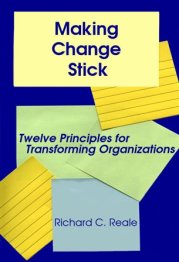 Two figures stand out when reading this book: twelve and twenty. What do they have in common? The same man, Richard C. Reale. For twenty years, he’s studied why change fails and why it succeeds. Then he boiled down his knowledge base into twelve principles that are absolutely necessary if change is to happen correctly and last in an organization. The amazing thing is that these principles will not only ensure the success of a transformation, but will pay dividends in the long run, by having made an organization more change-capable.
So what’s missing? What’s causing organizations to fail when implementing change? The most common reason is the “failure to consider the human side of change.” It’s easy enough to draw the roadmap. The hardest part is the execution, the fulfillment of that plan. If you don’t believe it, just look at the last time you resolved to do something. What was harder: making the decision and putting some thought into how to best achieve it, or actually doing what you planned?
The twelve principles outlined in this book allow organizational leaders to focus on the people, and to empower them to bring change to fruition. It’s about setting down the right process for change, and following along closely, making sure change is proceeding as planned. It’s about walking the talk, and encouraging people to do the same by praising their efforts to change, and setting them up for success. It’s about monitoring the right metrics, the ones that will tell you how you’re really doing. In theory, it doesn’t sound hard, but in practice, it’s another story. Fortunately, the author explains every one of the twelve principles in detail, and the examples he gives clearly illustrate the point. Inspirational quotes from notable personalities are also provided, to help drive home the point.
This book is a wonderful resource. Twenty years of “on-the-job” experience can’t be wrong. The author’s expertise shows, and will help guide the book’s readers toward that great goal of organizational change, which is a hard goal to achieve indeed. If individual change is hard, organizational change is orders of magnitude harder – but this book will show you how to do it successfully. Get it, and achieve lasting change!
Two Tickets to Broadway (1951)
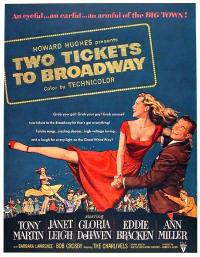 The story of this movie is simple, and normally bankable: small town girl makes good in big city. This is a story with plenty of room for nice little twists and turns that make a movie worthwhile. However bankable the story is, the movie feels fake all the way through. Granted it’s a musical, and they’re always a little fake, but still, it’s terrible, and I can point exactly to what’s ruining it: the screenplay. Who wrote this pickle of a screenplay, anyway? Yikes! It’s just not grounded, it goes all over the place and tries to do too much. They should have used it for toilet paper instead of filming it.
It’s a shame, too, because the actors were good, and the singing was good, even great at times. Bugsby Berkeley’s choreography was surprisingly toned down, and it sort of fit in with the atmosphere of the movie. I say sort of, because Bugsby’s stuff never really fits in, it always stands out. When he steps into a movie, it changes. Thank goodness there were none of his usually outlandish dance numbers here, although I have to say the American-Indian dance was too weird. It was just insulting, and I bet it wouldn’t get done nowadays, in our more relaxed culture. What were those people thinking when they left that number in?
Things to watch for if you want to kill some time watching this movie: Janet Leigh is great all the way through, Tony Martin sings beautifully, Ann Miller is her usual self, dancing all over the place and baring her long legs as usual, and the reparte between Charles Dale and Joe Smith, as Leo and Harry, the owners of the deli, is just plain funny.
Restoring planes is one expensive hobby
Paul Allen, one of the Microsoft co-founders, turns out to have more up his sleeve than the X Prize, although it’s related to it. He loves restoring old war planes. I’m not talking about painting them up so they can be placed in a museum, I’m talking about getting them up in the air! Just the idea sends shivers down my spine. I’d love to see a 1918 Curtiss Wright, or a Messerschmitt take flight, and he’s done it! What’s more, no expense is spared to restore them to their exact state when they were in flight, with the same materials and look. This is amazing restoration work, and it’s also very costly, bringing the price to hundreds of thousands of dollars per plane.
He’s purchased about three dozen airplanes since 1998, and about half of them are on display in two hangars at the Arlington airport outside Seattle. Once a year, he holds a flight day, where these old planes take flight for a public audience. His collection is open for viewing on Fridays and Saturdays, and the fee is $20. Definitely worth it!
 Raoul Pop