Reviews

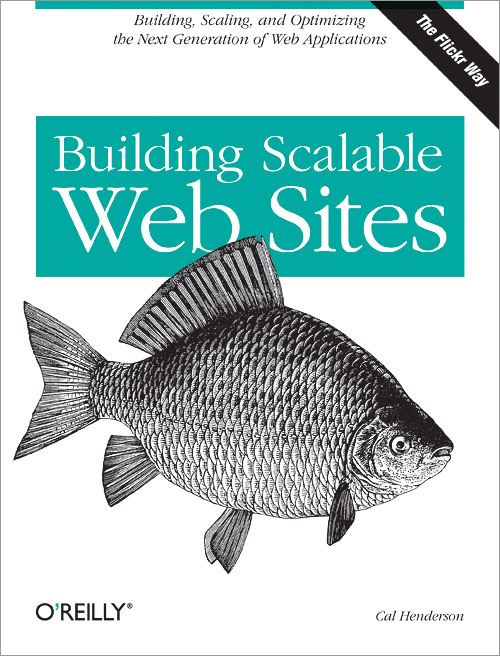
Building Scalable Web Sites, by Cal Henderson

I love this book! There, I’ve given away the clincher already.

Truth is, the writing is addictive. Once I picked it up, it was hard to tear myself away. Perhaps it’s because I’m fascinated with the subject matter, but boy, the writing style ain’t too shabby either. It’s easy on the eyes, and easy on the brain. You just start reading, and go on reading. There are no stumbling blocks, just nice, smooth writing that encourages you to keep moving on as you’re reading.

Let’s face it, which web developer out there doesn’t want to find out how to build scalable websites? Don’t we all dream that our sites or web apps will hit it big, and we’ll have to start planning how to expand? Well, this book will show you how. No, this book won’t show you how to code such sites. There are so many languages out there, it’d be impossible to do that in a book. And besides, code and its structure varies wildly based on the application you’re building. The load imposed on the server varies as well, based on the nature of your application. Some require more RAM, others crave more disk space, others are cuckoo for I/O… you get the point.

What this book will do is to set you straight: what is scalability, and how it’s done, from scratch to finished product, from hardware planning to software planning. It’s all laid out, and it’s easy to understand. Oh heck, Cal even explains what a web application is. And he’ll shatter a few myths, such as this: scalability and performance aren’t the same thing. And, PHP can be used in scalable applications. What?! The heresy! Only Java is scalable, right? Nope.

You’ll also learn things such as… Which scaling (vertical or horizontal) is more cost and resource-effective? How do you load balance with both software and hardware? What in the world is involved when exposing web services? Well, it’s not about nerds flashing in the server room, that’s for sure. How should you react when someone pulls an RPC on your XML? Should you wash it with SOAP, or should you cry API Abuse? Is a data cache a good thing? Should you worry about your database slaves? Should you buy cheap machines like Google, or should you spend your cash on real servers? Read the book, and find out the answers to all these captivating questions.

By my estimate, most people interested in the subject will manage to read the book in less than a week, and that’s with leisurely reading in the evenings. That’s more than I can say about many tech books, where you get bogged down trying to understand the code and what it’s doing. This book is instructive, entertaining, and intellectually enriching. Cal has a lot of knowledge in building scalable websites, and there’ll be no mistaking that when you pick up the book. This fellow speaks from personal experience. Do yourself a favor, and don’t build a hamstrung site. Read this book first!

Standard
Reviews

Some really cool news and products

Wired News is running a great FAQ on Intel’s Dual Core processors – what’s on the market now, and what’s going to get here pretty soon. Bottom line – if you’d like some fast laptop processors, wait until the Merom line gets on the market, which will be late August. Perhaps some laptop makers (Apple included) will allow us to pre-order?

The Economist has an insightful article on the history of the PC and what awaits us in the future. Bottom line: some of the basic PC functions, like email and the web, are being relegated to other devices/appliances. The PC’s functions are changing, but that’s not to say its popularity is diminishing.

Western Digital has put out a new mini-HD called the Passport Pocket, at 6GB for $100, that can automatically sync itself to certain folders on your computer, will automatically encrypt the data, and will allow you to enter contact and reward info that will be useful in case you lose it. Only this information will be visible to strangers. Nice!

Merriam Webster has come out with a USB Dictionary and Thesaurus that they’re storing on a 256MB hard drive. The tool comes with a few freebies as well: a phonetic spell correction, a grammar guide, confusable word alerts, and a crossword puzzle solver. Alright!

You’ll finally be able to use that RDS function (RD-what?!) on your radio, with the Kensington iPod FM Transmitter with RDS. What this means is your car’s radio will now be able to display the artist and song info, so you won’t have to endanger yourself and others on the road by squinting at the iPod screen. Very, very nice!

Standard
Lists

The Best of the Joy of Tech!

If you like JoT, or if you like comics and/or Macs, then you’ll love this book! 🙂 And at $16.95, it’s a steal.

The Best of the Joy of Tech book

Standard
Reviews

Meet LaserMonk in Chief

You wouldn’t think a monastery deep in the western woods of Wisconsin would be involved with re-manufactured laser printer cartridges, but there they are, a multimillion dollar business, up to their necks in profits… See, the monastery was in dire financial straits, and Father Bernard McCoy, now the Chief Operating Monk, struggled to keep it afloat. One day it struck him as he searched for a way to save on toner cartridges. Why not tell others about the great deal he got? And why not act as the middle man and purchase these cartridges for them?

The monastery’s initial investment of $2,000 turned into $2.3 million in sales in 2005, and is expected to double this year. The monastery is out of the pits, and can now afford a private plane and a horse stable, among other perks. How do they manage the profits? The monks are all volunteers working for the monastery, and take no salary. LaserMonks is a non-profit. To top it off, Father Bernard has high plans. He wants to take over the toner market. With this sort of a business model, they’re a real threat to their competitors. I have to wonder about the scalability and sustainability of their business, but only time will tell.

Standard
How To

Getting back to Archimedes

In 1906, a German scholar discovered some of Archimedes’ long lost works in a medieval prayer book. A 10th century scribe had transcribed them from an even earlier manuscript, but in 1229, the pages were erased and used to make a prayer book. Normally, I haven’t got anything against prayer, but I think a priceless piece of history is worth more than a medieval prayer any time, period.

At any rate, science can now rectify this reckless destruction of knowledge. Using a synchrotron, which accelerates electrons to nearly the speed of light to produce x-rays, and has only a 50-micron wide beam, Stanford physicists can read under the misbegotten prayers to get at the hidden knowledge of the Greek mathematician. Gives a new meaning to reading between the lines!

Standard