Reviews

The Raccoons

I recently re-discovered a show I used to watch and love as a kid: The Raccoons. I can’t remember if I saw it in the US or in Romania as I grew up, but I remember the characters quite well. My wife remembers watching the show as a child, too. Now, thanks to Boomerang, I can watch it once again.

The Raccoons

What I like about it is the stories, which always have a nice lesson in them for children, and the show’s setting — a beautiful evergreen forest somewhere in the mountains. The characters, though odd at first, get to be quite likable as you watch the show regularly.

When I was little, I didn’t really care who created the show — I only wondered why the main characters had to have big, bent noses, and why Bert and Cedric had such whiny voices. Now that I’m older, I still wonder about the noses and the voices, but I also want to know who is responsible for creating this wonderful show and bringing it to market. One name pops up time after time in the show’s credits, as producer, director and writer: Kevin Gillis.

Kevin Gillis

Kevin Gillis - creator, producer, director and head writer for "The Raccoons"

As you can see, he looks like a normal human being. I wondered about that… He doesn’t have a huge, bent nose, so I don’t know why he chose to make the characters that way. And since I haven’t yet heard his voice, I don’t know if it’s whiny, like Bert and Cedric’s. I guess that’ll have to wait. In the meantime, I’m glad I can watch “The Raccoons” once more.

If you have children, please know that I highly recommend this show. If you have Boomerang where you live, or have another channel where it’s being shown, then definitely tune in and enjoy it. If you don’t, the store pickings are unfortunately fairly slim. The DVD production is discontinued for now. At leat YouTube has quite a few video clips from various episodes available.

Images used courtesy of Breakthrough Films & Television. There’s more info about the show on IMDB and Wikipedia.

Standard
Reviews

The Beatrix Potter Collection (2008)

The Beatrix Potter Collection (3 DVD set) was just released for sale on 2/12. Ligia and I bought the set just a few days ago, and we’re very happy that we did it. The series was done very well by the BBC. Each DVD contains three animated stories, and each story has a live action introduction filmed in an idyllic English country setting. Some of the live action introductions do repeat, and we found that to be a bit annoying. It would have been ideal if a different intro was filmed for each cartoon, or if only intro was present per DVD, to keep things different.

We love the animation because it looks just like watercolor book drawings that have come to life. The lines are well defined, the colors are wonderfully chosen, and the sound effects almost too real. The movement of the characters is a bit awkward, but I like it because it reminds me once again of their book drawing origin. I can’t say it enough, so I’ll say it again: watching the DVDs is just like seeing the book drawings come to life.

The stories are wonderfully plotted and contain great lessons for the little ones. It’s a pleasure to watch and follow along with the characters. The story-telling is relaxing but won’t put you to sleep. It’s just the right tempo. Some of the stories are a little scary, like that of Pigling Bland or Samuel Whiskers, but the scary scenes are only alluded to, not shown. Still, it’s effective enough to send chills down your spine, so you might want to pick and choose which stories you show to your children based on their age and level of understanding.

Here is what’s included in the set (images of each DVD cover are included below):

  1. The World of Peter Rabbit and Friends
    1. The Tale of Peter Rabbit and Benjamin Bunny
    2. The Tale of the Flopsy Bunnies and Mrs. Tittlemouse
    3. The Tale of Tom Kitten and Jemima Puddle-Duck
  2. The Tale of Pigling Bland and Other Stories
    1. The Tale of Pigling Bland
    2. The Tale of Samuel Whiskers or the Roly-Poly Pudding
    3. The Tailor of Gloucester
  3. The Tale of Mrs. Tiggy-Winkle and Mr. Jeremy Fisher and Other Stories
    1. The Tale of Mrs. Tiggy-Winkle and Mr. Jeremy Fisher
    2. The Tale of Mr. Tod: The Further Adventures of Peter Rabbit and Benjamin Bunny
    3. The Tale of Two Bad Mice and Johnny Town-Mouse

I’m trying to think what other cartoons I can compare them to, and their closest “relative” is probably Little Bear, which is a series about a bear family living in an American forest. The drawing style and movement of the characters is similar, thought the colors aren’t pastels in Little Bear.

I definitely recommend these cartoons. They’re great for children, but you don’t need to be of that age to enjoy them. Ligia and I both found them enjoyable.

Buy The Beatrix Potter Collection

The Tale of Pigling Bland and Other Stories

Standard
A Guide To A Good Life

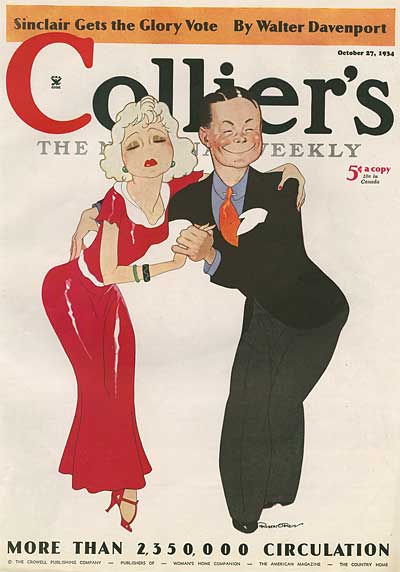
I miss Collier's Weekly

I know Collier’s has been gone for a long time, but when I see stuff like this, or this or this, I can’t help but love it. Maybe we should have more drawings in our magazines, and they should be done with the same classy style and atmosphere. Things are a bit too realistic nowadays. We can always get plenty of reality. We can’t avoid it. It would be nice to open a magazine and get lost in its own little world, where the articles, drawings, photos and yes, even ads are different from all the rest.

Collier’s Weekly

Image Credit: ASIFA-Hollywood Animation Archive

Such little thought is given these days to good cartoonists. Let’s not forget a good cartoonist made Harper’s Weekly what it was, and great artists gave Collier’s its look. Instead of getting celebrities to do provocative photo shoots on the cover — and to manipulate their looks into something completely artificial — it would be better to feature wonderful art like Collier’s did.

Ad from Collier’s Weekly

Image Credit: ASIFA-Hollywood Animation Archive

When we think class these days, fashion magazines come to mind. You open them up, and about 80% of those things are ads with lanky, weird-looking models sulking or posing awkwardly/provocatively. There’s very little substance, and very little interesting stuff. True class in a magazine is a style that comes through the page, and it’s about art, layout, colors, copy and yes, atmosphere. It should invite the reader to open it. While it deals with the problems of the world, it should be upbeat and entertain. Maybe I’m off the mark, but from what I’ve seen so far, I really do wish Collier’s could be resurrected, with the same style and panache of its heyday.

Standard
Reviews

Thomas TimberWolf

Thomas TimberWolf

Back in 2001, you could see some wonderful and innovative cartoons on the Internet. I’m talking about Thomas TimberWolf, an (unfortunately) short series made sometime in 2000-2001 by Chuck Jones and company. This series is possibly the last animation work of Chuck Jones, who died in 2002. This was about the same time that you could see some truly crappy cartoons on TV — not that things have improved much nowadays. But let’s get back to the good stuff…

One of the wonderful things about Thomas TimberWolf is that the series was done in Flash. While some of the smooth movement and art of hand-drawn cartoons was lost, what we gained was a small file size (about 2.8 MB for 5-6 minutes of fun) and vector art. Vector art?! Oh yeah. It means you can scale any of these cartoons up to whatever size you want, and the lines will still be smooth and crisp. No pixelation, no blurriness, only clear lines and colors. Wonderful!

Let’s also not forget that the cartoons themselves are great. I mean, c’mon, we’ve got an intellectual timber wolf with a tragi-comic flaw: every time he says the word “Timber!”, trees fall on him. He spends his days trying to avoid falling trees and not entirely succeeding. How can you not be entertained by that? 😀 What’s even better is that Chuck Jones’ signature style was retained during the computer animation process. We’ve got the same minimalistic gags, the familiar, endearing character art, and that wonderful, non-specific warm and fuzzy feeling that you get when you watch quality stuff. I can’t describe it, but any cartoon aficionado will probably know what I’m talking about.

Thomas TimberWolf was released on the Internet in 2001, and it seems that a short while after the series ended, the Flash files became easily accessible on various sites, without copyright restrictions. I’m not sure entirely sure about that, so don’t quote me on it, but that seems to be the case. At any rate, I believe I downloaded the episodes from this same site several years ago. They’re still up and available there, so that’s a good thing.

Although only 13 episodes got released to the public, there are about 6 more episodes available, and that’s straight from the horse’s mouth. Stephen Fossati, who created, directed, wrote and co-produced the series, said it sometime in 2005. Stephen Fossati is Chuck Jones’ only living protege and worked closely with him for about 10 years. Their collaboration culminated with the Thomas TimberWolf series. I would love to see the other episodes, and I wonder where they are. If anybody has information about them, please let me know.

If for some reason the site where the episodes are posted goes down, I have them and can post them here. I’m not sure about the legality of it. If someone can give me the all clear on it, I’ll gladly put them up.

So, while they’re still available, go download all of the episodes, and keep them safely on your hard drives. They should be preserved for posterity.

More information

Standard
Thoughts

When animation trash gets called art

Last year, I stumbled over the blog of one of the directors for the Ren & Stimpy cartoons, by the name of Vincent Waller. I subscribed, curious to see what one of the people who’d worked on that horrible cartoon was doing nowadays. It didn’t take long for me to find out…

A few days later, he blogged about a cartoon made by one of his fans. He lavished so much praise on it that I watched it. It was an utter bunch of filth, filled with suggestive sex, curse words, violence and bestiality. It was done in the style of the Ren & Stimpy cartoons — same sort of animation, similar character movement, similar colors, etc.

I left a comment on his post, telling him that I couldn’t believe he’d posted that garbage to his blog. I honestly thought the guy knew better than that, but I was wrong. He deleted my comment. I left a subsequent comment. He deleted that as well. I contacted him via email. He answered back and seemed somewhat rational. I thought I might have a decent conversation with him, and I asked him out of sheer curiosity why the Ren & Stimpy cartoons ever got made. What was the rationale behind them? I told him I found them depressing altogether, and I found the subject matter crude and filthy. I said that as a child, I wanted to see cartoons on TV, and very often, only Ren & Stimpy were on in the evenings, so I had to watch them if I wanted to watch any cartoons at all.

He told me to go away and not bother him again. He said that there was something wrong with me, that I should have watched something else, and that he and the series creator happened to like them, and that’s why they got made. That was the end of that conversation.

But, it got me thinking about the people behind Ren & Stimpy and the other horrible cartoons that our children can watch on TV nowadays, or were able to watch until not long ago — stuff like Beavis and Butt-head, for example.

These people make this horrible crap that appeals to their sick and twisted minds, filled with all sorts of suggestive behavior and language meant for adults, and they put it on TV, where it gets shoved by the cartload into the minds of our children. Do they take any responsibility for their actions? No, they do not. They blame the viewer for watching their stuff if he or she complains.

What they also do not want to recognize is that stuff that’s on TV carries weight with people (yes, it still does, in spite of widespread cynicism). If it gets shown on the air, people assume it’s been vetted and there’s some merit to it. It’s a false assumption, I know, but most adults don’t know this, much less the children. They don’t know the stuff is crap. If it’s on Nickelodeon or the Cartoon Network, it must be good, right? Wrong.

Generally speaking, crap cartoon shows get made because the creator is friends with a network exec, or he’s worked on a successful series and can now pitch his idea with some leverage. But that doesn’t mean that these shows are any good or that they’ve been vetted responsibly. It only means they got into the channel through the back door, and yes, they smell like it, too. What’s more, series creators and directors often get “artistic freedom” once a show has been approved. Execs don’t dare censor stuff, because that would stifle the series’ “creativity” — and I use that word very loosely in this context. So a bunch of weirdos with no self-control get to put together shows that get shown to children. What’s more, they absolve themselves of any blame whatsoever if children are influenced negatively by their work, and call people who protest “legless, armless lumps” (that’s the term used on me by that director I mentioned in the first paragraph), because they should know better than to watch their stuff.

They do not want to acknowledge, however, that children do not yet have the power to filter things properly. They don’t have a fully developed moral compass, and more often than not, choose to sit in front of the TV and hope that something good is on. Or, these thoughtless, immature “artists” also pull out the parent argument. They say that parents ought to monitor what their kids watch. Well, it’s a bit difficult to do that when you’re at work and your child is at home. Nickelodeon and Cartoon Network are supposed to be fairly safe channels, so you can’t just disallow them altogether. If you can’t even allow them, what can you allow?

But does any of this register with them? No. All they care about is making their crap, expressing themselves “artistically”, and getting paid for making their crap.

The sad thing is that the creator of Ren & Stimpy (whose name is not worth mentioning here) is now enjoying some sort of fame, since he was one of the few people who still adhered to the old animation methods (storyboards, character development, hand drawings, etc.) when he made Ren & Stimpy. He’s getting praised on various animation sites for that, and for contributing heavily to the ASIFA-Hollywood Animation Archive.

I think ALL of that praise is misplaced… You can follow all of the right methods, you can make all the storyboards you want, you can draw painstakingly well, but if your original vision is horrible, the end result will be horrible as well. Ren & Stimpy should have never made it to TV. It should have been released to tape, and I bet if that had happened, we’d have it archived in obscure, seldom-seen videos on YouTube, uploaded and viewed by a few animation geeks, because no one else would have liked it.

In spite of the fact that this man is doing his part to preserve a somewhat lost art in animation, he’s a poor example of putting that art to work. Judging by the stuff he’s created so far, he’s not fit to hold a candle to Preston Blair or any other of the Golden Age animators he is aping. There’s a LOT to be said about censorship in animation, and Disney, in spite of all his shortcomings, had a very, very bright idea when he kept an iron grip on what got made and put out at his company. He made sure it was okay to show to children. The man was a genius.

I’ve done a lot of talking about bad cartoons in this post. What about good cartoons? What cartoons do I think are appropriate for children? Well, it just so happens that I wrote a post on how to find cartoons for children last year. It’s a good read, so have a look at that. I encourage parents out there, and the younger folks as well, if you’re looking for good cartoons, don’t stop looking, and don’t settle for garbage. Go looking for better stuff. If you have to buy DVDs, buy them. You can also rent from Netflix.

Make sure the stuff you watch is good stuff. You’ll know it’s good stuff because it’s the stuff that makes you feel warm, fuzzy and comfortable when you watch it. When you get up after watching it, you feel happier and better. Look for the good stuff, and let the bad stuff go to waste, because that’s where it belongs.

Standard