Places

Chasing RFI Waves – Part Four

Here is part four of my non-fiction work about the National Radio Astronomy Observatory. You can also read parts one, two, three, five, six and seven.


A Walk Through the Jansky Lab

This is the place at NRAO where all of the circuitry is put together for the observatory. It was named after Karl Jansky.

First, let’s understand their particular kind of telescope. We normally think of a lens-based device when we hear the term “telescope” but in NRAO’s case, a telescope refers to a large radio antenna that helps them “see” radio signals that are emitted far away.

A radio telescope operates in two different fashions. In the first, radio signals come from space, hit the main reflector, the sub-reflector, and are then are beamed down to the receiver room. For the second type, a boom is swung out above the dish, and the signal is reflected directly into the receiver that gets mounted on the boom. For both types of telescopes, the signal is fed into a receiver through a feed horn that’s machined out of aluminum and anodized. The receiver is housed in a vacuum.

The observatory has a complete machine shop, where they make their own circuits and components. The feedhorn is a funnel for radio signals. It’s ridged, and there’s a very good reason for that. The explanation is complicated – too complicated for me to understand – but the net effect is that it clarifies the radio waves; it breaks up different modes of propagation within the feed horn itself. The point is that you want to funnel the signal without affecting it. Mr. Sizemore’s droll statement about feed horns is as follows: “I’m not a feed engineer, I don’t want to be a feed engineer, there is entirely too much math involved.”
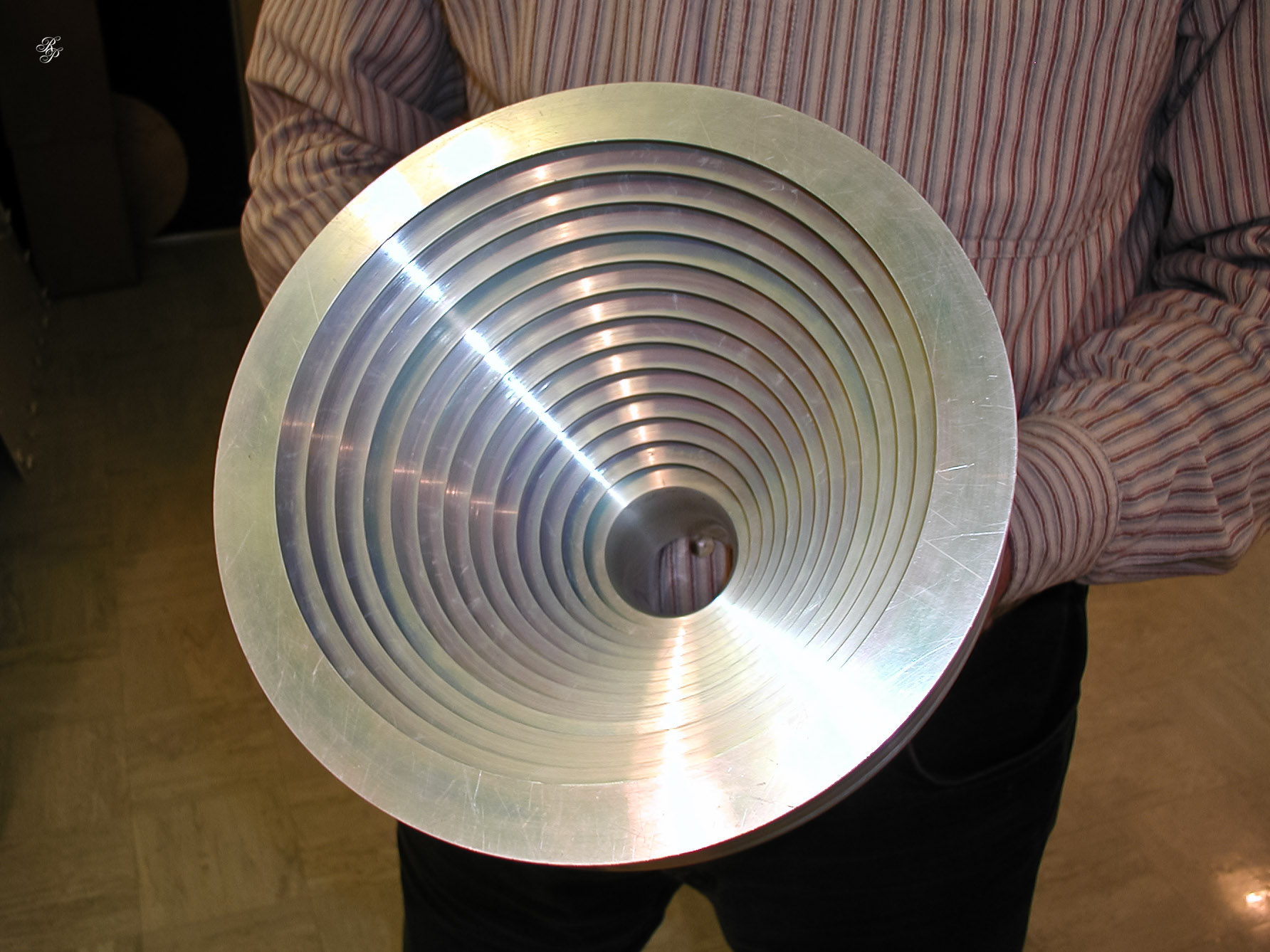
The feed horn isn’t made from layers, it’s a single machined piece, milled from the inside. Feedhorns vary in size, but they fulfill the same purpose every time: they funnel the radio waves into the receiver.

Inside the receiver, they’ve got a wave guide, which is nothing more than a metal conduit, but it’s a very special conduit, that drives the signals directly to the amplifier through the vacuum chamber, which is called a “dewar vessel”.

An ortho-mode transducer “straightens out” the radio waves. If you look at the antennas in your neighborhood, you might see they’re pointed either vertically or horizontally. Most of the man-made radio signals are transmitted with a linear polarization. They’re either horizontal or vertical. The ortho-mode transducer takes circularly polarized astronomical radio signals and splits them into horizontal and vertical radio signals. These transducers also vary in size depending on the telescope where they’re used.
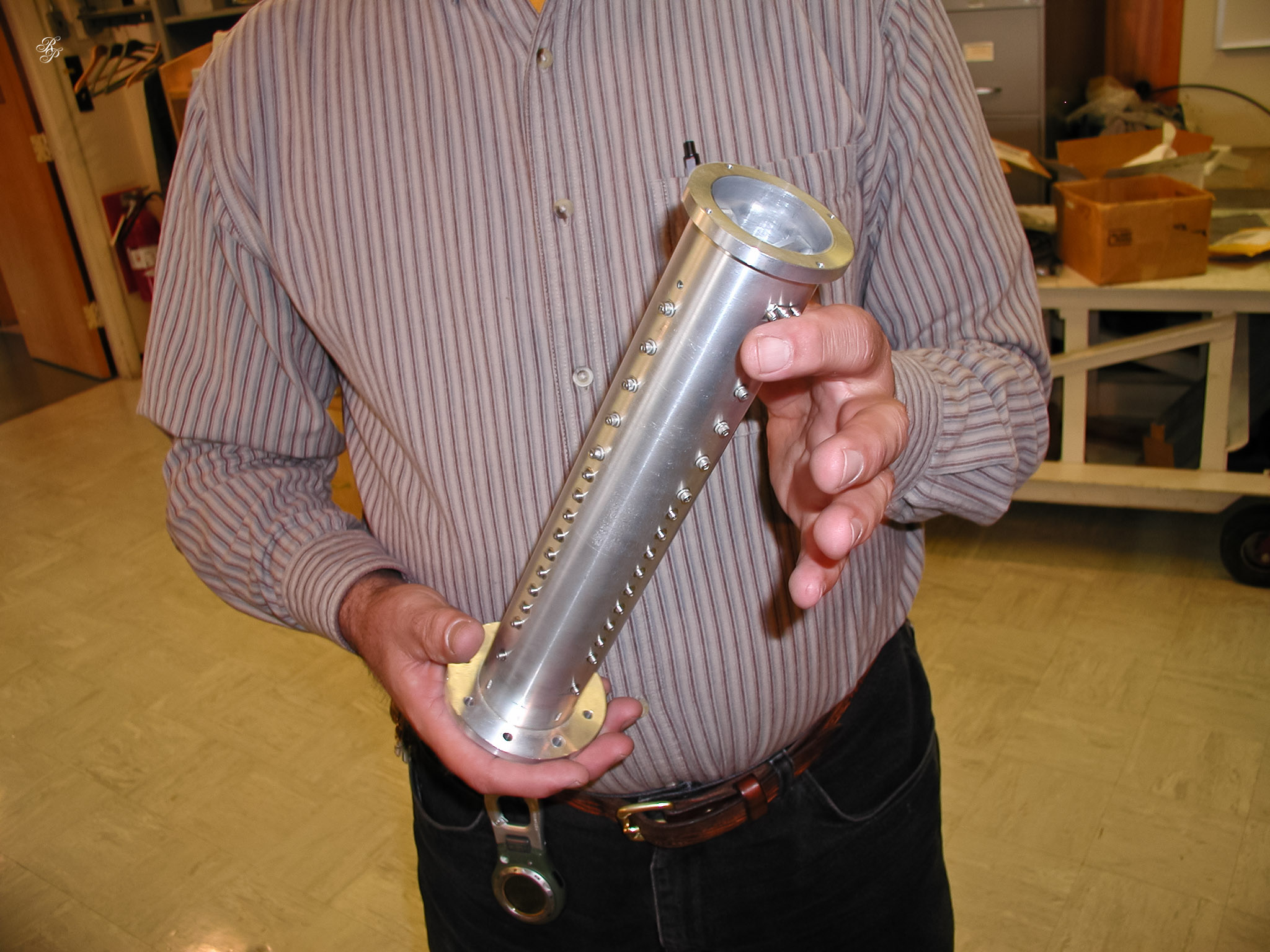
All of the receivers are housed in vacuum chambers equipped with refrigerator pumps. All of the components are built in-house. The amplifiers, for example, are made in the Central Development Lab in Charlottesville, VA. Because the operations at the observatory are so unique, there are no companies making certain parts, and NRAO has to manufacture them. I gathered from talking to Mr. Sizemore that most every time they relied on outside contractors to do work at the observatory for certain projects, the results were much less than satisfactory, even with close supervision. In the end, more time, effort and money was spent with contractors, when it would have been quicker to do things in-house. The rule now is that they do everything they can do, unless it’s not feasible or practical.
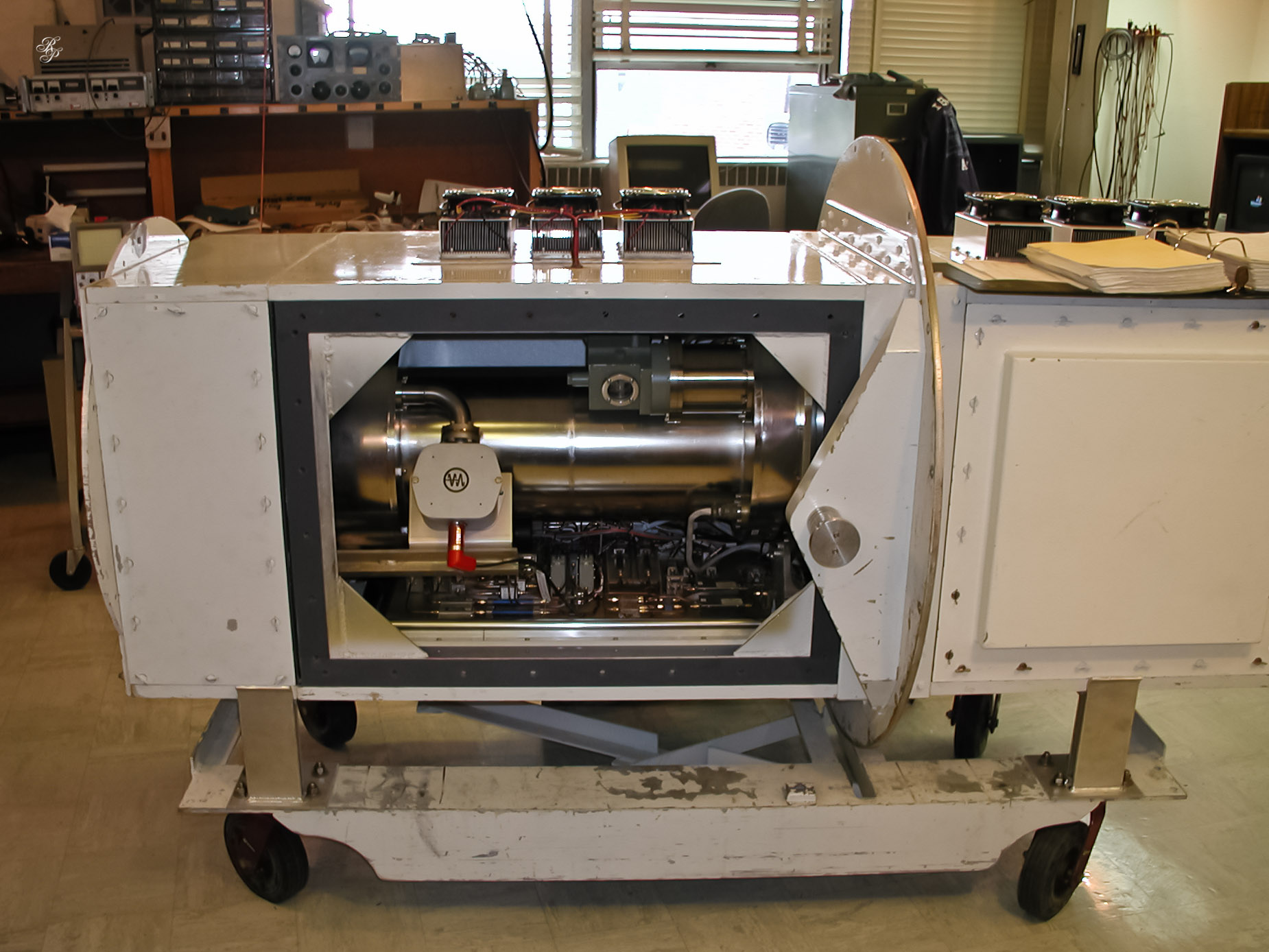
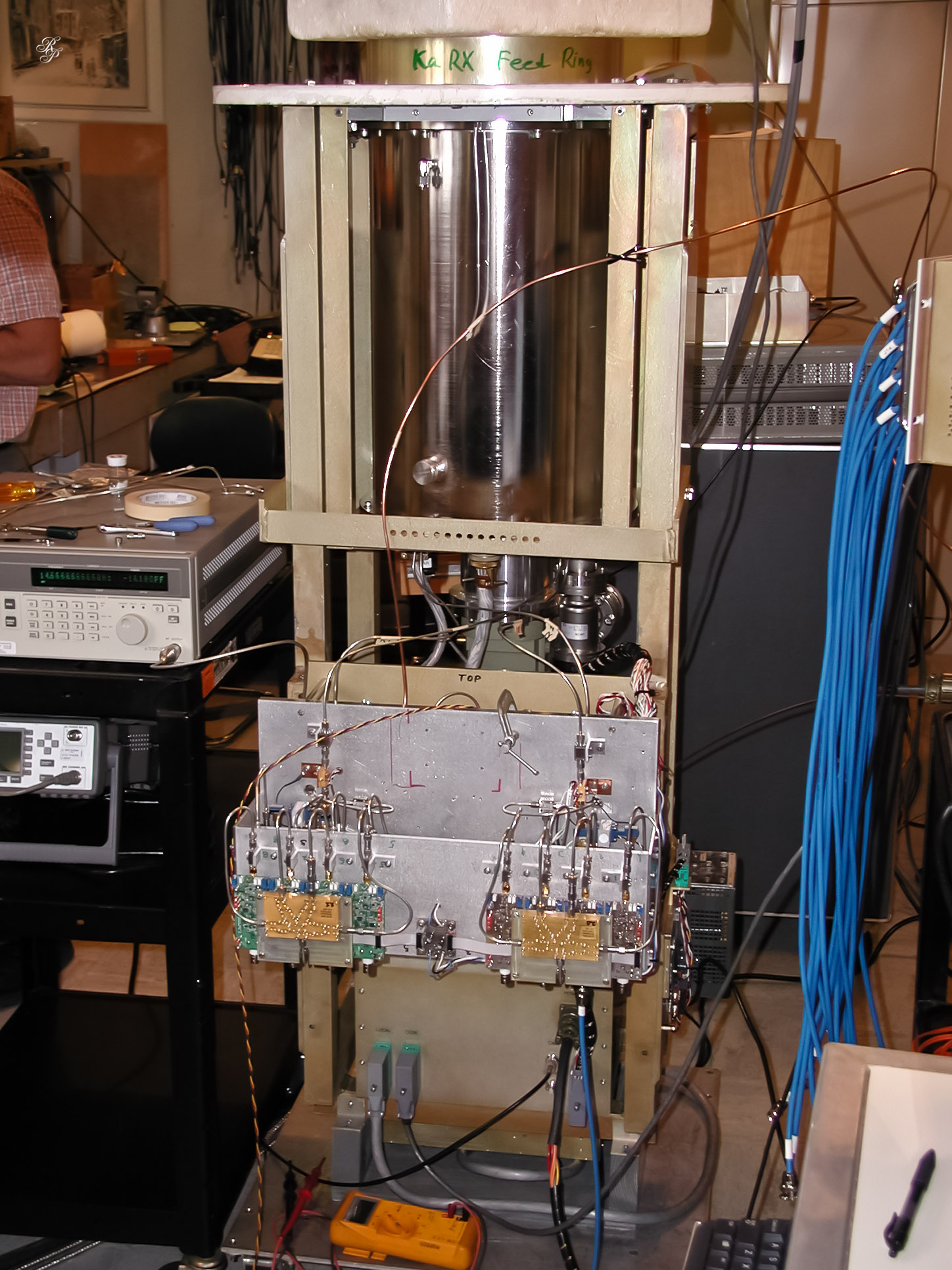
NRAO has gotten more involved with fiber optics. Interference problems in the past weren’t necessarily caused by the feed from the receiver, but from the cables that connect the receiver to the control room. What NRAO now does is to convert the radio signals to optical signals and bring them to the control room that way, unaffected by line noise. It’s converted back to a radio signal there, without any loss.

Long cables act just like antennas, and pick up signals unwittingly. That’s why the quality of your cable TV signal improves if you use higher quality coaxial lines (thicker copper, more shielding). That’s also why Monster Cable is doing so well. They’ve managed to convince most folks that it’s worth it to pay extra for higher quality cables if you want less interference. Same concept. The difference there is that you experience little to unnoticeable interference for short cable runs like the ones from your TV to your amplifier, for example, so unless you’re using really poor cables, your signal will barely suffer.
Another analogy is the use of optical fiber lines to connect buildings on a common LAN (Local Area Network). The signal would simply die out or incur too much interference if it would be carried through regular CAT5 cables from building to building, especially if they’re spread apart, so what’s done is the electrical signals from the CAT5 cable are converted to optical signals in a switch room, then carried through a fiber optic line from one building to another, where they are once more converted to electrical signals in another switch room. What people have now started doing is to forgo fiber optic lines altogether and simply transmit the signal through laser from one building to another. It’s still an optical transmission; it’s like shining a flashlight and seeing the beam. Here you’d need a clear line of sight, and during inclement weather, the quality of the connection would decrease or drop out altogether.

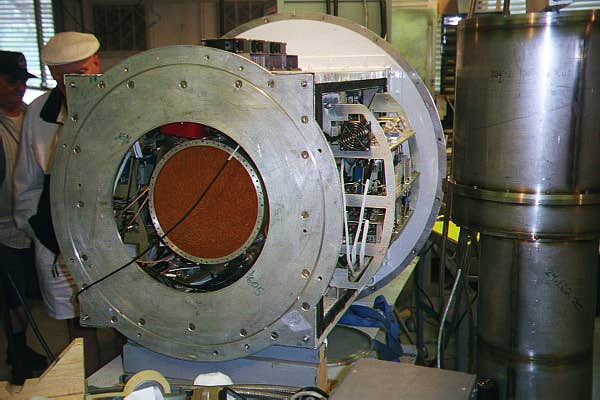
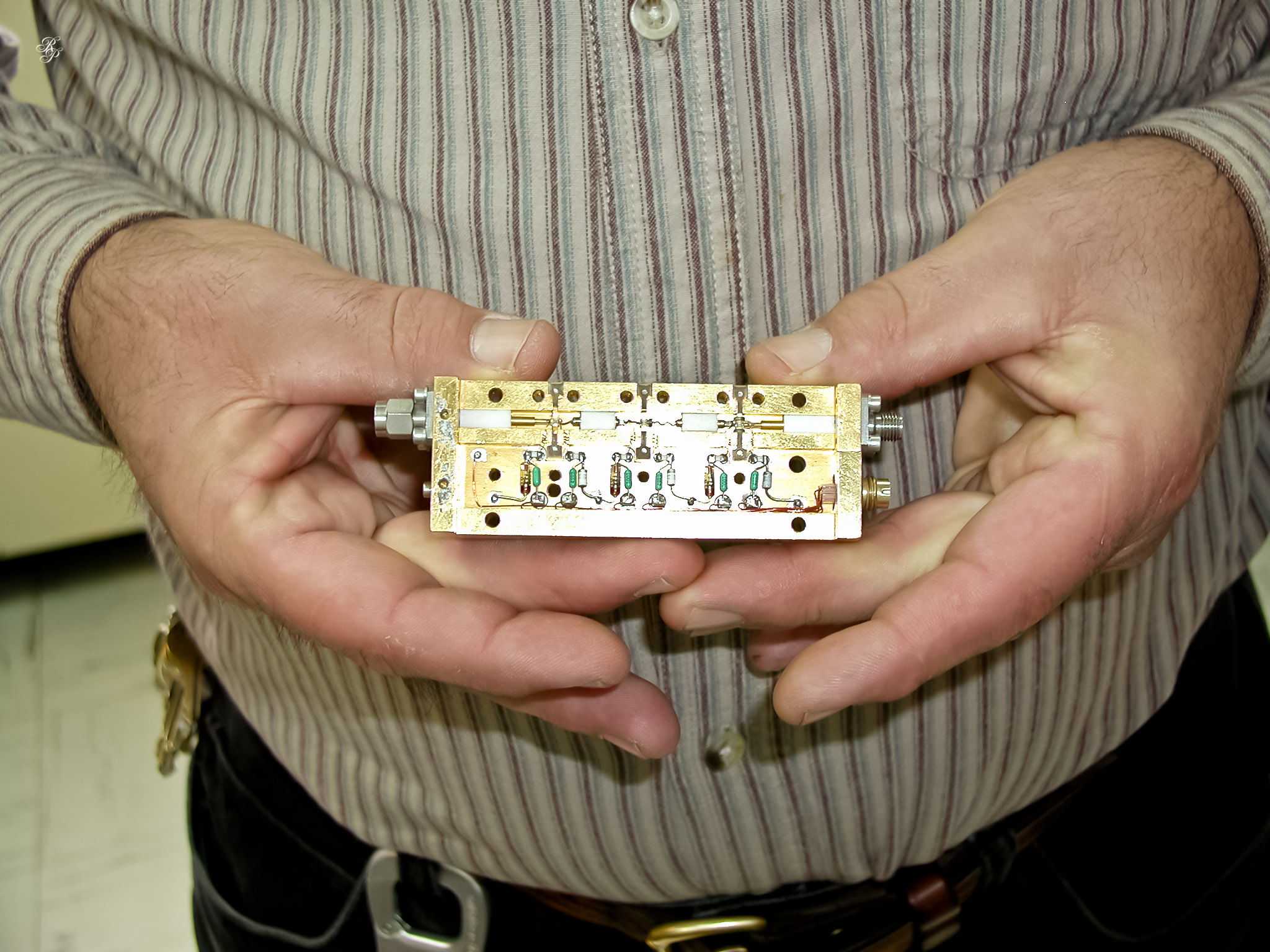
Usually, an engineer and a technician are assigned as a team to take care of a receiver. This photo shows the work being done on the W band receiver, which is a high-frequency receiver. NRAO hopes to be able to receive the high-frequency band in late spring or early summer of 2006, which is when I hope this book will be published [sic]!
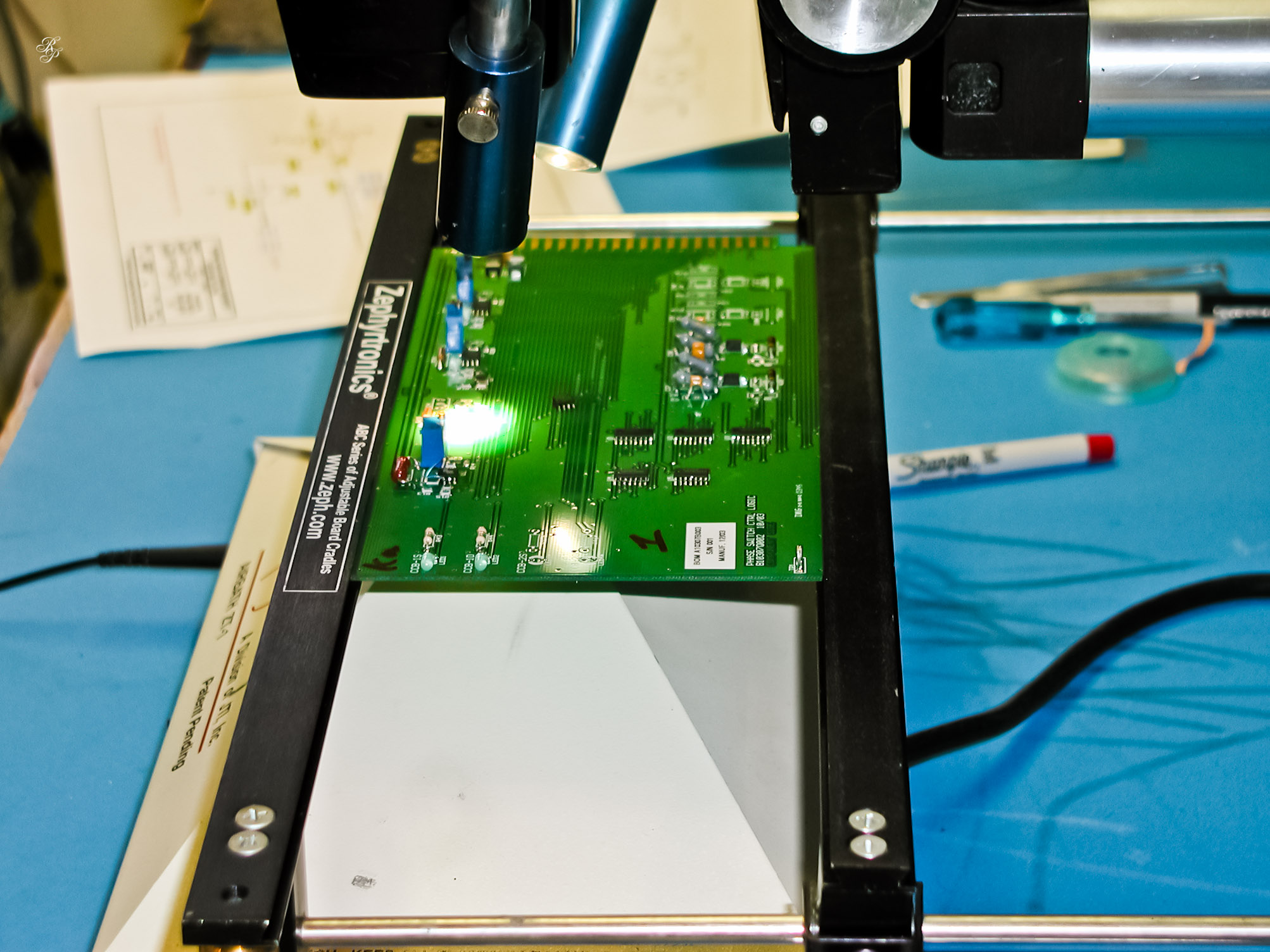
The higher in frequency folks get, the harder it gets to focus the waves, because they are so small that any irregularities in the dish shape can smear them, or put them out of focus. As work is being done on the higher-frequency receiver, they’ve got to be really careful about what they’re doing, or things won’t work properly.
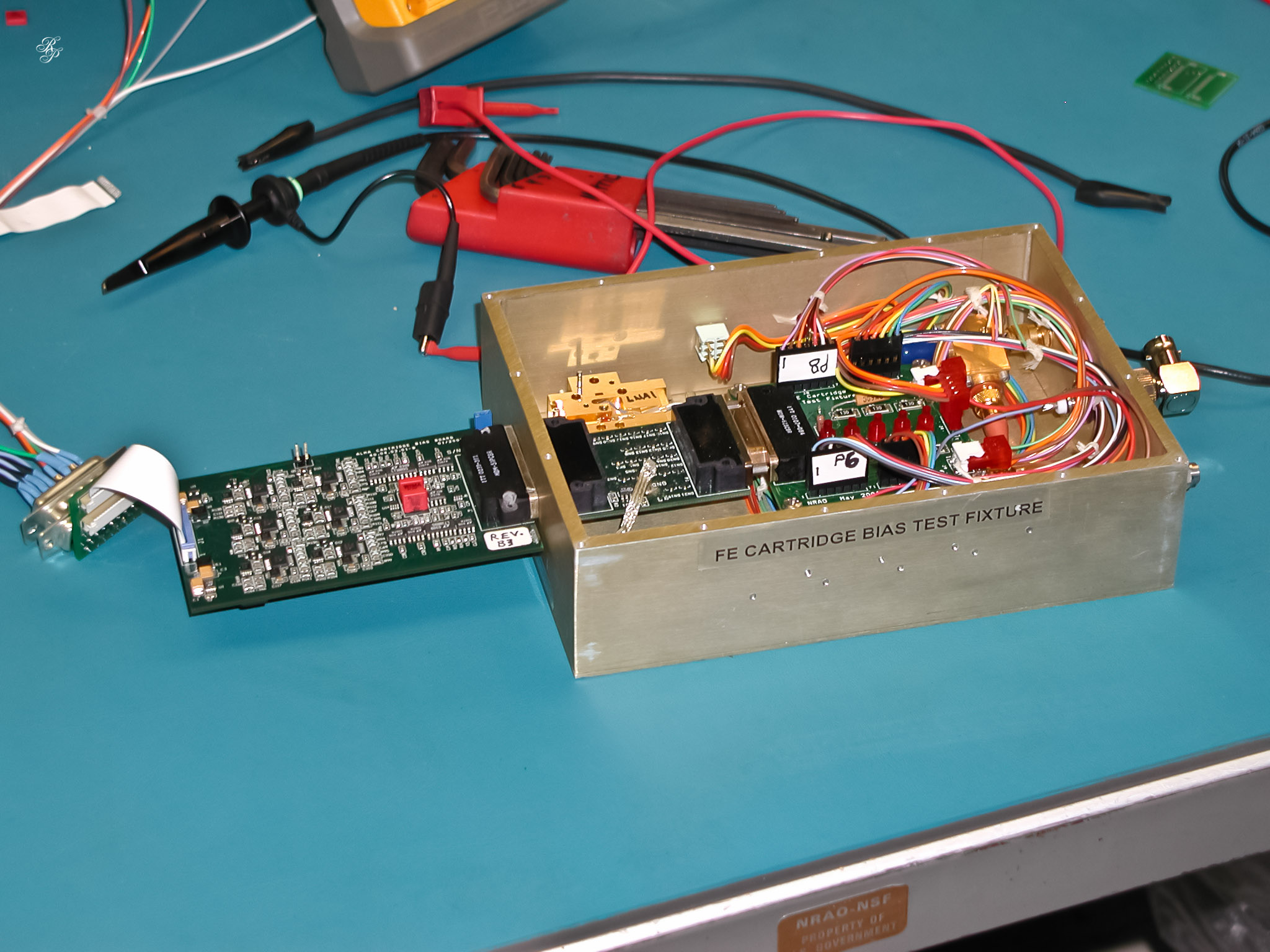
Most of your current devices have something called Field Effect Transistors. NRAO uses High Electron Mobility Transistors, which are the next generation of transistors. NRAO happens to be the proving ground for new technology. The first transistor they used cost about $50,000. Its manufacturer, a company in Japan, gave it to NRAO for free, asking them to try it. If NRAO would be happy with it, they’d know everyone would be also. Why? Nobody works to the standards of NRAO, in terms of signal fidelity, clarity, etc. If an electronics company can satisfy NRAO, they’ve just satisfied everybody in the world. For that reason, it’s not seldom that companies contact NRAO and offer them products to try. All that they ask is for data in return. How did the product behave? What are its limitations? What can be improved? It works out very well for both parties. That’s one of the direct spin-offs for NRAO’s work. Everyone in the world benefits indirectly from the work they do.

Most amplifiers at NRAO start out as solid pieces of aluminum. They’re machined by them, on-site. Nowadays, the amplifiers are made at the Central Development Lab in Charlottesville, VA, also part of NRAO. Again, the rationale is very simple. That sort of a product simply can’t be bought commercially. It’s not available, just like most of NRAO’s components – they are one of a kind.

One of the other things that NRAO has gotten involved with is the surface-mount technology for different electronic components. Some of them are so small that if you were to sneeze around the technician, it would very likely mess up his work.

Each little cubbyhole, people are building different components. In one, folks are at work on the Alma Array, which is getting built in the Chilean Atacama Dessert. JD, a technician, and one of the engineers, are working on the little cards (circuits) that will process the signals received there. The Array will employ many telescopes and many cards will be needed.

It’s a good working environment at NRAO. It’s a rural area, so by nature people try to maintain good relationships. In Wesley’s words, “the guy you piss off may be the guy you need to help you get out of the ditch in the winter,” so there are extra incentives to maintaining friendly relationships. There are some downsides, as well. For major shopping, the closest towns are 1 ½ hours away, like Harrisonburg or Roanoke.

Interferometers and the GBT

The United States is not the only country involved in radio astronomy. There are observatories throughout the world. There are maps in one of the NRAO lobbies showing the locations of such observatories. The unique thing about the Greenbank observatory is that it is protected by the National Radio Quiet Zone. This is the only area where folks are compelled to coordinate all radio frequencies with NRAO. There are some other areas in the world such as Puerto Rico, where limited frequencies are controlled.

Incidentally, the Puerto Rico telescope was used in one of the James Bond movies. The NRAO folks are waiting (but not holding their breaths) for the Green Bank Telescope, the GBT, to be used in one of the science-fiction movies. It’s just so out of this world, in both its proportion and look, that it’s bound to end up in a sci-fi movie sooner or later.
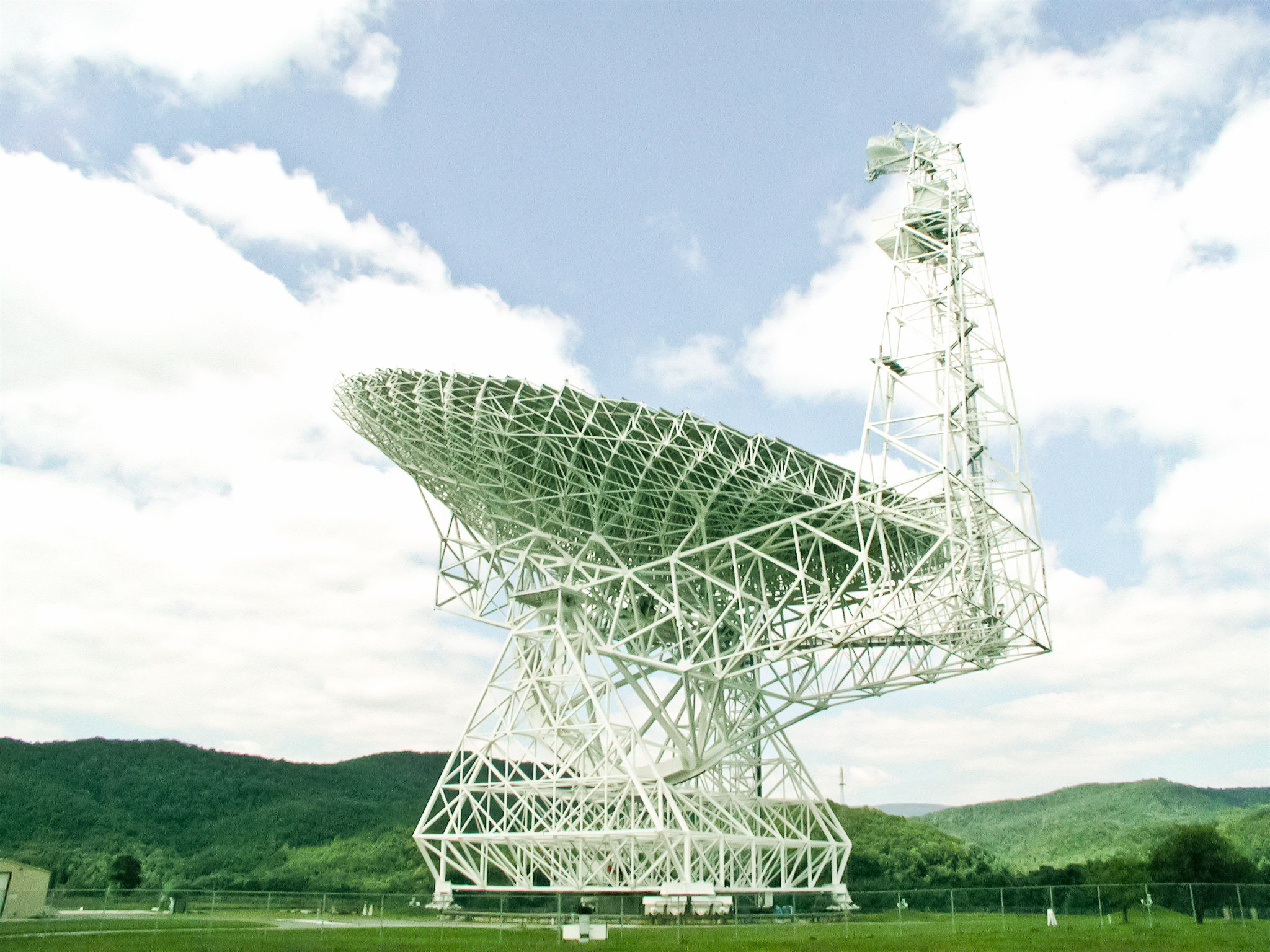
Some of the telescopes are single dishes, and some are arrays. Why do you need an array of dishes? Well, why do you have two eyes instead of one? The answer is depth perception.

The term in radio astronomy is spatial resolution, but it’s the same thing. You want the large collecting area of the single dish in order to get the weak signals. You want the arrays of telescopes in order to get the depth perception. Ideally, NRAO would like to have an array of GBTs, but it’s not economically feasible. In those cases, the GBT can be used as one part of an interferometer – that’s another word for arrays. That way you can get the best of both worlds. You can have a large collecting area – for signal strength – and a remote telescope, somewhere else, that gives the astronomers the base line signal, for spatial resolution. The further your “eyes” are spread apart, the better you perceive “depth”.

For telescopes that are close together, technicians can use wave guides to gather signals from each, but for telescopes that are far apart, it becomes impossible. So what NRAO does is to use GPS signals. Each one of the telescopes records the data individually and marks it with GPS ticks from GPS satellites. The data then gets sent to the Array Operations Center, where all of the data is brought together and synced using the GPS timing ticks.

One of the first interferometers built was at Green Bank. It was a three-element interferometer. It worked great, so they got some money together and built the array in New Mexico, which is currently an array of 27 telescopes and will be expanded to 35-40 telescopes in the near future.

They got even more excited about the capabilities of interferometers and decided to make a very long baseline array of 10 telescopes. They used 8 telescopes in the US, one in the Virgin Islands, and one in Hawaii.

The long baseline array also worked very well, so they set to work on building an even bigger array. Unfortunately, the found out it couldn’t be done on the face of the Earth. If the telescopes are too far apart, they can’t see the same object at the same time. The solution to the problem is to put a radio telescope in orbit around the Earth. NRAO actually did a project with Japanese researchers, where they put a telescope in an elliptical orbit around the Earth, and NRAO used the GBT to get the best of both worlds. They had the large collecting area for signal strength and a huge baseline for spatial resolution.

Let’s carry the situation even further. “What about sticking one on the moon?” I asked Mr. Sizemore. “We would like to,” he said. There are plans to do that. Ideally, it should be located on the dark side of the Moon, because it’s never toward us – the Earth. It always faces toward space, and thus would incur significantly less interference from radio signals coming from the Earth than terrestrial telescopes. The stepping-stone to that would be to put a telescope at the LaGrange points, the gravitational balance points between the Earth and the Moon or the Earth and the Sun.
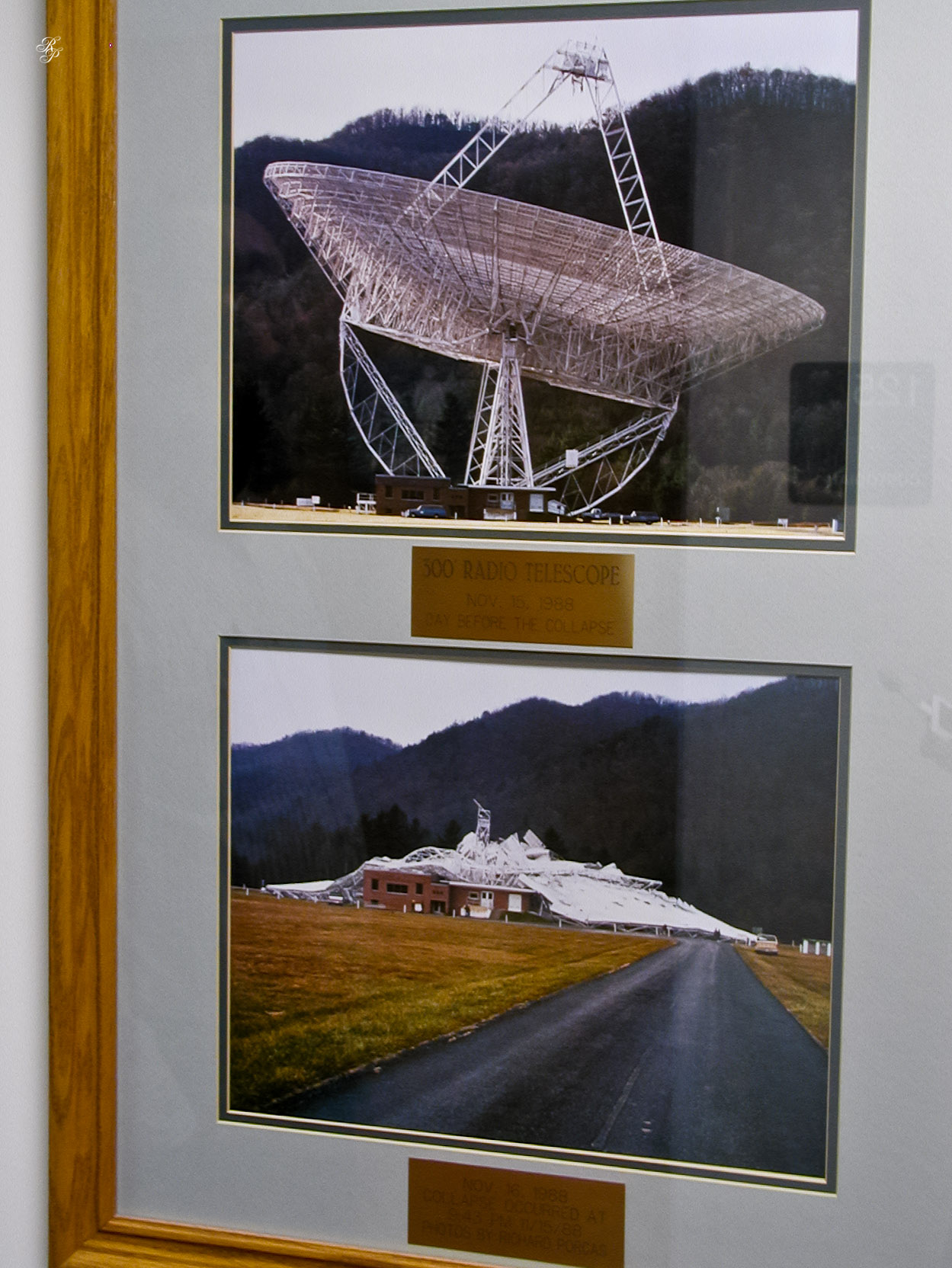
This is the 300 ft telescope that fell down some time ago. It was a perfectly calm night, there was no wind, no weather at all. When it collapsed, they decided to do a finite element analysis on it, and discovered (after the fact) that indeed it would have fallen down sooner or later. At the time it was built, it was designed to the best of the available technology. Unfortunately it simply reached the end of its useful age. Nobody was at fault. What actually happened was that a gusset (a joining place) cracked, and when it failed, it took about 12 seconds for the entire telescope to crash down. They were able to determine that from watching the temperature data on the receiver. The temperature went up as the telescope went down, and then the data simply stopped recording as the sensors and wires got destroyed. Remember, the receiver’s kept in a refrigerated vacuum, and it stopped functioning when the structure started coming apart. NRAO sold the telescope for $10,000 for scrap metal, then it cost them $30,000 to clean up the asbestos damage in the building. “We actually lost on that deal,” said Mr. Sizemore.

He went on: “Senator Byrd, bless his heart, was able to get an emergency one-time appropriation to rebuild the telescope. NRAO used that money to build the Green Bank Telescope (GBT), which is a very unique piece of machinery.”
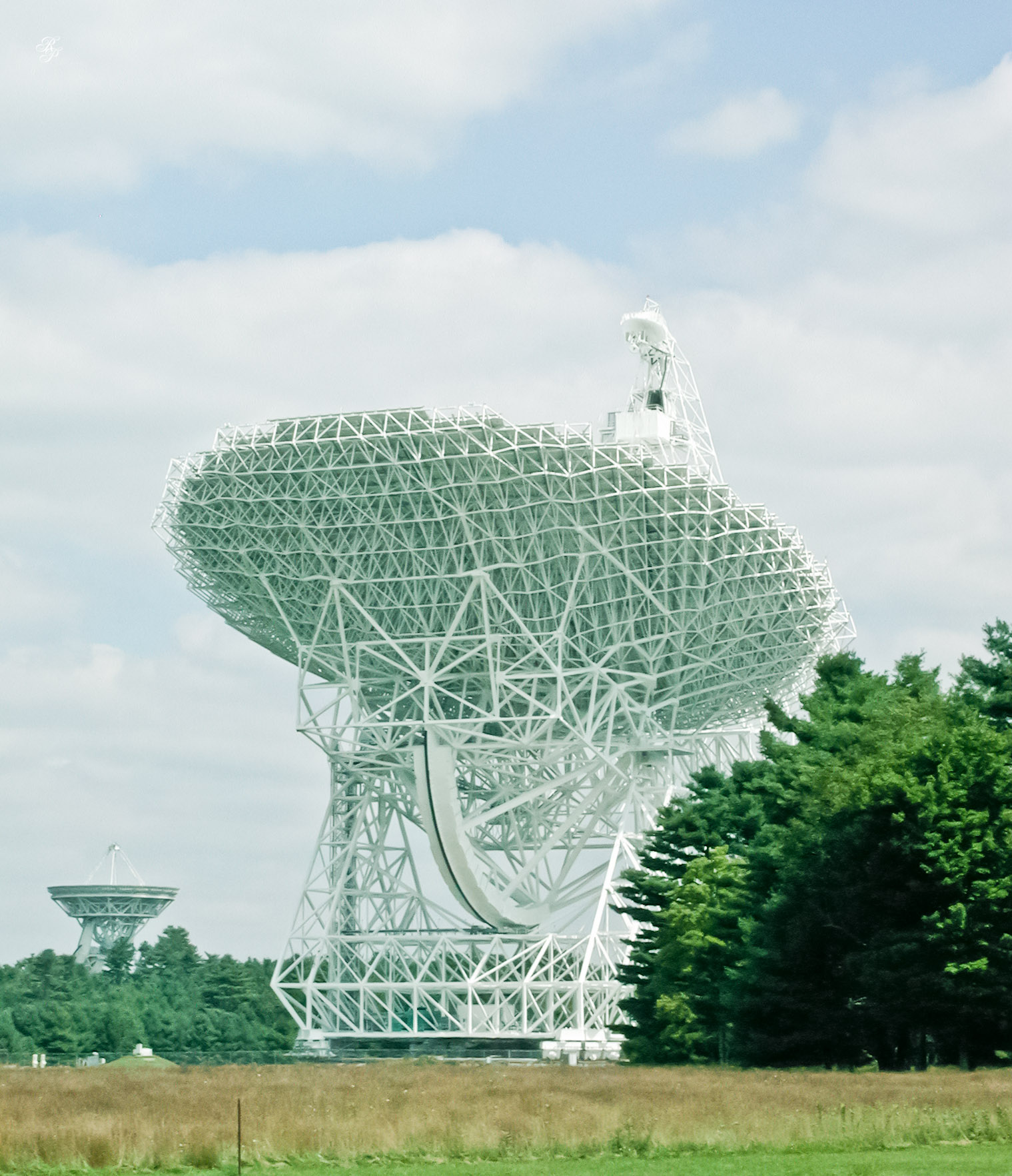
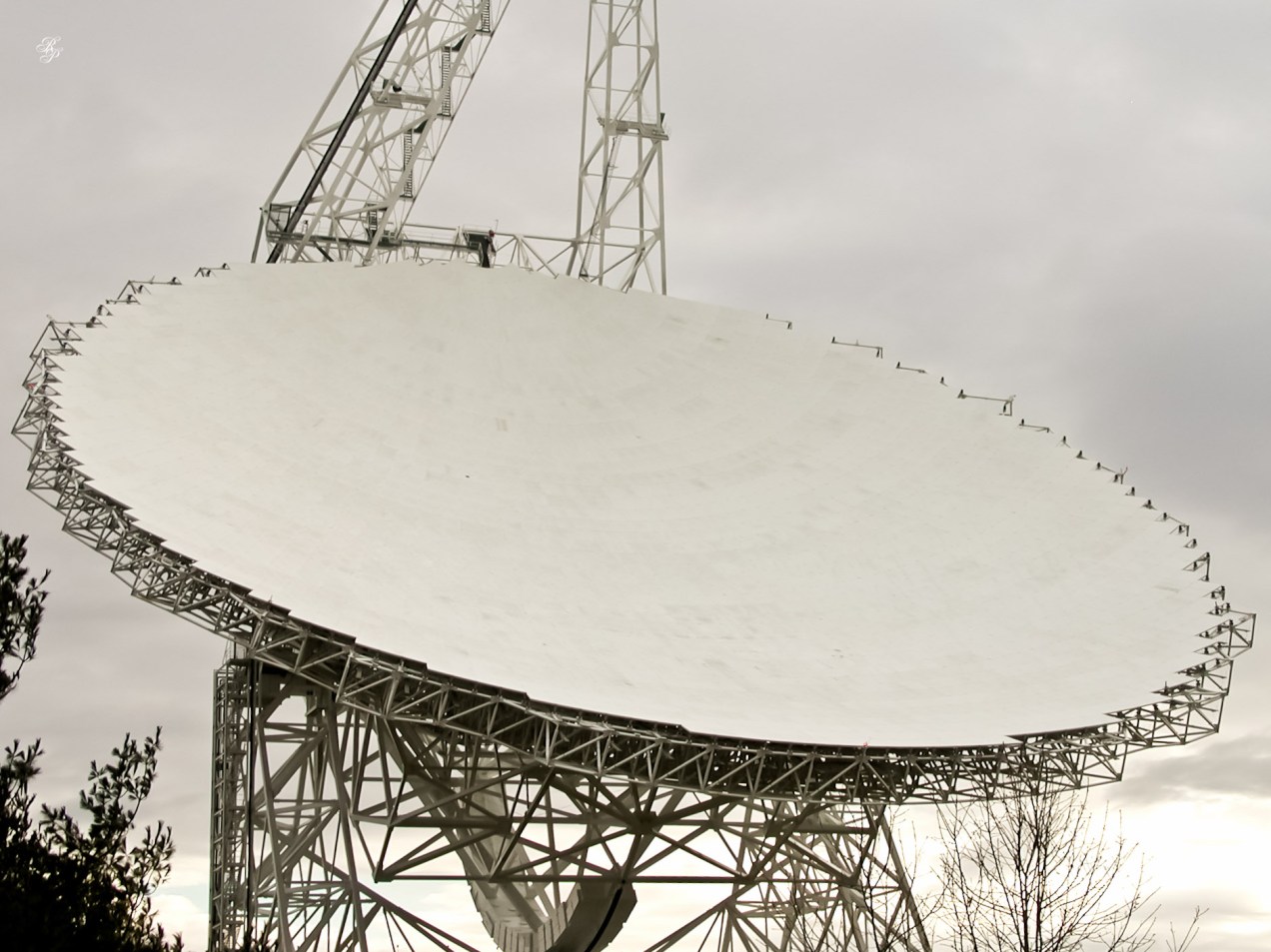
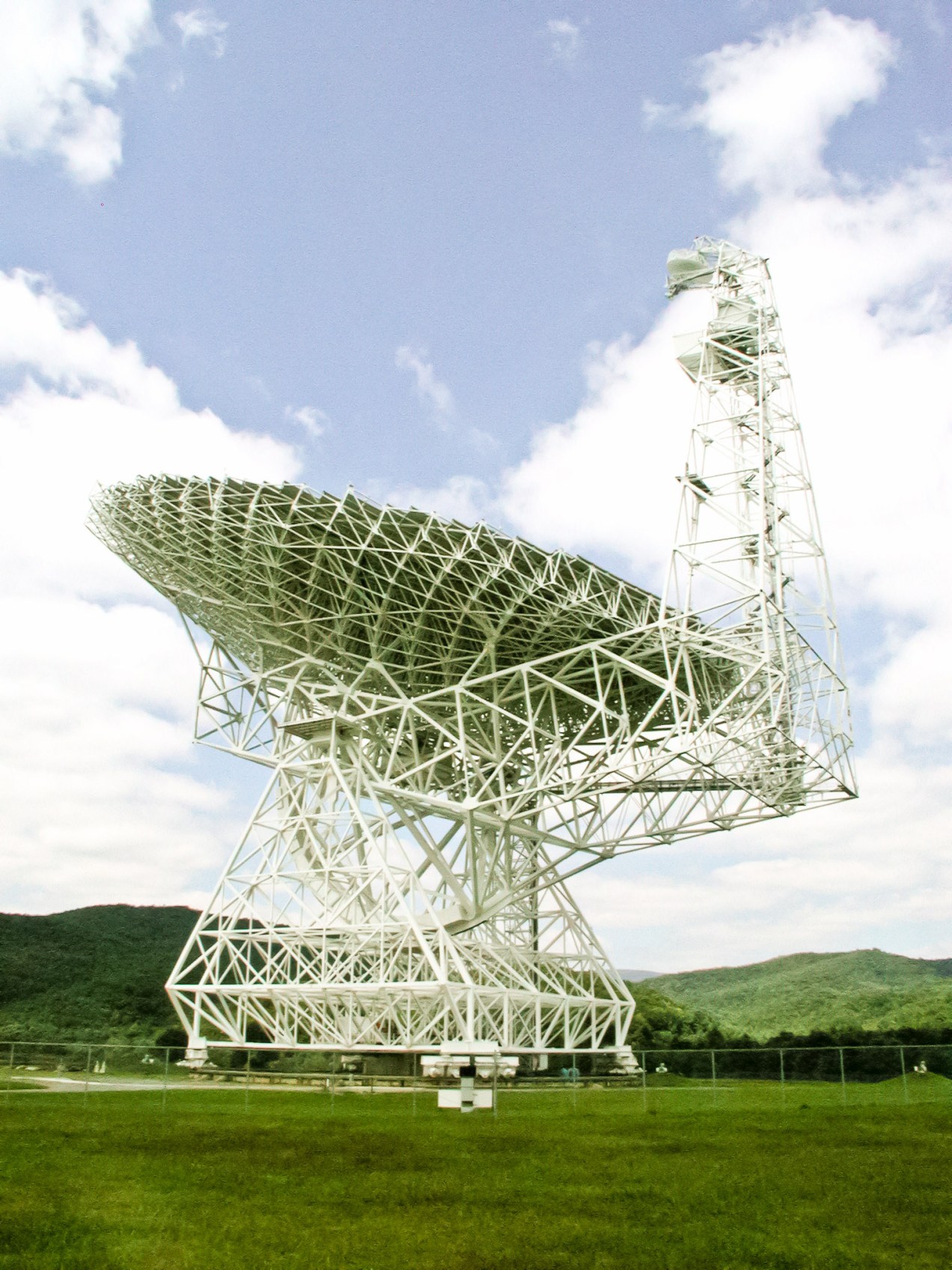
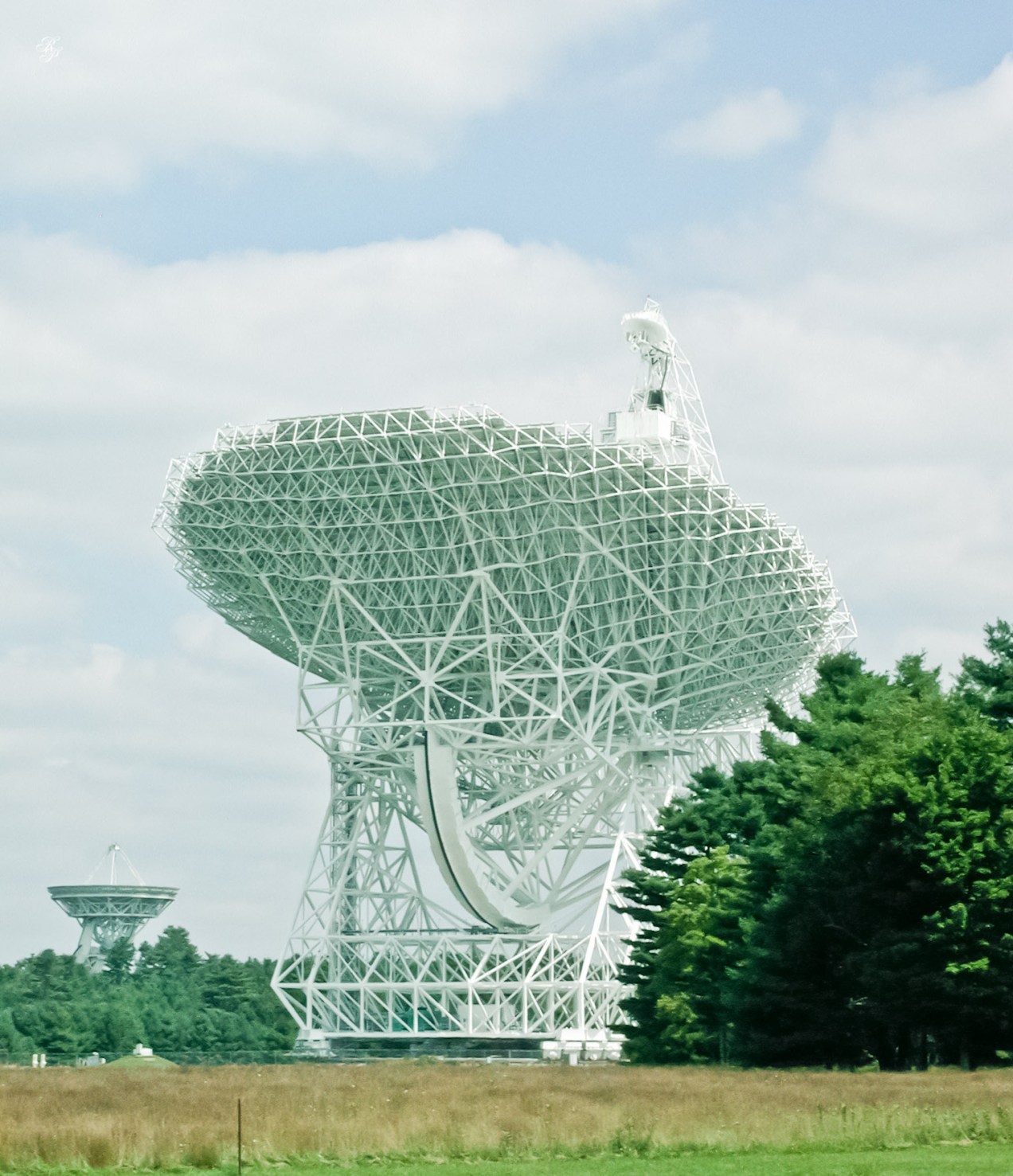
The GBT has several innovations. The most obvious innovation is the offset feed. If you look at the other telescopes on site, you will see they all have the boom holding the receiver in the center of the reflector. Not so with the GBT – it has its receiver off-center. With a center-mounted feed, man-made signals will get reflected by the legs of the boom and cause interference. The GBT doesn’t have that problem. All of the astronomical signals get correctly reflected into the sub-reflector, then into the receiver, and from there get transported into the Control Room.
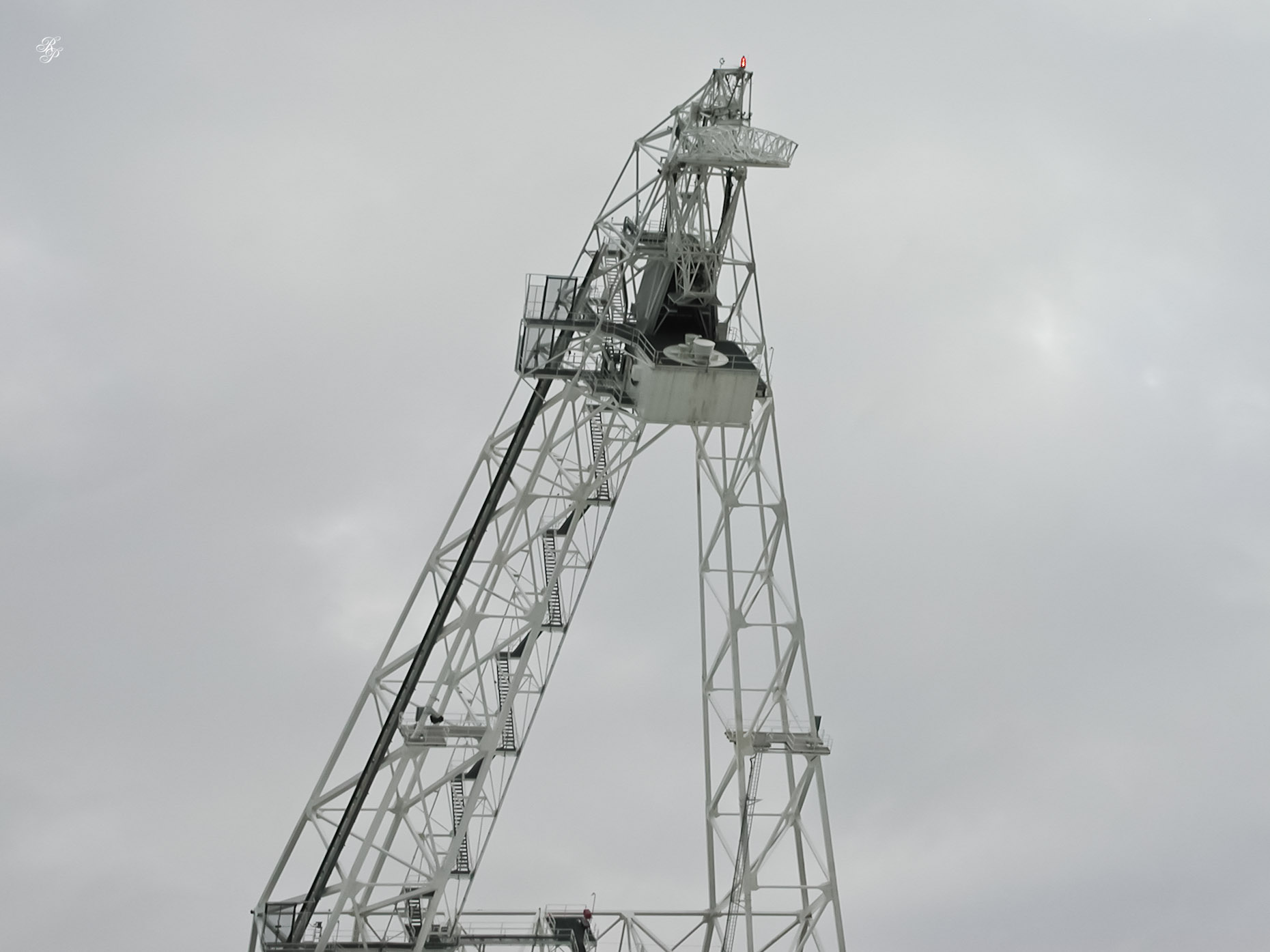
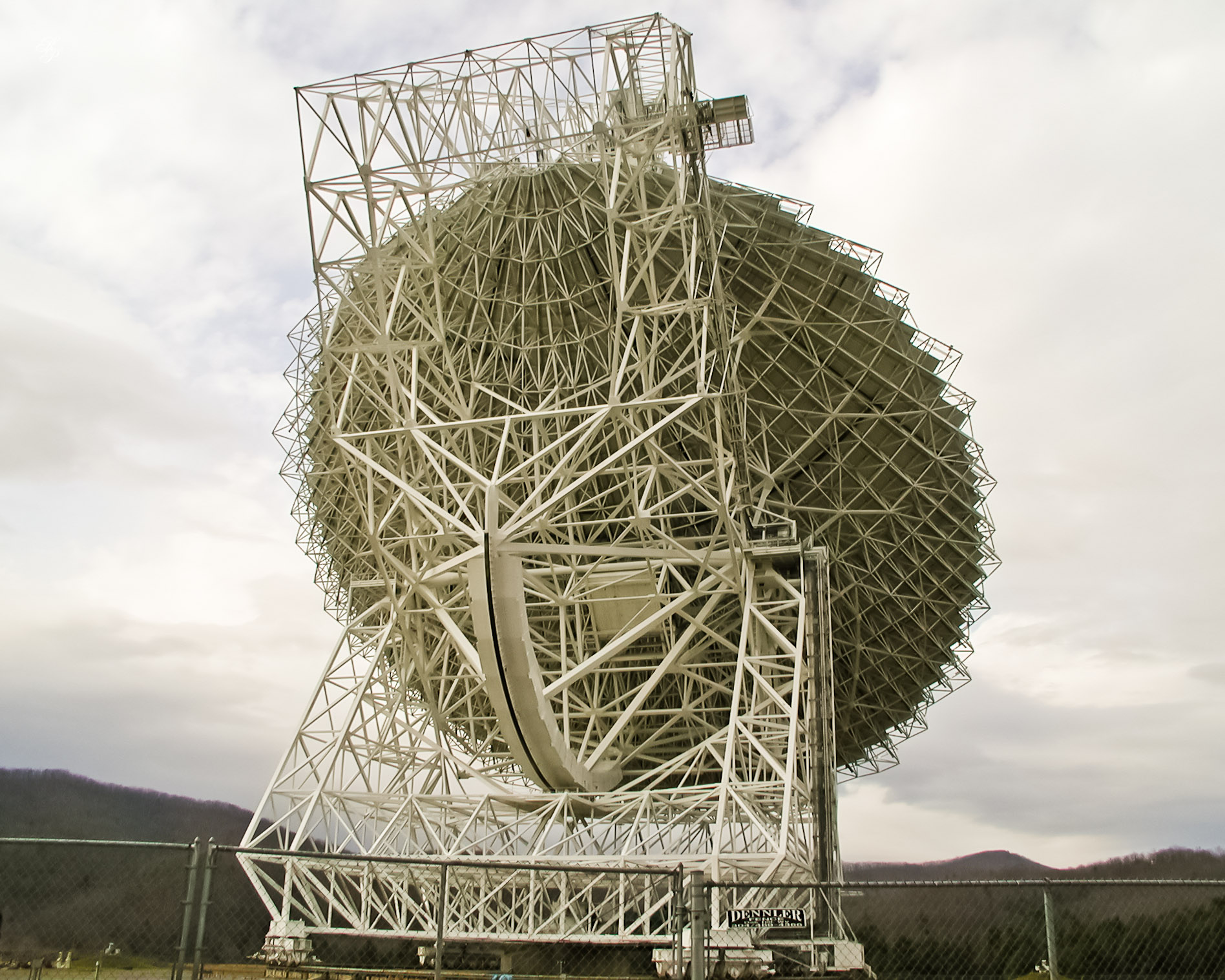
Another unique innovation about the GBT is that it’s fully adjustable. All of the panels – and there are over 2,000 panels – can be moved individually. The moving weight on the telescope’s track is about 17,000,000 pounds. NRAO believes the GBT is the largest moving object on ground, and no one has disputed that yet. The only larger moving object on Earth is a ship at sea. The tipping weight on the elevation axle this year is around 13,000,000 pounds.
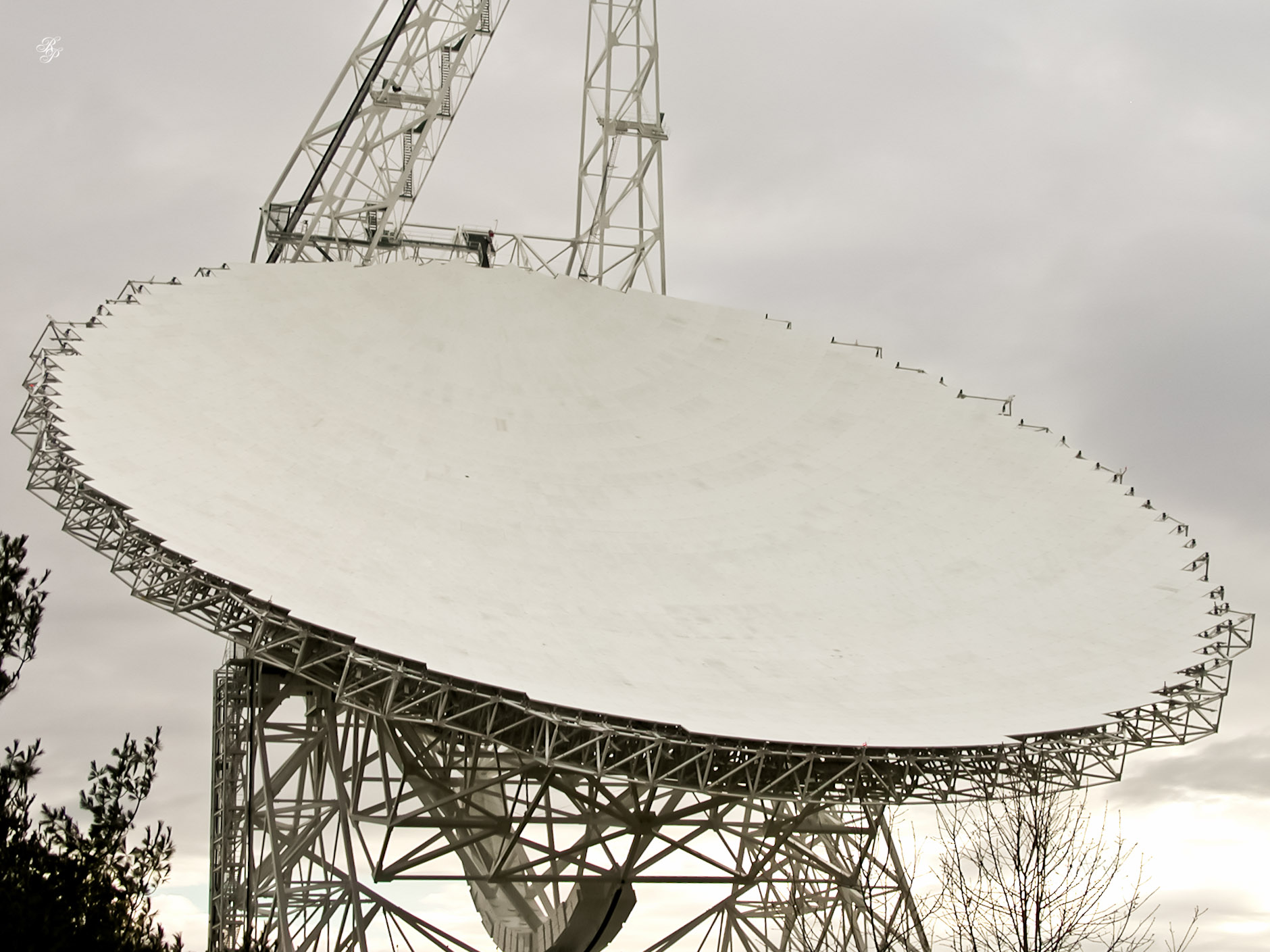
When you tip that much weight, gravity will tend to sag the reflecting surface and distort it. NRAO needs to keep that reflector as accurate to a parabolic shape as possible, because that will dictate their efficiency at high frequencies, where the wavelengths are shorter.

The dish is built in such a way that they can adjust each individual panel to take out any deformations in the overall shape. The original plan for solving this problem was to use a laser ranging system. Twelve lasers were set up around the dish, giving them a known reference plane. They would then use additional lasers pointed at the dish, at the feed arm, and other different points on the structure. Any movement of the structure could be monitored that way. By doing this, they found out that the gravity deformation was not as serious as the thermal deformation. The structure was getting heated and cooled at different rates depending on where those parts were located. The chief culprit was the sun. It would shine only on certain portions and not on others, subsequently causing thermal expansion in those exposed parts. So NRAO stopped relying on the laser sensors, and started using thermal sensors. They mounted about 20 such sensors around the structure, in order to compute the thermal variations and use that data to correct the focus of the receiver and the positions of the individual plates in the dish. They are still working out the details of the thermal sensor monitoring and adjustment. Once they work this part out, they’ll go back to the laser sensors for the fine tuning. Their goal is to keep the 100-meter dish within 1/5,000th of an inch of the horizontal plane. That’s the thickness of a sheet of paper. Amazing, isn’t it?

Because of the fine adjustments they can make, they are able to advance to higher frequencies such as 50 GHz and soon, 100 GHz. They are doing science that hasn’t been done before. They are finding things that could not be found with any other instrument in the world.

Mr. Sizemore showed me photographs of the construction of the dish. What many people don’t know is that it was built three times! It was put together once, at the manufacturer site, then it was taken apart and shipped to NRAO. Once there, as many of the parts as possible were assembled on the ground. A large crane was then used to lift them into place.

One of the other unique innovations of the structure is that it is a continuously welded structure. There are no bolts supporting weight in the GBT. They will never build a structure like this that is bolted together, including bridges. When the 300-foot telescope collapsed, they did an analysis and found out that the collapse was caused by a tiny crack in the material that had gotten larger over time. Engineering studies have actually shown that any time one punches a hole in metal, one makes a stress fracture that will propagate over time. What one must then do to avoid these fractures is to never punch holes in metal that is supporting weight. It must be welded.

In building the GBT, over 50 tons of welding wire were used. About 300 welders tested for the job, and only about 30 of them passed. The welding needed to be very precise and very accurate. Some of the passes they had to weld involved dozens and dozens of back and forth welds to fill up large gaps. Of course, NRAO does constant testing of the structure. All of the welds are inspected, radiographs are also taken, and all of the constant maintenance ensures the structure remains in great shape.


That was part four. You can also read parts one, two, three, five, six and seven.
Standard
Places

Chasing RFI Waves – Part Three

Here is part three of my non-fiction work about the National Radio Astronomy Observatory. You can also read parts one, two, four, five, six and seven.

Chasing the Interference

Wesley Sizemore’s job at NRAO is to safeguard the NRQZ (National Radio Quiet Zone). As such, he is made aware of any RFI (Radio Frequency Interference) to the work being done at NRAO, whenever it occurs.

Following are stories about chasing the RFI, which are not only interesting in and of themselves, but provide very good data about how sensitive NRAO’s telescopes truly are and why it is imperative that the NRQZ is properly maintained.

RFI may occur at night, but Mr. Sizemore will still only start chasing it in the mornings. He prefers not to go out chasing signals at night, because most of the folks in the surrounding area are hunters, they have loaded weapons inside their houses and know how to use them. “You don’t go knocking on doors in the middle of the night unless you have a good reason, and you definitely don’t go prowling around people’s property.”

“You get in, you find that you have a source of interference, and that becomes your priority for the day.” As a result, he is never able to successfully plan his day. Every day was different. He’d come in expecting to do something, then the phone would ring and his schedule disintegrated.

For example, one day he got a call in the morning when he’d already planned his day that the 140 ft. telescope was receiving interference and after investigating the problem, they found it to be airborne radar. There was nothing to be done about it. An hour later, it was gone. He then started monitoring those bands just to see if and when it’ll return.

During most of his career at NRAO, he was the only person taking care of interference. That included administration of the NRQZ and responding to interference complaints from the astronomers. Now there are three, soon to be four people doing it. He’s got help on the administrative side and he can devote his time to interference problems.

The Grade School Thermostat

Thermostats arc when they close. They emit a small spark of electricity as two points of contact come together. They do so when the desired temperature in the room is reached. The thermostat measures the room temperature and can also be set to a certain temperature. Each temperature level has a metallic point of contact. When you rotate a thermostat lower or higher than the room temperature, you are in effect putting a little bit of distance between the two metallic points of contact. As the air conditioner or convector then works to increase or decrease the temperature in accordance with your desired setting, the point of contact assigned to the room temperature comes ever closer to the point of contact that corresponds with the setting you’ve chosen. When they get close enough, they’re supposed to make contact, creating a short that activates a circuit which then shuts off your convector.

As thermostats get older, the points of contact get corroded; the room temperature is also measured inaccurately, etc. As the points of contact get closer, they start to chatter before they close. Instead of making contact, they sit there, close enough so that sparks of electricity are exchanged between them. These sparks are tiny enough that you don’t see or hear them, but they’re big enough to bother the radio telescopes at NRAO.

In this case, Mr. Sizemore came in one morning and found that RFI was occurring in the proximity of the site, and it really affected the work being performed on one of the telescopes. He started to track it.

It took him 2 days to track the signal for ½ mile. The signal was only there for a few seconds every 15-20 minutes. He would have to take the antenna and swing it around, find out which direction the signal was strongest at, and move toward it. You may be able to go about 100 yards, but then you have to sit and wait until the signal re-occurs. When it occurs again for 3-4 seconds, you spin the antenna like mad, and determine the direction again. You slowly triangulate onto the signal. When you finally beat it down to a building, you can finally say that it’s in the building. Now it has to be found inside the building. You take portable equipment inside, and you begin to listen to the signal. When it occurs, you say, “It’s loudest over here!” Eventually you reach it.

It was one of the heaters at the local school. It would cycle on depending on temperature changes in the room, whether or not kids were going out of the classroom, if windows were opened, etc.

He got to the heater, unplugged it, and waited 30 minutes to see if the noise would reoccur. It didn’t. What he did was to take the heater off the wall, took it to the lab and replaced the switch onto the thermostat. Then he took it back down to the school, mounted it, and things worked fine afterwards.

The reason this thermostat was such a problem was that the grade school borders on the NRAO property. It was in a direct line of sight to the telescopes. The signals fall off just like optical signals, inversely proportional to the square of the distance.

Powerline Noise

Anything that generates an electrical arc will generate radio signals. A lot of time is spent chasing down just those things.

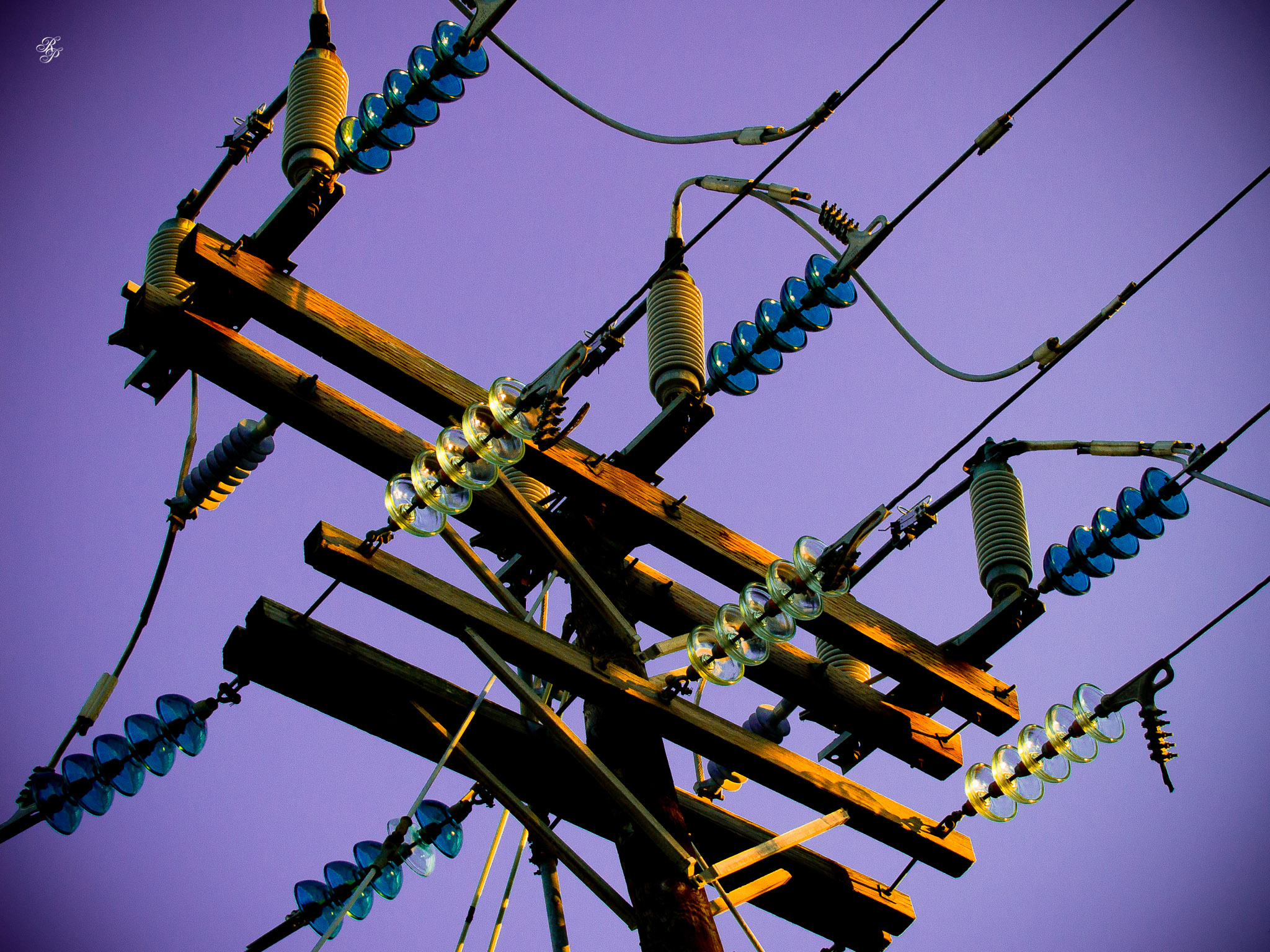
A lot of time is spent chasing powerline noise. A powerline can generate radio signals. You’ve got a power pole, a powerline coming in, and a powerline going out. What you don’t want to happen is to have the powerline touching the pole, because that shorts it to ground and creates problems. So what is normally done is that the line is jumpered around the pole. It gets wrapped around a Bell insulator with a little hook. The line then goes around the pole and wraps around another Bell insulator. These insulators are bolted to the pole. There’s a metal to metal contact there. If that contact, or hook, gets corroded, you build up a difference of potential between the two metal pieces. The potential will build up and then arc over in order to neutralize itself. This will be an ongoing cycle. Potential builds to a limit, then arcs, only to build up and arc again and again.

For example, if you tune your AM radio between stations and drive around, eventually you will hear the noise from powerline arcs. It’ll make a recurring “bzzzzt” noise. Those are the arcs of powerlines. This normally doesn’t bother most people, but amateur radio operators have problems with it. Most of it is spectral content, its radio energy is at lower frequencies. Because NRAO dishes are so sensitive, the relatively little arcs will cause problems for them. In the past, NRAO’s 300 ft. dish did a lot of pulsar observation, and that particular band is very susceptible to power line noise. Mr. Sizemore spends a lot of time tracking down those noises.

Once the noise is located on his monitoring station, Mr. Sizemore locates it by driving in its general location and using a CB radio as his guide. That can get him as close as a ½ mile of the source. Then he takes a handheld device that will localize it to a particular pole. He swings it around. Since the antenna has a very narrow beam, he can get pretty good direction. He then uses an ultrasound machine – any electrical arc has an ultrasound component to it – to localize it to an area the size of a half dollar. He then contacts the power company and asks for their help in fixing a particular insulator-wire assembly on a particular pole. Understandably, he prefers to let the power company take care of the poles, because of the inherent danger that comes from working with such high voltages.

The Dead-blow Hammer

In the middle of a night, on weekends, you can’t call the power company. They’re not going to respond to an interference complaint from the observatory. So what do you do if an interference develops during non-business hours?

One of the techniques used is a dead-blow hammer. This is sort of a like a sledgehammer, but it’s loaded with shot. When you strike something with it, like a power pole, the hammer hits the pole, then the shot impacts the head of the hammer and vibrates the pole without leaving big marks on the power pole. If you use a regular hammer, all of the energy goes into the pole immediately, not necessarily vibrating it, and you also make a big mark on it, which the power company won’t like. With a dead-blow hammer, which has a fairly soft head, you simply make a much less forceful contact with the pole, which in turn causes the shot to impact the hammer head while it is still in contact with the pole, inducing vibrations. These vibrations hopefully remove some of the corrosion at the contact point between the wire and the hook, thus eliminating – or drastically reducing – the arc interference for a matter of hours, or sometimes even days, until it corrodes again. Eventually, of course, the power company will need to come out and replace the worn-out components, tighten the line and make sure things are working well.

Another thing that can be done is to shake the guide-wire of the pole. This wire is what secures the pole to the ground. Think of it as a line coming down from the maypole, or as a line you would tie around a young tree to help keep it pointed straight toward the sky. If you shake or pull on the guide-wire, you can get the top of the pole moving a bit, and thus clear out some of the corrosion and cut down on the interference. One has to be very careful when doing this, because if the top is set into motion, the lines will start to swing and may touch each other, shorting and causing a very large arc to occur. They may even snap or break and fall to the earth, or worse, on you – and that would be the end of you!

At one time, there was some very strong power line noise, fairly close to the observatory site. Mr. Sizemore got a direction on it, got into the mobile unit, found the general area, looked out across the field to the power pole, and he could actually see the wires arcing. The cable from the transformer to the hot clamp, which clamps onto the power cable, was broken. It was laying there, beside it, metal-to-metal contact, visibly arcing. That was as close as he got to it, for safety’s sake.

You also run into situations where tree limbs get into the power lines. They will arc and spitter and sputter until the wires burn the limb in two, at which point they fall off. This is why you may see your power company out and about, trimming the branches of all the trees near power lines, once or twice each year.

The Knot

Once an arc was traced down to a knot in an electric fence that people were using around their garden. They used a monofilament line that had threads of aluminum wire in it. It wasn’t a solid wire, so it bent very easily, making it easy to manipulate. A loosely tied knot in the monofilament line was causing interference for NRAO! The solution to that was simple. Mr. Sizemore got the owner to turn off his fence, then he took out his Leatherman tool and tightened the knot. Problem solved! But it took half a day to trace down that particular knot.

The “Damn Dog”

There was an elderly couple that had retired from the observatory – they had been employees there – and NRAO started receiving low-frequency interference. Mr. Sizemore jumped into the interference truck and started looking around the site. Normally power line interference is localized to within a line of sight, or a mile or two from the observatory. Because they’re in mountainous terrain, once there’s an obstacle – a hill, a wall of stone – between the observatory and an earth-bound signal source, they’re attenuated enough that they’re not a problem. Thankfully for Mr. Sizemore, he doesn’t have to patrol a big area because of that.

After chasing the signal for several hours, he localized it. There were several houses there. As usual, he got out of his truck and used his portable equipment to pinpoint the source. It so happened that it was in the couple’s backyard. There they had a very nice tent for their dog. Mr. Sizemore loves dogs, has dogs of his own, doesn’t hunt, but his characterization of the animal was stark: “it was an elderly dog, an ugly, nasty dog,” he said.

Being the lovely couple that they were, they wanted to make their dog as comfortable as possible. The lady had taken her heating pad and placed it outside, in the doghouse. The dog’s pen was off to the side of the building and the dog’s house was built right against the side of the house and raised off the ground. There was an outlet next to it, rated for outdoor use, and the pad was plugged directly into it. Still, you don’t lay on a heating pad. It’s written very clearly in the instructions for these products. Also written in the instructions are clear warnings about not using the pad in wet environments. The couple was breaking both rules.

Mr. Sizemore traced the interference signal to the heating pad, which was cycling on and off frequently, because it was outside, in a cold environment. Every time it would turn on, it would generate interference. It was an old pad, worn out, perhaps by the dog’s chewing or playing with it, and wires inside were broken. Luckily, for whatever reason, it didn’t shock the dog, which was good.

The problem with interference is that NRAO is operating equipment (their radio telescopes) that cost several thousand dollars an hour to operate, and they’re picking up garbage due to interference. The solution is to replace defective equipment, within reason.

Mr. Sizemore knew that they made heating pads specifically for dogs. What he had to do for the couple was to take their old heating pad, destroy it and purchase them a new pad after researching the market to see if one was rated for outside-use. A company called RC Steele sold it. He ended up on their mailing list for more than 10 years afterwards and couldn’t get off it, just because he bought that one heating pad from them.


That was part three. You can also read parts one, two, four, five, six and seven.

Standard
Places

Chasing RFI Waves – Part Two

Here is part two of “Chasing RFI Waves”, my unfinished non-fiction work about the National Radio Astronomy Observatory. You can also read parts one, three, four, five, six and seven.

So, how in the world can they get these weak signals? How can they see them over the man-made noise? There are certain requirements whose details are given below.

A quiet area

That’s why NRAO is in a high mountain valley, where it has fairly good terrain shielding. Radio signals don’t like to go through dirt, forests and mountains.

A rural area in which the population growth will be limited into the future

How do you get that? Through a national forest. You cannot build a permanent dwelling in a national forest. You have difficulty even running power lines through a national forest. If you look at a map of the Green Bank area, you will see that they are surrounded by a lot of state and national forests. The population of Pocahontas County, which is one of the larger counties in West Virginia, is around 9,000. There are three stoplights in the entire county. NRAO was placed in this rural area – that will remain rural into the future – for a good reason.

A way to control transmitters around you

Hence the National Radio Quiet Zone. That’s what Mr. Wesley Sizemore has cared for over the past two decades. The NRQZ was enacted by the two frequency-regulating bodies in the United States: one of them is the FCC (Federal Communications Commission); the other is the NTIA (National Telecommunications and Information Administration), which regulates government users such as the military, Justice department, ATF, FAA, etc.

Those two bodies formed the NRQZ in 1959, which is an area of 13,000 square miles in WV and VA, in which all permanent, licensed radio transmitters must meet NRAO criteria. That means that NRAO enjoys the privilege of reviewing the specifications for proposed transmitters in the NRQZ and commenting on them to the FCC and NTIA. The enforcement authority stays with the FCC/NTIA. They make the final decision, but the comments/recommendations provided by NRAO play a large role in that decision.

There are instances where those limits are exceeded. Radio astronomy recognized that the protection of life and property is more important than radio astronomy. The best example are the local 911 services in Pocahontas County. They have a standing waiver from NRAO for emergency communications only. The dispatch is monitored by the Sheriff’s Department, and they use it only for emergency communications. There’s no chit-chat over the air, such as “John, your wife called, bring home a loaf of bread,” and other such nonsense. Any such waivers are granted on a case by case basis. For example, if two towers need to be built in order to get proper coverage for an approved service, that might be okay. But if a thousand towers need to be built, that won’t happen. NRAO entertains waivers for emergency communications only. If folks are out to make a profit from using the radio waves in the NRQZ, their application will not get approved.

Helpful local legislation

A WV House Bill, a Zoning Act, also gives NRAO a 10-mile radius of protection around any radio telescope in that state. The NRQZ only regulates permanent, licensed fixed transmitters. It doesn’t regulate things like a digital camera, or a family’s own radio service (think cheap walkie-talkies you can get at department stores), or radios, or emissions from motors on ski lifts at Snowshoe, or leakage from the cable TV system, or leakage from power lines, etc. The House Bill gives NRAO legal standing on everything else in the community that isn’t regulated by the NRQZ legislation.

This all sets the groundwork for the reception of weak signals in terms of outside factors. But what about internal ones?

Cryogenically-cooled, vacuum-enclosed receivers

The next thing needed is a way to receive those weak signals without adding any more noise to the reception. The Robert C. Byrd GBT (Green Bank Telescope, not “Great Big Telescope”) is a 100-meter dish. NRAO would like to have a 1,000-meter or a 10,000-meter dish, to be able to collect as much of the weak signals as possible, but that’s not structurally or economically feasible. The GBT collects the very weak signals and runs them through a cryogenically cooled amplifier.

Why cryogenically cooled? Because of static, or internal noise from the components. Have you ever tuned your radio inbetween stations? What did you hear? That’s the noise made by the internal components – it’s little molecules, bumping into another and making noise. If you take that radio and put it into a deep-freeze, the molecules will slow down and the static will be greatly reduced, if not disappear altogether. You will have less thermal noise generated by the internal electronics.

So with the GBT, the first amplifier that the signal hits is cryogenically cooled. It’s cooled down to almost absolute zero (0K or -273.15°C). They use liquid helium to get it around 7K or -266.15°C. When they do that, the very weak signals can be amplified without adding any more noise to them. The amplifier is also in a vacuum chamber, because it acts as a very good thermal insulator. Once that’s done, they can shift it to an ambient-temperature amplifier, filter it, massage it, do what they need to do with it. It’s now big enough to work with.

Band-optimized receivers

NRAO receivers are also optimized for a particular bandwidth. For example, one of the NRAO engineers can take any FM receiver and tweak the electronics in it so much that it will bring in your favorite station perfectly, but you won’t be able to get any other station. FM receivers on the market are tuned for compromise. They are tuned in such a way that a range of stations can be received, but the quality of the reception for each of those stations is reduced.

Every one of the components in an NRAO receiver is optimized for a certain band. That means there are different receivers for different bands. It’s like using different radios for different stations. Receivers are then mounted on turrets that can bring each of them into the focal point of the telescope depending on what band they need to observe. Right now, NRAO can observe anything from 100 MHz to 50 GHz.

Paraboloid dish surface

NRAO works with two types of dishes: a “perfect paraboloid” and a “partial paraboloid” (also called an “offset feed” or “clamshell design”). Their biggest dish, the GBT (Green Bank Telescope), uses a “partial paraboloid” design; its advantages will become clearer in Part Four of this series.

They are currently attempting to receive frequencies up to 100 GHz, but that depends on how accurate they can keep the surface of the telescope’s dish. Any imperfections in the surface of the dish make it harder to focus the waves on the receiver. Surface accuracy becomes crucial for higher frequencies such as 50-100 GHz.

That’s because the higher the frequency, the shorter the wavelength. Think about this in very simple terms. If you were to stick a plank in a wading pool, and you caused a ripple, then a splash, and counted the waves (big and small) hitting the plank, in which case did more waves hit the plank? Was it the ripple, or the splash? It’s the same with radio waves. Their size needs to decrease if they are to have higher frequencies. And if they’re smaller, any irregularity in the telescope surface will deflect them at a different angle than the expected one, thus causing them to veer off the receiver’s field of view, smearing the focal point.

Ability to track the signal

This is where movable telescopes earn their keep! Some of the telescopes only move North and South, and depend on the earth’s rotation to bring objects into focus, and yet others, like the GBT, are fully steerable. The source can be picked up as soon as it comes across the horizon, and it can be tracked all day long. The added advantage to that is the ability to do a long-term integration, where numerous scans from days of tracking are combined in order to isolate and eliminate any random noise. As study over study is pasted on top of each other, the noise floor can be pushed down, and the true signal can be brought above it. However, there’s a caveat to integrations. If there is a burst of interference during those times, it drives the noise floor up unexpectedly, obscuring the astronomical signal. Fortunately there are techniques to work around that, but it is something that researchers watch out for, such as taking short looks with the telescope and adding things together later.

Given the tiny strength of the signals received, and the problems inherent in capturing them, it makes sense to really worry about RFI, or Radio Frequency Interference. It doesn’t take much to swamp the astronomical signals. One analogy Mr. Sizemore uses is that radio astronomy is like trying to see a flashlight in front of a spotlight. That is why the NRQZ is maintained. Interference is interference is interference. It doesn’t matter where it comes from. NRAO and Mr. Sizemore work hard to maintain an interference-free environment on-site, in the local community and the larger area of the NRQZ. There is no one else in the world looking for signals as weak as the ones chased by NRAO.

They are now even concerned about digital cameras. Any electronics can emit signals. While they comply with FCC Part 15 rules about unlicensed devices, and won’t interfere with any normal devices in the world, they will most definitely interfere with NRAO’s telescopes. Things that don’t interfere with anybody else in the world interfere with NRAO!

The higher the frequency of a wave, the harder it is to shield against it. While it’s relatively easy to shield against AM waves by simply building windows with frames 1-2 meters apart, and to shield against cellphone signals by planting pine trees whose needles are about the same length as a phone’s antenna, it’s much harder to shield against smaller waves.

Most electronics nowadays are in the lower frequency range, which is below a few GHz, approximately 1.5 GHz. But as computers become faster – think about your 3.0 GHz Pentium processor, signals get higher and higher in frequency and they become more difficult to shield. But the good thing is that higher-frequency signals don’t like to go through dirt and trees, and they become a little more attenuated.

NRAO has no legal standing when it comes to mobile transmitters and satellites, unless they’re in an allocated radio astronomy band or happen to be encroaching into an allocated band. Even though the NRQZ exists, it’s not totally RFI-free, but compared to the rest of the world, NRAO has a unique location. They have better access to the spectrum than anywhere else. There are quieter areas in the world, such as the Amazon, the Arctic and Antarctic, but it’s not economically feasible to operate a radio telescope in those environments.

Water vapor can absorb high frequency waves. On foggy or cloudy days, high frequency work can’t be done. That’s why NRAO is building a telescope array in Chile, where the site is above the clouds. They’ll get much better reception of high-frequency waves there.

Any electrical arc emits interference. Whether it’s lightnining, at the lower frequencies, or spark plugs on a vehicle, or an arcing thermostat, RFI is emitted.

The NRAO is funded through the NSF (National Science Foundation). One area where they always have to watch for interference is their pocketbook. There are always people who demand “bang for their buck”, or rather the taxpayers’ bucks, since the NRAO is ultimately funded by them. Since NRAO is engaged in basic research on a daily basis, and this kind of research doesn’t pay off immediately, they are constantly in need of justifying their existence. If you are a scientist, you know that knowledge for knowledge’s sake is worth the pursuit, but for some people, like the politicians or the irate taxpayer, that isn’t necessarily on their radar.

Here are just a couple of arguments in their defense.

In any area of basic research, there are always predictable and un-predictable spin-offs. The predictable spin-off in radio astronomy is radio receivers. The amplifiers that NRAO uses are the best in the world, period. Therefore, they are the proving ground for receiver technology. What they have in their receivers today will be in your home entertainment system, your cellphone, in 5-10 years.

The unpredictable spin-off could be the next Teflon, the material that was originally used in the Apollo project and is now used by all of us. The shining star in the area of radio astronomy, as far as unpredictable spin-offs are concerned, are the original MRI (Magnetic Resonance Imaging) algorithms. When molecules in our bodies are placed in a big magnetic field that is turned on and off, they will emit radio signals. To a receiver, it makes no difference whether the signals are coming from space or our bodies. That receiver will record the signals and transmit them to a computer for processing. The algorithms and computer programs that astronomers were using to make sense of their data were directly translated to medical imaging technology.

While current-day MRI technology has advanced far beyond this, numbers from an MRI scan can still be plugged into NRAO programs today, and they can generate a false-color image of that particular radio signal. They can color it, set levels, so you can obtain contoured images. So the original MRI technology was a direct spinoff that couldn’t be predicted yet turned out to be very useful.


That was part two. You can also read parts one, three, four, five, six and seven.
Standard
Places

Chasing RFI Waves – Part One

Updated 5/25/19: I have published a re-edited digital edition of “Chasing RFI Waves” which is available on the Apple Books and Google Play online stores. Check it out! 

Back in 2005, I started writing what I’d planned to be a non-fiction book about NRAO (the National Radio Astronomy Observatory), based on visits, photos and interviews to that very interesting place. My contact was Wesley Sizemore, NRAO’s public face and “Keeper of the Quiet”, a term which will make more sense to you once you read more about NRAO and the NRQZ (the National Radio Quiet Zone).

I didn’t get to finish the book. Life intervened, I got caught up in other things and my photos, interviews and written pages (there are quite a few of them) sat in my Documents folder, gathering digital dust ever since (it’s been about seven years now).

Rather than let it all sit there till oblivion, I thought it’d do more good published, unfinished as it is. If I ever get the chance to make subsequent visits and finish writing the whole story, great. If not, here it is for your enjoyment. NRAO is a neat place doing interesting research into things that have always obsessed humans: outer space, planets, aliens, etc.

I am deeply indebted to Wesley Sizemore for this work. He welcomed me to NRAO with his wife, Sherry, who also works there, and took precious time out of his schedule to talk with me at length and drive me around the campus in order to show me the various telescopes. He was patient, welcoming and incredibly informative. The book is based, by and large, on my recorded interviews with him. I wouldn’t sound nearly as smart as I do below if it weren’t for his detailed explanations of these arcane concepts.

I also need to make it clear that the book isn’t finished. Some sections aren’t filled in properly. As I wrote them, I had more questions that would get clarification only during subsequent visits, which never materialized. So please forgive whatever rough edges you find, including my barely adequate photos, since I was also at the start of my photographic career at the time.

I’ll publish a section of the book here, every Sunday, until it’s done, so don’t forget to check back every week in order to catch up on each installment. Here’s part one. You can also read parts two, three, four, five, six and seven.


Preface

It was 1:22 pm on the 4th of September, 2005 that I visited NRAO (The National Radio Astronomy Observatory) with Ligia (my wife) and Chris and Lis, good friends of ours. We had just spent the weekend in a rustic cottage on the Greenbriar Trail in West Virginia. We had a lot of fun cycling on the trail and going up the mountains in the C&O Scenic Railroad, but I was disappointed about the lack of cellphone signal everywhere. This was due to the entire area being in what is known as the National Radio Quiet Zone (NRQZ).

We’d had a real adventure finding the cabin earlier that weekend. With road signs sparse and a pitch black night to boot, Ligia and I spent a few hours hunting down the route. We couldn’t use our cellphones and the few public phones we found weren’t working. We made it in the end, but a few choice words were rolling around on my tongue about the “Quiet Zone” during those hours.

When we checked out of the cabin a wonderful weekend later, Chris proposed we visit NRAO with them to find out more about the Quiet Zone. The prospect of a straight four-hour drive back home to DC wasn’t too appealing, so Ligia and I readily agreed we would stop at the Observatory for the tour, to give us a well-needed break from sitting in the car.

There we were, in the parking lot. The sun was out, but an icy cold wind descended from the surrounding hills and chilled us to the bone. Maybe it’s the Florida in me, but I can’t take winds like that, so I scampered inside the building like a scared puppy.

I can’t describe how different this place is from the surrounding WV fare, but it’s readily apparent when you drive through there. You’ve got your farms and forests and hills and mountains with snowy caps, and fields of corn or other crops, plus the occasional redneck sighting (rusted cars, mobile homes in various states of decay, etc.) and then there’s NRAO, a modern stone and glass building. Just the fact that the door slides open as you approach it is a wondrously surprising thing after you’ve taken in the low-tech surrounding countryside. Here I need to clarify that the sliding doors are mechanical, not automatic — automatic sliding doors produce RFI (Radio Frequency Interference), which is to be avoided at NRAO.

Having had a bad customer service experience at one of the WV state parks that weekend, I fully expected the staff there to be unaccommodating, and I was pleasantly surprised when we were invited to join the tour even though it had already started. Into the auditorium we went, happily staking some cozy seats and settling down to enjoy the presentation.

It was that presentation, dear reader, that sparked the idea for this book. Two little stories mentioned during the presentation were simply too interesting to pass up. You see, the folks at NRAO not only “listen” to the stars, they’re also on the lookout for the rogue toaster or thermostat or odd electric heating pad for the pooch. When things such as these are broken, they emit RFI (Radio Frequency Interference) waves, and they can be “heard” for miles around. They actually have folks who are dispatched at the first notice of such waves, and they drive around, Ghostbuster-style, chasing waves with scanners and other high tech equipment. Once they’ve found the source, they look for ways to banish them. The stories of their adventures are in this book, and I hope you will agree with me that they were begging to be published.

A Little Background Information

Let’s get a little wonderful knowledge under our belts! The terms and issues I’m going to briefly address here will help you understand the stories a little better. You’ll be in the know, and you’ll be able to thumb your nose at the initiated who wonder what an omni-directional antenna is. Think of this as your own personal decoder ring to the world of NRAO.

Radio astronomy is a very young science. It all started in the 1930s with Bell Telephone Labs, and noise on their long-distance phone lines. They assigned one of their engineers, Karl Jansky to the problem. His directive was to, simply put, get rid of the noise.

Karl built an antenna like the one that sits in front of NRAO. It looks at low frequencies along the horizon. Using that antenna, he discovered that the radio interference affecting the phone lines was coming from three sources: local thunderstorms, distant thunderstorms, and from the center of the Milky Way galaxy. It was pretty easy to determine the first two sources. It was a bit trickier to find the third.

It just so happened that bursts of interference from the Milky Way galaxy came several minutes later each day. He started asking other folks why that was happening, and they said, “Oh, that’s sidereal time!” Side-what? That’s what I thought too, when I heard it. It turns out “sidereal time equals the right ascension of any point on the celestial sphere crossing the meridian at a given moment.” (Definition obtained from this web page, which is now defunct.)

More confused? So was I. In layman’s terms, this means the time at which a certain star is at its highest point in the sky, and this will vary each day, because of the various movements and rotations of heavenly bodies, of which we are one. Alright, so that explains why the bursts showed up later each day. But what to make of them? Well, that’s where a telescope came in handy. Using his dandy new antenna along with it, he started watching the skies. Sure enough, when the Milky Way galaxy came into view, he started getting bursts of energy on his antenna. Bingo! He made the front page of the New York times with that little tidbit of information, back in 1937!

By the time he completed his research, WWII was starting. All of the research efforts shifted toward the war and everyone forgot his work, except for one gentleman. His name was Grote Reber. Mr. Reber is considered the father of Radio Astronomy. Why? Because he followed up on Jansky’s research and made the first serious discoveries in the nascent field. Being a radio amateur, he wanted to confirm Jansky’s work, so he built a larger dish, made mostly of wood – this same dish is now sitting in front of NRAO as well. He discovered that not only was interference coming from the center of the Milky Way galaxy at the frequency that Jansky was working, but also from other sources, and at other frequencies.

The lucky thing is that by the time Reber was solidifying his research efforts, WWII started winding down. There were a lot of advances made in the field of communications over this period of time, and there was a great big puzzle staring back at researchers: radio signals from space. There was a lot of radar and other equipment left over from the war, so radio astronomy had the tools to be off and running.

Some of Grote Reber’s work, including his machinery, is on display at NRAO. He built these pieces in such a way that modern engineers still can’t figure out how they work.

Grote Reber lived in Wheaton, Illinois when he did his research, but moved to Tazmania and stayed there until his death. He did that because the area was interference-free at low frequencies, at least from earthly sources.

He had grown up during the depression, and had gotten into the habit of living very sparsely. He would take any food left over from his lunches, wrap it up and take it with him. He was also deaf as a post and couldn’t hear a thing without his two hearing aids.

He was at NRAO for 6 months or so, helping to set up his equipment for display. Mr. Sizemore likened Reber to Galileo. That’s the man’s stature in the field of radio astronomy. When he stayed at NRAO, there were a lot of summer students there, who always crowded around him, wanting to get to know him, asking questions, and when he’d get tired of them, the old gentleman wouldn’t say a word, he would simply reach his ears and “click, click” turn his hearing aids off, then go about his business, oblivious to the incessant chatter of the children. That was the end of the conversation! You couldn’t call him, because he wouldn’t hear you. When he did that, you knew that was it, he was free for the day!

What generates radio signals?

There are two basic mechanisms that generate them naturally: thermal and non-thermal.

The easiest way to think of the thermal mechanism is to think of the structure of a molecule. Use hydrogen as the simplest molecule. There’s a nucleus, and an electron in orbit around that nucleus. If you heat or cool the molecule, the electron will gain or lose energy, respectively. It will make a transition – a jump – from one orbit or energy state to another. When it’s heated, it’ll jump to an outer orbit, and when it’s cooled, it’ll come back down to an inner orbit. When it makes one of those transitions (either going up or down in orbit/energy) it will generate a very specific radio signal. That radio signal is unique to the transition of that electron on that molecule.

Hydrogen is the most abundant molecule in the universe. It’s also the simplest molecule. All of its signals – at rest frequencies – are from 1400-1427 MHz. If you look at band allocation tables, you find that this band isn’t used by anybody in the world. That is an exclusive passive research band allocated throughout the world. There should be no emitters in that hydrogen band.

Now it gets a little more complicated. Those unique frequency signatures hold true for every molecule, whether it’s hydrogen, helium, formic acid, formaldehyde, water, etc. They all have unique frequencies associated with the transitions of their electrons. When radio astronomers look at a source – it may be some wispy clouds in the sky, or some unique galaxy – they see certain frequencies, and can identify the molecular composition of those sources by consulting “dictionaries” of “electronic signatures”.

We can use a simple analogy to explain this even better. Look at a prism. You can use a prism to break up light into its various colors and get a rainbow where you can say the green is copper, blue is magnesium, the yellow is sodium, and so forth. We can do the same thing with radio signals.

Everything in the universe is moving relative to us and relative to everything else. All of the frequencies are Doppler-shifted to some degree.

Doppler shift is easily understood when you listen to an ambulance as it goes by you. The pitch of the car becomes higher as it approaches you, because the radio waves are compressed, and lower as it gets farther from you, because they’re stretched. We can think of the Universe in those same terms. It’s expanding, so it’s like a balloon on which dots have been drawn. As that balloon’s volume increases, the distance of the dots from the baloon’s center increases, as well as their distance from each other. All of the signals perceived in radio astronomy are therefore Doppler-shifted to some degree.

We can gage how things are moving relative to us because of the Doppler shift. Radio astronomers have observed Hydrogen frequencies as low as 800 MHz, which meant that whatever object in space emitted those frequencies was moving away from us (the Earth) at some enormous velocity. Radio astronomy is now looking for Doppler shifted signals as low as 125-250MHz to identify “the epoch of re-ionization“. Now we have a way through Doppler shift to get a handle on the motion of objects in space. That’s the thermal mechanism in a nutshell.

The non-thermal mechanism has to do with charged particles moving on magnetic field lines. Let’s take hydrogen again. If you have a conglomeration of molecules moving together, they’re bound to bump into each other and knock a few electrons out of orbit. That means we’ll be left with a negatively charged electron and a positively charged ion, floating around in space. The interstellar medium, the space between the stars and galaxies, is not completely empty, although people tend to think of it that way. It is not a total vacuum. There are molecules or charged particles in that medium. This same space is also permeated by magnetic field lines. Let’s look at auroras to help you imagine this. They are created here on Earth when charged particles from the Sun hit the magnetic fields of the Earth and spiral down to the poles. In space, similar magnetic field lines exist, upon which charged particles can move. Now, depending on the velocity of their movement, and their movement itself, they can generate known radio signals. This can be anywhere in the spectrum, depending on their movement. These signals give us a way to study the interstellar medium.

Because these radio signals have traveled great distances in great amounts of time (billions of years), by the time they reach Earth, they are “astronomically” weak – pun intended.

How weak? The typical signal levels that NRAO looks for are 0.000000000000000000000000001 watts! That’s 1 x 10-26 Watts / Hz · m2 or a Jansky. Most of their signals are milliJansky levels – that’s 10-3 Jk!

This might not mean a lot to you until we look at the energy levels of a few common things:

  • Your cellphone needs approximately 1 milliwatt of power to reach its antenna in order for it to register a signal (10-3 W)
  • A cellphone tower broadcasts around 200-300 watts (3×10² W)
  • A lightbulb is 60 watts (6×101 W)
  • A broadcast station operates at 10-30,000 watts (3×10⁴ W)
  • The energy released by rubbing your thumb and index finger together is an enormous amount of power compared to what NRAO looks for when they scan the sky!
  • This last comparison should drive the point home: the energy released by a single snowflake hitting the ground is more energy than has been received from space by all radio telescopes on the face of the Earth since the beginning of radio astronomy!

So, how in the world can they get these weak signals? How can they see them over the man-made noise? There are certain requirements whose details are given below.


And that’s the end of part one. You can also read parts two, three, four, five, six and seven.

Standard
Thoughts

Want to see what I did this summer?

If you’re curious to see how I spent my summer, watch this video (you can see it below). It’s Ligia and I, presenting our work. She wrote her fourth book (our third on raw food) and I did the design, layout, editing and photography for it.

The book is called “Deserturi pentru Parinti si Copii Sanatosi”; in English, that’s “Desserts for Healthy Parents and Children”. As you can imagine, it’s a book filled with yummy and healthy raw food desserts that your whole family will love.

The second book we show in the video is Ligia’s second book, which is now in its third edition. It’s called “Retete Vegane Fara Foc”; in English, that’s “Raw Vegan Recipes”.

The video’s in Romanian (and so are the books) but you’ll get the gist of it even without understanding the language. It’s short, sweet and to the point, and yeah, we spent the whole summer working on those two books. If you count all of the time spent on the book of desserts, writing and trying out the recipes, taking the photos etc., it comes to about a year’s work.

Part of that year’s work was finding a good print shop, one that can print at the highest quality possible, using only the best materials. We believe we found it, after a long search, and are very happy with the results. Both of the books we printed with them look amazing and are well worth the purchase.

Enjoy!

Standard