How To

Getting back to Archimedes

In 1906, a German scholar discovered some of Archimedes’ long lost works in a medieval prayer book. A 10th century scribe had transcribed them from an even earlier manuscript, but in 1229, the pages were erased and used to make a prayer book. Normally, I haven’t got anything against prayer, but I think a priceless piece of history is worth more than a medieval prayer any time, period.

At any rate, science can now rectify this reckless destruction of knowledge. Using a synchrotron, which accelerates electrons to nearly the speed of light to produce x-rays, and has only a 50-micron wide beam, Stanford physicists can read under the misbegotten prayers to get at the hidden knowledge of the Greek mathematician. Gives a new meaning to reading between the lines!

Standard
Reviews

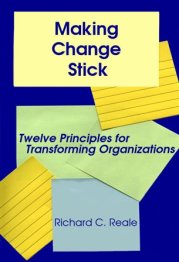
Making Change Stick: Twelve Principles for Transforming Organizations by Richard C. Reale

Making Change Stick: Twelve Principles for Transforming OrganizationsTwo figures stand out when reading this book: twelve and twenty. What do they have in common? The same man, Richard C. Reale. For twenty years, he’s studied why change fails and why it succeeds. Then he boiled down his knowledge base into twelve principles that are absolutely necessary if change is to happen correctly and last in an organization. The amazing thing is that these principles will not only ensure the success of a transformation, but will pay dividends in the long run, by having made an organization more change-capable.

So what’s missing? What’s causing organizations to fail when implementing change? The most common reason is the “failure to consider the human side of change.” It’s easy enough to draw the roadmap. The hardest part is the execution, the fulfillment of that plan. If you don’t believe it, just look at the last time you resolved to do something. What was harder: making the decision and putting some thought into how to best achieve it, or actually doing what you planned?

The twelve principles outlined in this book allow organizational leaders to focus on the people, and to empower them to bring change to fruition. It’s about setting down the right process for change, and following along closely, making sure change is proceeding as planned. It’s about walking the talk, and encouraging people to do the same by praising their efforts to change, and setting them up for success. It’s about monitoring the right metrics, the ones that will tell you how you’re really doing. In theory, it doesn’t sound hard, but in practice, it’s another story. Fortunately, the author explains every one of the twelve principles in detail, and the examples he gives clearly illustrate the point. Inspirational quotes from notable personalities are also provided, to help drive home the point.

This book is a wonderful resource. Twenty years of “on-the-job” experience can’t be wrong. The author’s expertise shows, and will help guide the book’s readers toward that great goal of organizational change, which is a hard goal to achieve indeed. If individual change is hard, organizational change is orders of magnitude harder – but this book will show you how to do it successfully. Get it, and achieve lasting change!

Standard
Reviews

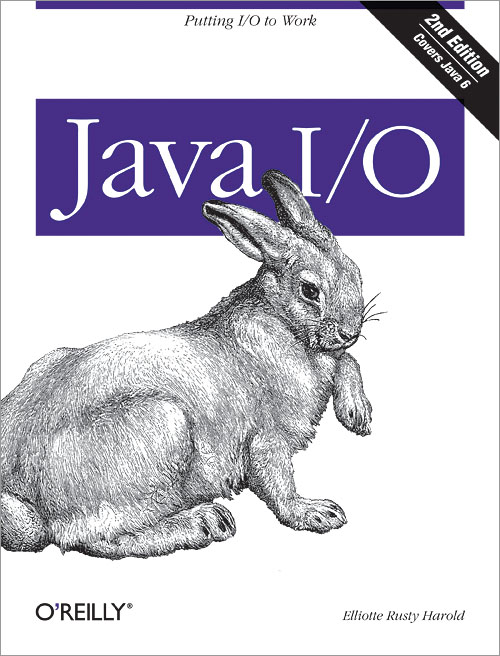
Java I/O 2nd Edition by Elliotte Rusty Harold

Java I/O discusses in great detail a subject that is, in many ways, the bread and butter of Java: input and output. Given the expanded capabilities introduced with Java 1.4, 1.5 and 1.6, this book’s attention to them is timely and on target.

Here are some techniques that the book teaches:

  • Reading and writing files
  • Communicating over network sockets
  • Filtering data
  • Interpreting a wide variety of formats for integer and floating-point numbers
  • Passing data between threads
  • Encrypting and decrypting content
  • Calculating digital signatures for streams
  • Compressing and decompressing data
  • Writing objects to streams
  • Copying, moving and renaming files and directories
  • Choosing files from a GUI
  • Reading and writing non-English text in a variety of character sets
  • Talking directly to modems and other serial port devices
  • Controlling printers and other parallel port devices
  • Managing and communicating with USB devices
  • Transmitting data wirelessly with Bluetooth
  • Communicating with the outside world from small devices such as cellphones and PDAs

The book has 25 chapters, divided into the following logical parts:

  • Basic I/O, or the stream
  • Data Sources, such as files and networks
  • Filter Streams, or processing data as you read or write
  • New I/O, which deals with the changes made in Java 1.4
  • File System: moving, deleting, renaming and choosing files
  • Text: reader and writer streams
  • Devices: the Java Communications API, USB, J2ME and Bluetooth

Java I/O isn’t for everyone. It’s an in-depth book that assumes you already have a basic familiarity with Java, and you know its syntax. You should already know object-oriented programming, and you should already have written simple applications and applets. Although the examples given in the book are straightforward, you will quickly be overwhelmed if you’re a Java beginner, so you may want to pick up another book such as Learning Java or Java in a Nutshell first.

Elliotte Rusty Harold put a lot of hard work and detail into making Java I/O understandable and usable, and it shows. This book will prove an invaluable resource to the Java programmer interested in strengthening his or her I/O knowledge.

Standard
Reviews

The Art of Raw Conversion by Uwe Steinmueller & Jurgen Gulbins

The Art of Raw ConversionAesthetically speaking, this book is beautiful – inside and out – which is as it should be, since it deals with the art of photography. The covers are glossy and beautifully designed, the title font choice reminiscent of a DSLR viewfinder. The next thing that one notices is the detailed Table of Contents. A good TOC is a must have for a good instructional book, and a great TOC, one that breaks topics down to their essential line items and makes it easy to find just what you’re looking for, is a joy to behold.

The TOC shows one more thing: the authors were thorough in their writing. They set out to discuss the art of RAW conversion with the tools currently on the market, and by golly, they accomplished it. Each chapter is well put-together and it deals with the topic at hand. The writing is focused and easy to understand. The illustrations are plentiful and do a good job of helping to explain the more difficult concepts.

The first two chapters are dedicated to preparing the reader for implementing a RAW conversion workflow. The next six chapters discuss the features of the RAW converters currently on the market. Finally, the last six chapters teach the reader specialized skills, such as correcting images in Photoshop, doing batch RAW processing, the new DNG format, photo metadata, custom camera profiles, converter calibration and RGB to B/W conversion. A wonderful glossary is included as well, explaining specialized terms.

Whether you are a skilled photographer knowledgeable about using RAW images, or a hobbyist who is just getting to know the RAW format, this books is great, because it will help you find out why you should shoot in RAW, and, more importantly, how to manipulate these images once you’ve transferred them to your computer. Yes, RAW conversion packages for both major desktop platforms (Mac and PC) are discussed, in relevant detail, no more, no less.

If you read this book, you will gain a tremendous amount of knowledge about RAW photography, and you will know how to use the features of the RAW format to your best advantage. In the end, your photos – your end product – will be much better for it.

This book is a must-have. Not only does it deal with a unique subject, about which little quality information is to be found in print or on the Internet for that matter, but it also does it thoroughly and skillfully.

Standard
A Guide To A Good Life, Reviews

Mister Ed and Me, by Alan Young with Bill Burt

Mister Ed and Me(1994, St. Martin’s Press, New York)

The TV show “Mister Ed” is my perennial favorite. My wife and I love it, and we watch it regularly. I was thrilled to discover that Mr. Young had written a book about the history of the show – and also included a short autobiography. The book proved to be a wonderful read. I couldn’t put it down until I finished it! Mr. Young revealed himself to be the same nice person in real life as in the TV show. I highly recommend buying this book. If you do, get it directly from Mr. Young’s website, where you can get an autographed copy!

Recommended: Yes

Standard