Thoughts

Pitch black darkness

Last night, the power went out everywhere. Completely. I happen to be staying in a village in the province of Dobrogea, Romania at the moment, and just as I stepped out of the house to walk to my car, all the lights blinked out of existence. It was, as they say, a dark and stormy night, with nary a star in the sky, not to speak of the moon, which had probably been stuffed in thick sackcloth and kidnapped.

Do you want to know what things look like when you’re in the middle of a wide open field and everything goes pitch black? It looks something like this.

Pitch Black Darkness

It’s an eerie feeling, one that throws you for a loop, even if only for a few moments. I looked around, but there was nothing to see. I reached about me, and wasn’t sure where to reach for a wall or something to hold on to. Everything was black. Even the dogs went quiet. Then, someone in a house nearby stumbled over something and mumbled some sort of swear, then called out for a light from his wife. Others, elsewhere, called out to each other. Things came back to life, but it was still pitch black outside.

I pulled out my little spotlight, the same one I reviewed recently, and found my way to the car. I unlocked it, and the interior lights came on. I climbed in, sat down and turned on the engine. The dashboard lights came on, reassuringly. Then I realized something which sounds obvious to someone who doesn’t have to deal with a power failure, but is a downright epiphany when you’re in pitch black darkness: cars have standalone electrical systems; they do not depend on the grid for power; they make their own power. When the grid goes down, your car can still run, thanks to its battery and to the fuel that makes its alternator turn and charge that same battery. It’s an amazing system when you think about it. I don’t know what we’d do without it.

Shouldn’t homes have similar standalone electrical systems, just in case grids go down? Sure, we’ve made inroads with solar panels and wind turbines, and some homes do have batteries that charge up from the sun or the wind, but the overwhelming majority of homes in this world don’t have any sort of backup power. If the electricity goes down, they’re down as well.

We should really invest more into making each of our homes more self-sufficient. Each home ought to be able to function, at least for a period of time — say 4-8 hours — without grid power, in and of itself, from power stored in batteries or capacitors or in some other container of energy, so that people can carry on with their lives and at least have enough time to prepare for a prolonged power outage once the grid power goes out.


Standard
Places

Green power

Someday perhaps we'll derive most of our energy from non-polluting sources such as the sun and the wind. Until then...

Someday perhaps we'll derive most of our energy from non-polluting sources such as the sun and the wind. Until then...

One of my most popular photos at Flickr. Taken at Cabin John Regional Park, in Potomac, MD.

Standard
Thoughts

Thank you Congressman Van Hollen!

This is Congressman Chris Van Hollen, the man that represents our district on the Hill. He’s got our heartfelt thanks and gratitude.

Do you want to know why? My wife and her students had to suffer for seven months at her piano studio — without heat in the winter and without air conditioning in the summer — because of Pepco’s unbelievable (one could call it criminal) inability to fix a panel on the outside of the building where she works and had caught fire. (Pepco is our local electricity company.)

The store owner and store manager called Pepco on numerous (countless) occasions to ask about the status of the repairs. They’d get one excuse after another. Usually, Pepco tried to blame the county, who they said was moving too slow in their approval of the repairs permit. Most often, they simply didn’t pick up the phone. Too busy, I gather. Hah.

The store owner even tried to contact the Washington Post, to see if they’d be interested. They weren’t. Shame on them. I guess the story was too small to bother with, right?

This went on for SEVEN MONTHS. I’d love to know how an electricity company that can respond within hours in case a tree downs a power line can’t get their act together and fix an electrical panel in SEVEN MONTHS.

I wrote about it here on my site back in April. Nothing came of that, either. I guess Pepco doesn’t care about bad PR unless it airs on big media, like the Washington Post — who didn’t seem to care.

Long story short, do you know who cared? Congressman Van Hollen, that’s who! We wrote to him on 5/27/2008, and a day later, on 5/28, he wrote a letter back to us and promised he would look into it. He put us in touch with one of his staffers, Miti Figueredo, who even called us to confirm that the congressman was interested in helping us.

Fast forward to 6/09/2008 (yesterday). It was horribly hot — temperatures approached 100 degrees. Pepco showed up in force, with a large team, and got the panel fixed within hours. The store and the studio now have air conditioning once more!

Thank you, Congressman Van Hollen! Thank you for caring when no one else seemed to care! You have our many thanks and gratitude! Thank you for truly representing your district and for caring about your constituents!

Standard
Reviews

Pepco fails to fix store's electrical panel after 6 months

Updated 5/27/2008: It has now been a month since I wrote this post, and Pepco still HAS NOT fixed the electrical panel. This makes it 7 months, which is simply unacceptable. I am going to write to Chris Van Hollen, our Congressman, to see if he’d like to get involved in the matter.

Updated 6/09/2008: We received a reply from Congressman Van Hollen on 5/28/2008, just a day after I wrote to him via email, assuring us that he would look into the matter, and putting us in touch with one of his staffers, Miti Figueredo. Today, on 6/09/2008, Pepco showed up with a team of about seven people and got the electricity working again in a matter of hours. I know this wouldn’t have happened without Congressman Van Hollen’s intervention. Congressman, we are deeply grateful and thank you from the bottom of our hearts!

Piano Place, the store where Ligia has her studio, experienced a power outage on November 2, 2007 (over 6 months ago). It was caused by a badly wired electrical panel outside the store, which caught on fire. Pepco, the local (and only) electrical company, has failed to fix that panel ever since, in spite of having the luxury of over 6 months to do it.

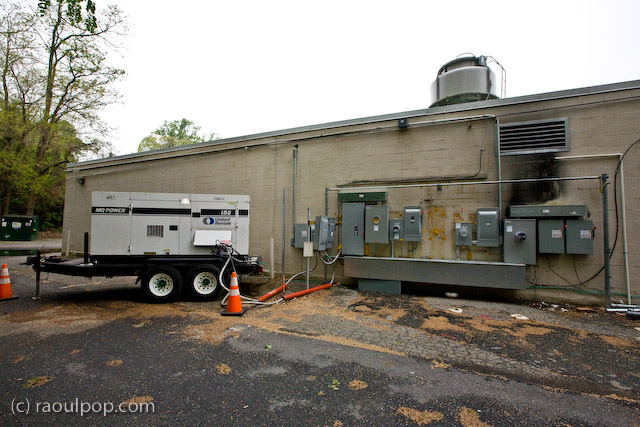
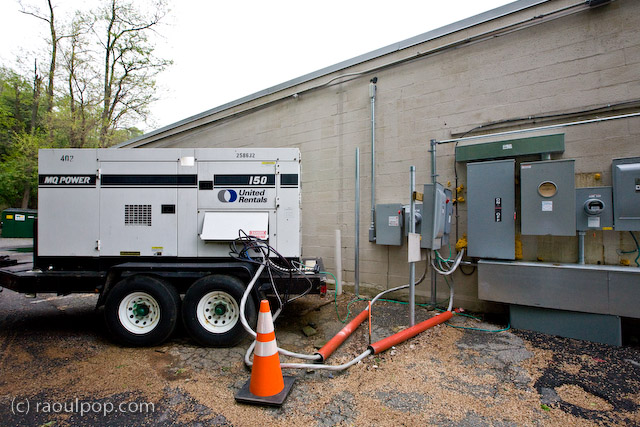
When the panel caught fire, the fire department and the police evacuated all of the stores for a day out of bureaucratic zeal, even though the fire didn’t spread inside the building. Then the store was without power for a few days until a generator was installed outside and connected to the electrical panels.

That same generator has sat outside the building since it was installed in November of last year (for over 6 months), waiting for Pepco to get off their lazy bums and fix the electrical panel. You’d think a job like this is of epic proportions, and that’s why it’s taking so long, but as you’ll be able to see from the photos, it’s something that could be done in a day or less with the proper crew.

The smoke on the wall mark the extent of the fire caused by the faulty panels. The wires that carry electricity inside the buildings weren’t damaged, because the generator is connected to them, and the store is able to feed off the generator to get part of its power. Pepco would simply need to fix the panels themselves, but they have offered up excuse after excuse during each of these six months. Appeals to their executives have not helped. The Washington Post has refused to get involved by publishing news of this complete failure in customer service.

Meanwhile, the store is paying $15,000 each month to rent the generator (with fuel charges extra), and still is not up to full power. It has had no air conditioning (only lights) all winter. That means they’ve had to do with space heaters here and there, and Ligia has frozen on many an occasion inside the studio because of Pepco’s utter laziness and unresponsiveness.

Now that summer is approaching and temperatures are climbing into the 80s, the store gets stiflingly hot (understandably so) on those days, because it has no air conditioning. Who’s to blame? Pepco, that’s who!

As if all this is not enough, the store has had the generator stolen once (the entire thing!), and on a separate occasion, it has even had the fuel siphoned off from the generator.

I have to wonder when Pepco will get their act together and fix the damned electrical panel. What will it take to get them to move on this?!

I see this as the strongest possible argument for competition in the marketplace. Pepco has a monopoly on the local power market. There is no other electrical company here, so Pepco can do whatever it pleases and get away with it. There is no one to hold them responsible. The lazy hacks can get away with treating customers like this for months and months, and no one from the local governments seems to care.

I find this outrageous, and I’m fed up with it. So the next time I hear one of Pepco’s hypocritical ads that say “We’re connected to you by more than power lines”, I’ll have to ask what they’re connected with: laziness, lies, inefficiency, procrastination, lack of customer service, monopoly, irresponsibility?

And when I see one of their trucks, I’ll know what sort of people drive them: the sort that would have people freeze in the middle of winter and bake in the summer heat rather than do their jobs.

Standard
Thoughts

Ways in which companies waste money and energy

I want to focus in on a few specific ways in which companies waste money and energy. I see the following things happen daily in the workplace. They’re not specific to any company. Chances are that if you visit any American company, they’re probably doing at least one of these things.

Lights are left on regardless of time or day, and whether or not there are people present in the room

Many people will turn on their lights during the day, even if they have an office window that lets in plenty of light. That makes no sense. Want to know what else doesn’t make sense? Walk around at night in a big city. Look at how many businesses have left their lights on. Now look through the windows (it’s easy to do with skyscrapers) and see if you can see any people in there. Chances are you won’t. Those big offices are empty, and the lights are fully lit. What for? Don’t tell me it’s to discourage theft, because it doesn’t work. Having the lights turned off and making the thief use some sort of light to see his way around is a much better way to discourage theft.

Utility bills are doubled and tripled by leaving lights on at night, and yet that sort of expense is just shrugged off as a given. Well, it shouldn’t be that way. It’s wrong. And no, using CFLs doesn’t really count. They reduce electricity consumption dramatically, yes, but that doesn’t excuse you from turning lights off when you leave the office.

Computers are left on at night and when not being used

This one bothers me a lot. As a past IT director, I know computers consume a lot of electricity, and I also know that most people don’t need to leave their computers on when they leave their office. Short of server rooms, which need to stay on all the time, and selected desktops (used mostly in IT departments) that need to stay on because they’re being accessed remotely, most computers can be safely turned off or put into standby or hibernation at the end of the day. Do people do it? No.

Each desktop system consumes anywhere from 200-500 Watts of power (or more) while turned on, not counting the displays, which vary from 50-200 Watts (or more). IT departments should institute group policies (it’s doable in Windows) that automatically put computers into standby or hibernation if they’re idle and not used. Just think of the energy savings that could be obtained! By the way, Macs come pre-programmed to do just that, so they will give you energy savings right out of the box.

No recycling program in place

Most businesses will have a document shredding services, but they’ll have no recycling containers on site for aluminum, glass or plastic products. They’ll trash them and pollute the landfills, when they could be easily recycled and re-used. What’s more, they miss an important opportunity to set a good example for their employees.

No equipment recycling policies

Related to the overall recycling program, companies usually do not have any arrangements in place to recycle their used computer equipment. When computers and other equipment reach the end of their usable lifespan, they most likely get trashed, not properly recycled through businesses that specialize in this sort of thing. Some companies donate their computers to non-profit organizations that re-use them, which is laudable, but those are few and far between.

Do we really want old circuit boards which contain toxic chemicals polluting landfills everywhere and seeping into our water supply?

Not enough telecommuters

It’s true that a lot of jobs can’t be done via telecommuting. But many of them can be done that way. Programming, web development and design, project management, accounting, etc. are only some of the jobs that can be done from home, if things are planned out correctly. There are many benefits to be reaped by both companies and employees when telecommuting policies are worked out. One of them is cost reductions, for both parties, and another is less pollution on the environment.

Read this article I wrote on telecommuting for the details. Here are just a few of the benefits that can be observed right away:

  • Reduced office space
  • Reduced utility costs
  • Less crowded roads
  • Less stress
  • Higher job satisfaction
  • Less expenses for employees
  • More family time

I’m sure there are more items for this list. If you know of any, please let me know in the comments.

Standard