Thoughts

This video is an epiphany. It explains how people’s conceptions of time affect their lives and societies — and vice-versa. My jaw kept dropping as I watched it. If you’re a sentient human being, you will think it’s the best 10 minutes you’ve spent in a long time.

RSA Animate – The Secret Powers of Time

The Secret Powers of Time by Philip Zimbardo

Aside
Thoughts

So long, Contenture

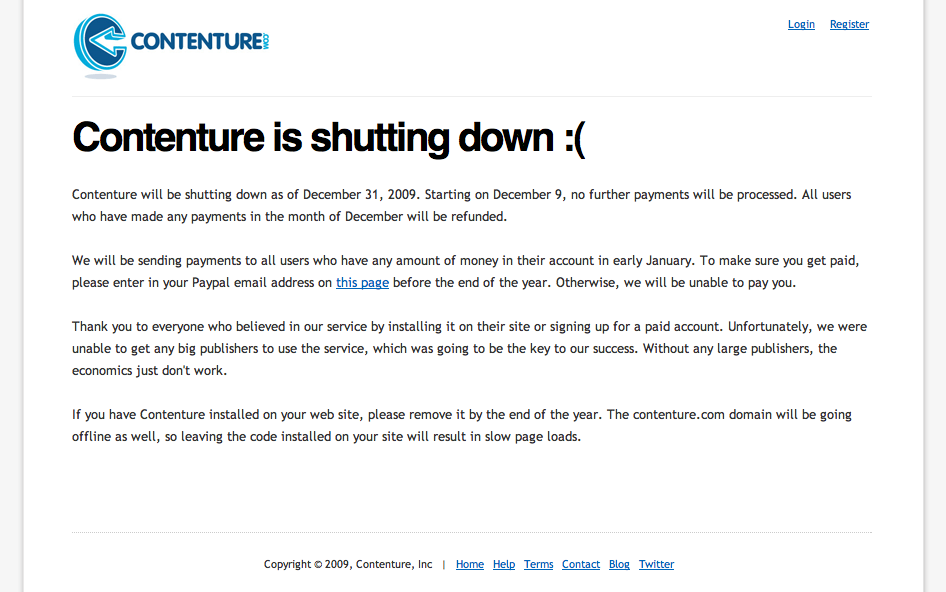
According to their website and blog, Contenture is going out of business. That’s unfortunate. I signed up with them back in June of 2008, endorsed their services here on my site, and while I didn’t make a lot of money with them, I knew the idea of micropayments for web content was something that would eventually catch on, if only given enough time to take root. It’s sad to see them go, and I’m sorry they couldn’t hang on until they saw some profits.

I only know of one other company that offers similar monetization services, and it’s called CancelAds. Here’s hoping they stay in business, and the idea of micropayments/subscriptions for web content continues to gain momentum.

Standard
Reviews

Using Contenture to handle micropayments

Back in April, I wrote about micropayments, and why I thought they were an equitable way to reward web publishers for their time and effort. I shared my thoughts on ad revenues, which, for most people, are minimal and not enough to live on, unless you are one of the relatively few websites that gets massive amounts of traffic.

In that same article, I also talked about how I thought micropayments should work, via a standard, instant way to charge readers a few cents per article, through protocols that were integrated into each browser. Instead of charging fees for each transaction, which would be impractical for such small amounts, micropayment processing centers would charge for bundles of transactions which exceed a set limit.

Fast forward a few months, and ZDNet publishes an interview with Barry Diller, one of the early Internet millionaires, where he talks about the very same thing: the need to go beyond falling ad revenues by charging small amounts for useful information. That article was hotly debated on FriendFeed, which is where I found out about it. Among the comments, I found one pointing me to Contenture, a newly launched micropayment system (it saw the light of day on 5/26).

contenture

Contenture’s method of handling micropayments is different from what I envisioned, in that it involves a monthly subscription. Here’s how they say it works:

“… a fully automated system that requires no user interaction. Users simply pay a set fee to Contenture on a monthly basis, and that money is automatically distributed to the sites they visit. How much each site gets from each user is determined by how often that user visits that web site, relative to all of the other Contenture sites they visit. Users get their seamless experience, and the site actually makes money. Everybody wins.”

So what’s involved on my end? I installed Contenture’s WordPress plugin and pasted in an extra line of code to customize the ad hiding behavior. Others might need to paste a Javascript snippet in their footer, which is basically what the plugin does for you.

On your end (the reader), the code will check to see if you’re a Contenture user, and will automatically distribute your subscription fee to the websites that you visit, based on how often you visit each site. As an immediate benefit, all ads on my site are hidden from you. They’ll load as the page loads, but they blink out of view and the ad space collapses unto itself as soon as the page finishes loading. It’s pretty cool.

Other benefits I might be able to offer you in the future are the ability to view exclusive content, or perhaps to even close off the archives to those who aren’t Contenture users, although I’m not too keen on that, since Google won’t be able to index me properly any more if I do it. At any rate, the ability to offer more benefits is built in, and that’s nice.

Contenture’s model is opt-in (also called freemium) and so it has some limitations, in that I don’t get paid for everyone that accesses my content. My micropayment model, the one I envisioned and the one Barry Diller and others are talking about, is standardized across platforms and browsers and works for everyone, all the time. Eventually, I think we’ll get there, but Contenture has made a good start of it, and they did it now, which is why I signed up with them.

To let site visitors know they can support my site, I placed a small link in the header, as you can see below. I also have a link in the footer, also shown below.

header-screenshot

footer-screenshot

I look forward to seeing Contenture’s user base grow, so I can tell whether I’ve made the right choice. I want to keep writing and publishing online for a long time to come, but the only feasible way for me to do that is if I get rewarded properly for my efforts. I believe micropayments are the way to do it. It’s affordable for the readers, and it scales up nicely for me, the web publisher. Time will tell exactly which micropayment method will work best, and you can be sure I’ll continue to monitor the options available out there.

Standard
Thoughts

Predictions about computer drives in the future

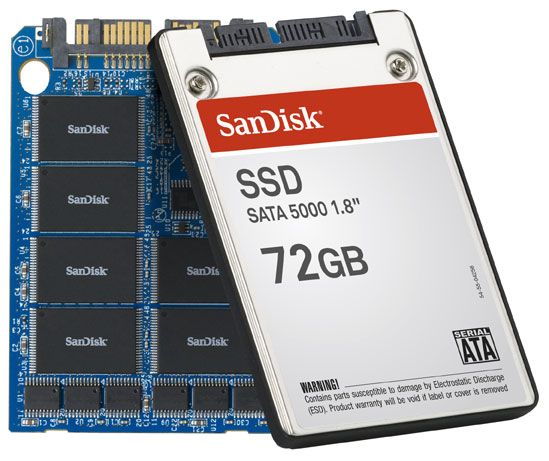
72GB SanDisk SSD SATA 1.8"

On 1/16/09, Computer World published an article where the author paints a future full of SSDs. He puts forth the idea that drives will not only be replaced by memory chips, but that these memory chips will be integrated into the motherboard, doing away with the SATA interface. There are a number of things I don’t agree with in that article, and I’m not the only one who’s annoyed. Others have called out the author for his statements as well.

For one thing, let’s remember that computer memory once relied on chips integrated into the central circuits. Going back to that sort of approach would be like going back in time. Weren’t we supposed to progress, not regress? The advantages have to be truly worthwhile, and I’m not convinced.

A claim made in the article is that of increased speed: “By making the drive part of a system’s core architecture — instead of a peripheral device — data I/O performance could initially double, quadruple or more.” I love these nebulous claims, don’t you? It could double, quadruple or more. Hey, why not 8x faster? Maybe 16x faster? Let’s just inflate the numbers, it looks great on paper…

From my experience, I noticed that transfer speeds to flash memory vary tremendously — based on how much used space there is on the memory itself, or the file size. Larger files transfer much faster than smaller ones. Sure, in my experience, there was a SATA or USB interface in the way, but that doesn’t change what happens with the flash memory itself.

We should also keep in mind that flash memory is limited in the number of write operations it can take before it expires. On the other hand, regular hard drives have a much longer life span. I for one don’t want to be in a situation where I have to replace an expensive SSD on my laptop because I’ve saved one too many files and it has just gone belly up.

That brings to mind another issue: will these SSDs be soldered onto the motherboard, or can I pull them out and replace them as needed, like I do with RAM modules? I think you can readily imagine how inconvenient it would be to have to service your computer if its SSD is soldered onto the motherboard.

How about space on the SSD? What do I do if I want to increase the space on my drive? Do I have to buy another full SSD? I’d much prefer we had SSD bays, like RAM bays, where I could stick additional SSD modules to automatically increase the space, just like it works with RAM. A partitioning tool integrated within the OS should then allow me to resize my existing partitions and spread them over the newly available space, or to create another partition out of that space.

I keep hearing people say that 250GB or 160GB is plenty of space for your laptop. That’s nonsense. I’m always maxing out my laptop’s hard drive when I go on trips, because I fill it with photographs and videos which I then unload to my external storage when I get home.

I find that for my needs, a 500GB or 1TB laptop hard drive is what I need right now. At some point in the future, I may need more. I haven’t started working with HD video for example. I know that’s a tremendous space hog. I think a 1TB drive would be the minimum I would need if I started to work in that arena.

With SSDs, price is still an issue, and so is space, at least for now. I just don’t find it practical to spend money on SSDs at the moment, and I don’t think my opinion will change unless their prices and storage specs start to match those of regular hard drives.While we’re on the subject of price, where in the world did Gartner get their figure of 38 cents per gigabyte? That’s the figure quoted in the article. I’m sorry, Gartner, but you folks need to check your math. I came up with 9 cents per gigabyte recently.

On the other hand, I do understand that the additional interface between the motherboard and the hard drive is a bottleneck. If we can do something to speed that up, I’m all for it. But you’ve got to prove to me (and to other consumers out there) that your technology is affordable and reliable and offers tangible benefits other than tech media hype.

I’m also excited about the possibility of increasing drive space on a modular basis, where I simply put in more SSD modules in expansion bays on the motherboard, like I do with RAM. But there’s no indication that we’re heading in that direction from the article itself. Until we get to that point, I’ll still continue to think that SSDs are aimed at the wrong market segment. Not everyone is a MacBook Air-toting management type. The bulk of computer users out there need affordable technology with plenty of storage, well made, and reliable over 3-4 years or more. SSDs just aren’t there yet.

Image used courtesy of SanDisk Corporation.

Standard
A Guide To A Good Life

American habits

Slow down. That’s a phrase not often heard in the US. At least not among the people I know. But it’s a notion that’s slowly starting to make more sense.

Americans love to think big and spend big. They want progress on every front, no matter what the cost. In the 20th century, that sort of thinking worked well. It carried us through to the 21st century, where, however reluctantly, I think we’ve got to change the way we operate.

There’s a newspaper article I’ve been saving since June of 2007. It’s about people who overextended themselves in order to keep up with the Joneses, and were paying the price. It’s called “Breaking free of suburbia’s stranglehold“. Even before the real estate bubble burst, sensible people were finding out they couldn’t sustain their lifestyle and stay sane, so they downsized. Each found their own impetus, but they were acting on it. That was smart. I wonder how many people had to downsize the hard way since last year…

How about a more pallatable reference, one for the ADD crowd? There’s a Daft Punk video called “Harder, Better, Faster, Stronger“. The lesson to be drawn from it is found at the end of the video, but to get it, you have to watch it from the start. I’ll summarize it for you here. Don’t be fooled by glitter and glamour. There’s a price to pay for everything.

Paying for it isn’t a new notion. It’s been around for ages. Take “pay the piper“, for example. You look at almost any language, and the idea of everything having a price can be found embodied in certain evocative phrases.

Let’s look at a few more concrete examples:

  • You want a bigger house? There will be a cost for that, as seen above.
  • You want the house of your choice AND the job of your choice? You might have to do some really nasty commuting, and now that gas costs a lot more, you’ll not only pay with your time, but with your wallet as well.
  • You persist in wanting to drive an SUV? There’s a price to pay for that too, and it’s not just in gas.
  • You want a house that looks like a mansion, but you don’t want to think about how things get built? That’s okay, you’ll get a plywood box with fake brick cladding that will look like a mansion and will only last you 20-30 years at most (not to mention that your HVAC bills will go through the roof, literally).
  • You want your meat, particularly your pork? There’s a big cost for that, and it’s measured in incredible amounts of environmental damage and in chronic and deadly health problems for the people who work on the pig farms.
  • You want to keep your computers and lights on all the time at work? You want to keep the temperature at 65 degrees Fahrenheit all the time? Do you want to keep all of your employees on site instead of letting them work from home? As a company, you’ll see increased costs because of your wasteful habits.

These are all hard lessons to learn. It seems the only way to get people and companies to learn to act responsibly is to increase costs. When your actions have a direct and immediate impact on your bottom line, you tend to change your ways in order to stop the bleeding.

It’s a shame it has to be that way, and perhaps at some point in the future, the new way of thinking will be more ingrained in people’s minds, and they’ll think about slowing down, conservation, sustainability and efficiency on a daily basis. Perhaps they’ll realize having a more meaningful life is more important than having a busy life filled with material nothingness.

I’m grateful that at least some are already seeing things the right way. I myself have already started to cut out unnecessary expenses and time commitments, and will continue to do so. I have several more important changes still planned.

If you’d like to do the same, one place to start is a book entitled “Take Back Your Time: Fighting Overwork and Time Poverty in America“. It’ll get you thinking along the right lines, but it’ll be up to you afterwards to make the needed changes in your life.

Standard