Reviews

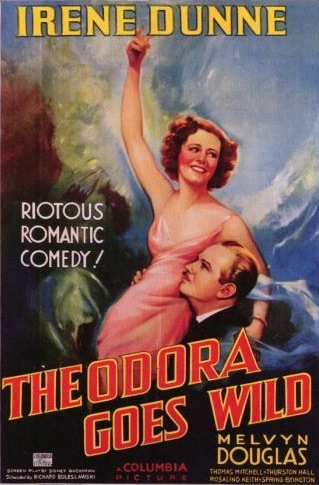
Theodora Goes Wild (1936)

Movie poster for Theodora Goes Wild.

One of the many wonderful comedies made during the Great Depression, Theodora Goes Wild explores a young woman’s quest for freedom in a society where tight constraints are the norm. The film’s humorous and entertaining look at some of the hang-ups of the period is a very fun way to spend about 90 minutes. Interestingly enough, we discover that not many things have changed since. Gossip still rules, small town folk are always too interested in each other’s lives, and people still yearn to live their lives the way they see fit.

Theodora Lynn, a respected daughter of the town’s prominent family, has written a book called “The Sinner”. It’s a wildly successful look at the life of an imaginary woman who does things her own way, very much unlike Theodora. She has penned it under the name Caroline Adams, to protect her identity. Meanwhile, the town is in an uproar over the scandalous morals of the book’s main character, all the while unaware that the very same young woman that plays the organ in church every Sunday morning and obeys her aunts to the letter is the author of said scandalous book.

Theodora visits her publisher on an occasion, and while there, meets Michael Grant, played by Melvyn Douglas, a debonair artist who works for the publisher but is very informal. He takes an immediate liking to her, and coaxes his way into having dinner with her and the publisher that evening. During dinner, he gets her to drink (which she never does) and as she unwinds and lets loose, he enjoys his little game more and more. He decides to pursue her back to her town and “free” her, as he puts it. He succeeds, but he has unleashed a force greater than him. She now intends to “free” him.

The film’s gloriously funny twists and turns had us in fits of laughter throughout. And the skewering of the old biddies in that small town was great fun too! The film showcases Irene Dunne’s incredible talent for comedy and sexiness (it’s no wonder she made such a great on-screen pair with Cary Grant), and fits Melvyn Douglas to a tee. He has an endearing quality that shows through his devilish smirks and his on-screen antics. That same quality made him perfect for the role of Leon in Ninotchka (opposite Greta Garbo) three years later. I can safely say that he’s become one of my favorite actors.

Just one year later, Irene Dunne made The Awful Truth (1937) with Cary Grant, one of my all-time favorite movies. It’s so funny to see her honing and refining the same skills she used to great success in that movie while watching this one. The same little trills of laughter, the same thin smiles, the same looks, glances… It’s wonderful to catch great actors doing some of their best work. It’s time well spent to watch them act.

There’s an important lesson to be learned from the movie as well. It’s easy to forget nowadays how stifling society used to be, and how scandalous certain behaviors were considered just a few decades ago. To some extent, that was a good thing, but it must have driven some people mad with frustration. Nowadays, things are much more relaxed, although we still tend to be judgmental. It seems we always want to tell others what to do and what not to do. Sure, it’s important to point out what’s morally and ethically wrong, but that’s the duty of our parents and families, NOT our neighbors and townsfolk. I don’t believe in the saying that “it takes a village to raise a child”. No it does not! That sort of a village would be the quickest way to get me to rebel if I were still a child.

It’s also important to point out that while Theodora rebelled against the gossipy old biddies and against society, she did it all with a purpose, all while not compromising her own morals. She did not demean what she saw as her true worth. She simply put on a show to prove a point, and she certainly proved it. That’s something to keep in mind for the young people of today, who are so ready to step over any rules they might have set to get at what they want. Sometimes there are horrible consequences to that sort of behavior. If you watch the movie, you’ll remember that Theodora kept “both feet on the ground”. Keep that in mind. Have your fun, achieve your dreams, prove your point, but don’t do something you’d later regret.

More information

Standard
Lists

Condensed knowledge for 2008-03-10

Standard
Lists

Condensed knowledge for 2008-03-09

Standard
A Guide To A Good Life

I miss Collier's Weekly

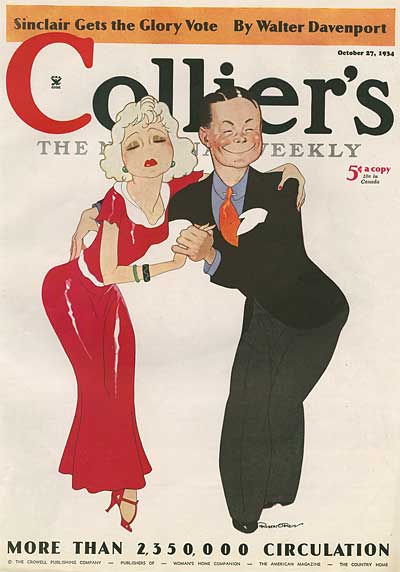
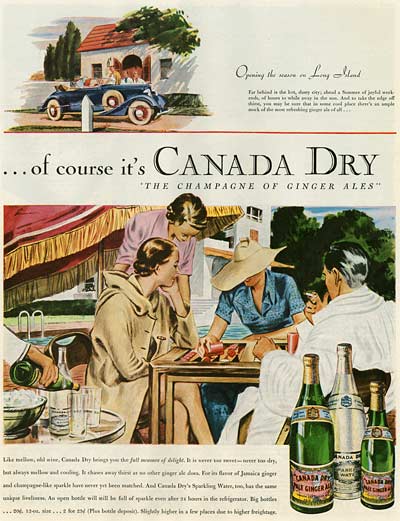
I know Collier’s has been gone for a long time, but when I see stuff like this, or this or this, I can’t help but love it. Maybe we should have more drawings in our magazines, and they should be done with the same classy style and atmosphere. Things are a bit too realistic nowadays. We can always get plenty of reality. We can’t avoid it. It would be nice to open a magazine and get lost in its own little world, where the articles, drawings, photos and yes, even ads are different from all the rest.

Collier’s Weekly

Image Credit: ASIFA-Hollywood Animation Archive

Such little thought is given these days to good cartoonists. Let’s not forget a good cartoonist made Harper’s Weekly what it was, and great artists gave Collier’s its look. Instead of getting celebrities to do provocative photo shoots on the cover — and to manipulate their looks into something completely artificial — it would be better to feature wonderful art like Collier’s did.

Ad from Collier’s Weekly

Image Credit: ASIFA-Hollywood Animation Archive

When we think class these days, fashion magazines come to mind. You open them up, and about 80% of those things are ads with lanky, weird-looking models sulking or posing awkwardly/provocatively. There’s very little substance, and very little interesting stuff. True class in a magazine is a style that comes through the page, and it’s about art, layout, colors, copy and yes, atmosphere. It should invite the reader to open it. While it deals with the problems of the world, it should be upbeat and entertain. Maybe I’m off the mark, but from what I’ve seen so far, I really do wish Collier’s could be resurrected, with the same style and panache of its heyday.

Standard
Thoughts

Living in a mad world

There are two things I want to talk about today. The first took place right here in the US, and the second happened in Italy. Both happened recently.

We’ve got a conductor who has forgotten the US still means freedom. Apparently, a tourist, possibly from Japan, who knew very little English, was taking photos of the scenery (mostly nature) on an Amtrak train between New York City and Boston. The conductor saw him, and asked him to stop in the “interest of national security”. Huh?! For taking photos from a train? For trying to preserve the memories of a trip?

But that wasn’t enough. She screamed at him even though he didn’t understand what she was saying, then called the police in and had him arrested and removed from the train. Yeah, you read that right.

How wrong is that? It’s the sort of thing that makes one’s blood boil. At the very least, that conductor, and the policemen that went along with that sick gag should be censured or suspended, so they can all remember we don’t arrest people willy-nilly in the US, not for taking photos from a moving train open to the public.

The Economist reports that Italy has passed a decree authorizing the expulsion of any Romanian immigrant who is deemed a danger to public safety. This bothers me a lot, since I’m Romanian by birth and upbringing, and I want to clarify the situation.

There was an incident where an Italian woman was killed and possible raped by a Romanian immigrant. There’s a catch to the story though. That was NOT a Romanian immigrant, it was a gypsy from Romania. There’s a BIG difference, so let me explain.

It’s hard for Americans to understand this sort of thing, but ethnicity is a very touch issue in Europe, particularly in Eastern Europe. Just think of the wars in Bosnia and Herzegovina, or go back through the last few hundred years and look at the geography of Europe. All of those governmental and boundary changes created and continue to create ethnic conflicts which may smolder for years, or break out into open war, which is what happened in Bosnia. I’m not saying this to set up my arguments, just to give you some background info. There is no animosity between Romanians and gypsies, just deep-seated and justified frustration with these nomadic people that have chosen to settle in Romania over time.

I was born and grew up in Romania, so I’m a bit more aware of these things than outsiders who decry the situation in the country without really knowing what’s going on. You see, we’ve got a lot of gypsies in Romania. They’re nomadic people, but they’ve chosen to settle there in the last few hundred years. Other countries have them as well, but we seem to have been “blessed” with unusually large numbers of them. There are a few classes of gypsies, and they can be differentiated based on how well they integrated into society, and how clean they are.

First you have the Gabors, which are the most civilized. They’re clean, hard working, responsible people and integrate well into society. I have no issues with them and would be happy to have them as my neighbors. There’s another group whose name escapes me — I don’t know much about them except that while they’re more aloof, they’re also fairly decent in terms of how they interact with other people.

Unfortunately, you then have the gypsies per se, a very mixed class of individuals and families that share these common characteristics: they do not integrate into society, they live mostly in shanty towns, they have little or no hygiene or cleanliness, and they have a very high rate of crime. They call themselves the Roma, which is a title I must protest. It’s much too close to the word Romanian or Roman, and they hail neither from Romania, nor from Rome.

You do not talk about normal living when you talk about these gypsies, the so-called “Roma”. You find them begging on the streets or dealing in God knows what, but mostly, you find quite a large number of them stealing, raping and murdering. This isn’t an exaggeration and has been their historical record. Since they do so poorly in Romanian society and certainly have no interest in obeying the laws of the country, they do not deserve to be called Romanians, and indeed, I would not call them citizens of Romania or bestow on them the rights that go along with that citizenship.

When Romania got accepted into EU, several programs got started whose aim was to integrate these gypsies into society. So far, they have failed. Why? They’re too different and have no interest in life as civilized people know it. Really, they don’t, and if you don’t believe me, you’re welcome to go there and try to integrate them yourself. You will fail miserably.

At any rate, it’s these gypsies that immigrated to other European countries in droves when the borders were opened, along with a number of actual Romanians. When the gypsies arrived in these Western European countries, they started engaging in their usual behavior: living in shanty towns, polluting society in general, participating enthusiastically in crime and other misdemeanors, etc. When they’d get caught by the police, they’d say they were Romanian citizens, which, as I’ve just explained, is not quite true. Ethnically speaking, they most certainly aren’t Romanians, and behaviorally speaking, they’re an entirely different breed.

A few years ago, there was a case where gypsies caught and ate swans from a German lake. There was an uproar, and Romania got the blame for it. As if normal, law-abiding Romanians had something to do with that… Don’t get me wrong, I’m not saying genuine Romanians don’t engage in crime, because every orchard has its rotten apples, but at least the crime rates are very different among Romanians and gypsies.

In the recent case in Italy, we’ve got a gypsy who lived in one of their shanty towns, who accosted, beat up and possibly raped an Italian woman. Who got the blame again? Romania. Why? Because that gypsy was from Romania. Was he a Romanian? Not really. So now we’ve got Italians horribly worked up against Romanians in general, when most of the Romanians that went to Italy did so to find honest work that they couldn’t get in Romania, who’s still having problems with its economy.

It’s just not fair that Romania keeps getting blamed for the actions of gypsies, which, as a group, cannot be controlled or integrated into any society or country where they happen to live. I wanted to set the record straight when it came to this, and do hope that I’ve managed to make my point.

Updated 11/29/07: Came across a great photo-documentary of gypsy life in several countries. Have a look at it. It has photos of gypsies from Romania as well. Try not to romanticize things as you look at the photos. There’s nothing romantic about an utter lack of hygiene or living in a hovel.

Standard