Thoughts

Changes in TV viewing habits

The BBC reported recently on how TV viewing is becoming a more social experience. When I read through that article, I said, hang on a minute, I had an idea back in October of 2005 along the same lines… I called it audience-inclusive advertising, but the thoughts I wrote in there can be applied to other content on TV, like shows, which is what’s currently happening.

It’s fun to read through my original article and see how much of the stuff has already come to fruition. Here’s one:

A site can be set up and maintained by a consortium of advertising agencies and brand owners or a neutral body, that would either track viewer product preferences through data mining and random surveys, or would actively encourage users to register and provide product preferences. Alternately, existing user data could be compiled from various databases.

Now we have Facebook and Twitter, and advertisers love to mine their data sets for user product preferences, to give them surveys (think of all the annoying quizzes on Facebook), and collect data on them every time an app is authorized. So this has already happened.

Through the medium of the website, brand owners can also take a cue from the users about the kind of products they need to advertise, this time in a more direct way, through hard data. Even more, they can more easily survey the users about the kind of new products they want to see.

Think of all the fan pages set up on Facebook by companies and brands. You can become a fan, learn more about the company, and be surveyed, live, about your preferences. Beautiful.

Another way to keep the audience is to offer prizes for watching the ads and picking through clues that are weaved through both the ads and the shows. Entries can then be registered on the show’s site or at this main site for a chance to win something, perhaps even products featured on the show, or something as banal as an actor’s coat, or the actual bottle of perfume used by an actress on the show. These aren’t things that cost much but mean a lot to the audience.

Do you notice how many product giveaways there are on Facebook and Twitter? Companies are giving away not just stuff that doesn’t cost a lot, like an actor’s wardrobe, but they’re giving fans cars, computers, cameras, TVs and other things that cost a fair bit of money. And it’s all done for the purpose of keeping users (fans, if you will) tuned into the company’s platform and brand.

It’s also fun to see what stuff didn’t get implemented (yet?), but I’ll let you do that by reading through my original article.
Standard
Thoughts

YouTube and music publishers: a model for revenue sharing

One of the videos I uploaded to YouTube recently was identified as using copyrighted music. I’d used a song from the 50s, thinking that after 60 years, no one would give a hoot whether that song was being used as a track in a YouTube video. Still, it was identified by YouTube’s content ID program and pointed out to me.

Leaving aside the discussion of music copyrights in the US, which is absolutely insane, given that even 70-year old songs still aren’t public domain, I’d like to propose a model for revenue sharing among YouTube users and music publishers. It’s quite simple, and allows for easy licensing and monetization of music tracks. If implemented, I dare say it would also increase the revenues of music publishers quite a bit.

Here’s how it would work:

  1. Music publishers use YouTube’s content ID program to identify potential matches between their catalogs and YouTube videos, same as they’re already doing.
  2. Potential copyright issues will continue to be identified, same as they are right now.
  3. Videos won’t be restricted, as they are now, but will continue to play in all geographical locations, for every YouTube user, accumulating views.
  4. If the videos are successful and accumulate over 10,000 views, they will be invited into YouTube’s revenue sharing program.
  5. Once they start making money through that program, a portion of that money will go to the music publishers who own the licensing rights for that particular song or piece of music. I wouldn’t mind paying up to 25% of the profits from a video to a music publisher if I chose a particular song I loved for my video, and my video was successful. Besides, I wouldn’t have to actually “pay” myself. YouTube would automatically distribute the revenues accordingly.

The best part of this is that the process is fair, doesn’t punish anyone, and benefits all involved. If a video is successful, then it pays, and if it only gets a few hundred views, who cares if uses a song that should be licensed? If a tree falls in the forest and no one’s around to hear it, does it still make a sound? Does it matter?

Prosecuting individuals in this day and age, when the practice of adding songs to videos is so widespread, is terribly inefficient, and fosters ill-will. Why not use existing technology and platforms to add value, make money and foster goodwill?

The two areas where I see some tweaking will be needed are in the correct identification of music tracks, where the dispute/review process will need to be made easier and faster, and in the use of a sliding scale to calculate the percentage due to the publishers for the user of their songs, based on the song’s popularity and relevance. But those are minor things given the immense potential of this model to revolutionize the way we look at music copyright disputes on YouTube.

Standard
Thoughts

Undercover Boss was my idea too

A couple of weeks ago, my jaw dropped as I browsed Twitter. SNL had put together a skit lampooning a new show on CBS called “Undercover Boss“. I didn’t even know the show existed, much less that it had been on SNL.

Since the show’s launch after the Superbowl, it turned into a nationwide hit, because it struck a vein with viewers. Several powerful themes are at work in each show, themes which I knew would make the show a success when I thought of it, such as the contrast between the rich and the poor, the proverbial desire to “be in someone else’s shoes”, and the will to find out what’s wrong and right it.

Don’t get me wrong. No one stole my idea. There was no foul play involved. I was simply late to the table. When I thought of the idea, the show was likely already in development. By the time I was looking for a production company to help me develop the show, “Undercover Boss” was already in production. Two different people had the same idea — well, almost the same idea, because my concept was slightly different, as I’ll explain in a bit — but one of them had it sooner than me.

My concept of the show differs somewhat from what is currently in production. I thought of it from a different angle perhaps. I’m not sure how many of you are familiar with the story of Scheherazade, the mythical Persian queen and the teller of “One Thousand and One Nights“, but I read those stories avidly as a child, and I still remember them.

A recurring theme in some of her stories is that of the caliph (ruler or king if you will) disguising himself in different ways and going out into his country by himself, or accompanied by a trusted servant, to see first hand how things are going, and what he must do to make things better. There’s a certain element of thrill in taking on a different position in life, particularly for someone who’s been accustomed to the royal treatment all his days, and clearly, there’s a benefit to his subjects if he gets to know how they live and is motivated to change things for the better.

Nowadays, there are very few kings left, and they haven’t got much power, unfortunately. Presidents don’t need to disguise themselves to find out how things are, because in those countries where there is enough freedom of speech, everyone is eager to tell them just what needs to be fixed. Even in countries where there is little freedom of speech, like Iran, people will risk life and limb in order to voice their beliefs.

However, there are clearly places where people are afraid to speak their minds for fear of retribution, and that is in corporate environments. In small companies, the owner or director generally knows what’s what, but in large companies, particularly multi-national ones, there are so many layers between the workers and the top guy or gal that many of them only know their company through the figures that filter up through the ranks. If someone has an idea about how to do things better, or is unhappy with something, they’ll likely keep their mouth shut for fear of losing their job, particularly in these tough economic times. So how is the CEO to know what’s really going on, and how his or her policies affect each John or Mary that works at their companies? They can’t, unless they, too, do what the caliphs used to do.

So far, so good, right? Well, I didn’t want to have camera crews follow the “new guy” around all day long. That’s  pretty much a dead giveaway and doesn’t encourage true reactions. I wanted to film with concealed cameras and microphones. In situations where that wasn’t possible, we could have planted cameras in concealed locations, or used “co-workers” who were really production crew members, carrying the concealed cameras themselves. I also wanted to film an entire season without airing a single episode, so word wouldn’t get out about what we were doing. Then after filming a whole season, and doing as many of these shows as possible, we would have started to air the episodes. Now that would have been truly amazing.

But I’m not the one with show running on CBS, am I? I’m just the guy with the me-too idea — this time, anyway — so the important thing is the folks who had the idea first got it made, and it’s successful, and that’s good, not just for them, but also for the American worker, because I believe in the power of this show to encourage positive changes in America’s corporate environment, changes that can make things better for the average worker.

I have a few more good ideas like this one. If you’re a serious production company with the resources to help me develop and pitch a hit show to a TV channel, please get in touch with me. I’d like to move fast on my other ideas, so I won’t be left in the dust again. I look forward to talking with you!

Standard
Thoughts

Better media width compatibility in WordPress

One thing that works against you when you want to try out new WordPress themes (and this applies for either self-hosted WP installs or for WP.com blogs) is the width of your media, like the images you upload for your blog posts. Many themes are narrower than the width you may have chosen for your images over time, and this means images will either overflow beyond the margin of the main column, crowding out the sidebar and generally making your site ugly, or be cut off, which looks a little better but still ruins the user experience.

For example, most of my posts have images posted at 640 px, 600 px or 550 px wide, and that eliminates a lot of themes for me, even though they may be very nice, because their post column is too narrow to display the images.

I have a solution to this problem.

You know how you can set the size of your photos and videos on the Media Settings page?

And did you know there’s also a media width “guideline” within each theme’s CSS settings page (at WP.com)?

That width is the maximum allowed for videos and images. My current theme, “Journalist” by Lucian Marin, allows media embeds at widths up to 720 px, which is a LOT wider than most other themes, which are still stuck at 500 px or even less, at 420 px.

All of these differences would be okay, provided the WordPress platform were to read the maximum column width of a theme and adjust the maximum image width on the fly.

In other words, instead of hard-coding the image width when they’re uploaded to a blog post, it could simply say “thumbnail”, “medium” or “large”, much like it does for the image align attributes (“left”, “center”, “none”), then figure out what the “large” size really means by looking at the theme’s width limit value.

This way, no matter what theme we may choose, images and videos will still display properly and we’d be happier. After all, they’re already doing this for video auto-embeds. As you’ll see if you look at the screenshot I’ve posted above, they say “if the width value is left blank, embeds will default to the max width of your theme.” What’s to stop them from doing the same with images?

I would also encourage Automattic, should they consider building this into a future version of WordPress, to make sure it’s backward compatible, so that no user should have to go back through all of his or her old posts and make sure all the images are set to the right width if they decide to switch themes. Perhaps they can do this with a wizard that goes through all the images and sets them to the correct width, or the new image embed code can auto-magically fix the image width for old posts.

Standard
Thoughts

Why can't I use AirTunes from my iPod or iPhone?

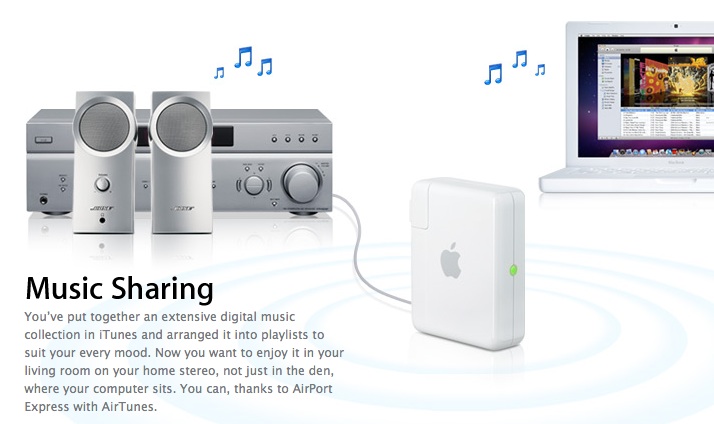
For those of us with an AirPort Express, this question comes up at some point: why can’t I play directly to it from my iPod touch or iPhone, using the same AirTunes technology that is available through iTunes?

apple-air-tunes

After all, an iPod touch or iPhone has WiFi, and AirTunes works through WiFi. If I can do it from my Mac, it stands to reason that I should be able to do it from my iPhone, doesn’t it?

Apple iPhone 3G

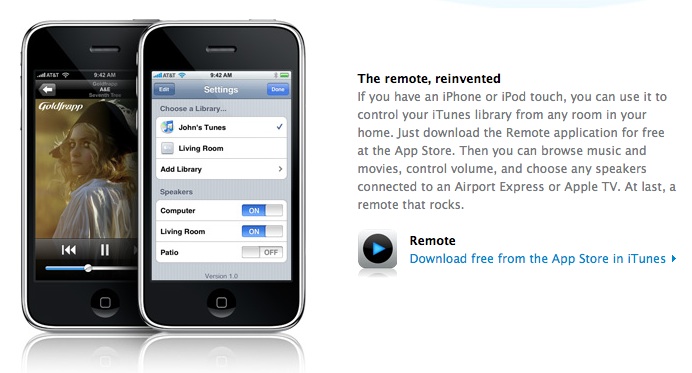
Instead, we get a hamstrung app like Remote, which is neat, but somewhat pointless. Think about it: you’re using a device which already has your music library stored on it (iPod touch) to play and control the same music, stored on your computer. Why the middleman? Why not go direct?

apple-remote-app

Sure, the Remote app is useful in the living room, if you also have a music library stored on your Apple TV. You can then control the playback of that music or videos without using the Apple Remote, which has a much longer battery life, is smaller, and much easier to use… eh, wait a minute, that doesn’t sound like it’s better, does it?

Given Apple’s commitment to the environment, I have to wonder why they insist on using the laptop or desktop machine when it’s not necessary.

apple-environment

I realize using AirTunes to play music directly from the iPod touch or iPhone will drain the battery much faster than playing the music through headphones or through a dock connected to a speaker, but hey, we should at least have that choice, right?

Standard