Exercise

This is how you can look at 72

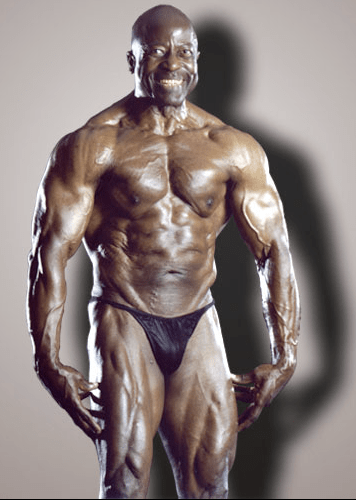
Meet Jim Morris, a 72-year old California man, who has been working out every day for most of his life and has won many bodybuilding competitions. He does it because he loves it. There’s a video of him working out on YouTube, originally broadcast one one of the local TV stations where he lives. The photo you see below is him at age 71, about a year ago.

Jim Morris 1

You can read more about his life and dedication to the sport of bodybuilding on his website. He is a personal trainer, and has helped many people get fit over the years, starting in the early 1950s. His diet is also something special. He only eats nuts, fruits, beans and vegetables.

Can it be done by anyone? I think so. You just need the inspiration, which Jim Morris has just provided, and the drive, which you must work up yourself. I think it’s worth it. Do you?

Images used courtesy of Jim Morris.

Standard
Lists

Finding inspiration

I think these following videos are wonderfully inspirational. We all know about Michael J. Fox’s fight with Parkinson’s Disease. What we may not know is that he’s a very gracious person, and a real inspiration to others. Watch this segment of an interview with Katie Couric, and you’ll see what I mean. I also wrote about Michael in this post, back in October of 2006.

This second video is the historic 1938 match race between Seabiscuit and War Admiral. It shows what you can accomplish when you have faith in someone, even in an aging horse that was considered useless.

Here is Mr. Roger’s testimony before the US Senate in 1969, back when President Nixon wanted to cut the funding for the Corporation for Public Broadcasting, which aired Mr. Roger’s Neighborhood.

When Reynaldo Ojeda lost his entire left leg, he didn’t let it stop him from becoming a professional salsa dancer. Watch this video of him and his dancing partner, Claudia Lopez, and be inspired.

Future by Design is a trailer for a movie that talks about Jacque Fresco, a modern day futurist and inventor.

During severe flooding in Mozambique, a dog and a monkey bonded, and remained inseparable afterwards. The dog apparently even fought to defend his little friend from other dogs. Wait till you see the droopy-eyed expressions on the two animals’ faces. You’ll think it’s the cutest thing.

Standard
Thoughts

Why are challenges a challenge?

I suppose they wouldn’t be called challenges otherwise, right? So how do we tackle them? What makes them so… challenging? Methinks it has to do with the things I’m about to write. They’re not groundbreaking, and I don’t think they’re new, but they’re worth stating.

First, we should remember that our attitude determines our altitude. Don’t know who said this, but it holds true here. How we perceive a challenge, whatever it might be, determines how we deal with it. Is it insurmountable? Do we think it is? Then we’ll cower before it and procrastinate till we absolutely can’t procrastinate anymore. And then, we’ll put out a mediocre, last-minute, so-called solution to the challenge that faced us. We’ll hope it’s good enough, and keep our heads low so we don’t meet with such challenges again. Or worse, we’ll give up. We’ll avoid it. We’ll call it quits.

Or do we find it an easy task? Great, then we’ll get right to work on it, till we get stuck, and all of a sudden, that small challenge starts growing before our eyes. The more stuck we get at whatever phase we are in our progress, the more scary the challenge becomes. If there’s a deadline looming, things get worse. All of a sudden, it’s insurmountable. It’s there that we face a choice. Do we move forward and get over that obstacle, or do we do what I outlined in the paragraph above? Most people opt for the “so-called solution”. Of course, others move right past that obstacle. They find a way, and they complete what they set out to do. We call them winners. I suppose we could call the others wieners, at the expense of offending them…

So what is it that separates the winner from the wiener? (I love saying that…) I don’t think it’s just innate ability, although that plays a part. The thing is, all of us have different gifts, and while we may be great at some things, we’re not so good at others. So what stumps us may be a piece of cake for the next fellow. What’s more, that means that we’ve all been winners AND wieners, so there’s no reason for anyone to feel offended. I think we can all think of times when we met with success, and times when we failed… or we put out the “so-called solution” and got by, but felt we could have done much better. I think what separates us is the ability (and this is not innate, but learned) to step back and look at things in a different light when we’re faced with an obstacle. It doesn’t mean we’ll necessarily come up with the solution, but it means we’ll give it another go, with a different mindset. It may mean we call for help, or we try a different method, or we go back to the drawing board — the specifics of what we do are different for each challenge. The point is, we don’t quit, we persevere.

What also helps is breaking down each challenge into bite-sized morsels. I actually can’t stress this enough, because it goes back to what I wrote in the second paragraph above. This directly affects our attitude, which then all but determines our success. I’ve found time and time again that if we take the time to plan something carefully and break it down into small steps, while that challenge may be huge, it becomes achievable and much less intimidating. I wrote “morsels” before because each step should feel like a small achievement, a victory, a reward that we can give ourselves. Feel free to do a little dance if you wish when you achieve a step in the process. Marking progress encourages us to push forward. I think it’s called a positive feedback loop.

It’s funny that no matter how intellectually advanced humans are (okay, that point may be a little debatable when we consider humanity as a whole…) we are motivated in the same way as animals. We give a hamster a morsel of food repeatedly after performing a certain action, and he’ll keep doing that action in the hope of getting more food. Pavlov’s dog is another example of this. Sure, we don’t usually strive to achieve goals for food — we do it for a sense of accomplishment, success, pride, vanity, lust, money, power, sex, things, and sometimes, food… but it still works the same, and that’s funny to me.

The next time you are faced with a challenge, remember, don’t be a wiener, be a winner. Break it down into small, achievable steps. Find out what motivates you (hopefully it isn’t something bad) and feed that motivation with little morsels of success. Get help when you’re stuck, or look at it in a different light. Above all, don’t give up, keep at it, and before long, you’ll find you’ve overcome it.

Standard
Thoughts

Follow your passion

I find sunrises to be very encouraging. When that sun starts peeking over the horizon and lights everything up in those glorious, golden hues, hope springs anew.

Follow your passion

There’s always more hope

Standard
Thoughts

Parish Kohanim: the pursuit of beauty

Apple Pro Profiles currently features eminent photographer Parish Kohanim. With an impressive career that spans 30 years, his photographs speak for themselves. Here’s a quote:

“Every image he shoots is animated by a single urge. ‘My obsession is to capture the beauty life offers,’ says Kohanim. And despite the way contemporary critics often measure artistic significance on a scale that ranges from the merely controversial to the outright disturbing, Kohanim staunchly defends the pursuit of the beautiful.”

His philosophy strikes a chord in me. It’s what I try to do in my photography. I don’t want to focus on the ugly, the negative. I want to try and find the beauty in everything I photograph, and in my personal life as well. There’s so much ugliness to life, so much misery, that focusing on it the way some artists do is just too much.

Here’s what he believes about portraits:

“‘There’s something beautiful about everyone, whether exterior or interior,’ continues Kohanim. ‘What I love to do is draw out the beauty that is there.'”

This is what I strive for as well. Obviously, I have a ways to go in my photography, but at least I know what I want.

As for his work philosophy, I love this quote:

“‘What I admire is someone’s devotion and commitment to his or her craft,’ he muses. ‘These are the winners in our society: the people who take pride in what they do. And it could be anything. Whatever you do, do it with 100 percent of yourself.'”

Mr. Kohanim uses Aperture to manage his photo library. I’ve got to give it a try one of these days. I’ve been using iPhoto, and on the whole, I like it, although it has certain limitations, such as the inability to move photos between film roles that are months/years apart (scrolling becomes uncontrollable and drag and drop won’t work), and the impossibility of editing the EXIF data in the photographs. Another photographer whose work I love, Thomas Hawk, has just recently started using Aperture, so I look forward to seeing what he has to say about it.

Standard