Reviews

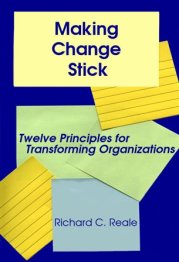
Making Change Stick: Twelve Principles for Transforming Organizations by Richard C. Reale

Making Change Stick: Twelve Principles for Transforming OrganizationsTwo figures stand out when reading this book: twelve and twenty. What do they have in common? The same man, Richard C. Reale. For twenty years, he’s studied why change fails and why it succeeds. Then he boiled down his knowledge base into twelve principles that are absolutely necessary if change is to happen correctly and last in an organization. The amazing thing is that these principles will not only ensure the success of a transformation, but will pay dividends in the long run, by having made an organization more change-capable.

So what’s missing? What’s causing organizations to fail when implementing change? The most common reason is the “failure to consider the human side of change.” It’s easy enough to draw the roadmap. The hardest part is the execution, the fulfillment of that plan. If you don’t believe it, just look at the last time you resolved to do something. What was harder: making the decision and putting some thought into how to best achieve it, or actually doing what you planned?

The twelve principles outlined in this book allow organizational leaders to focus on the people, and to empower them to bring change to fruition. It’s about setting down the right process for change, and following along closely, making sure change is proceeding as planned. It’s about walking the talk, and encouraging people to do the same by praising their efforts to change, and setting them up for success. It’s about monitoring the right metrics, the ones that will tell you how you’re really doing. In theory, it doesn’t sound hard, but in practice, it’s another story. Fortunately, the author explains every one of the twelve principles in detail, and the examples he gives clearly illustrate the point. Inspirational quotes from notable personalities are also provided, to help drive home the point.

This book is a wonderful resource. Twenty years of “on-the-job” experience can’t be wrong. The author’s expertise shows, and will help guide the book’s readers toward that great goal of organizational change, which is a hard goal to achieve indeed. If individual change is hard, organizational change is orders of magnitude harder – but this book will show you how to do it successfully. Get it, and achieve lasting change!
Standard
Thoughts

Restoring planes is one expensive hobby

Paul Allen, one of the Microsoft co-founders, turns out to have more up his sleeve than the X Prize, although it’s related to it. He loves restoring old war planes. I’m not talking about painting them up so they can be placed in a museum, I’m talking about getting them up in the air! Just the idea sends shivers down my spine. I’d love to see a 1918 Curtiss Wright, or a Messerschmitt take flight, and he’s done it! What’s more, no expense is spared to restore them to their exact state when they were in flight, with the same materials and look. This is amazing restoration work, and it’s also very costly, bringing the price to hundreds of thousands of dollars per plane.

He’s purchased about three dozen airplanes since 1998, and about half of them are on display in two hangars at the Arlington airport outside Seattle. Once a year, he holds a flight day, where these old planes take flight for a public audience. His collection is open for viewing on Fridays and Saturdays, and the fee is $20. Definitely worth it!

Standard
Thoughts

The Internet is not a truck

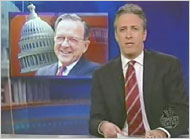
You may or may not have heard about the serious gaffe on the part of Senator Ted Stevens (R), who is Chairman of the Senate Committee on Commerce, Science, and Transportation. He voted against the Net Neutrality Act, and gave a speech on the Senate floor to explain his actions. He may have been better off not saying anything.

By giving this speech that keeps on truckin’, Senator Stevens has shown that he wasn’t knowledgeable enough about the issue to even speak about it, much less vote on it. It worries me that he’s in charge of a committee charged with deciding on matters as important as science, commerce and transportation, when his understanding of the Internet is that it’s a “it’s not a truck, it’s a series of tubes” that can get “clogged up”. I wonder which telecom lobbyist fed him that analogy. At any rate, the aftermath of the speech is haunting him, and one of the funniest takes comes from The Daily Show’s Jon Stewart.

I am reminded of an Abraham Lincoln quote: “Better to remain silent and be thought a fool than to speak out and remove all doubt.”

Standard
Thoughts

Someone's reading your email at work

This is a bit of old news, but the NYT is running a story on how companies read their employees’ email at work. The bottom line’s worth repeating, because people just don’t seem to learn: don’t use work email for personal messages!

I say this from experience. I’ve been an IT Director twice in my career, and I read people’s emails on both occasions. I didn’t and I don’t relish it – as a matter of fact, I hate it. But I had to do it, in order to see if activities that could incriminate or damage the organization were taking place.

Now I understand that my IT policies were actually pretty relaxed. I didn’t read email all the time, only when someone or something aroused my suspicion or that of the executives, and it was then that I went searching for evidence. I understand that in other places, this sort of a thing is automated, and happens routinely. Every email going out of the company is either scanned by a machine for keywords, or read by an employee, or even worse, every piece of email, internal or external, is scanned and flagged for further review as needed.

People, learn from this! It was not seldom that I stumbled onto emails where employees were flirting with each other at work, or talking about their supervisors in demeaning language. These sorts of things result in disciplinary action! If you’ve got to talk about those things, get a personal email account, and do it there, but don’t use company email for that sort of a thing! But I guess if you’re ignorant enough to badmouth your boss with a co-worker while you’re at work and supposed to be working, you’re ignorant enough to talk about it on company emails that can and will be used against you.

It’s time people realized the whole of their work activities is a permanent record, and this includes emails, and pretty soon will likely include voicemails. Make sure your email record is squeaky clean, and reflects your work ethic. If you talk the talk, walk the walk! If you say you’re a professional, let your email reflect that. Ask yourself this: if someone were to go through your work email now, would you be ashamed of what they’d find there? Is there something you could be disciplined or lose face for? If you work in a company that deals with secret/classified information, are you leaking company secrets, knowingly or not? If there is, cut it out! Put a stop to it! It won’t do any good to go back and delete emails, the company probably keeps a backup of the messages anyway. Just change your behavior and move on.

If you must get personal emails at work, use your personal account, or get a free webmail account from Gmail, Yahoo or Hotmail, and check that. Tell people to SMS you on your cellphone instead of emailing you. But for goodness’ sake, and for the sake of your career and bank account, don’t use your work account! It’s just plain dumb.

Standard
Reviews

The Fog of War (2003)

Just saw The Fog of War (2003), a documentary of Robert S. McNamara’s time as US Secretary of Defense, and was blown away by the behind-the-scenes look at what goes on during troublesome times. What strikes me is how lonely, how isolated, these people who hold key positions of responsibility must feel. Sure, there are plenty of people advising you, but in the end, if you’re the one making the decision, it’s an utterly heavy responsibility that is solely yours.

How do you decide to kill 100,000 people, or even less than that? Could you live with yourself afterward? Can you make a decision like that even when there’s a chance the data is faulty and/or its interpretation is wrong? How many politicians currently vying for top spots would be ready to make these decisions? Do they know that’s what they might have to do? Do they know everyone else around them will fade into the background and the decision will hang, like a millstone, around their necks? When do you decide to cut the cord?

I’m also impressed by the need to be more forgiving of the decision-makers of today. I can’t imagine the pressures of power have changed. If anything, they’re even more stressful nowadays. Yet so few people take the time to understand the issues before they start criticizing. I’ve been guilty of it myself. Robert S. McNamara makes a very good point in the documentary. One of his principles is that you should empathize with your enemy, in order to understand him. I’m not saying politicians are our enemies, but I think we should take the time to really understand where they’re coming from and the situations they’re facing before we, too, declare war against them, and yell for a change of office. The fact is, everyone makes good and bad decisions, and when the pressure of office is on, it’s even harder to sort through all of the conflicting information and do what’s right. You’re going to get some things right, and some things wrong, no matter what. We’re human, and we err. We can’t trust our senses and our perception of events is often wrong. It’s a wonder we don’t mess up more often.

What’s also true is that war as we know it is no more. It’s been evolving into some shapeless mass that rears its ugly head here and there, only to disappear before we can bonk it on the head and dispatch it. The frontlines of war are non-existent. We can no longer point out the enemy by their uniform, and Iraq is a perfect example of it. I say this because some people say there are plenty of “lessons learned” that could be applied. Perhaps, in some aspects of war, they prove useful. But when war has changed so much, and we still don’t know our enemies like we should, can we fault our leaders for making the wrong decisions? A lot of criticism out there is mere political posturing. We, as responsible citizens, should do our homework before we pick up the next critical catchphrase and hurl it at whoever’s in power.

I’m left with a feeling of surprise after watching the movie, and it’s because of this: political and world events are so complex, and wars are such ugly beasts, that I’m amazed we haven’t bombed ourselves out of existence yet. I’m thankful that calmer minds have prevailed, and that we’re still alive.

Standard