Thoughts

Rampant piracy in Romania

Not sure if you know this, but Romania is a virtual no man’s land when it comes to movies, books and music. Romanians often get to watch movies before they’re in theaters in the US, and there’s a large loophole in Romanian copyright law that makes it nearly impossible to prosecute those who break the law and share digital copies of movies, books or music online.

I consulted with our IP lawyer, and the gist of it is that in Romania, you’re allowed to make a copy of a “book” for “private, home use”. But since there’s no reference to movies or music or anything else in the law, courts extend that same privilege to them. And by “copy”, the courts have come to understand digital copies as well. As long as you don’t charge for them, the courts consider them “private” copies. So that leaves the door wide open for all uninformed (and informed) people to share “private copies” of movies, music and books all over the net.

Back in 2009, I wrote an article about software piracy in Romania, explaining that when software costs $300 to buy (i.e. Windows), a typical Romanian won’t be able to afford it, because that’s their monthly salary. My advice back then, to those who wanted to do the right thing, was to look at Ubuntu, which is free, friendly and completely legal. Now I can add OS X to the list. At $29, it’s certainly affordable for a Romanian, and for the tech savvy people, it shouldn’t be too hard to put together their own Hackintosh. Although not entirely legal, as pointed out in this comment, it’s still a better alternative to running a pirated copy of Windows.

Something I cannot condone though is the piracy of books, movies and music. Their price is affordable to the typical Romanian. A book costs somewhere between $10-30, often even less than that. A movie can cost anywhere from $1-5 to rent and $5-20 to buy — or you can subscribe to Netflix and watch all the movies and TV shows you want for $7.99/month. Music costs $0.99-1.99 per song. There is no excuse for stealing these. Most anyone can save 20-50 RON in order to buy a book or a movie, if they really want it, and anyone can most definitely spare 3 RON to buy a song. And yet, most Romanians don’t. They willfully elect to download pirated movies, music and books whenever they can.

When did it become acceptable to steal something just because you can’t afford it? If you can’t afford it, then you can’t have it. Save up for it and get it later, you’ll appreciate it a lot more than if you steal it.

Want to hear the sad part? It’s not the poor Romanians who are stealing books, movies and music. No, it’s people who have the means to buy these things in the first place, who could afford to part with a few RON in order to get the latest song from their favorite artist, or to see the latest movie. Their lame and legally/morally invalid excuse is that the artist/movie studio/writer is already rich or that everybody’s doing it, because society’s progressing and the old ways no longer work. Which old ways would that be? The need to pay for a service or a good? Well, when I can pay for my utility bills or my mortgage with a movie I downloaded from a torrent website, that’s when we’ll talk about the old ways no longer cutting it.

Since when did someone who has no idea about the hard work that goes behind making a song or a movie or writing a book and getting it published, get to make a judgment about the artist’s financial health or about whether or not it’s okay to steal their work? When did it become okay to steal? This is tantamount to stealing a piece of clothing from a store, or a chocolate from a supermarket.

These same people who complain they have no money then go out and eat at restaurants, they have vacations at sea side resorts, they spend their weekends in the mountains. That is hypocrisy. Ever since my wife and I came to Romania, I keep hearing there’s a financial crisis going on, and everyone’s complaining about how little money they’re making, but whenever I travel the country, mountain resorts are full, seaside resorts are booked up, restaurants are full, coffee shops are full, marketplaces, supermarkets, stores and malls are full of people, everyone’s barbecuing, there are tons of cars on the streets, and money’s flying left and right. Where’s the financial crisis? 

I don’t care if the law’s not up to snuff, stealing’s never okay. Romanians always brag that they’re good Christians. If they were good Christians, they would know the eighth commandment says, “Thou shalt not steal.”


Standard
Thoughts

Gotta give them something to do

It’s easy to decry TV, movies and sports as nothing more than a time suck, as a constant push toward looser morals and a consumer culture, but they also provide a benefit that’s not often discussed — that of giving people something acceptable to do with their time. Among other things, they redirect energy that would be spent on real life behaviors into vicarious behaviors, and in some ways, that’s a good thing in today’s world.

You look back through recent history, and you’ll see that as societies became more civilized, people distanced themselves from nature and segmented their existence not only in terms of time but also in terms of space. When economies were based solely (or mostly) on agriculture and crafts, people had plenty to do all day long. Life and work followed a natural cycle, and they intermingled. (You see some of that these days with telecommuting.) People had homes, and they had land, and they worked on that land and around their homes all day long. They put in long hours during the spring, summer and autumn, and relaxed during winter, at home with their families. Nowadays, very few people still live on that cycle. Most people have office jobs and live in apartment buildings, particularly in the larger cities where the costs of owning a home are prohibitive. When they get home at night, what’s there to do? Little, really. When you have an apartment, what are you going to do? Stare at the walls? Vacuum the floors? Re-organize your sock drawers? I suppose that’s how the need for mass entertainment developed, first with sports, then movies, then TV. When you have (roughly) five hours of free time per day, you’ve got to spend it somehow, so why not become a sports fan, or why not watch movies or TV?

As one follows the progress of their favorite sports team or TV show, they live in that world, through those characters or stars, and experience the highs and lows of that microcosm. Some would say that’s a form of population control, of dumbing down the population, of occupying their time with nonsense so they don’t wake up and start something. In some ways, it is, but it’s also needed. What would people do with the energy and time they spend on sports and TV if those outlets didn’t exist? Some would spend it in positive ways — with their families, on books, arts, hobbies, games, newspapers, trips and the like — and yet others (and this is a number that can’t be quantified) would spend it in negative ways — and the variety of those ways is something that would boggle the mind. For that group of people, the fact that they spend their time in front of the TV or in the stands, cheering for their sports teams, is undoubtedly a good thing.

So, beside the fact that there are very real benefits to TV networks and advertisers as more people tune in to see TV shows and sports matches, or to movie studios as more people go to see their latest creation, or to sports teams when fans fill their stadiums, there are arguable benefits to be gained for society in general as more people tune out the outside world and turn on their TVs. The issue is clearly more complicated than that, and I’m oversimplifying things, but I wanted to point out this particular aspect. It’s but one view among many that can be taken when you talk about this subject. The more I think of this, the more I realize its complexity can’t possibly be explained in a single post, so don’t expect an overarching conclusion here — just an observation.

Standard
Thoughts

The pain and importance of communication

During the past several months, I’ve had to work with people much more than before, and I learned a few things, one of which is the importance of communication.

Ligia and Raoul, talking

It’s one thing to sit in front of the computer all day and communicate via email and the occasional meeting, as it happens in IT work, and it’s quite another to only do it in person, face to face, explain concepts and ideas, try to get your vision across, then see how well others understood and delivered on the stuff you needed. More often than not, I’ve been disappointed, but I’m told that’s par for this course.

So where does communication help?

Where there’s tension, it helps deflate anger and potential conflict. I’ve been in situations where the tension had built up so much the hair stood up on my back and I was ready to punch someone, and yet if we were able to communicate rationally for a few minutes and hash out the various problems that we faced, all of that pent-up anger literally melted away. Of course, if the other person can’t communicate rationally, that’s another story altogether…

I can’t overemphasize the importance of communicating with each other as you work on a project with other people, particularly when it’s new territory for either one of you. Most people aren’t good communicators. They’d rather just do their work, but if they’re not taking the time to understand what it is you want them to do, being faced with an end result that differs from your expectations can lead to bad situations all around. So what I’ve had to do is to initiate communication most of the time, and to get these people to explain to me each stage of the work they were doing, several times a day, just to make sure they’re on the right track.

In the past, when I worked on IT projects, I had to do the same thing sometimes, but more often than not, I got too frustrated with the capabilities of others and brushed them aside, preferring to do the work myself, knowing I could do it faster and better. That wasn’t possible this time. I’ve been involved in construction/renovation work, and even though I could do the work myself, I couldn’t allow myself to do it because I needed to get results on a tight schedule. Doing things myself would have meant pushing deadlines into the future, and that wasn’t an option. The teams I worked with could deliver the stuff on time, but I had to make sure we were communicating properly. It was a real challenge, and I gained a new-found respect for general contractors and project managers. It’s very stressful and exhausting to work on construction projects and ensure everything gets done according to plan and to your vision when you’re dealing with people. Unfortunately, until we invent robots that can do all manner of construction work to spec — and I doubt that’ll ever happen — that’s what we have to work with.

In IT work, if something isn’t right, you can go back in and change things. You erase or modify the code, re-adjust the software options, etc. You’ve only wasted time, not materials. (Yes, you can also waste resources and others’ time, but let’s not bring that into the equation for this analogy.) In construction work, you not only waste time, you waste materials, and that can really add up. There’s also the painful cost of tearing down stuff that wasn’t built right and starting from scratch, and you pay for this in more stress.

So yeah, communication is vital, but there are some serious flip sides to it.

I’ve found out that you can still be misunderstood and judged even when you do your best to communicate as much as possible — and here I’m not talking about construction work, but life in general. Your every action can be perceived as the opposite of what you meant it to be. You’ll try to help someone else and they’ll think you’re trying to hurt them. You’ll do a good deed and it’ll get mocked or your kindness will be abused when others seek to take advantage of you. It is so painful to deal with this crap, and yet there’s no way around it unless you go live someplace away from everybody — and let me tell you I’m sorely tempted to do it.

There is so much potential in each of us to create, to do good things, lasting things, beautiful things, to achieve lofty goals working in harmony, but we’re stuck using language to communicate what’s inside us. There’s no better way to transfer information and ideas between us. Unfortunately, words can be sorely lacking in the power to transfer information and vision, in most situations where it’s really important for them to convey that. And yes, this is coming from a writer, someone who loves using words. It’d be so much easier if we could communicate what’s in our hearts, unequivocally, when we needed to do it, so there would be no doubt in the mind of the other person of what our true intentions really are. Of course my vision is somewhat utopic. After all, many people simply don’t aspire to do good things. Their goals stop at the ordinary or downright sordid aspects of life, and you can’t do much good with those people. You’re better off avoiding them, unless you welcome extra stress in your life.

I suppose one antidote for all this pain caused by living and working among people is to not care. By this I don’t mean we should be callous. I mean we shouldn’t care what others think of our actions or of us. We should stand rooted in our morality and do what we know is right, treat others the way we want to be treated, and let others think what they will of us. As long as we’re true to our own moral compasses, nothing else should matter. Right? But somehow it does, doesn’t it? And it’s so damned painful, too.

Standard
Reviews

Life Inc – another perspective on today's society

Douglas Rushkoff Douglas Rushkoff, an award-winning writer, documentary filmmaker and scholar, has written a book entitled “Life Inc”, where he delves into what he calls the “corporate mindset” of today’s society, and how to overcome it in order to make our lives and our world better.

I’ll let him tell you what the book is about in his own words:

“What I started to do was to look at the different ways we as modern Americans have become disconnected from one another, disconnected from the places we live, disconnected from the value we create, and even disconnected from our own sense of self-worth. I came to the conclusion that corporations, or what we call the corporate mindset, were really at the center of this phenomenon.”

“We’re living in a world where if you want to make money, you’ve got to work for a corporation.”

According to Rushkoff, it turns out this “corporate mindset” can be traced back to the Renaissance, which is when kings began to monopolize on the income created by people. Instead of letting them trade freely among themselves, they created charter corporations which had exclusive control over certain industries. The kings got shares of stock in those monopolies, thus income, and those companies got to make all the money there was to be made in those markets. This centralization of power continued right through to our own time.

“The society built through the Industrial Age was built to mythologize the mass-produced object, because we needed to create a society of consumers who thought buying all of this stuff would somehow make them happier.”

“Most of us spend so much time working and consuming that we have very little time left to do anything that has to do with other people.”

“The more we behave as individual actors in competition with one another, the harder it is to encounter one another in a friendly way.”

“People can start investing in one another and with one another, make their towns better, and earn returns that you’re not getting from your Smith Barney broker… and see the return of your investment in the place you actually live.”

“This [economic recession] isn’t just a crisis, it’s an opportunity. It’s the first moment in the last couple of hundred years that we’ve had to rebuild our society and our economy on principles that serve humanity instead of killing life.”

I agree with most of what he has to say, and it’s important to realize he’s not against corporations per se, but against the slow creep of the corporate mindset into everyday life. After all, it’s thanks to corporations that we have industrial design, which allows us to get products designed to exact specifications and high standards. And the concentration of capital and research at some corporations and organizations has resulted in amazing advances in technology that have benefited all of us. Yes, you can do a lot of things in your garage, and you can get a lot of stuff done with your neighbors and in your community, but you can’t build a highly sophisticated computer, digital camera or a modern car at home. (You might be able to assemble them from purchased parts, but those parts were made in factories, too.) There is plenty of value to what he has to say, and the book warrants a close read. We do need to become more human, more connected, more dependent on our communities.

There’s a 9-minute video summary of the book at his Vimeo account. He’s also posted video clips summarizing the main ideas of each book chapter there. I’ll post the main video summary and the first three clips below. There’s also more info on his website at rushkoff.com. You can get the book from Amazon.

Life Inc. The Movie from Douglas Rushkoff on Vimeo.

Life Inc. Dispatch 01: Crisis as Opportunity from Douglas Rushkoff on Vimeo.

Life Inc. Dispatch 02: Insulation Equation from Douglas Rushkoff on Vimeo.

Life Inc. Dispatch 03: Money as Debt from Douglas Rushkoff on Vimeo.

Standard
Thoughts

This is why I dislike tests

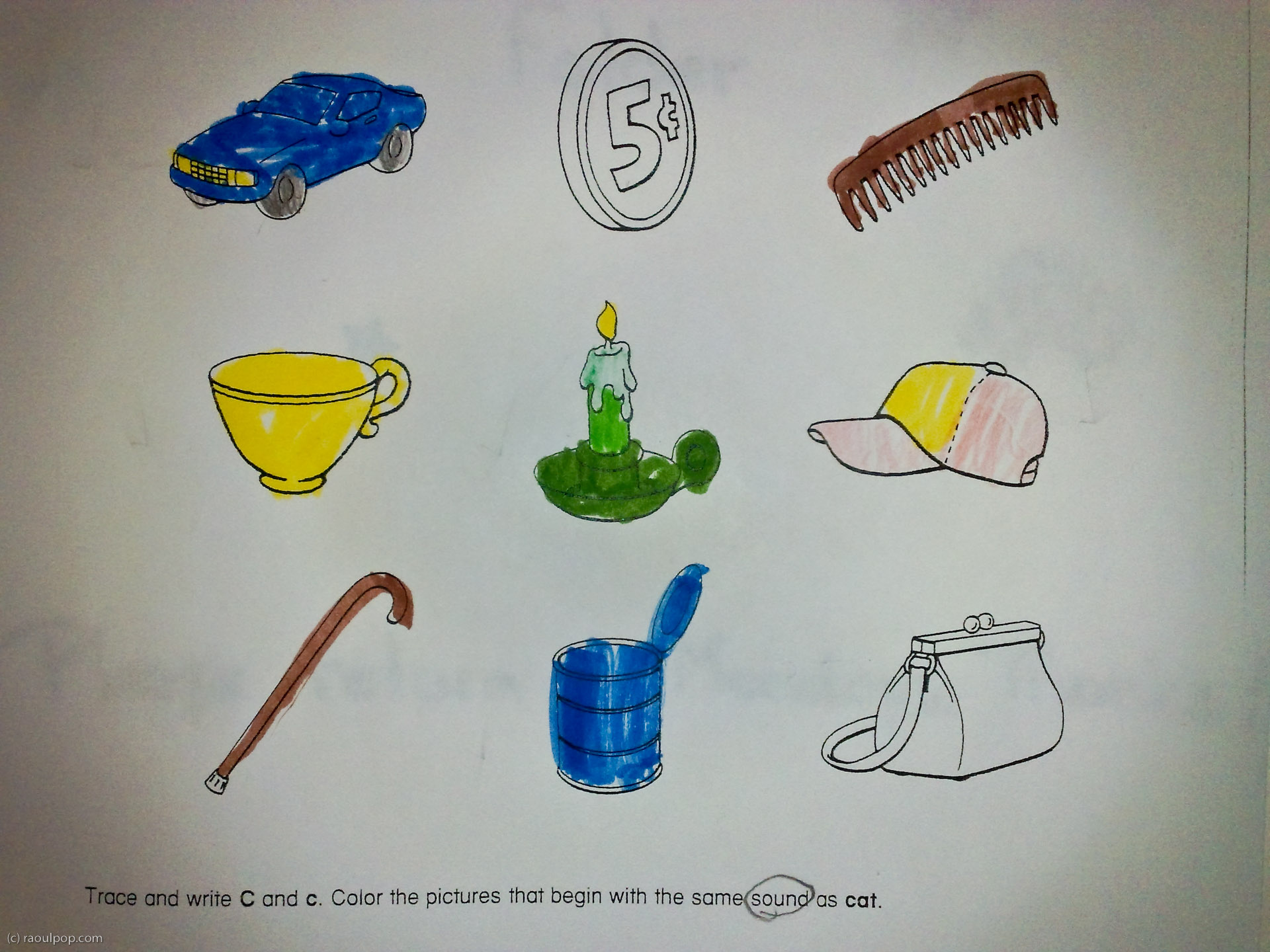
A couple of evenings ago, we were at our friends’ home, and I helped their daughter with her homework. She’s in kindergarten, and they’re teaching them how to read. One of the homework questions helped to re-awaken my dislike for tests. You can see the question below, I took a quick photo of it.

My beef with things like this is that there are usually multiple answers to a question, depending on how it’s interpreted. Unless you phrase it clearly and objectively from the start (which doesn’t happen very often), you’ll always have students that get it wrong, because not everyone thinks the same way. While in college and in graduate school, I’d often find myself at a crossroads when it came to answering many test questions; I’d come up with two or more different answers, all of which would be valid answers depending on how I interpreted the question. I’m fairly certain that some professors still remember my arguments with them on matters like these, and my insistence that my answer was also right, if only the question would be looked at another way.

If we look at this particular question, we see that it asks the child to “color the pictures that begin with the same sound as cat“. Okay, it sounds innocuous enough, until you start thinking about what that means. Do they mean the “c” sound of the word “cat”, or do they mean the “ca-” sound from the word “cat”? I don’t know. No further explanation is given.

Our friends’ daughter told me her teacher wanted her to choose the objects that began with the same “c” sound, and proceeded to do so. You can see what she did above. She told me that’s what her teacher wanted her to do, and those were the choices that her teacher wanted her to pick. But if you judge the objects by the teacher’s own definition, you see that the teacher is wrong. After all, the 5-cent coin starts with the same “c” sound as “cat”, unless you choose to call it a nickel, in which case it doesn’t belong on the list. So does the coin purse in the lower right corner, unless you choose to call it a purse or a bag, in which case it also has no place on this list.

No, I think the correct way to look at it is to interpret the instructions literally, and to pick the objects that begin with the same “sound” as “cat”, which is the “ca-” sound. If we do that, then we can only pick the candle, the cap and the can. The cane is a close call, but I’d say it’s not the same sound as cat. (If we were from Massachussetts, then we’d also be able to pick the car, since we’d pronounce it the same way due to our NE accent.)

Do you see the real problem here? It doesn’t matter what the right thing is or what the facts are. It only matters what the teacher thinks is right, which in this case, and quite possibly in many other cases, is wrong. As long as you learn what the teacher wants you to learn, facts, reality and objectivity be damned, you’ll get good grades and you’ll get ahead in life. As long as you go along with the generally accepted answer, you’re okay. This doesn’t encourage creative thinking, and it doesn’t encourage variety of thought; this is more or less brainwashing. This is why I dislike tests, and why I don’t like questions made up by others, particularly when they’ll only take one answer — theirs.

Standard