Places

Impressions from Walt Disney World – Part 3

This post is a continuation of my series on Walt Disney World.

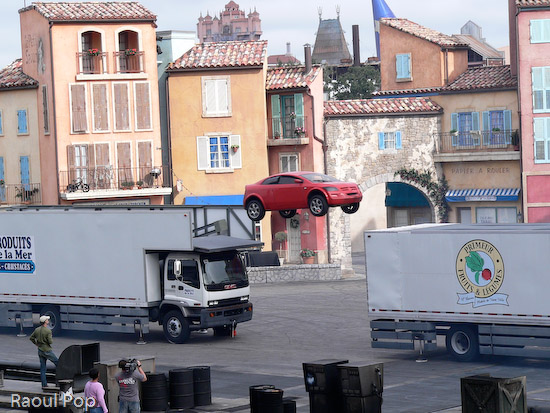
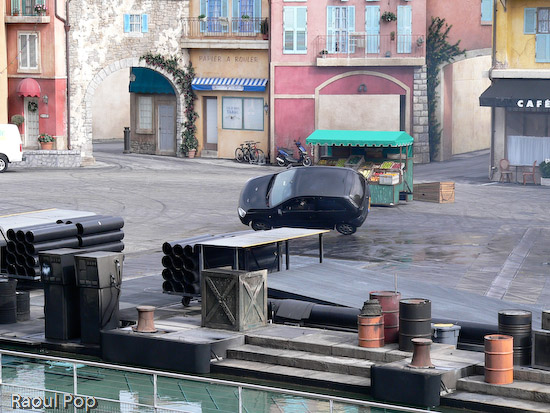
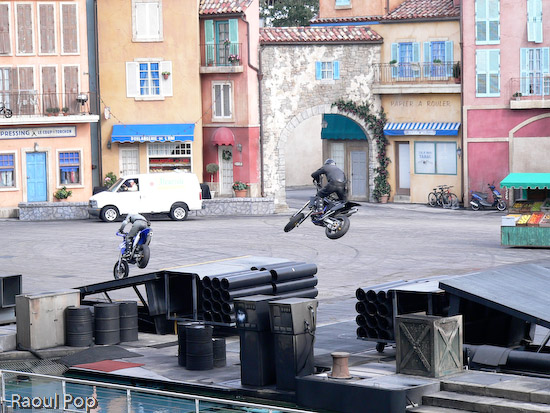
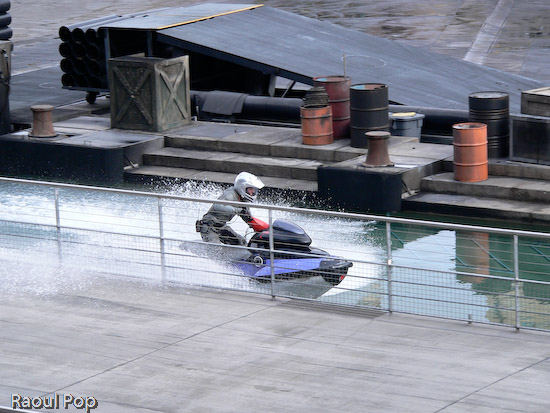
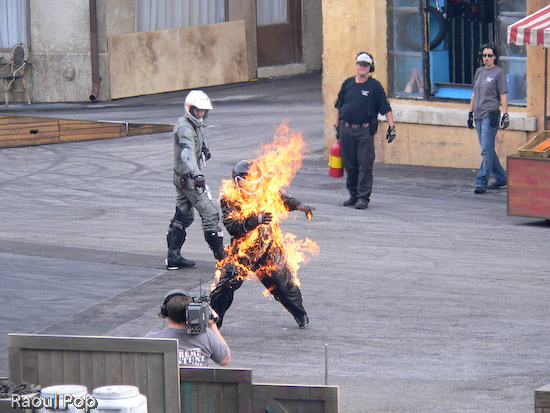
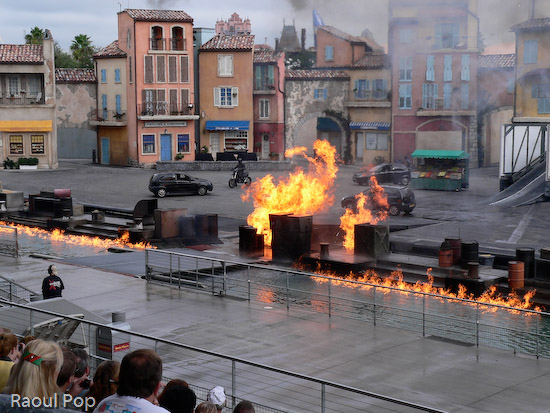
Lights, Motors, Action! is one of the shows at Disney MGM Studios. It runs only a few times a day, and it involves tightly coreographed action and stunt sequences with cars and motorcycles. The setup is that they’re filming scenes for an upcoming action movie. The truth is, they’re just trying to involve the audience a little more. I have mixed feelings about making everything seem like the movies, but I can certainly agree with this: the show and the stunts are great!

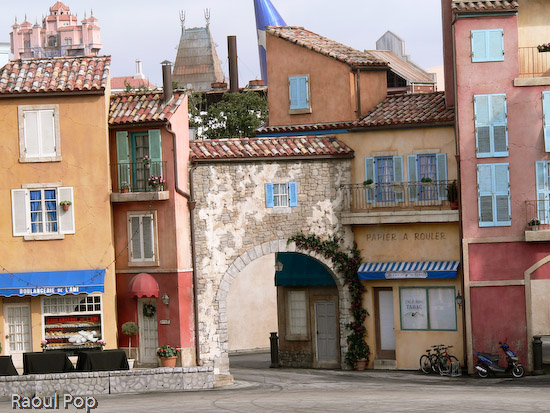
The set is built to resemble a small, Southern French town.

Marketplace

There’s an introduction, where the audience is told what to expect, then the stunts begin, with little breaks to allow the crew to set up the various scenes.

Hero and villain

Divide and conquer

Mid-air

Wheelie

Catch my drift

Jet-set

On fire

Finale

I understand the stunt drivers go through a set of tires in three days, and since the show began, they’ve worn down the pavement on the set by several inches, and it will need to be repaved. There’s also a surprise: you’ll get to see Herbie during the show!

Herbie

Standard
How To

World Electric Power Guide

Just stumbled onto a great site, which will help you make sense of the various electric power and receptable requirements in countries of the world. It’s called World Electric Power Guide. For example, do you know what countries use this plug/receptacle combination?

electrI.jpg

According to the site, it’s used in American Samoa, Argentina, Australia, China, El Salvador, Fiji, Guatemala, Kiribati, Nauru, New Zealand, Okinawa, Panama, Papua New Guinea, St. Vincent, Tajikistan, Tonga, Uruguay.

You can easily see how useful this becomes as you’re planning your trips to various countries.

Standard
Reviews

The Fog of War (2003)

Just saw The Fog of War (2003), a documentary of Robert S. McNamara’s time as US Secretary of Defense, and was blown away by the behind-the-scenes look at what goes on during troublesome times. What strikes me is how lonely, how isolated, these people who hold key positions of responsibility must feel. Sure, there are plenty of people advising you, but in the end, if you’re the one making the decision, it’s an utterly heavy responsibility that is solely yours.

How do you decide to kill 100,000 people, or even less than that? Could you live with yourself afterward? Can you make a decision like that even when there’s a chance the data is faulty and/or its interpretation is wrong? How many politicians currently vying for top spots would be ready to make these decisions? Do they know that’s what they might have to do? Do they know everyone else around them will fade into the background and the decision will hang, like a millstone, around their necks? When do you decide to cut the cord?

I’m also impressed by the need to be more forgiving of the decision-makers of today. I can’t imagine the pressures of power have changed. If anything, they’re even more stressful nowadays. Yet so few people take the time to understand the issues before they start criticizing. I’ve been guilty of it myself. Robert S. McNamara makes a very good point in the documentary. One of his principles is that you should empathize with your enemy, in order to understand him. I’m not saying politicians are our enemies, but I think we should take the time to really understand where they’re coming from and the situations they’re facing before we, too, declare war against them, and yell for a change of office. The fact is, everyone makes good and bad decisions, and when the pressure of office is on, it’s even harder to sort through all of the conflicting information and do what’s right. You’re going to get some things right, and some things wrong, no matter what. We’re human, and we err. We can’t trust our senses and our perception of events is often wrong. It’s a wonder we don’t mess up more often.

What’s also true is that war as we know it is no more. It’s been evolving into some shapeless mass that rears its ugly head here and there, only to disappear before we can bonk it on the head and dispatch it. The frontlines of war are non-existent. We can no longer point out the enemy by their uniform, and Iraq is a perfect example of it. I say this because some people say there are plenty of “lessons learned” that could be applied. Perhaps, in some aspects of war, they prove useful. But when war has changed so much, and we still don’t know our enemies like we should, can we fault our leaders for making the wrong decisions? A lot of criticism out there is mere political posturing. We, as responsible citizens, should do our homework before we pick up the next critical catchphrase and hurl it at whoever’s in power.

I’m left with a feeling of surprise after watching the movie, and it’s because of this: political and world events are so complex, and wars are such ugly beasts, that I’m amazed we haven’t bombed ourselves out of existence yet. I’m thankful that calmer minds have prevailed, and that we’re still alive.

Standard
Thoughts

Has your fish tasted funny lately?

Just found out from a Congressional Report that the US Military disposed of chemical weapons in the oceans from World War I through 1970. The report is frank about the quantities and make-up of those chemical weapons. It’s funny (in an ironic sort of way) how at first, they dumped them fairly close to shore, then, in 1970, they dumped them 250 miles offshore.

I wonder how many of those containers have already been corroded by the sea water, and how many will continue to corrode and release their poison over the years? And I also wonder how many other countries have been doing this, and when we’ll find out about it? Finally, I can’t help wondering what other dark and poisonous secrets we’ll get to find out about as the years go by… What’s been going on since 1970?

Standard
Thoughts

The world wouldn't be the same without Romania

This video will show you why Romania is a wonderful and inventive country. Yes, it was sponsored by some beer companies, but it’s very nicely put together, and the things it talks about are all true.

The subjects presented in the video are listed below in the order of appearance:

  • The invention of the fountain pen, by Petrache Poenaru
  • The invention of the cybernetic model, by Stefan Odobleja
  • Insulin, invented by Nicolae Paulescu
  • The first jet-powered aircraft, invented by Henri Coanda
  • The first History of Religions, written by Mircea Eliade
  • Defending four penalty strokes in a row – done by Helmut Ducadam, in the soccer World Cup of 1986
  • The second most spoken language at Microsoft is Romanian
  • The Maramures Gates – some of the most beautifully sculpted wooden gates in the world
  • Romanian girls are some of the most beautiful in the world – I should know, I married one!
  • The sculpture of Constantin Brancusi
  • Brancovenean Architecture
  • Baseball (its grandfather, anyway – the sport got started all the way back in 1364)

In case you’d like to learn more about Romania, ICI.ro has a great collection of illustrious Romanians right here. Use the link menu on the right hand side to brows by subjects like Geography, History, Politics, Culture and Tourism.

(Thanks, Cristina!)

Standard