
- Knight News Challenge: Round 2 Launches. The Knight News Challenge, in which winners get grants ranging from tiny to huge, is in its second year. It awards big money for innovative ideas using digital experiments to transform community news. The contest is run by the John S. and James L. Knight Foundation. Last year’s winners won awards ranging from $15K to $5 million. If you’ve got a worthwhile idea that’s news-related, by all means, submit it!
- ProBlogger.net has a great post that points out five WP plugins that can help with managing your comments and responding to readers.
- Brian Auer of the Epic Edits Weblog has a post on the differences between exposing for highlights, shadows or midtones.
- A couple of Russians put together a wry video where they demonstrate a new product, the Americanizer. Their English accent is a bit thick, so pay close attention.
- On the same blog, English Russia, you’ll find another post with HDR photos of the Moscow sewers. These are pretty well done, and I do believe I spotted a crocodile in two of them…
- The top tech blogs are revolting against Wikipedia’s “no follow” link policy by using the same rel=”no follow” tag in their outgoing links to Wikipedia. Alright! Wikipedia’s been getting a lot of link love for years, and I think they’ve been entirely ungrateful by not responding in kind.
- Sal Marinello, writing for BlogCritics, has a few words to say about the famed “300 Workout”, the physical regime that prepared the actors for their roles in that movie. A lot of people got it wrong. Also very worth checking out is the site of the physical trainers that put together that workout and trained the actors, Gym Jones. Have a look at the Video section. Very different stuff from what you see in gyms today, but you can’t argue with the results.
- Mental_Floss has a GREAT post on life before air conditioning. Why is it great? Because it points out why today’s construction is so horribly shoddy — our overreliance on air conditioning lets builders get away with using cardboard and plywood for what passes for homes in the DC area. The homes of old were built with thick insulation, out of stone or brick, and they could do just fine without A/C. If we’d be without A/C nowadays, we couldn’t live in our homes. Kind of makes me sad for all these people buying McMansions on River Road and Georgetown Pike and the like. I see the way they’re built, and it’s an insult to millenia of good building practices…
- The Daily Mail has an article on spotting illness by looking at our faces.
- On a similar note, Deputy Dog has a post on the 5 scariest medical mistakes. Don’t read it during lunch…
- Have you ever wondered about the 100 Inuit words for snow? Here they are.
- Hans Rosling gave a speech at TED this year, and they’ve posted it to their website. It’s really, really good stuff. You will not regret the 19 minutes spent watching it, I guarantee it. It’s about poverty and developing countries, but he’s got a very different take on things.
Yearly Archives: 2007
Lens review: Canon EF 24-105mm f/4L IS USM Zoom Lens
I’m going to talk about the Canon EF 24-105mm f/4L IS USM Zoom Lens in this review. It’s a wonderfully versatile L series zoom with surprising image quality and great image stabilization built right in. I’m also going to show you lots of photos I took with this lens, to illustrate the various points I’m about to make.
If you’re interested, I also wrote a comparison of this lens and the EF 24-70mm f/2.8L zoom. It might help you decide which lens to get if you’re interested in purchasing either of them.
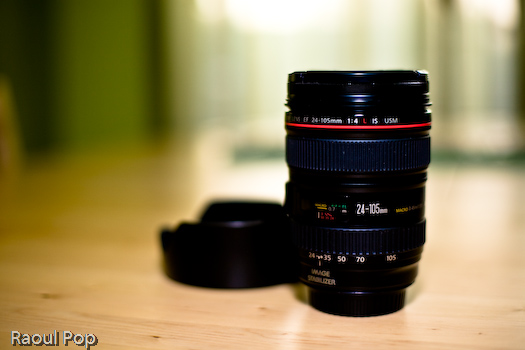
So, that’s the lens, right there on my table. It’s not as tall as my 100mm macro, but it’s also heavier, which is to be expected. There’s a lot more glass in zoom lenses. When you turn the zoom ring, the barrel extends outward. There’s some zoom creep, but that’s pretty much a “feature” on all zoom lenses I’ve tried, including other, more expensive zoom lenses.
I found its range to be just what the doctor ordered. At the wide end, the 24mm is great for landscapes or other interesting compositions, like you’ll see below, and at the tele end, 105mm is great for portraits and for bringing in distant details. Believe me, there’s a ton of difference between 70mm and 105mm when you’re trying to focus on some distant object. That extra reach is great! (By the way, I just dropped a hint in this paragraph. Did you catch it? It has to do with the 24-70mm f/2.8L zoom… There’s a review of it coming soon.)
The photo below was taken at 24mm after sunset, on a tripod.
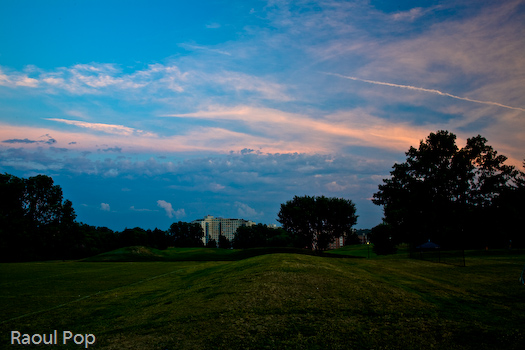
This one was taken from the same spot, but at 105mm. See how versatile the focal range really is?
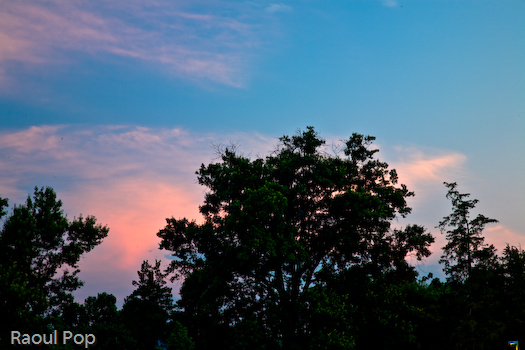
I mentioned something about interesting compositions at wide angles above. Here’s one:

I had doubts about this lens. After all, the 24-70mm L series zoom costs the same, yet it has no image stabilization and the focal range is shorter. How could a lens that packs in a longer focal range plus IS be as good as the other and at the same price? Let’s not also forget that Canon offers this lens as a kit lens for the 5D. Granted, it is an L series, but still… right? Well, prepare to be surprised.
I went to downtown Bethesda at night, and shot handheld, with the IS turned on. Keep in mind that the widest this lens will go is f/4.
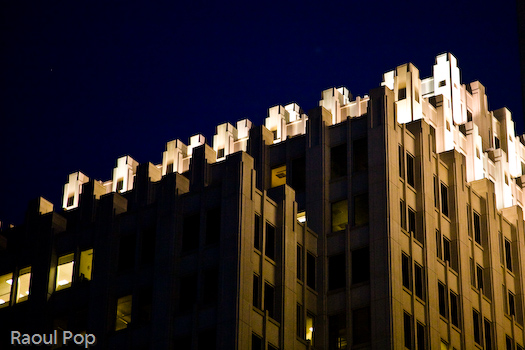
The photo above was taken at a shutter speed of 1/15th sec, handheld. At 1:1, those crenels are still sharp. But wait, that’s not all… The photo below was taken at a shutter speed of 1/8th sec — I propped my elbows on a balustrade to take it:
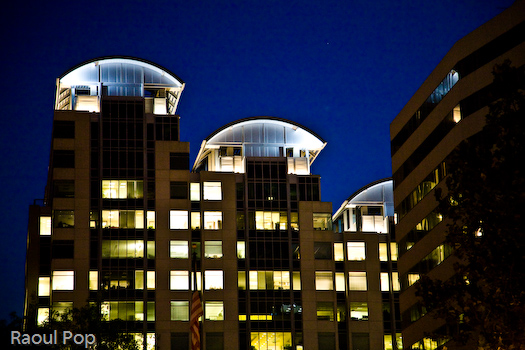
The details here are even sharper than in the previous photo. In my book, this means the lens is great in low light for a zoom. Nothing can beat my 24mm or 50mm primes at f/1.4, but there’s no mistaking the fact that the IS built into this lens does a great job of compensating for the smaller maximum aperture.
What about the contrast, sharpness and bokeh, you ask? Well, let’s look at a few photos:

The photo above was taken at close range, almost macro range. I believe I switched to manual focus when I took the shot. I was so close the AF stopped working. I did very little post-processing to the shot, and certainly didn’t alter the colors. The lens plus the camera did most of the work, including enhancing the colors present on that old barn. Having been there in person, I know the colors were more faded.
Here’s another photo taken at close range:

Look at the photo of the cat below. When I downloaded the photos from my 5D and looked at it, I was struck by how 3D it felt. The sharpness is all there, even at 1:1, the contrast is beautiful, the colors are great. That’s when it hit me: this lens is really good!

Let’s talk bokeh. Every lens has its approximate sweet spot when it comes to it. Stray from that proper distance to focal range ratio, and the bokeh looks all screwed up. Some lenses are better than others, and produce great bokeh across a larger focal range. I think this is one of those lenses. The bokeh isn’t entirely creamy, like you’d get with a fast prime opened up all the way — remember, it can only open to f/4 — but the bokeh’s there, and it does its job, which is to bring out the subject and fade out everything else pleasantly. Have a look at the photos shown below, and you be the judge:
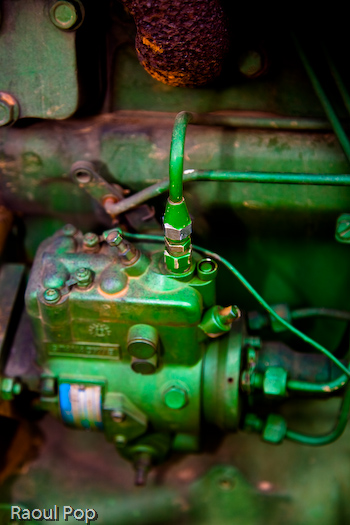


I really appreciated its versatility. I love my primes, but let me tell you, there’s nothing more annoying than missing a shot because I have to switch lenses. Primes are great for controlled conditions — nothing beats them there — but when you’re out and about, you don’t want to be futzing around in your camera bag, looking for your lenses, while your photo op passes by.
Have a look at these next few photos. It felt great not to have to switch lenses and still be able to take all of them.
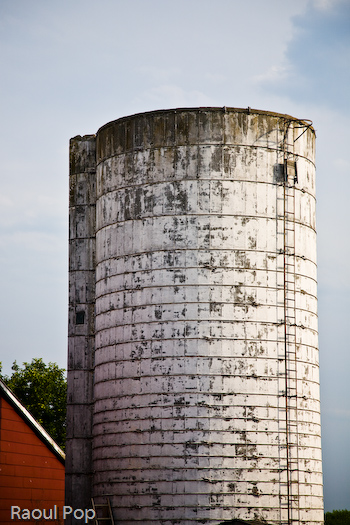


This is one lens that does not disappoint. It’ll likely stay on your camera body for 70-80% of the time. It’s an L series, so you know it’ll perform over a long period of time. It’s lighter than other L series zooms with similar focal ranges, and the image stabilization works just as I’d expect it. If you’re in the market for one, buy it.
You can find it at:

Talk of the Town (1942)
 This movie features two of my favorite actors: Cary Grant and Ronald Coleman. I thought I saw every one of the Cary Grant movies till I discovered this one at Netflix. When I added it to my queue, I had no idea Ronald Coleman was in it. Imagine my surprise when I started watching it!
Jean Arthur rounded out the cast. While I don’t much care for her looks or voice, I have to appreciate her comedic talents, which had me laughing the whole movie through. Her scenes with Ronald Coleman at the start of the movie are some of the best comedy I’ve seen in a long time.
The plotline goes like this: Leopold Dilg, played by Cary, is unjustly accused of burning down a decrepit old factory and supposedly causing the death of the foreman as well. Only things aren’t that way. Knowing he’s going to get a dud trial, he escapes from jail and hides in a house just outside the town. The house belongs to Nora Shelley (Jean Arthur). She agrees to help him hide out in the house, but unfortunately she has already rented it to Michael Lightcap (Ronald Coleman).
Lightcap is a distinguished professor and dean at an unnamed Boston law school. He arrives early, and hilarity ensues. Meanwhile, the town is whipped into a frenzy by the factory owner, who burned down the factory himself while in cahoots with the foreman. Leopold hides out at the house while disguised as a humble gardener, and works out a plan with Nora to convince Lightcap to take part in his defense. I won’t spoil the rest of it for you. All I’ll say is that we gave it five stars at Netflix.
It was a treat to watch these three talented actors carry scene after scene so elegantly. Cary looks a bit funny as the town activist. It’s always a odd to see him in roles that change the image we’ve come to know and love, even temporarily. I didn’t think I’d gotten so addicted to his classier roles, but there I was, wincing as he put on ordinary clothes. Grant’s darker side also comes through at the start of the movie, and for a few tense seconds, he’s so believable we’re not sure what to think.
The movie also makes a powerful commentary on social justice, and the importance of adhering not only to the letter but to the spirit of the law. The ongoing debate between Leopold and Lightcap throughout the movie serves to outline the differences between these two sides very well. I was glad to see true justice prevail, and to see Lightcap’s metamorphosis from dry scholar to lawman. The truly wonderful thing is that this commentary is all accomplished while the audience is kept laughing. That’s a testament to the great direction of George Stevens and the wonderful story by Sidney Harmon and screen adaptation by Dale Van Every, Irwin Shaw and Sidney Buchman.
More info:
Camera preview: Olympus E-3 DSLR
Olympus has been working on their new flagship DSLR, the “new E-1”, now called the E-3, for some time, and word is that it’s going to be launched later this year, possibly in November, or sooner. I’ve seen some concept photos of the new E-3 body, and it looks pretty sweet. They’re not the final version of the camera, but still, I think the E-3 will look pretty close to the photos you see below.
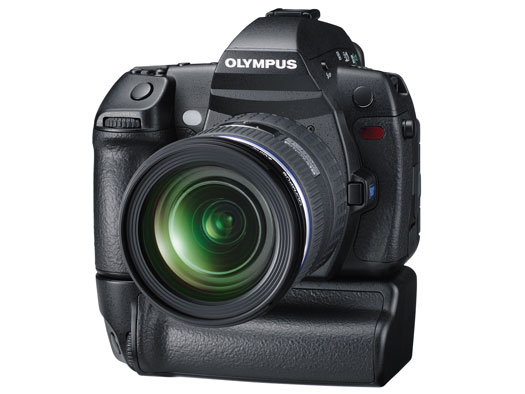
At the Olympus press event I attended on 8/1, I got to play with an old E-1 that belongs to Gene Hirschel of Internet News. The body was surprisingly light and sturdy, and I liked the various on-camera buttons that gave me direct access to functions like ISO, bracketing, white balance, etc.
I really liked the shutter action. It was unlike any other DSLR shutter I’ve tried. The movement was soft and made very little noise. It was muffled, but it felt great to keep pressing the shutter button. I took quite a few photos with it in the span of a few minutes. This is the body of the old E-1:

Have a look at the rest of the photos posted below and compare the existing E-1 body with what could be the new one. I’ll be very interested to test and review the new E-1 when Olympus launches it this year.
As you can see, the old E-1 came with a round eyecup, but the new one will likely get the more standard rectangular eyecup. The LCD screen will also be bigger, and quite possibly swivel out, since it will have the innovative Live View feature.
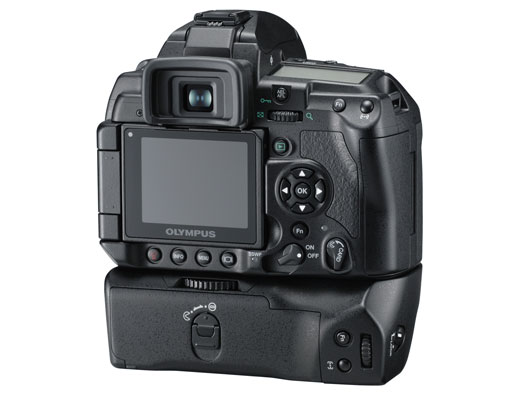
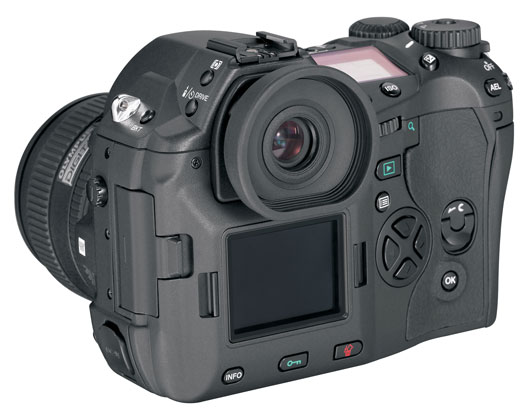
It also looks like the new E-1 will have a recessed function dial, like Canon DLSRs. I really do think that’s more useful than the fully exposed dial. Having it right there, next to your index finger, saves time, as you don’t need to take your hand off the grip to adjust settings. As a matter of fact, it looks like both function dials will be recessed, which is something I haven’t seen on other cameras. I also like the new On/Off switch.

I also spy an on-camera flash, which would be a new addition. The old E-1 had no flash, much like the Canon 5D. Personally, I prefer no on-camera flash. It’s always better to use an external speedlite, but I guess it is useful for most people to have a simple little flash they could use if they needed it.
All in all, I’m pretty excited about it. If it looks anything like the concept body in these photos, it should be a wonderful design.
Some interesting documentaries
Here are seven interesting documentary-type videos found on YouTube:
You’ve probably heard that Geek Squad technicians snoop around on customers’ hard drives and copy photos and other files for their own use. But have you also heard that they overcharge ridiculously for simple little repairs? Have a look below:
The metro bridge over the river Tyne at Newcastle, UK, was recently outfitted with LED lights that are programmed to never shine in the same sequence. The result is a mesmerizing light show that goes on and on:
Bill Crosby did a documentary in 1968 called “A Boy Like Me”, where he pointed out racial inequalities between black and white children. But he did it in such a poignant way that it’s really, really hard to miss the point. Watch this segment in its entirety, it’s only 3:28 minutes long.
The Falkirk Wheel is an advanced bridge for boats. It connects two bodies of water that are separated by a great height in a very interesting way:
Whether you may or may not agree with this first part of the documentary entitled “The Great Global Warming Swindle” (the other parts can be found on YouTube as well), I think you’ll realize it raises some interesting and valid points. I watched the entire documentary, and if you’ve got the time, I would encourage you to do the same.
The next video is pretty geeky in its approach, but it was made to demonstrate how IT security works for non-techies, and it does a great job of it. It’s entertaining, so you won’t get bored, either.
This last video is controversial, and I don’t know what to make of it. It’s actual news footage aired immediately after the crash of United Flight 93. It shows the crash site and surrounding areas, but the strange thing is that the place looks very much unlike a plane crash site. There are no large pieces of fuselage, no bodies, nothing — just a small hole in the ground, and that’s what makes it unusual. It just doesn’t look like a plane crashed there at all.
 Raoul Pop