Thoughts

The future is the past is the future

Back in late 2008, I heard of a technology that was touted as new: instant price matches, made available by scanning the barcode of a product in a store, through an iPhone app called Checkout SmartShop. I chuckled. This idea wasn’t new at all.

BarPoint

I worked for a company called BarPoint for a few months in 2000 or 2001, I can’t recall exactly. As you can see if you visit their domain name, it’s up for sale now. Back then, it was working just fine, and they were working hard to put together an online directory of products whose prices could be instantly matched from many stores. They even had gizmos with little barcode scanners you coud buy and carry with you to a store; they were little Palm PDAs outfitted with small add-on barcode scanners. These gizmos would connect back to the BarPoint servers via built-in dial-up modems, and would quote you prices from other stores.

BarPoint Wireless Devices

They had investors lined up, had cleared about two rounds of investing, had bonafide employees, etc. Unfortunately for them, it was the end of the dotcom boom. They were still burning through the cash and not generating any profits, because they didn’t get off the ground fast enough. I left as they started to cut employees. Other co-workers hung on through a company move from nice offices in downtown Ft. Lauderdale to a warehouse in Deerfield Beach (both in South Florida), and many efforts to revive the company. Things didn’t work out for them. You’re welcome to follow the site’s progress and slow death on the Internet Archive’s Wayback Machine.

What is obvious now is that they had two things going against them: the idea was ahead of its time, and the market crashed. Back then, this wasn’t so obvious. People thought the idea was cool and wanted to make it work. I thought it was cool and even thought they might somehow pull it together and start making profits, even after I left. I bought some stock in the company, only to watch its price sink to very near $0 over time.

The interesting thing about the iPhone is that it’s truly a game-changer. It penetrated the market quickly, and app development for it is so easy that you don’t need an army of people, like BarPoint did. You also don’t need to sell the devices, or worry that device adoption is reserved for a very small segment of the market. The iPhone is practically everywhere. I don’t even know if Kigi Software, the makers of the Checkout SmartShop, is a real company, or a dba name for one or two smart developers working from home. But that’s what’s cool about these times. The price for bringing an interesting product to the market is no longer prohibitive, like it was for BarPoint. Almost anyone can do it if they want to, nowadays. And the end product is something that kicks BarPoint in the rear quite effectively.

You simply enter the barcode into the iPhone using the numeric keypad, and you get instant price matches. Voila.

Enter UPCGet online price quotes

You can even find out where the product is being sold in other local stores, or read online reviews. It does everything the BarPoint product would have done if it could have gotten off the ground.

Get local storesGet reviews

Very nice indeed.

Standard
Thoughts

WordPress Stats plugin has gone cuckoo

For over a month now, I have been unable to rely on the official WordPress Stats plugin. (I say official because the folks that made WordPress also made this plugin.) It, all of a sudden, started assigning all site visits to the same article, so that all of my stats became completely skewed. Let me explain it with a screenshot:

WordPress Stats has gone cuckoo

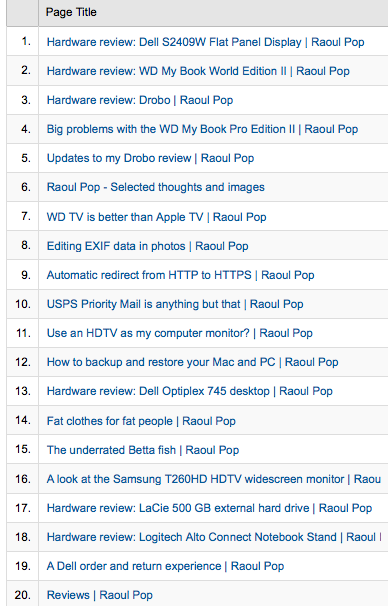
Instead of seeing the proper distribution of site visits by titles, which is what happened in the past, almost all of the site visits get assigned to a random post. I have no idea any more which titles get the most traffic for a given day. I know this is wrong because I’m also using Google Analytics. Here’s a screenshot of the 20 most popular titles for the past 30 days.

Google Analytics Content by Title

I like WordPress Stats because they aggregate the data almost instantly, whereas there’s a 3-4 hour delay with Google Analytics. Sometimes they even correct the data a day afterward (this happened to me recently) so you can’t rely on their figures until 24-36 hours after the fact [reference].

I stopped using WordPress Stats for a while, hoping the problem would somehow work itself out, but when I re-activated the plugin, all that happened is that it started assigning all site visits to a different random post. Whoopee…

If someone at WordPress reads this, please let me know if it’s something I’m doing wrong, or if it’s something that you’ve got to work out on your end. I posted about this problem in the WordPress forums, but I have yet to receive a reply there.

Standard
Thoughts

Pitch black darkness

Last night, the power went out everywhere. Completely. I happen to be staying in a village in the province of Dobrogea, Romania at the moment, and just as I stepped out of the house to walk to my car, all the lights blinked out of existence. It was, as they say, a dark and stormy night, with nary a star in the sky, not to speak of the moon, which had probably been stuffed in thick sackcloth and kidnapped.

Do you want to know what things look like when you’re in the middle of a wide open field and everything goes pitch black? It looks something like this.

Pitch Black Darkness

It’s an eerie feeling, one that throws you for a loop, even if only for a few moments. I looked around, but there was nothing to see. I reached about me, and wasn’t sure where to reach for a wall or something to hold on to. Everything was black. Even the dogs went quiet. Then, someone in a house nearby stumbled over something and mumbled some sort of swear, then called out for a light from his wife. Others, elsewhere, called out to each other. Things came back to life, but it was still pitch black outside.

I pulled out my little spotlight, the same one I reviewed recently, and found my way to the car. I unlocked it, and the interior lights came on. I climbed in, sat down and turned on the engine. The dashboard lights came on, reassuringly. Then I realized something which sounds obvious to someone who doesn’t have to deal with a power failure, but is a downright epiphany when you’re in pitch black darkness: cars have standalone electrical systems; they do not depend on the grid for power; they make their own power. When the grid goes down, your car can still run, thanks to its battery and to the fuel that makes its alternator turn and charge that same battery. It’s an amazing system when you think about it. I don’t know what we’d do without it.

Shouldn’t homes have similar standalone electrical systems, just in case grids go down? Sure, we’ve made inroads with solar panels and wind turbines, and some homes do have batteries that charge up from the sun or the wind, but the overwhelming majority of homes in this world don’t have any sort of backup power. If the electricity goes down, they’re down as well.

We should really invest more into making each of our homes more self-sufficient. Each home ought to be able to function, at least for a period of time — say 4-8 hours — without grid power, in and of itself, from power stored in batteries or capacitors or in some other container of energy, so that people can carry on with their lives and at least have enough time to prepare for a prolonged power outage once the grid power goes out.

Standard
Thoughts

Obama wants to increase airport security tax

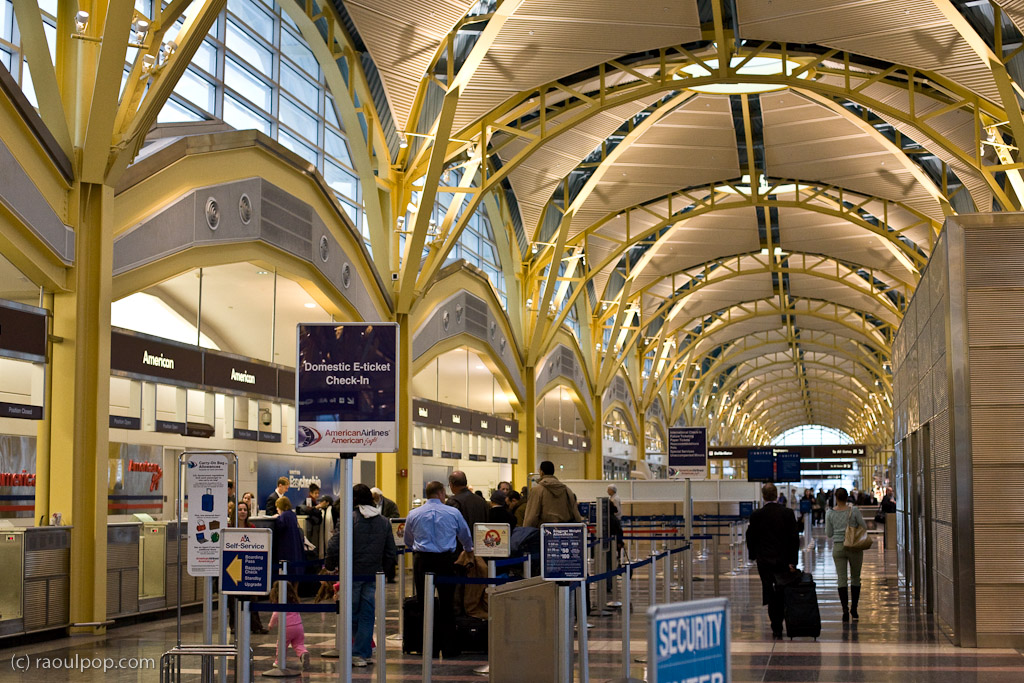
Waiting to check in

We’re currently getting charged $2.50 per passenger to go through the security theater* at our airports. Now the Obama administration wants to increase this fee. Quoting from this article at the Economist:

“The Homeland Security portion of Obama’s proposed 2010 budget (PDF) includes a plan to raise the fees by an as-yet-undisclosed amount in 2012. The increase, the White House says, is needed because the current fee only funds about 36% of airport security costs.”

So let me get this straight: not only do we have to go through the inane, annoying and useless experience of getting scanned, uber-prodded and turned over every time we want to board a plane, but now we’ll have to pay more for that unsavory experience as well? Thanks a lot, Mr. Obama. I can see my vote went to a good cause.

As I said before, I think we should be doing away with the whole darned thing. What happened to accepting the risk and moving on? That’s how the United States was founded and built. It wasn’t built by wimps who wanted to make sure no letter openers or nail clippers got on the plane with them. Why zap us with X-rays, make us take off our shoes, put us through air blowers to sniff us (I’ve half a mind to fart when I go through those things just to see what happens), open up our luggage, and generally speaking stink up the whole flying experience when we don’t really need any of it?

It’s shocking to hear that, isn’t it? Truth of the matter is we wouldn’t really need any of it if security were done right, and if people had the courage to step up and disarm the terrorists when and if they dared do something on a plane. Since the general populace is a bunch of pansies who’d rather have big-brother government do everything for them, now we have to put up with cretinous security checks and starting next year, with increased fees for said security checks. Hooray for democracy, where the majority rules with a pudgy, slightly damp and sweaty fist, tired from holding the remote control too long.

* Term coined by Bruce Schneier.

Standard
How To

How to minimize your risk of prostate cancer

A long-time friend who does research into complementary and integrative medicine and is a wiz with statistics — his name is John Lewis — has just published an article entitled “Intake of Plant Foods and Associated Nutrients in Prostate Cancer Risk” where he, along with other researchers, found that your risk for prostate cancer becomes significantly lower if your diet consists mainly of vegetables, fruits and/or fruit juices.

On the other hand, if your diet has an increased amount of protein — or, interestingly enough, daily servings of grains — your risk for prostate cancer is increased. Another finding of his study ties into the racial/ethnic differences in the incidence of prostate cancer, which happens to be higher in African-Americans. The study shows a strong link between dietary intake and the risk of prostate cancer. Caucasian controls had significantly higher daily servings of vegetables and fruits and/or fruit juices compared to their African-American controls, and their incidence of prostate cancer was lower. Thankfully, the study found that those who changed their diets significantly to include more fruits and vegetables stood a better chance of surviving prostate cancer, regardless of race or ethnicity.

The lesson to be learned is simple: eat your fruits and vegetables if you want to keep away prostate cancer.

I should mention that he is also a CFS (Chronic Fatigue Syndrome) survivor. He was bedridden for over a year because of CFS. He cured himself by changing his diet to include only vegetables, fruits, nuts and grains, by exercising regularly, and through special intra-venous vitamin boosters — a treatment called chelation therapy.

Standard