How To

Do you want to know how long your hard drive will last?

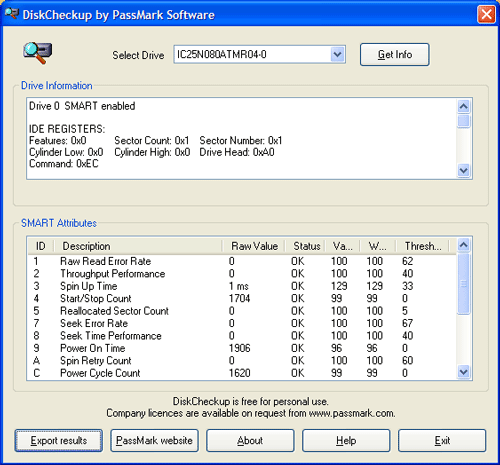
If you do, then use the DiskCheckup software from PassMark. This software is free for personal use and $15 for business licenses. Just download it, unzip it and run the DiskCheckup executable to get an instant report on the health of your drive. The software reads the data put out by the S.M.A.R.T. feature standard on most hard drives nowadays and can tell you through a simple to read report if it’s time to really back up the files on the drive and get ready for its demise. I ran a report on my laptop’s drive, and it passed with flying colors. I’m alright for now!

DiskCheckup Test Results

Standard
How To

Turn your doberman into a poodle

Hey, are you sick of tired of dirty looks from your neighbors, just because you have a doberman? Then you need the Poodle Disguise Kit for Dobermans!

The Poodle Disguise Kit for Dobermans

I kid you not. This site called attackchi put it together. It’s tongue-in-cheek, I’m sure, but it’s also in protest at what they say is the unjustified treatment of breeds like the dobermans, mastiffs, rotweillers, etc. – which have acquired a reputation for biting when in truth, all dogs can bite.

So, you want to see the fantastic kit in action? Here it is:

What the heck have you done to me?

Want to hazard what the poor dog’s thinking? I think it’s: “What the heck have you done to me? You think this is funny?!”

How about this lovely pic?

Mark my word: your day is coming soon!

I think it’s saying: “Mark my word: your day is coming soon!” And people wonder why dobermans turn vicious…

(Pics courtesy of attackchi)

Standard
How To

The mosquito ringtone

A while ago, I wrote about an inventor in the UK, who’d made a machine that emitted a very high-pitched sound and could be used to make loitering teens go away. Apparently only they heard the noise, and older people were unaffected. Well, the teens have now turned this around, and are using the same high-pitched, mosquito sound, as a ringtone for their cellphones. This way, teachers and other authority figures can’t tell when they receive text messages or calls on their mobile phones. 😉

If you’d like to hear it, just play it below. You can even download it if you like.

Standard
How To

How to hack Windows Desktop Search and turn it into a dictionary

If there are some of you out there using the beta version of Windows Desktop Search – you know, the one that imitates both Spotlight and Google Desktop Search – then you probably know it’s alright.

I’m amazed that Microsoft has actually turned out a usable piece of software that doesn’t crash. I like it because it starts finding documents as soon as you start typing (like Spotlight), and the search index is live, unlike the Google Desktop Search, which is time-delayed, and also contains bad entries for files you’ve moved or deleted.

When you search with WDS, you get the option to search your Desktop, or the Web. Well, there’s one huge caveat: don’t bother searching the web with the Microsoft Live Web Search, or MSN Web Search, or whatever the heck they call it these days. It’s downright pathetic, and if you’re using IE 7 Beta, it may even crash the browser. Fortunately, Google has come up with a solution. Just surf over to their main site, and within IE 7, you’ll get a JavaScript note (not window) in the top right corner of the web page, that will invite you to set your IE search engine to Google’s. Run the tool, and do that.

Now, for the fun dictionary hack. In the Windows Desktop Search bar (located in the taskbar), type the usual Google shortcut for searching definitions: “define:word”, then click on the Web button. Bingo! Now you’ve got your very own dictionary, neatly accessible right from the taskbar. Enjoy!

Standard
How To

When it comes to home computers, k.i.s.s. and forget it

I’ve been learning a hard lesson these past few weeks, as my parents go through a time of computer trouble, and since I’m the one who purchased their computer equipment and set up their network, it’s up to me to get things right again.

What’s the lesson, you ask? As encapsulated in the title of this post, and as I’ve been yelling it at myself in quiet moments, it’s: keep it simple. 

Here’s how their setup looks:

  1. Cable internet connection
  2. Wireless router
  3. Vonage box hooked up to router, in turn hooked up to phone w/ answering machine, and multi-function printer/fax/copier/scanner
  4. Same multi-function printer/fax/copier/scanner also hooked up to router because it’s networkable
  5. Older desktop hooked up to router, another printer through parallel port, and to the multi-function machine through the network
  6. Laptop with wireless card, using the wireless router, configured to the networkable multi-function machine through the network

Where should I begin? Gee, let me start with WPA. Why? Because that’s how I had their wireless router set up. And every time something happened with the connection, they either couldn’t find the passphrase, or for some reason the laptop’s card didn’t feel like connecting to the router. Lesson learned: ditch encryption, just set up MAC filtering. That way, they can connect on the go, and don’t have to bother with WEP or WPA, which is a real hassle unles you’re a geek. Plus, with MAC filtering, unless someone can spoof a MAC address, they can’t connect to the network. And if they can spoof a MAC address, there’s a good chance they know how to get in even if encryption is enabled. Yes, I know the traffic can be sniffed if the encryption isn’t enabled, but who cares? Even WPA encryption can be sniffed and decrypted with readily available utilities. So why bother with it?

As I banged my head against the wall, I rued the day I set up their multi-function machine through the network. Why? Because if you have to delete it and re-install the printers, or you have to re-format the OS (Thanks, Windows, for the crappy OS, and thanks, driver manufacturers, for the horrible, latrine-worthy job you do writing those drivers – for all devices, not just printers!) you can never find the machine on the network so you can re-configure it, and you spend hours re-setting it to factory defaults through the printer’s LCD menu, then hunting for it on the network. Have you ever tried to walk someone through a printer’s LCD menu when you can’t remember the options, and they’re not familiar with it? It’s not fun. Lesson learned: install through USB, and set up local printers.

Quick question: if you unplug your printer’s or computer’s network cables from the wireless router, can you plug them into the IP telephony router? I guarantee you your parents or friends won’t know the difference, and they’ll plug them into it, then wonder why they can’t get on the Internet or connect to their printer. Lesson learned: forget IP telephony devices like Vonage. It may be cool for us youngsters to brag about how we slashed our phone bill by switching to Vonage or just using Skype, but it’s not cool for your parents when they can’t receive phone calls or faxes. (Yes, I’m talking to you, Vonage, with your awkward and arcane programming steps (or rather, button dances) so I can get my printer to send/receive faxes through your connection! Forget that!) Just set your parents up with a dedicated fax machine, plugged into a wall phone outlet, then sit back and relax, because they won’t call about it! And it’s the same with the phone! Leave it plugged into the wall! Forget saving $5 or $10 a month just for IP telephony. It’ll cost you and your parents much more in stress when their phone doesn’t work.

When my parents lost data because their laptop crashed and had to be reformatted, I realized the value of setting them up with automatic, regular data backup, the kind that just works. You know, you don’t think twice about setting up backups in the server room, but somehow you think the data on your laptop or desktop will take care of itself… Unfortunately, Windows doesn’t come with an easy backup program. Lesson learned: buy a big external hard drive, and set up automatic, regular backup jobs to it. It’s preferable to get a drive that comes bundled with a backup utility. Have any of you used the Windows Backup utility? What a stinker! How do you edit scheduled jobs? First, you can’t edit their every aspect after you’ve created them, and second, who’d think to look under a completely different app, called Scheduled Tasks, to find them there? Really, would anyone other than a geek know that? Why in the world aren’t the jobs available for editing within the Backup utility? It’s just plain dumb design.

As I had to re-educate my parents about the various ways of doing things on the computer, I came to realize (duh!) that I should have spent more time training them at the outset. Yeah, it seems like a no-brainer now, but back when you’ve just spent a couple of days transferring all their stuff and settings from the old computer onto the new one, do you really feel like spending another half day training them on the new machine? No, you just sit them down in front of it, point out the highlights, and tell them to enjoy it! Well, you pay for it later. Lesson learned: spend time training the user at the outset – you’ll avoid problems down the road. And define simple pathways for them, stuff like:

  1. This is where you save your documents.
  2. This is where your email archive gets stored.
  3. This is how your email account is set up. Make sure the settings stay this way!
  4. This is how to back up your bookmarks.
  5. These are the passwords and simple access instructions for the firewall, router, computer accounts, etc.
  6. This is where the photos get stored. Use this application to manage them. Download the photos from your digital camera this way…
  7. This is where the music gets stored. Use this application to manage it. This is how to sync the iPod…
  8. This is where the videos get stored. Use this application to download the videos from your camcorder to the computer. Here’s a simple way to make a DVD from a video…

It’s stuff like this that saves you countless headaches. If you need to, make screen-capture movies and put them on a “how to” DVD for them. Or write instructions, with screenshots. But make it simple, or you’ll pay for it!

Finally, as I troubleshooted why the laptop kept crashing because of obscure driver errors (everything was up to date, and the latest driver versions were installed), I learned the following three things:

  1. Buy a good brand. Don’t get a cheap brand. My parents have an Averatec laptop. That thing clonked out from the start. It was supposed to be able to output video to a TV through an S-video port, and it wasn’t even able to do that. When I called Averatec support, their advice, right off the bat, was to reformat the laptop. Great, the panacea fix used by all lazy tech support people! Then, after the 1-year warranty expired, it started to crash unexpectedly, even though there were no viruses and no spyware on the computer. It didn’t have any weird applications installed, either, just mass apps like Office, Firefox, iTunes, Picasa. So, don’t buy Averatec.
  2. Get an extended support plan. Don’t get cheap when you shouldn’t! Get that support plan, and make sure it includes accidental damage coverage, as well. You’ll be thanking yourself when you have someone to call if the hardware goes bad, or you need help with the system.
  3. Don’t buy Windows. Sounds harsh, doesn’t it? But it’s true. People who aren’t geeks need a simple operating system that’s not fragile – one that doesn’t crash or is susceptible to hundreds of thousands of viruses and malware. Windows may be good for developers who are shackled to it by the work they do (like me), and it may work fine at the office, (where you have a Help Desk department, and you’ve got an industrial-strength firewall and anti-virus thin clients pushed out to all the client computers, with the latest virus definitions,) but it’s not good at home – not for people who are at a loss when they need to tell a bad file apart from a good file. The choice becomes pretty simple: Mac OS! Just get a Mac for your parents, or tell your non-geek friends to get one. Then, when they don’t call you to complain that it keeps crashing, you’ll get some time to pat yourself on the back.

I hope this helps you streamline your work as you set up your parents’ or your friends’ machines. I sure wish someone shoved this under my nose when I started to set up my parents with new computer equipment.

Standard