
I had an idea recently about a new faucet design. (If you’ve been reading my website for some time, then you may remember I post my ideas here — when I remember to write them down and don’t forget them.)
When you look at a shower, right after it’s been used, you’ll see the splash line is somewhere at chest or shoulder level. Very little water goes above that line, unless you’ve been monkeying around in there.
If you’ve also seen the pipes being put in for a shower, and the faucets also being put in, you’ll know that first the pipes have to be laid in the wall, then the tiles placed over them, making sure to leave two holes with the appropriate hot and cold water connections for the faucets. And these holes happen to be right at waist level, where it’s easy for most people to reach the faucets — and where most water also happens to splash.
What you’re essentially doing is piercing the water barrier (the tile or marble wall) with two big holes right where you throw the most water. If you’re concerned about water seepage into your wall, or if your walls already have water issues, then this isn’t the smartest thing to do. Plus, there’s a lot of mildew that accumulates around those two holes, and no matter how much silicone you put there, you still get mildew and overtime, you still have water seepage into the wall.
Behold my new faucet design, which does away with this problem. I scribbled it down on a piece of paper when I got the idea.
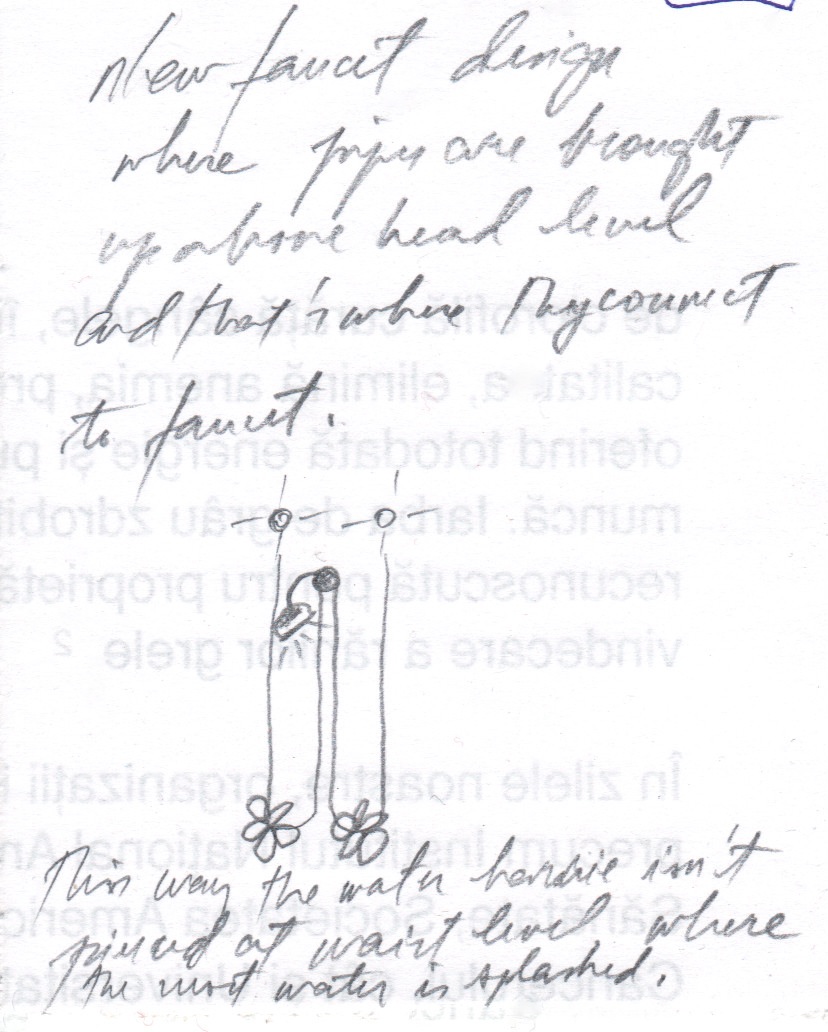
The point here is that the two faucet holes are brought up above head level, above even the shower head, where water is seldom splashed, if ever. The faucet design consists of its two attachment points at the pipes, with hot and cold water lines coming down, exposed, to waist level, where the faucets are located, then continuing upward to the spigot, where they unite (or they could unite down, in-between the faucets, then come up to the shower head as one pipe). The shower head can be included as part of the package, or you can attach your own shower head to the faucet assembly.
So, there are three points of attachment for this faucet assembly to the wall. Two at the faucet lines and one at the shower head. There are no screws that connect the faucets to the wall at waist level. There the faucet assembly has two contact points with the wall, dressed in rubber, which can be left as is or secured to the wall with a bit of silicone.
What are the implications of this design? Well, it will clearly be bigger than normal faucet designs. It’s also not going to be for everyone. It’s going to be for those discerning consumers who want to reduce the seepage of water between their shower cabinets and the wall, who want to protect the beauty of their shower walls, and who are interested in a new design.
It also means that the builders will have to be clearly instructed where to place the new faucet holes. This faucet will need to purchased ahead of time and its exact location determined before the bathroom walls are laid with tile or marble or precious stones. It also means existing bathrooms cannot be fitted with this new faucet unless significant modifications are undertaken to the shower cabinet.
Like I said, this new design isn’t for everyone. It’s for certain discerning consumers.












 Raoul Pop