Thoughts

Meet Fritz, our new bunny

At the end of July, we brought home an addition to our pet family: a fluffy little grey bunny we called Fritz. His full name is actually Fritz the Wonder Bunny from Brazil. You might think his name’s unusual, but he’s done a great deal to earn it, as you’ll see in a future post. Let’s meet him!

He truly was tiny. He fit into the palm of my hand — a scared little grey furball with a heartbeat so fast I thought he was going to burst.

After he calmed down and ate some kale leaves and carrots, we introduced him to our cats (we have four of them), and watched carefully to make sure they got along. The kittens were all quite curious to see who (and what) he was.

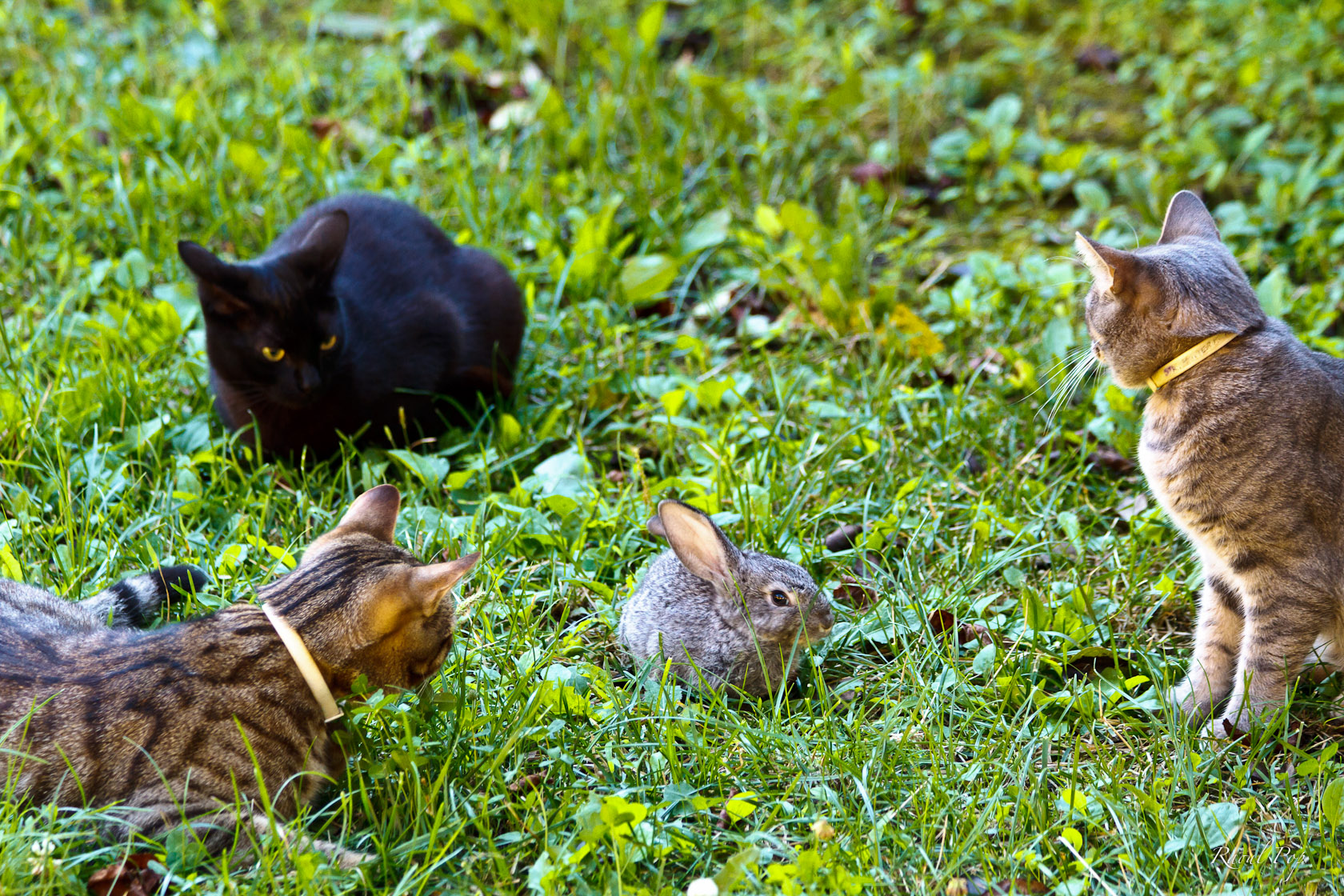
Zuzu (the black one) made her “I don’t like this” face. See how her ears are turned back? Zuzu does that quite often, but she’s friendly as can be. Bubu (the one in the lower left corner) was very curious. He wanted to smell Fritz and touch him and play with him, but Fritz was understandably a little scared of a cat about four times his size (Bubu is a big tabby). Tira (the one on the right) approached Fritz first, touched him with her paw and smelled his scent.

Fritz stood there in the grass, small as he could make himself, probably thinking he’d get gobbled up, but our kittens are those kinds of cats. They’re nice and friendly. They do tend to get a little mischievous at times, but they didn’t want to hurt Fritz.

Next up was Bubu, who could barely contain his curiosity. He wanted to jump on Fritz and play with him, but we managed to calm him down somewhat.

Fritz got accustomed to his surroundings fairly fast, and was soon up and about, smelling the various grasses in our yard and picking what he wanted to eat (he’s quite picky, but in a good way; he’s a veritable gourmand).

It’s now been about a month since we brought Fritz home, and he’s doing great! We kept him in a little cage for most of the day and all of the night during his first few weeks, because there were a couple of hawks and an owl who had their eye on him. Now that he’s bigger and he’s shown us that he can take care of himself, we let him roam freely through our yard and garden. He’s already found a few great hiding spots. Not even we can find him sometimes. He comes out when he wants to eat and socialize. And he gets along great with all of our cats.

Contrary to popular belief, he hasn’t made short change of our vegetable garden. He’s shown little interest in it so far. He prefers to eat certain kinds of grasses and weeds.

Just so he wouldn’t get lonely, we recently got him a girl companion we called Rita, a fluffy little white bunny whom he already adores; there’ll be more about that soon. Unfortunately for him (and fortunately for us), when he matures a little more, we’ll sterilize him, because, you know the old adage, they’ll be multiplying like rabbits if we don’t…

I’ll leave you with a little rough footage of Fritz eating grass in the yard, shot with my cellphone (so I apologize in advance for the poor video quality). I’ll have better video of Fritz soon!

Standard
Thoughts

The boring sameness of Romanian restaurants

Romanian cuisine was (and still can be) wonderfully varied and delicious. Not only are there different dishes in each region of the country, but even the basics, the staple traditional dishes, are prepared differently from region to region. Visiting Romania should be a delectable experience for one’s palate — the potential and the means to bring it about are there.

Sadly, if you should walk into more than one restaurant in Romania these days, your chances are better than 95% that you’ll see the same limited menu — the same soups, the same entrees, the same salads, the same meat dishes, the same desserts, the same drinks etc ad nauseam… It doesn’t matter if the restaurant is part of a two-star, three-star or four-star hotel or pension or if it’s a standalone place in a mountain or seaside resort or just some place alongside the road. Beside a few dishes or drinks that sometimes vary, they share the same boring menu.

They all have vegetable soup (most of them don’t know how to make it). They all have tripe soup (in varying degrees of stomach-turning oiliness). They all have fried trout, most of it bland beyond belief to the taste. They all have, of course, lots of pork, beef and chicken dishes (the same fattening dishes across the board), so it’s no wonder most Romanians are starting to look like potbellied pigs. They all have the same salads, and most seem to compete in using the most withered vegetables, drowned in a sea of oil and topped with nose-turning vinegar.

The question then arises, can you find decent food as you travel through Romania? Sure, if you manage not to get sick of eating the same dishes… We’ve traveled a lot through the country (we’d like to travel some more) and we have come across a few restaurants that do some dishes well. We’ve also seen a few restaurants that have impressed us by straying from the boring sameness with different and delicious dishes. But these places were few and far between, and when you’ve been on the road all day and you walk into a restaurant only to see the same menu, it’s a very disappointing experience.

There’s also another factor that adds a certain degree of difficulty to our search for food. We’re raw vegans, which means we prefer to eat raw, uncooked vegan foods. When we don’t have a choice, we’ll eat cooked vegetarian dishes, such as soups, side dishes or salads. But that doesn’t mean we don’t look at the whole menu, just to see what a particular restaurant is offering to the general public, and that’s when the disappointment sets in.

Having grown up in Southern Transilvania, my palate is naturally accustomed to Southern Transilvanian foods, which include Romanian, Saxon and Hungarian dishes. Those dishes were, surprisingly enough (by today’s standards) mostly vegetarian dishes (ovo-lacto-vegetarian). As I grew up, we ate meat once a week (on Sunday), and it was most likely chicken. We ate beef very seldom (I remember only a few occasions during my childhood), but we did eat pork quite often (to my chagrin) in winter-time. I loathed the stuff, but that’s what we had in the pantry, so that’s what I ate.

If you should go to a restaurant in Southern Transilvania these days, their menu won’t reflect the traditional cuisine of the region at all, even if they say they’re a traditional “Transilvanian” restaurant. (Somehow the stupidity of calling a restaurant “Transilvanian” when it’s located smack-dab in the middle of Transilvania escapes the owners…) They have the same dishes you’ll find everywhere else, prepared in mostly the same ways. And they’ll have mostly meat dishes. Where are the traditional soups, entrees and dishes I grew up with? They’re certainly not on the menu!

My grandmother used to make a delicious sweet potato soup. She also made a sour potato soup with tarragon and milk that makes my mouth water even now. She also made cabbage soup, a nice thick soup with dill and all sorts of condiments, completely unlike the pig food they call cabbage soup in restaurants these days. In the spring, she’d make a wonderful sour salad, watercress or wild garlic leaf soup. Her noodle soup was the best. And she’d also make a dumpling soup that had me licking my fingers and begging for more dumplings.

The meal that had me begging for more was chicken drumstick stew with mashed potatoes. That was the best. But she only made that once a week, on Sunday. She also made a delicious mushroom stew. Oh, and her pea stew was so good! Her fried onion sauce, usually served with mashed beans or whole bean stew, sure made my mouth water. She also made a mean potato stew with sweet sauce. Her fries were amazing, particularly when she sprinkled a little grated cheese on top! I can’t even find proper fries in restaurants these days! Most restaurants decided it’s better (for them, not for the customers) to buy frozen, pre-cut fries and warm them up instead of making them from fresh potatoes, as is the rule.

For dessert, my grandmother also made “gomboti” (a sort of dumpling) filled with plums, apricots or peaches. Or she made “clatite” (a small crepe) filled with fruit jam or honey. She made a lot of desserts as well (layered cakes and more) all of them delicious, unlike the cakes you find in pastry shops these days.

My mother and my wife both cook (my wife is a raw food chef) and they both make their own versions of the vegetarian dishes listed above. They’re all delicious. And as we visited various Romanian friends during my childhood and later life, I got to eat some pretty interesting variations on these same recipes.

When we go to restaurants, I can’t find any of these traditional dishes. Instead, what we’ll find is lots of bland, badly cooked side dishes and lots of meat dishes. And when we go to restaurants in other parts of the country (Moldova, Muntenia, Dobrogea), we can’t find any of the traditional dishes from those regions, either.

When did Romanians start to eat meat every day? That was certainly not the case 15-20 years ago. And look at them now, as a nation… They’re almost as fat as the Americans. Most Romanian men over 30 have pot bellies, which they proudly display and rub as if they’re some treasure. Hey, guys, I got some news for you, big bellies are nothing to brag about. In fact, they’re a sign you’re overeating and they’re also a precursor to erectile dysfunction. Think about that as you gulp down steaks and other fat-laden dishes…

My questions for Romanian restaurant owners are these:

  • Where are the foods that set Romanian cuisine apart?
  • Where are the traditional dishes we know and love?
  • Why do you all have the same menus?
  • Will you serve more vegetarian dishes? 

I’m curious to see what answers I’ll get (if any).

Standard
How To, Reviews

How to watch Netflix from abroad

At the start of 2009, when I left the US to spend most of the year abroad, I was an avid Netflix subscriber, and I looked forward to being one even as I lived abroad. There was a loophole in the Netflix protocols which allowed my wife and I to watch movies from outside the US (see this post), but they plugged it very quickly — within three days after I wrote about it.

I was, needless to say, very disappointed. Here I was, a US citizen, with a US mailing address, a US bank account and a US credit card, wanting to watch movies legally instead of downloading them from torrent websites, not able to do it, just because my IP address happened to be from another country. This was not fair. I cancelled my subscription. In hindsight, my anger was unnecessary. The situation is probably a result of certain stipulations in their contracts with the movie studios.

Still, there’s obviously a need for a legal way to watch movies online, right? And until Netflix (or another company) decides to open up their servers to paying customers from all over the world (which I hear might happen), here’s how to watch Netflix from abroad, right now.

You’ll need:

  1. A US credit card and a US mailing address. If you’re from the US but you happen to be abroad, great, you’re in luck, because you probably still have both of these. If you’re not from the US, see if you can make some arrangements with friends in the US.
  2. A VPN connection that will give you a US IP address, or a DNS Proxy Service subscription which will make Netflix and other US streaming sites think you’re based in the US. 
  3. A computer that’s compatible with Netflix Streaming. At this time, I believe only Mac and Windows computers can do it. The last time I tried it, a Linux machine wasn’t compatible. You could get a Netflix-compatible device or media appliance but if you want to keep things simple, stick with a computer.

That’s all you’ll need.

The DNS Proxy Service is a fairly new offering and is, in my opinion, the easiest way to configure your device to watch Netflix from abroad, without installing any additional software or configuring a custom VPN connection. You simply change the DNS servers for your network card (see these instructions).

Now let me talk a bit about the VPN service. In the two years I’ve spent abroad, I’ve used two services: AceVPN and HideMyNet. I’m currently using HideMyNet for my VPN service, and I’ve been using them for the past four months. Both cost about the same, but from my experience, HideMyNet has faster, more reliable service.

I started out with AceVPN but after several months, I started getting a lot of buffering messages when watching Netflix (you know, where you wait for it to load up the movie). It would take minutes, sometimes 5-10 minutes to load up a movie, and toward the end of my subscription with them, the movie would stop playing multiple times as we watched it, and we had to wait for it to rebuffer. It was annoying, particularly when the movie stopped playing during a gripping scene. Who knows, perhaps they were experiencing growing pains or temporary issues with their servers…

Out of the blue, the folks from HideMyNet contacted me to see if I wanted to try their service and write about it. Disclaimer: they offered me a 1-year subscription to give an honest opinion about their service. I told them I would, but that I’d need to try out their service thoroughly before I spoke about it, and if I found anything negative, I was going to reveal that as well. That was back in April of this year. It’s now August, four months later, and after all this time, I can definitely recommend them.

I do have a few pieces of advice for you:

  • If you’re not sure how to set up a VPN connection as L2TP or PPTP on your Mac, go with OpenVPN and Tunnelblick. Check out their setup instructions for the details. If you’re on Windows, setting up an L2TP connection is super easy and takes only a few minutes.
  • Make sure to ask their Tech Support which of their servers would be faster for you. Here’s some general advice I got from them on this issue: “Generally you want to connect to whichever server is closest to you [geographically]. If you’re in the EU you should try our DC and NYC servers. If you’re in Asia you should try the Seattle or LA servers. If you’re in South America you should try the Dallas and LA servers.” 
  • They currently have a limit of two simultaneously connected devices, so keep that in mind. I believe Netflix has the same limit, but if you were, for example, watching Netflix on one computer and browsing the internet on another, both through their VPN service, you wouldn’t be able to, for example, connect a third device (computer or phone) through the VPN service until you disconnected one of other two.

So there you have it. That’s how you can watch Netflix from abroad. It’s simple, it’s easy and it’s legal.

On a side note, I can’t understand why movie studios prefer to hang on to costly and outdated ways of distributing content, and thus encourage piracy, instead of promoting lower-cost, easily available methods of renting or purchasing their content, for any customer, anywhere. There are many people who would rather pay than use torrents, but the cost is either too high, or there’s no way to pay even if they wanted to. Thank goodness for VPN technology, otherwise I’d start thinking about using the torrents as well.

Standard
Places

Old Town, Annapolis

About three years ago, we visited Annapolis, MD and walked through Old Town. While it was a bit hot during the early afternoon hours, it cooled off nicely toward the evening and we had a wonderful time walking about.

I love it when towns make the effort to preserve their historic sections. Not only is it good for business (because of the tourists) but it helps to ground the townspeople, because they’re always reminded of their heritage.

Standard
Places

The Spanish Monastery in Miami, FL

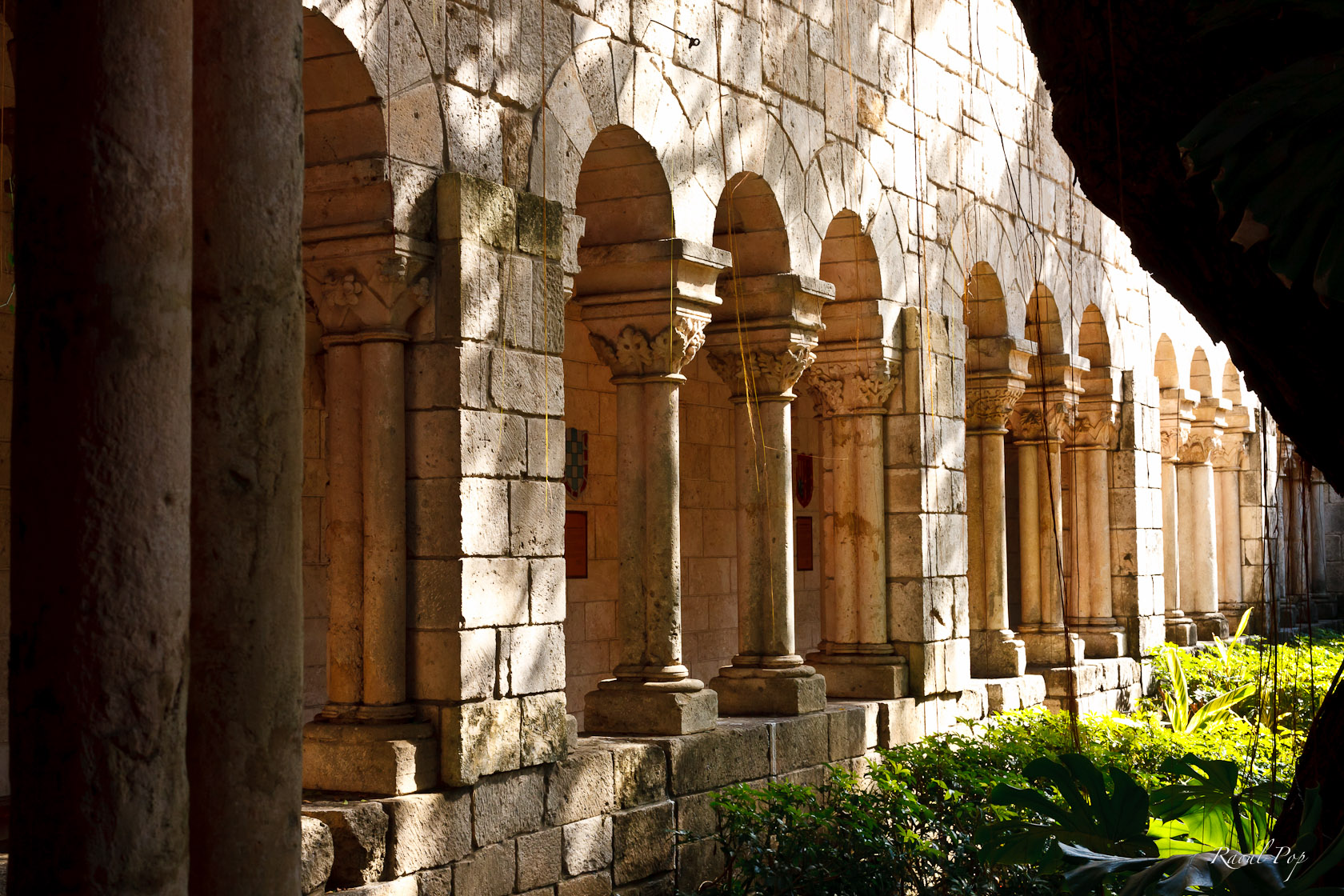
The Monastery of St. Bernard de Clairvaux (also known as The Spanish Monastery or The Cloisters of The Ancient Spanish Monastery) was built in Sacramenia, in the Province of Segovia, Spain, during the period from 1133 to 1144. It is now found at 16711 West Dixie Highway, in North Miami Beach, FL.

This slideshow requires JavaScript.

If you’re in South Florida, please make time to visit this monastery. It’s like stepping back in time. It’s easy to miss it as you drive by. It’s hidden by large trees, it’s in the middle of a large garden, and if you don’t know where to look, you won’t see it.

Upon the canonization of the famous Cistercian Monk, Bernard of Clairvaux, a leading influence in the Church during that period, the Monastery was renamed in is honor. Cistercian monks occupied the monastery for nearly 700 years. From then on, the history of this monastery got very interesting and very complicated.

In the mid-1830s, the Cloisters were seized, sold, and converted into a granary and stable due to a social revolution in that area. In 1925 William Randolph Hearst purchased the Cloisters and the Monastery’s out-buildings. The structures were dismantled stone by stone, bound with protective hay, packed in some 11,000 wooden crates, numbered for identification and shipped to the United States.

About that time, hoof and mouth disease had broken out in Segovia, and the U.S. Department of Agriculture, fearing possible contagion, quarantined the shipment upon its arrival, broke open the crates and burned the hay, a possible carrier of the disease. Unfortunately, the workmen failed to replace the stones in the same numbered boxes before moving them to a warehouse. Soon after the shipment arrived, Hearst’s financial problems forced most of his collection to be sold at auction.

The stones remained in a warehouse in Brooklyn, New York, for 26 years. One year after Hearst’s death in 1952, they were purchased by Messrs. W. Edgemon and R. Moss for use as a tourist attraction. It took 19 months and almost $1.5 million dollars to put the Monastery back together. Some of the unmatched stones still remain in the back lot; others were used in the construction of the present Church’s Parish Hall.

St. Bernard’s Church, as we know it today, started out not on these grounds but at a savings and loan building on N.E. 167th Street as “The Mission of St. John the Divine,” and services were held at that location for approximately one year under the leadership of Rev. Harold L. Batchelor (1963-64). The Mission of St. John the Divine became the Church of St. Bernard de Clairvaux, named in honor of the great Saint who had been a leading influence among the Cistercians 847 years ago, and whose feast day is commemorated on August 20.

In 1964, Bishop Henry Louttit purchased the property for the Diocese of South Florida, later to become the Diocese of Central, Southeast and Southwest Florida. Shortly thereafter, when the three dioceses ran into financial difficulties, the Monastery was put up for sale and the parishioners of St. Bernard feared a second move. During the Bishopric of the Rt. Rev. James Duncan, Col. Robert Pentland, Jr., a multimillionaire banker, philanthropist and benefactor of many Episcopal churches, purchased the Cloisters and presented them to the parish of St. Bernard de Clairvaux, thus ensuring the monastery’s survival and its permanent location.

The text of this post has been re-published (with small modifications) from the original found on the monastery’s official website. The story is so interesting I couldn’t cut it any shorter, so I hope the folks from the monastery don’t mind it. The photos are entirely original. I took them, edited them and published them. 

Standard